Announced 19 Oct 2026 · Sources checked
What Dream Labs launched
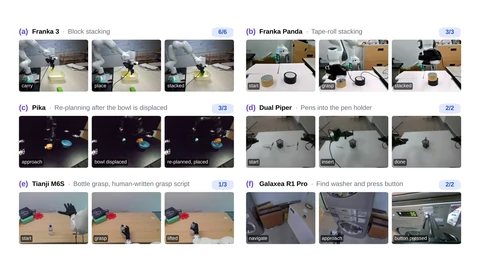
Dream Labs, a San Francisco robotics startup, came out of stealth on 19 October 2026 with Dream-1, a robot foundation model it says can control two-armed robots it has never seen, on tasks it was never shown, in places it has never been. In its launch post the company says that given a new bimanual robot with parallel grippers, Dream-1 can start working through its API out of the box, with no fine-tuning, no demonstrations from that robot and no machine-learning expertise required.
The model is available the same day through a public API, the Dream API, starting at $3 an hour. Dream Labs calls it a research beta. It says plainly that Dream-1 will make mistakes, has not been validated for safety-critical use, and should be tested in controlled settings with extra care around people. It asks users to report unsafe behaviour to a dedicated safety address.
Alongside the model, the company announced $90 million in seed funding. The launch post shows Dream-1 sorting candy, folding shirts and boxes, stacking cups, hanging a mug and restocking cans, and controlling an original PR2, a research robot released 18 years ago, without any data from that machine.
Who is behind it
Joel Jang, the chief executive, wrote on X that he and his co-founders, Scott Reed, Yunhao Ge and @youliangtan, began calling their approach a World Action Model in February 2026 while they were still at NVIDIA. Forbes describes the founders as former leaders of NVIDIA's GR00T robotics research team, and the launch post says Dream-1 is the result of six months of building.
According to Forbes, B Capital led the seed round, with A.Capital, Kindred Ventures, Unusual Ventures, SV Angel, Wing VC, Scribble VC and Adrian Aoun participating. Forbes reports that the company has more than 20 hardware partners and that the robots supported at launch cost between $2,000 and $10,000.
Jang's pitch, repeated in the company's statement, is an analogy to a rental car. When you get into a car you have never driven, you do not relearn how to drive; you find the controls and your experience does the rest. Dream-1 is meant to approach a new robot the same way, so it can do useful work in minutes rather than months.
How Dream-1 works
Dream-1 is a World Action Model, a term the team introduced in its February 2026 DreamZero paper. A WAM learns to predict video and actions together, so controlling a robot and imagining what the robot will do next become the same problem. Dream Labs says the model is trained on video of people doing everyday tasks, much of it filmed from a first-person view, but it has not disclosed the exact data mix.
The trick for unseen robots is the action space. Many robot policies output joint angles, which ties them to one body. Dream-1 can do that for robots it supports natively, but it can also predict end-effector poses: where each gripper should be and whether it is open or closed. Any robot with two arms and parallel grippers shares that interface, and its own inverse-kinematics solver turns the poses into joint commands.
That alone would not be enough, the company argues. Earlier work on the Universal Manipulation Interface showed transfer across arms only when every arm used the same gripper and the policy relied on wrist cameras. Dream-1 sees through a head camera and a wrist camera on each arm, and because every robot shows up as pixels, the video-prediction side of the model gives it a shared representation even for grippers and bodies it has not met. Jang put it simply to Forbes: if the model can predict a video of a robot doing a task, it can do it.
What Robocurve measured
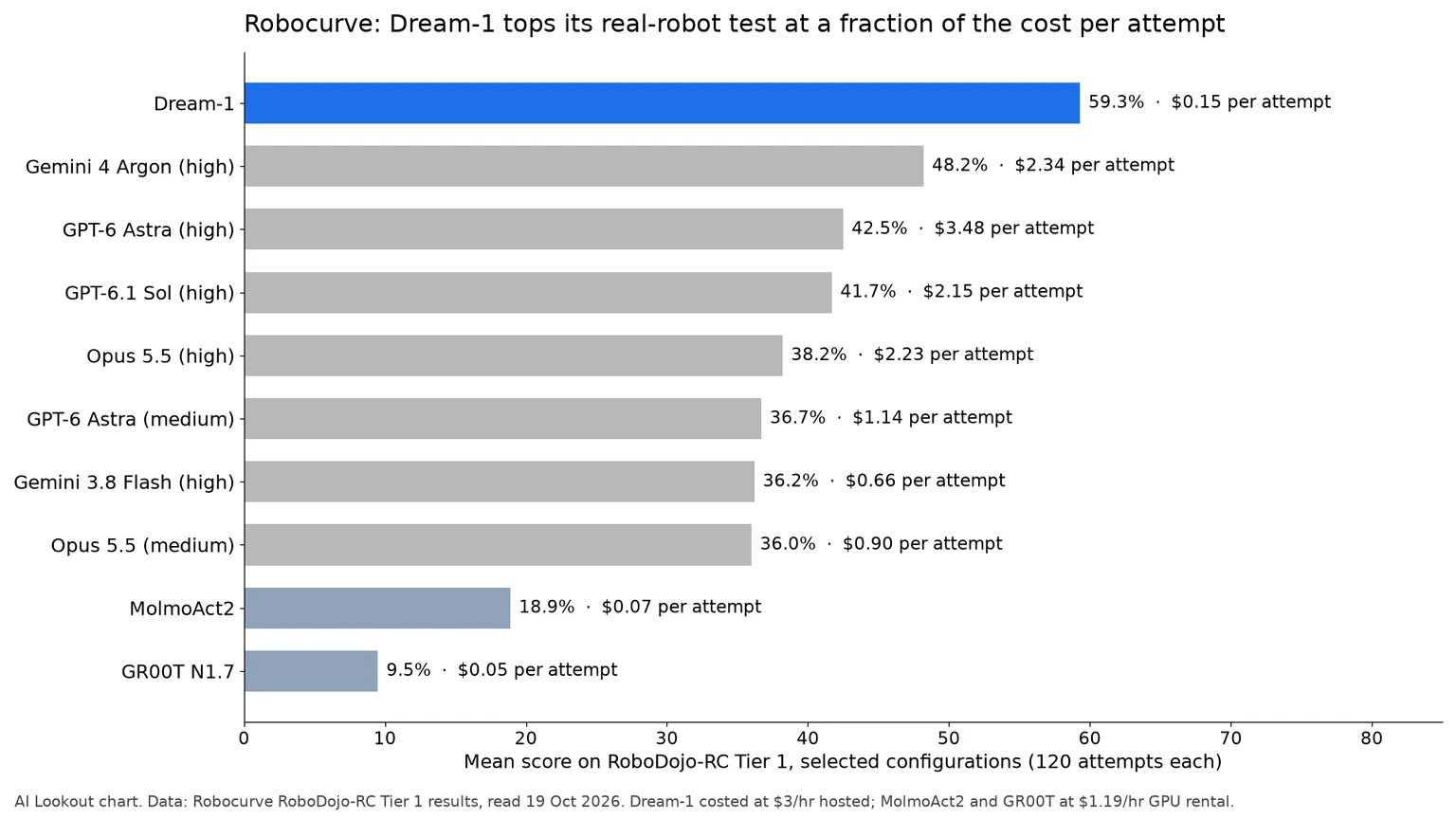
Robocurve, a public benefit corporation that runs real-world robot evaluations, tested Dream-1 before launch on its RoboDojo-RC Tier 1 benchmark. Dream-1 posted a mean score of 59.3 percent over 120 attempts, ahead of every other configuration on the board. The next best was Gemini 4 Argon at high reasoning with priority access at 48.2 percent, followed by GPT-6 Astra at 42.5 and GPT-6.1 Sol at 41.7.
The comparison is unusual because most rivals on the board are general LLMs driving a robot through code, the setup AI Lookout described in Artificial Analysis's AA-Robotics test and in Google's Gemini 4 Argon robotics demos. Robocurve caps them at 40 model calls per attempt. The two other robot-specific models listed, Ai2's MolmoAct2 and NVIDIA's GR00T N1.7, scored 18.9 and 9.5 percent.
Cost and time are where the gap widens. Robocurve estimates Dream-1 at $0.15 per attempt using its $3 hourly price, against $2.34 for Gemini 4 Argon, which Dream Labs rounds to 16 times cheaper. Dream-1 took 1.4 minutes per attempt, against 4.0 minutes for GPT-6 Astra at high and 20.5 minutes for Argon. One third-party benchmark is still one benchmark, and Robocurve's tasks are its own, so the scores say little yet about kitchens or warehouses.
Price and access
Dream Labs publishes its pricing in unusual detail. Each call returns 1.6 seconds of actions, so an hour is 2,250 calls, which the company puts at about $0.0013 an action for Dream-1. Running the flagship around the clock comes to just over $26,000 a year, Forbes calculates.
The price of the smaller model is not consistent across sources. The launch post lists Dream-1-flash at $2 an hour, about $0.0009 an action, while Forbes reports $0.75 an hour. AI Lookout has not been able to resolve the difference; the company's own page is the safer reference until it clarifies.
Getting started is meant to take minutes. The condensed client code in the post creates a client with an API key, selects the dreamlabs/dream-1 checkpoint, sends an observation of camera images and robot state with a task, and gets an action back. The Dream Labs site also offers a Robot Playground where people without a robot can prompt a real one remotely, and Dream Labs says performance depends partly on the quality of each robot's inverse-kinematics solver.
Fine-tuning when zero-shot falls short
When zero-shot is not enough, Dream Labs offers what it calls Fine-tuning-as-a-Service. Users collect data on their own robot and get back a custom model ID; Forbes reports the turnaround is hours. The launch post shows two partner robots, a reBot B601-DM and a Maker Arm, adapted on five minutes of data each.
Robots further from what Dream-1 knows need more. A Dexmate robot with Sharpa dexterous hands took 77 minutes of data to pick bread from a toaster, and a YAM fitted with a compliant gripper and a modified knife gripper took 98 minutes to cut the leaf off a strawberry. Across twelve robots from its beta partners, the company says fine-tuning lifted the language-following score on ten.
Dream Labs presents this as a business model for small operators: find a task someone will pay for, collect a little data, adapt the model, deploy, and keep everything above the hourly cost.
Limits and open questions
The company lists its own limits. Predicting gripper poses instead of joint angles means Dream-1 does not control how the arm reaches a pose, which matters around obstacles and joint limits, and robots whose workspace or dynamics differ sharply from what it has seen may get infeasible plans. One-shot adaptation still beats zero-shot, so a gap remains. Today Dream-1 only handles bimanual robots with parallel grippers; mobile manipulators and dexterous hands are future goals.
Success rates are modest by industrial standards. Jang told Forbes zero-shot pick-and-place works about 80 percent of the time and other tasks land at 50 to 60 percent, which he says is not aimed at factory lines. That fits a pattern AI Lookout noted in SenseNova's study of GPT-6-Astra: strong benchmark numbers do not yet mean dependable robots in the real world. There is no paper, model card, parameter count or training-data disclosure for Dream-1, and AI Lookout did not test it.
Why it matters
Most robot models still need data from the exact robot they will run on, which keeps cheap hardware from being useful on day one. A hosted model that can drive an unfamiliar arm through an API, priced by the hour, is a different offer from open-weight policies such as Kyutai's REKI that developers must fine-tune and host themselves. If the zero-shot results hold up outside Dream Labs' demos, Dream-1 could matter most to hobbyists, researchers and small firms buying $2,000 robots.
Common questions
What is Dream-1?
A robot foundation model from Dream Labs, launched 19 October 2026, that learns from video to control bimanual parallel-gripper robots it was never trained on, offered through a public API.
How much does the Dream API cost?
Dream Labs lists $3 an hour for Dream-1. Its post lists Dream-1-flash at $2 an hour, while Forbes reported $0.75; the company has not explained the difference.
Who founded Dream Labs?
Chief executive Joel Jang with co-founders including Scott Reed and Yunhao Ge; Forbes describes them as former leaders of NVIDIA's GR00T robotics team. B Capital led its $90 million seed round.
Sources & further reading
How this story was made
Written by Kristian Kostov with AI assistance and checked against the linked sources. Company performance claims are attributed to the company. Analysis reflects AiLookout’s interpretation; we have not independently tested the products discussed. The cover is an AI-generated editorial illustration, not a photograph or evidence of an actual event.
Our editorial standards