Announced 15 Oct 2026 · Sources checked
What the report found
A 60-author team led by SenseTime's SenseNova group has published one of the most detailed public tests yet of a frontier language model driving robots. The report, Has GPT-6-Astra Achieved Embodied Intelligence?, posted to arXiv on 15 October 2026 with a project page and code in the SenseNova-RoboRSI repository, runs OpenAI's GPT-6-Astra across 12 robot benchmarks, eight physical robots and a simulated house.
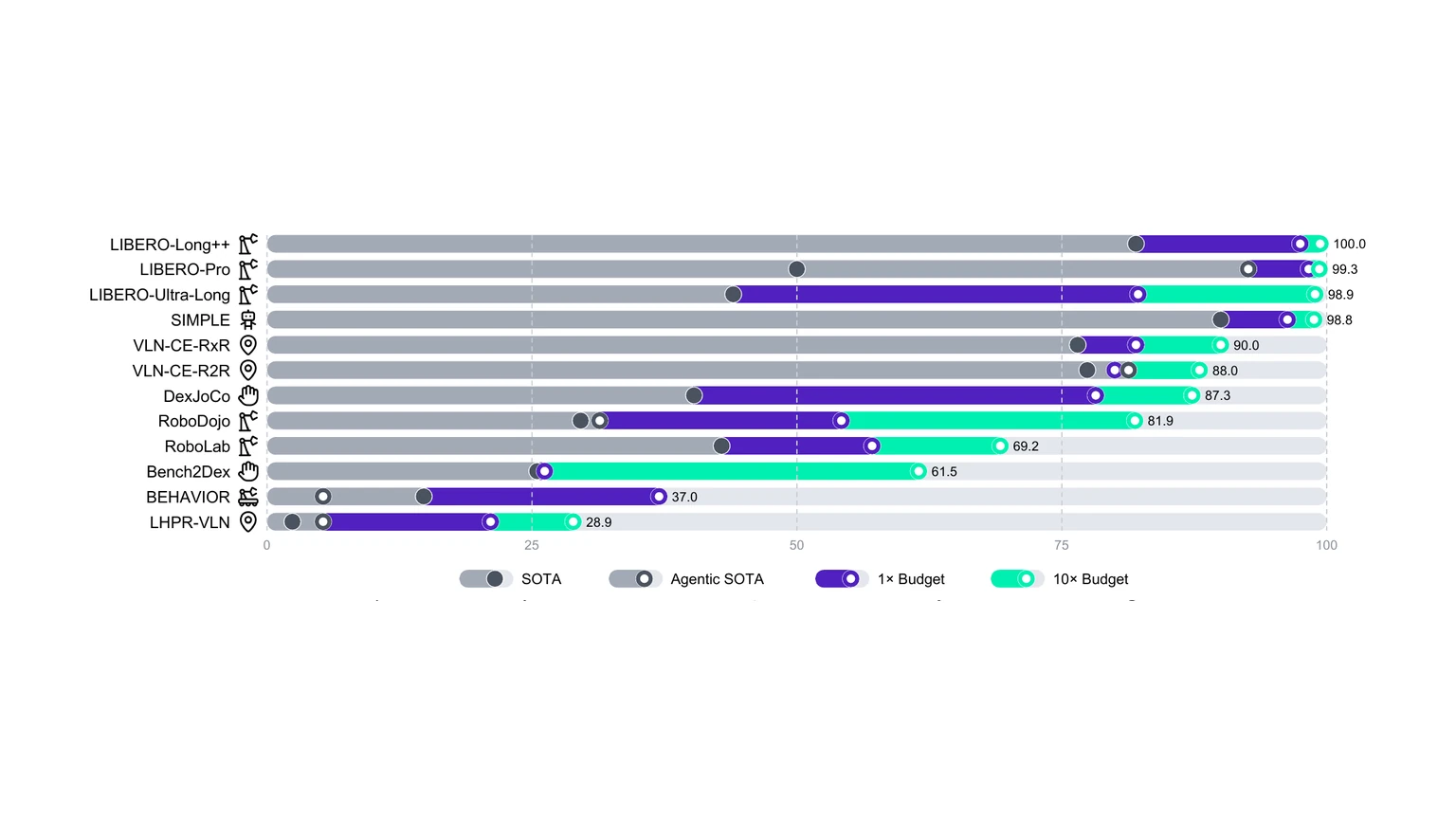
Its answer is split. On benchmarks, the authors write that GPT-6-Astra "has largely crossed the threshold of embodied competence", approaching saturation on the LIBERO family and SIMPLE and reaching 81.9 percent on RoboDojo and 87.3 percent on DexJoCo. On practical deployment, their answer is "not yet": the same model is slow, expensive, poor at checking whether a physical task is really done, and much weaker once demonstrations and unlimited retries are taken away.
The title page carries the logos of SenseNova, Ropedia, Nanyang Technological University and the University of Tokyo, and the author list includes SenseTime co-founders Dahua Lin and Xiaogang Wang. The report evaluates a model it did not build, so it reads less like a launch and more like a field survey with a verdict.
How the 12-benchmark test worked
The team ran every benchmark under one protocol with two deliberate changes from the usual rules. First, GPT-6-Astra was allowed in-context learning from each benchmark's training set. Before testing, the model studies the successful demonstrations and writes itself a frozen knowledge package of task guidance, motion and visual references, small executable helpers, recovery procedures and metadata, which it then retrieves and adapts in each test scene. The authors argue this is fair because smaller task-specific robot policies are trained on the same data.
Second, the model got up to ten times the official step limit, continuing the same episode without resets. The report says standard step limits significantly underestimate GPT-6-Astra because it can notice a failed action, change strategy and try again. That failure recovery is the mechanism that turns extra steps into higher success, most visibly on RoboDojo and the dexterous-hand benchmark Bench2Dex.
Under those conditions the scores in the report's chart run from 100 percent on LIBERO-Long++ and above 98 percent on LIBERO-Pro, LIBERO-Ultra-Long and SIMPLE, through about 88 to 90 percent on the VLN-CE navigation tests, down to 69.2 on RoboLab, 61.5 on Bench2Dex, 37.0 on BEHAVIOR and 28.9 on the long-horizon navigation test LHPR-VLN. The comparison baselines are earlier best results with a cut-off of 12 October 2026.
Where GPT-6-Astra still fails
The more useful part of the report may be its list of what still breaks. In-context learning transfers poorly: the knowledge packages help when test tasks resemble the training data and fade when they do not. RoboLab has no training set, so no knowledge package could be built, and there GPT-6-Astra reached 69.2 percent even with the extended budget, well below its near-perfect LIBERO scores.
Cost is the second problem. The project page puts a single LIBERO-Long++ episode at about one million tokens and nearly an hour, LIBERO-Ultra-Long at roughly nine million tokens and two hours, and an extended-budget RoboDojo episode at more than three hours on average. About 98 percent of tokens are cached input, so the team estimates one million tokens at roughly one US dollar, and inference latency is not counted in the step budget at all.
The authors also find that GPT-6-Astra can tell a task is unfinished but not which physical condition is unmet, so its corrections fail to converge. It struggles to recover from irreversible mistakes, because each attempt changes the state the next one starts from, and it has to keep re-checking earlier subgoals that a later motion can undo. Recovery works, the report says, when the model changes strategy rather than repeating itself.
The harness matters as much as the model
A separate ablation on RoboDojo looks at how GPT-6-Astra should be connected to a robot. Letting a low-level vision-language-action model run alone was not enough. Having GPT-6-Astra act as a slow "System 2" that reviews actions proposed by a fast "System 1" policy, in this case Physical Intelligence's π0.5, worked well but cost tokens on every review. Physical Intelligence recently opened its own robot models to outside developers, which makes that pairing easier to try.
Reviewing four proposed actions at a time saved 63.5 percent of tokens compared with checking each one, and adding in-context learning gave the best result at about 6.9 times the tokens of the best setting without it. The interface mattered too: directional end-effector commands helped, raw joint angles hurt, and letting the model choose how many actions to commit at once beat a fixed chunk in success rate, at a higher token cost.
The conclusion matches what smaller studies such as Artificial Analysis's AA-Robotics test have suggested: language models do better when the robot interface speaks their language, with precise motor control left to lower-level controllers.
Eight real robots, very different results
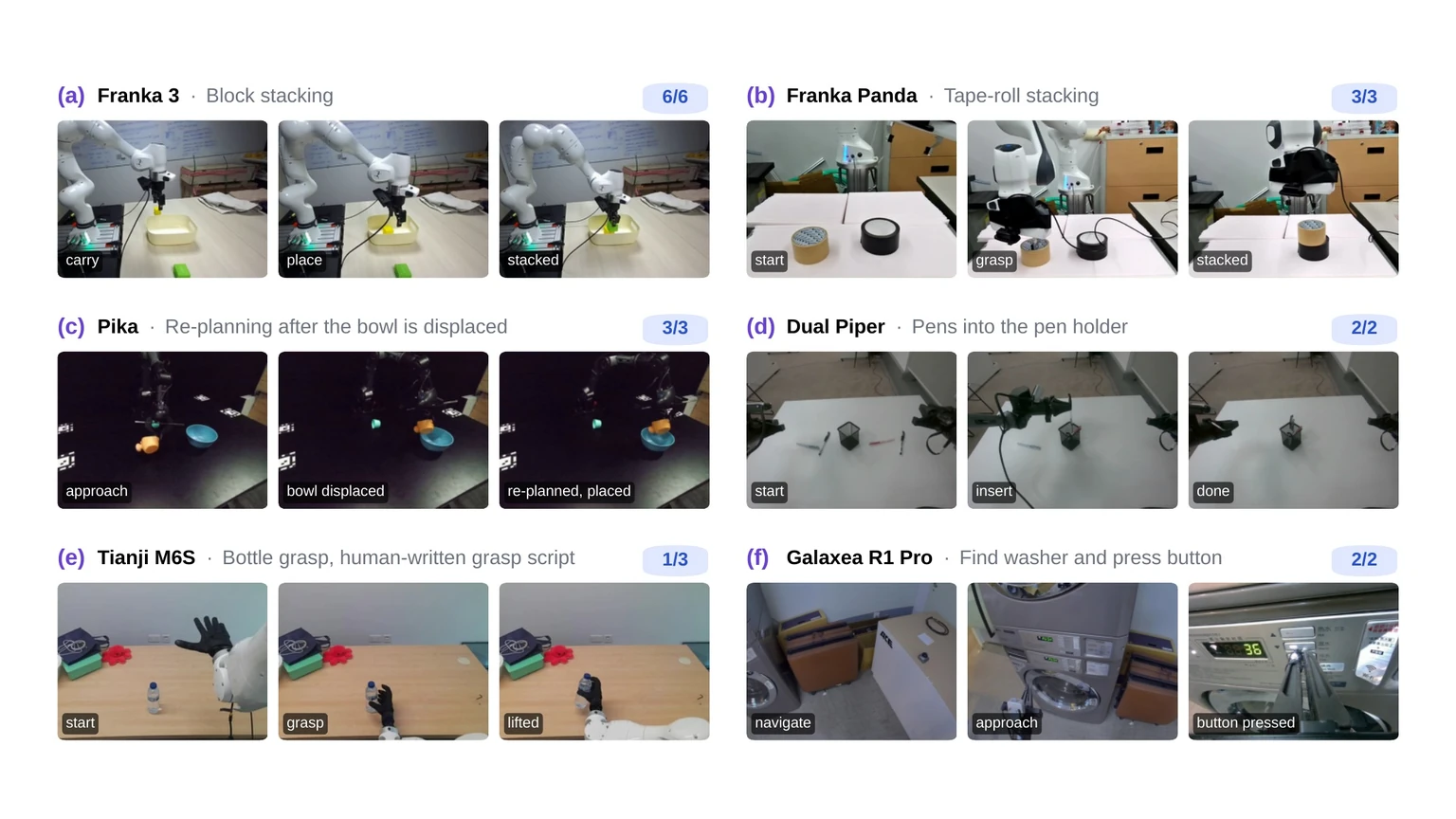
The real-world section uses eight robot setups, from single Franka arms to a dual-arm Piper, a Tianji M6S and a Unitree G1 humanoid with Wuji dexterous hands, a Galaxea R1 Pro and an AgileX Tracer mobile base carrying an xArm7. There are no demonstrations or knowledge packages here. Instead a human writes structured context: tool schemas, joint limits, camera placement, safety constraints and, on some platforms, admissible grasp points, but no high-level skills such as pick or place. Trials are normally capped at 60 minutes, an operator holds an emergency stop, and success is judged from the physical outcome rather than the model's own claim.
The results depend heavily on the task. Rigid pick-and-place succeeded in 17 of 18 trials and matched simulation. Cloth folding worked 2 of 4 times on the Franka 3, plug insertion failed in all 11 trials across three platforms, and navigation on the AgileX Tracer succeeded 9 times in 23. On the Unitree G1, GPT-6-Astra picked and dropped a plush toy in 2 of 3 runs and walked to a table through the vendor's velocity interface in 3 of 3, which the authors describe as feasibility under slow supervision, not real-time control.
One finding stands out. In a flower-insertion task the gripper's own wrist camera cannot see the vase mouth, so a single arm fails. On the dual-arm Piper, GPT-6-Astra moved its free arm until that arm's camera could see the opening, then completed the insertion, using viewpoint as part of the action. The authors note that teleoperated demonstrations rarely contain this kind of active vision.
A benchmark where the world keeps moving
The final section prototypes what the authors think the next robot benchmark should look like. Tasks come from human needs and are stated the way a person would, such as "Could you make me breakfast?", and are judged on both the request and unstated duties. No in-domain demonstrations are provided, and the simulated world keeps running while the model thinks.
In that household prototype the weaknesses become concrete. GPT-6-Astra attends to the object in hand and loses track of what else it changed, such as leaving a refrigerator open. Without demonstrations it does not work out how unfamiliar fixtures move or where its body needs to be. And because thinking takes world time, it correctly decides to turn off a burner once an egg sets but does so about 90 seconds late, and the egg chars.
The report also lists open problems for evaluators: vision-language success detectors reach at most 60 percent balanced accuracy on contact-rich assembly, simulation predicts real-robot results reliably only for short tabletop tasks, and hour-long trials are expensive to repeat. Google's recent Gemini 4 Argon robotics demos, which leaned on MuJoCo simulation twins and mostly single demonstrations, face the same questions.
RoboRSI and the 27B model due on 20 October
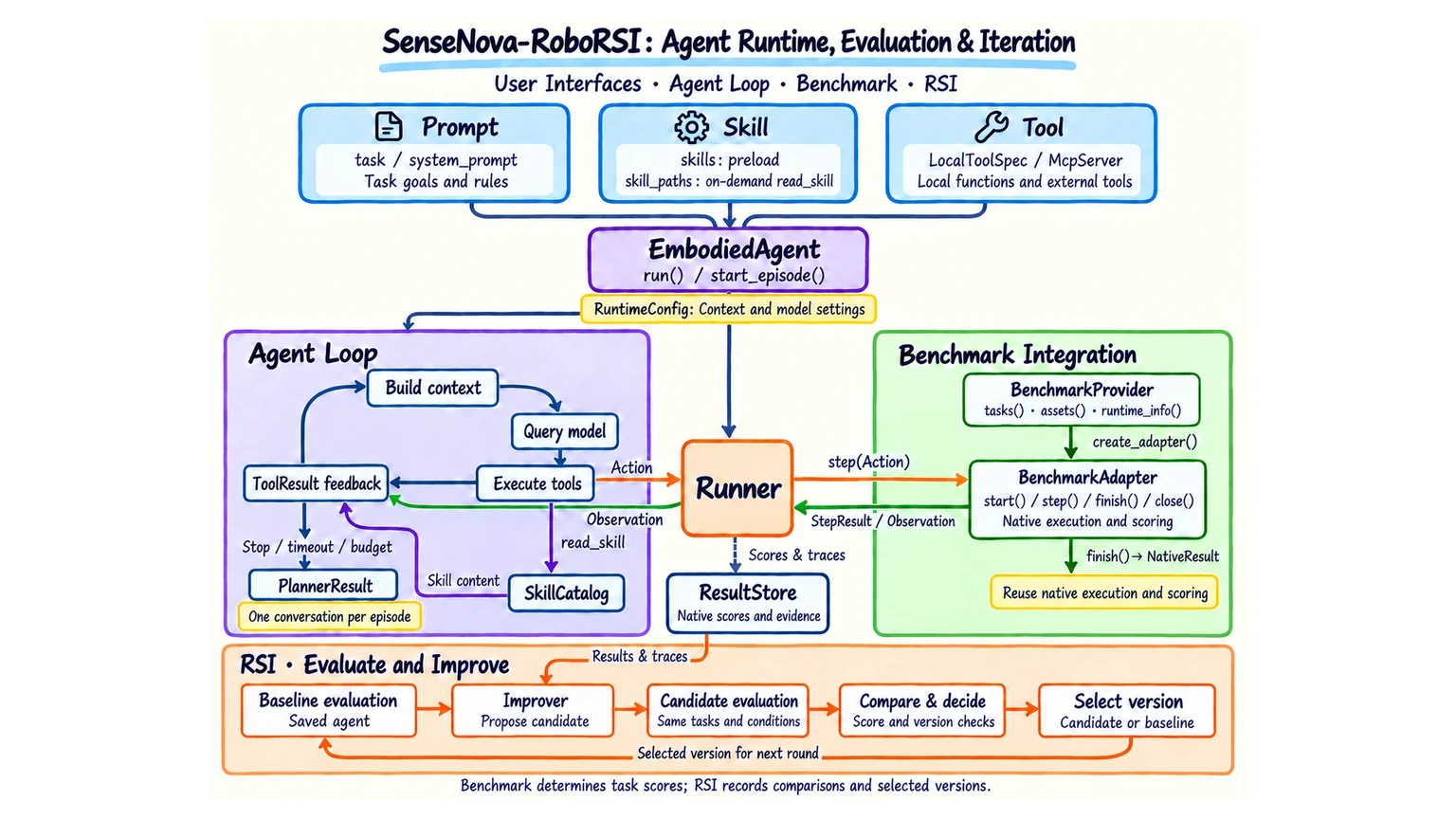
Alongside the report, SenseNova released the first code for RoboRSI, a shared runtime for building and evaluating embodied agents with a recursive self-improvement loop that proposes harness changes, retests them under the same conditions and keeps validated versions without changing model weights. According to the repository README, the initial release covers LIBERO, LIBERO-PRO, LIBERO-Long++ and LIBERO-Ultra-Long, with RoboDojo and other benchmarks marked coming soon, and the status badge says pre-alpha.
The README reports that the RoboRSI harness on GPT-6-Astra scored an average of 60.08 and a 54.17 percent success rate on RoboDojo-Sim, against 28.97 and 22.48 percent for the plain GPT-6-Astra baseline on the leaderboard, and says the results are being submitted to the official RoboDojo leaderboard. It also claims 94.5 percent on LIBERO-PRO's task and swap suites.
The team says SenseNova-RoboRSI-27B-Preview, a model trained from Qwen3.8-27B on validated interaction experience, will be released as open weights on 20 October 2026, with a technical report to follow. The README claims it raised RoboCasa365 success from 26.0 to 46.5 percent over the base model while cutting average output tokens by 73.3 percent, and scored 2.84 points below GPT-6-Astra on RoboDojo.
How to read the numbers
The headline percentages come from a protocol that is generous by design. In-context learning from training demonstrations and ten times the step budget are reasonable ways to find a ceiling, but they are not how most leaderboards are run. The report's 81.9 percent on RoboDojo, RoboRSI's 54.17 percent and the leaderboard baseline of 22.48 percent describe different setups, not one model getting better overnight.
That difference is visible in a second paper from the same week. HexaShell, from HexaFuture, used Codex with GPT-6-Astra as a robot coding agent and reported a 39.7 percent success rate across all 42 RoboDojo tasks, calling it a new state of the art under leaderboard averaging. Its authors reached a similar conclusion: the limit is contact, not reasoning, with pushing tasks at 92.5 percent and tight insertion at 8.3 percent.
None of the results has been peer reviewed, all numbers are the authors' own, and the 27B model was not yet downloadable when AI Lookout checked on 19 October. The useful takeaway is the split the report draws: general models can now solve many isolated robot tasks, while cost, verification, recovery and real-time operation decide whether they can be deployed. The RoboDojo leaderboard and the 20 October weight release are the next places to check.
Common questions
Has GPT-6-Astra achieved embodied intelligence?
The SenseNova-led report says it has largely achieved embodied competence on benchmarks but not practical embodied intelligence, because cost, reliability and real-world constraints still block deployment.
Why are the RoboDojo scores so different between sources?
They use different rules. The report's 81.9 percent allows in-context learning and up to 10 times the step budget, RoboRSI's 54.17 percent uses its own harness, and HexaShell's 39.7 percent follows leaderboard averaging.
When will SenseNova-RoboRSI-27B-Preview be available?
The README says the open weights are expected on 20 October 2026 on Hugging Face, with a technical report to follow later.
Sources & further reading
- Has GPT-6-Astra Achieved Embodied Intelligence? (arXiv 2610.22471; report PDF) ↗
- Has GPT-6-Astra Achieved Embodied Intelligence? (project page) ↗
- SenseNova-RoboRSI: Recursive Self-Improvement for Embodied Agents (README) ↗
- HexaShell: A Thin Harness for Exploring the Limits of VLM Agents as Robot Coding Agents (arXiv 2610.23479) ↗
How this story was made
Written by Kristian Kostov with AI assistance and checked against the linked sources. Company performance claims are attributed to the company. Analysis reflects AiLookout’s interpretation; we have not independently tested the products discussed. The cover is a cropped example output published by the developer in its openly licensed repository, credited in the caption. It is not an AiLookout test or screenshot.
Our editorial standards