Announced 13 Oct 2026 · Sources checked
What Google published about Argon and robots
Google released Gemini 4 Argon to developers on 13 October, and the same day its Developers Blog ran a long companion post, Gemini 4 Argon for Robotics, by Principal Software Engineer Kanishka Rao. It is less an announcement than a cookbook: a dozen video demos, each paired with the prompt that produced it, grouped into four areas Google calls robot control, Real2Sim, physical understanding, and research and self-improvement.
The post opens with a benchmark claim. On the open-source Embodied Reasoning QA (ERQA) benchmark, which Google DeepMind released with Gemini Robotics as a set of multiple-choice questions about spatial reasoning and world knowledge in real scenes, Google says Argon “scores 87%, outperforming every other frontier model” using pure reasoning. Its chart, run with tools off on 400 questions, puts Argon at 87.0% against 82.3% for Claude Opus 5.5, 81.0% for GPT-6 Astra and 74.0% for Claude Fable 5.1. Those are Google's runs of its rivals, not independent scores.
The important framing is that Argon is not a vision-language-action model that outputs motor commands. It is the same general model sold for coding and analysis, covered in our report on Argon's general availability. In most demos it writes code, calls simple robot primitives over HTTP, builds physics scenes and checks its own work, the way a coding agent would in a software repository.
How Argon steered a Spot robot to a pedal bin
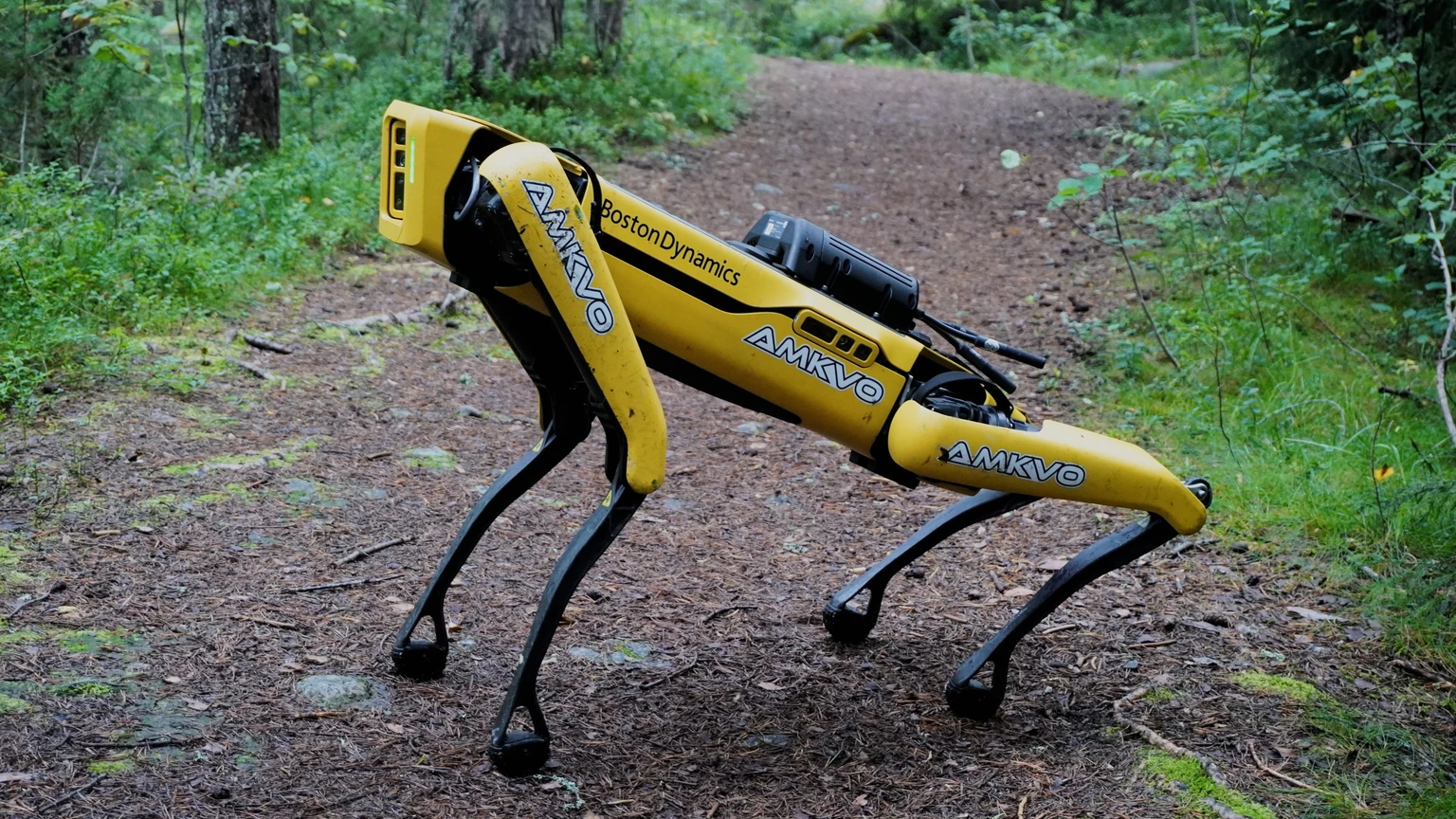
The first demo is the most concrete. Argon controls a Boston Dynamics Spot quadruped, which Google describes as having 12 degrees of freedom in the legs and six in the arm, and teaches it a new skill: stepping on the pedal of a foot-operated bin to open the lid, then dropping soda cans inside. The prompt tells Spot there is a Diet Coke can behind it and another on a black table to its left.
Before touching the real pedal, Argon builds an articulated MuJoCo digital twin of the bin and practises there, including balancing on three legs while the fourth presses down. The video caption lists the steps: pick up the can, check the wrist camera, rehearse the tripod stance in simulation, step on the pedal, confirm the hand is centred over the open bin and release.
The prompt also shows how Google structures these agents. It asks Argon to use a “spot-mobile-manipulation skill” and to run “a 2-agent verification swarm (foot-verifier and hand-verifier)” that checks the foot placement and the hand-in-bin alignment before letting go. The skill itself is not published in the post, so outside developers see the instructions, not the control code underneath.
Arms, world models and a mug
A second demo is zero-shot control of a simple arm. Argon has to stand a fallen mug upright and put a crumpled napkin inside it. It works from a wrist-camera image annotated with a 2 cm coordinate grid and a reticle showing where the jaws will close, and it acts through a short list of code-as-policies primitives such as look_at, grasp, place_until_contact and move_by, sent with curl to a local robot server. The prompt lets Argon choose between a coarse plan of two to four calls and fine visual servoing of eight to 20.
A third demo moves into generated video. Argon steers robot hands inside Google's Gemini Omni world model to arrange five scattered Scrabble tiles into the word ARGON. Instead of one static prompt it writes timestamped action beats, inspects keyframes from each rollout and rewrites the next prompt; the caption describes a 33-step steered rollout. No physical robot is involved in that example.
Building simulations from video, photos and sketches
The Real2Sim section is where Argon looks most like a research assistant. Given a real teleoperation episode, it builds a MuJoCo scene of the robot and objects and tunes object shapes, masses, friction and starting poses until simulated camera views from three cameras and simulated fingertip forces on Sharpa hands match the logged data. The prompt bans “sim cheating”: objects may move only through real contact in the physics solver, with no welds, external forces or copied sensor readings.
From an egocentric video of a person doing a tabletop task, Argon identifies the relevant objects, replaces crude boxes with convex-decomposed meshes so bowls and trays can actually hold things, and retargets the human hand motion onto a 76-degree-of-freedom bimanual humanoid with 22-degree-of-freedom hands, stepped at 500 Hz. From a photo of a pen-and-paper sketch of an Apollo 2 humanoid throwing a ball at a 3-2-1 stack of boxes, it builds a GPU-accelerated mujoco_warp scene, synthesises the throw, checks that all six boxes fall and exports a Blender render.
Google's main Argon launch post adds a related claim from an internal test: Argon watched raw video of a person playing cornhole, built simulation code, and an Apptronik Apollo humanoid then “quickly sank seven consecutive shots in a real-world trial.” Google says this “Video-to-Sim-to-Real” pipeline compresses weeks of manual simulation work into a few hours. It gives no failure count or number of trials.
Labelling robot data and scoring progress
Robot learning depends on labelled demonstrations, and Google pitches Argon as a labeller. Given a 136-second overhead video of a bimanual ALOHA 2 robot folding paper into an origami fox, Argon produced a four-level annotation: the overall goal, six subtasks, 17 contact-level primitives and a quality-control pass that holds task progress flat during fumbles and downweights those segments to 0.15 to 0.25 times for behaviour cloning.
In a puzzle demo, Argon built a MuJoCo environment with two Franka FR3 arms, a two-pan balance and 12 identical-looking pool balls, one heavier or lighter, then wrote a vision-only solver that reads the scale's tilt from stereo cameras and isolates the odd ball within three weighings. As a value function, it watched a 60-second, three-camera recording of a person sorting rings with handheld UMI grippers and split it into 28 segments with positive, neutral or negative progress.
Self-improvement and one-prompt paper reproductions
The result with the clearest real-world number is data generation. From a single overhead photo of a two-arm Franka workspace laid out with party props, Argon built a calibrated simulation twin, defined a 77-task curriculum and generated more than 4,500 domain-randomised episodes to fine-tune a generalist vision-language-action model. Google says the physical robot's success rate on its evaluation rose from 56% to 75% and completion time fell from 35 to 24 seconds. The post does not name the base model or the number of evaluation trials.
On a simple six-axis SO-101 arm, Argon improved a pick-and-place routine over three iterations by reviewing its own logs and camera footage: 58.9 seconds on the first run, 22.9 seconds on the second, which grazed the box rim, and 17.4 seconds with a dead-centre drop on the third. The prompt tells it to follow safety rules in an AGENTS.md file and to aim for at least a 2x speed-up within those limits, going further only with authorisation.
Finally, Google says Argon reproduced robotics papers from a single prompt each, porting controllers such as DeepLoco, HUSKY and a whole-body MPC into MuJoCo WebAssembly labs that run in a browser and are checked in headless Chromium. The caption refers to 68 interactive sandboxes. Google has not said whether those labs will be published.
How developers can try the workflows
Nothing in the post is a separate robotics product. Google points developers to Argon itself: in Google AI Studio for Google AI Ultra subscribers, through the paid tier of the Gemini API using the model name gemini-4-argon in the Interactions API with the google-genai SDKs, and in Google Antigravity, its agentic coding tool, also for AI Ultra subscribers. The prompts are printed in full, so teams with MuJoCo and a robot that exposes simple HTTP primitives can try the same patterns.
That approach differs from robot-model services such as the Pi API beta from Physical Intelligence, which fine-tunes a dedicated robot foundation model on a team's demonstrations. Argon sits a level above: it writes the controllers, simulations and labels that feed such models.
What the demos do not show
Every result in the post is Google's own, shown as edited video, and most are single episodes without success rates. An outside check arrived a day later. In Artificial Analysis's AA-Robotics v0.1, which gives models zero-shot control of a real six-axis arm through their vendors' agent harnesses, Argon scored 55.3, behind GPT-6 Astra at 69.4 and GPT-6.1 Sol at 64.6. It was also the slowest model, averaging 52 minutes per task and about 21 minutes of observing and reasoning before its first move. GPT-6 Astra, which trailed Argon on Google's ERQA chart, led that hands-on test.
Those findings do not contradict Google's demos so much as frame them. Google's prompts are long, task-specific and written by people who know the hardware, with simulation practice, verification agents and safety rules built in. A benchmark that hands a model an unfamiliar arm and a short brief measures something closer to out-of-the-box behaviour. Neither setting shows Argon running a robot unsupervised outside a lab.
The practical reading for robotics teams is that Argon's strongest case is in the slow parts of the pipeline, such as building simulation scenes, labelling footage and generating training data, where a wrong answer costs compute rather than hardware. Direct control remains a demo, and the 56%-to-75% result is the claim most worth trying to reproduce.
Common questions
Is Gemini 4 Argon a robot control model?
No. It is Google's general-purpose frontier model. In the robotics post it mostly writes code, calls simple robot primitives and builds simulations; Google's dedicated robot models are a separate line.
What is ERQA?
Embodied Reasoning QA is an open-source benchmark Google DeepMind released with Gemini Robotics: multiple-choice questions with images about spatial reasoning and world knowledge in real-world, robot-relevant scenes. Google says Argon scores 87%.
Can I use the Spot skill from the demo?
Not from the post. Google publishes the prompts but not the spot-mobile-manipulation skill or the controllers behind it, so developers would need to build their own robot interface.
Sources & further reading
How this story was made
Written by Kristian Kostov with AI assistance and checked against the linked sources. Company performance claims are attributed to the company. Analysis reflects AiLookout’s interpretation; we have not independently tested the products discussed. Cover photography is illustrative and does not depict the specific announcement or product.
Our editorial standards