Announced 13 Oct 2026 · Sources checked
What did Google make available on 13 October?
Google DeepMind’s Koray Kavukcuoglu announced that Gemini 4 Argon is now available globally for developers and enterprises through the Gemini API in AI Studio and the Gemini platform, for Google AI Ultra subscribers in Google Antigravity, and for AI Ultra and Pro subscribers in the Gemini app and AI Mode in Search. A companion developer post points builders to the paid tier of the Gemini API, Android Studio and Antigravity.
This is the second step of a phased launch. When Google first announced Argon on 30 September, it rolled the model out only to trusted cyber defenders in its Fairwind Program and said it would widen access after more testing and the US government’s voluntary pre-release review. Our earlier article on that announcement noted that broad access was still coming. As of 13 October it has arrived for paying API customers and Pro and Ultra subscribers.
Google describes Argon as a model for long, multi-step “deep work” in coding, finance, legal work, cybersecurity and science, and says it ranks first on the Vals Index of economically weighted tasks. The model card adds that Argon is a new sparse mixture-of-experts model trained on Google TPUs, not a fine-tune of an earlier Gemini, with a knowledge cutoff of March 2026.
Who can use Gemini 4 Argon, and what does it cost?
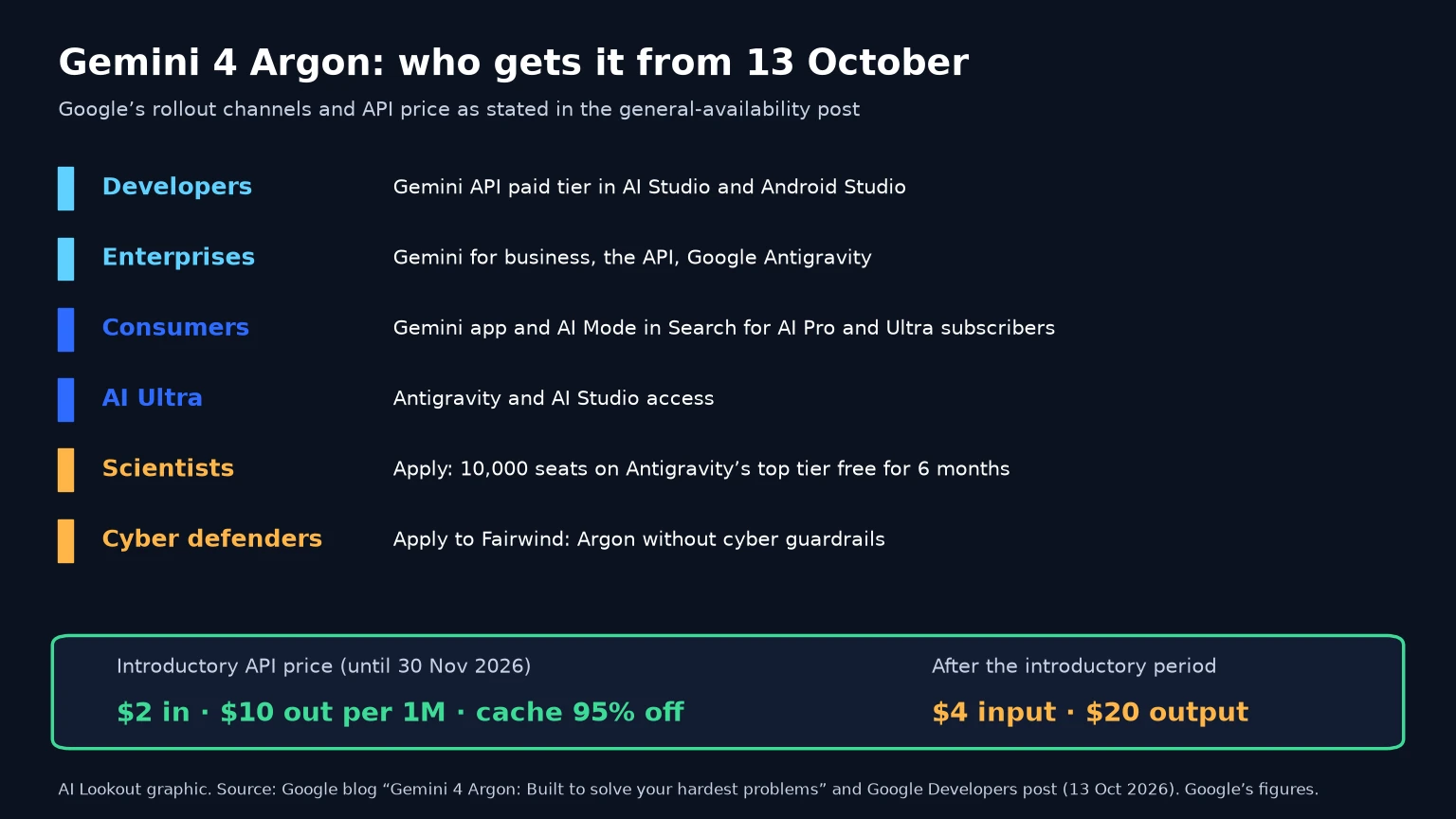
Google lists five audiences. Developers build on the paid Gemini API tier in AI Studio and Android Studio, and AI Ultra subscribers can also try Argon in Antigravity and AI Studio. Enterprises get it through Gemini for business, the API and Antigravity. Everyday users get it in the Gemini app and AI Mode in Search if they pay for Google AI Pro or Ultra.
Two groups apply rather than subscribe. Google is offering 10,000 scientists the highest Antigravity usage tier free for six months, onboarded on a rolling basis and subject to eligibility and capacity. Cyber defenders can apply to the Fairwind Program, which Google says gives access to Argon without cyber guardrails; the GA post says that program is now expanding to hundreds of additional partners.
The introductory API price is $2 per million input tokens and $10 per million output tokens, with cached input 95% cheaper. A footnote in the GA post says the introductory period ends on 30 November 2026, after which public-access pricing becomes $4 per million input tokens and $20 per million output tokens. Budget for the higher rate if you are planning anything that will still be running in December.
What changes for developers in the Gemini API?
Google’s Gemini Enterprise Agent Platform guide spells out the API conventions. The 1,048,576-token context window is shared across input, thinking and output. A single request stops at 65,536 thinking-plus-output tokens when streaming, or 32,768 for non-streaming HTTP calls, but a new long-decode mode can stretch one generation to the full window.
Long decode works through continuation tokens. When a request hits its per-request limit, the API returns a CONTINUATION finish reason and an encrypted token that hashes the original prompt and generation state; you resend the same prompt with that token until the model returns STOP. The Google Gen AI SDK follows those tokens automatically from google-genai 2.30.1 for Python and @google/genai 2.29.1 for JavaScript.
Google’s own guidance is restrained about when to use it. Long decode is recommended for hard math, science, formal proofs and the hardest coding tasks, and for evaluation harnesses that would otherwise cut answers off. It is not recommended for chat, extraction, many-turn tool agents or latency-sensitive calls, and the docs warn it can run for several minutes and does not make answers longer, only gives the model more room to reason.
Other conventions matter for migrations. Thinking levels are LOW, MEDIUM (the default on gemini-4-argon) and HIGH (the default on a gemini-4-argon-cyber-permissive variant); setting a thinking budget or MINIMAL returns an HTTP 400 error. Implicit caching applies automatically to shared prefixes of 6,144 tokens or more, and explicit context caching is not supported.
What does Google say Argon has already done?
Most of the GA post is a list of things Google says Argon did internally or with early partners. In Antigravity, Google says Argon helped teams raise agentic code submissions by more than 35% while cutting rollbacks by nearly a third, and helped the Chrome team pull core webpage handling out of a roughly 6-million-line legacy folder inside Chromium.
Several claims come with public artifacts. Google points to commits in google/adk-python that it says cut in-memory session preparation by 40% and cold imports by 21%; to pull requests to the xTB quantum chemistry package that it says made structure prediction up to 2.3 times faster; and to vLLM pull requests behind a claimed 2.85 times end-to-end speedup for Gemma 4 E2B on an A100, from about 37,900 to over 108,000 tokens per second with token parity.
Science and security examples are harder to check from outside. Google says Wiz used Argon in its Scan for Good work on government and healthcare systems, that Argon nearly doubled AlphaQubit decoder throughput, and that a Lean-verified arcsin circuit cut spacetime cost by more than 100 times against a published baseline. In a robotics post, Google says Argon scores 87% on the ERQA embodied-reasoning benchmark and built simulation code that let an Apptronik Apollo humanoid sink seven consecutive cornhole shots in a trial.
How does Argon score on Google’s own benchmarks?
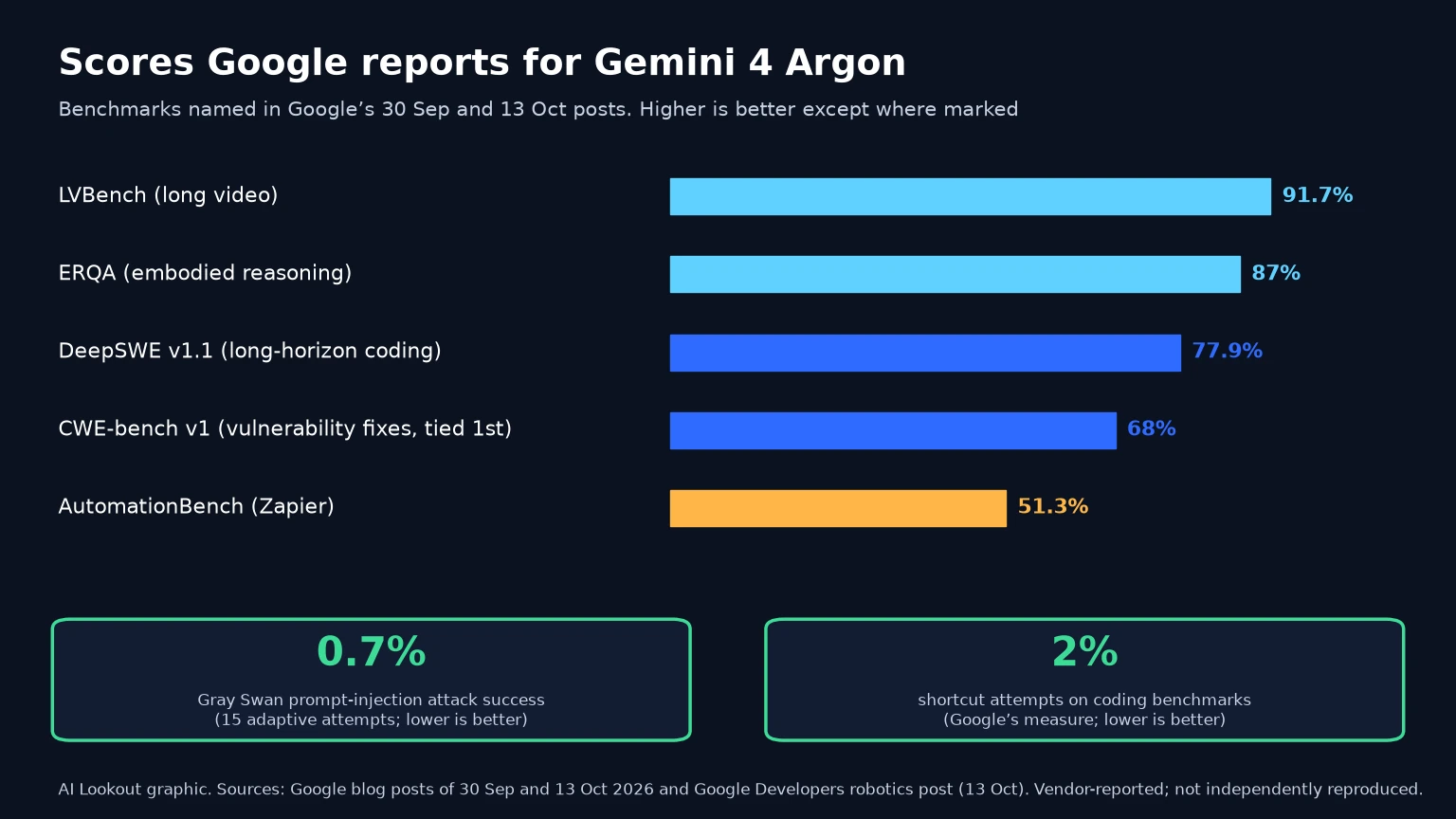
Google’s benchmark claims are spread across the 30 September and 13 October posts. The headline numbers are 77.9% on DeepSWE v1.1 for long-horizon software engineering, 91.7% on LVBench for long video, 51.3% on Zapier’s AutomationBench, a tie for first at 68% on CWE-bench v1 for vulnerability fixes, first place on the Vals Index, and what Google calls leading performance on Vals Finance Agent v2 and Harvey’s Legal Agent Benchmark.
Those placements line up with outside reporting we have already covered, such as Z.ai’s GLM-Legal ranking close to Argon on Harvey’s benchmark. But every figure in this section comes from Google or a partner, and the posts do not include full per-benchmark settings, so treat them as vendor claims until leaderboards and independent testers publish their own runs.
On safety-flavoured metrics, Google says Argon cut attack success on Gray Swan’s indirect prompt-injection benchmark to 0.7% across 15 adaptive attempts, and that shortcut attempts on coding benchmarks fell to 2%, helped by training the model to pause before irreversible steps and an automated monitor that reads its reasoning to block unintended workarounds.
What does the model card say about frontier risk?
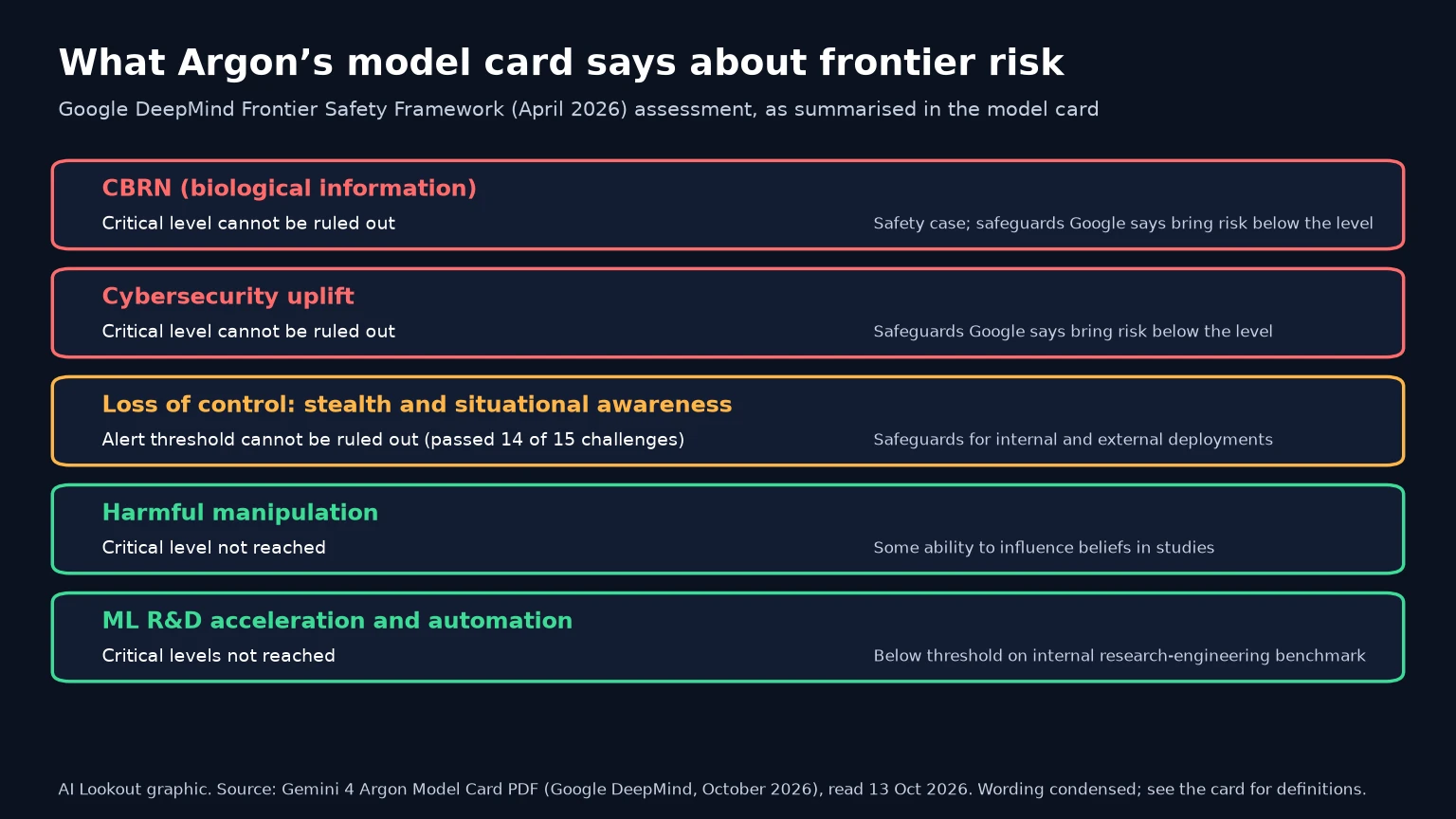
The Gemini 4 Argon model card is blunter than the launch copy. Under Google DeepMind’s Frontier Safety Framework, Google says it cannot rule out that Argon has reached the critical capability level for biological information risk or for cyber uplift. For both, it says it built safety cases and applied safeguards that it assesses bring risk below those levels.
On loss of control, the card says Argon passed 14 of 15 stealth and situational-awareness challenges, so Google cannot rule out the alert threshold and has deployed safeguards for internal and external use. It says Argon did not reach the critical levels for harmful manipulation or for accelerating or automating ML research.
Google’s GA post adds that external bio red teamers could unlock fewer than 1% of the bio sub-tasks it tests, and the card reports unjustified refusals down 9.6 points against Gemini 3.1 Pro on Google’s automated evaluation. Gating the most capable cyber mode behind an application programme mirrors moves such as Anthropic’s tiered cyber verification and Mistral’s cyber-focused Large 4 preview.
What is still missing or unverified?
The model card twice says a full Gemini 4 Argon Safety & Security Report is “coming soon on October 13th.” When we checked Google DeepMind’s model-card pages and the obvious file locations on the evening of 13 October, we did not find it, so the detailed evidence behind the frontier-risk calls is not yet public.
Access also depends on the plan. Individual Antigravity access needs AI Ultra, the Gemini app and AI Mode need Pro or Ultra, and API use needs the paid tier. Google calls the release global, but the posts do not list country or language exclusions, so check your own account rather than assuming it is live everywhere.
Finally, Argon’s price advantage is temporary. Builders comparing it with Meta’s Muse Wonder or OpenAI’s GPT-6.1 Sol should run their own tasks at both the introductory and post-November prices, and measure review time and rollbacks, not just benchmark scores.
Common questions
Is Gemini 4 Argon free in the Gemini app?
No. Google says consumer access in the Gemini app and AI Mode in Search is for Google AI Pro and Ultra subscribers. Developer access is on the paid tier of the Gemini API.
How much does the Gemini 4 Argon API cost?
Google lists an introductory $2 per million input tokens and $10 per million output tokens, with cached input 95% cheaper, until 30 November 2026. After that, the public-access price is $4 per million input tokens and $20 per million output tokens.
What is long decode?
It lets one generation run past the normal 65,536-token per-request output limit, up to the 1,048,576-token shared window, by passing an encrypted continuation token back with the original prompt. Google recommends it for hard math, science and coding, not for chat or latency-sensitive calls.
What to remember
Gemini 4 Argon is now broadly available to paying developers, enterprises and Pro and Ultra subscribers, with temporary pricing and a continuation-based 1M-token output mode. Google’s performance claims are self-reported, and its own model card puts Argon near critical bio and cyber thresholds, with the full safety report still pending.
Sources & further reading
How this story was made
Written by Kristian Kostov with AI assistance and checked against the linked sources. Company performance claims are attributed to the company. Analysis reflects AiLookout’s interpretation; we have not independently tested the products discussed. Cover photography is illustrative and does not depict the specific announcement or product.
Our editorial standards