Announced 12 Oct 2026 · Sources checked
What did Meta release on 12 October?
Meta announced the Muse Wonder series on 12 October 2026 in a newsroom post and a longer research blog. There are two models. Muse Wonder is available to developers through the Meta Model API and in Muse Code, Meta’s terminal coding agent. Muse Wonder Full, the larger and stronger variant, is available only to Muse Code subscribers.
Meta calls them its most capable models to date and positions them for “personal and professional agentic tasks”: its examples run from navigating an insurance claim and reading a lease to building a working app. The company says Muse Wonder will soon power more of the Muse consumer assistant, rolling out first to paying subscribers, and will be used for artifact generation and to develop smaller specialised models for everyone else.
The release follows Muse Spark, which Meta Superintelligence Labs introduced in April 2026 as its first model and has since updated to version 1.3. Meta says the Wonder series came out of a “ground-up overhaul” of its AI efforts that began 14 months ago. Before launch the models were known by the code name Watermelon, according to Axios, which also quotes Meta Superintelligence Labs head Alexandr Wang calling them “true frontier models, competitive with the best models in the world.”
How does Meta say Muse Wonder works?
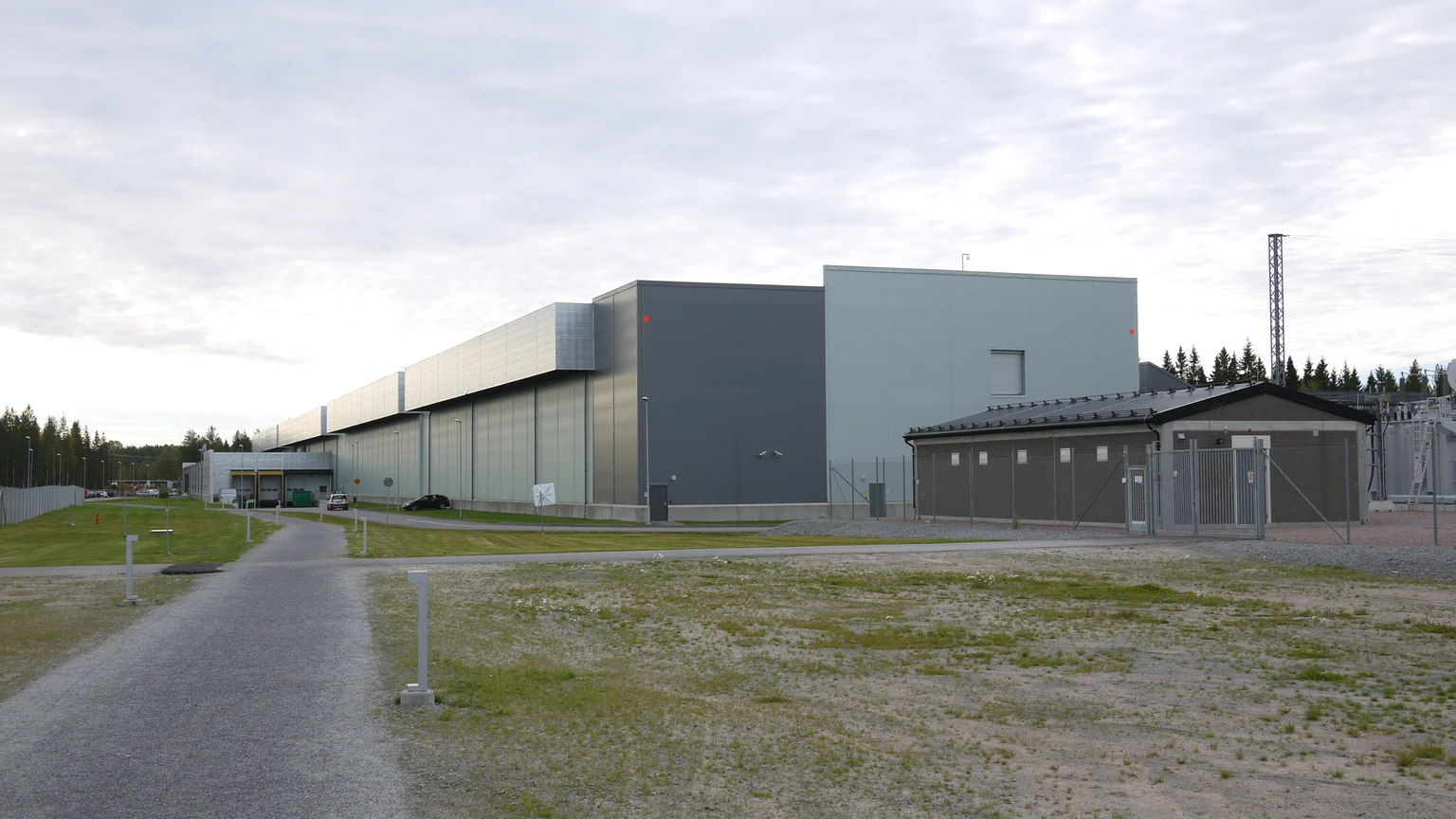
Meta does not publish an architecture, a parameter count or a training-data description. What it does say is that both models build on “larger, stronger base models” than Muse Spark, were trained at its gigawatt-scale Prometheus data center, and received more reinforcement learning on long-running tasks.
The two capabilities Meta emphasises are named features rather than mechanisms. “Active Memory” is the ability to carry context about a user across conversations and retrieve the details that matter for the task at hand; Meta tests it with an internal MemoryBench of 64,000- to 100,000-token conversations seeded with distractors and conflicting updates. “Active Focus” is persistence: trying alternative approaches, working through blockers, asking for clarification and checking in before important actions. Our explainer on what an agent should remember and forget covers why both are harder than they sound.
The research blog also makes a claim about generalisation. Meta plots in-distribution scores, on the kinds of tasks it targeted in post-training, against out-of-distribution scores on tasks it did not target, at several reasoning-effort levels. It says Muse Wonder Full sits above the trend line of Muse Spark 1.3, meaning it does better on unfamiliar tasks than its targeted scores would predict, and attributes that to the stronger base model. That is a reasonable test of “benchmaxxing”, but Meta chose both task sets and has not published them.
According to the model card, the models accept text, image, video and audio input and produce text output, and support a 1M-token context at inference. Meta lists general assistance, coding, personal and professional agents, legal, finance and health knowledge work, multimodal understanding, and research as intended uses.
How does Muse Wonder score against GPT-6 Astra and Claude?
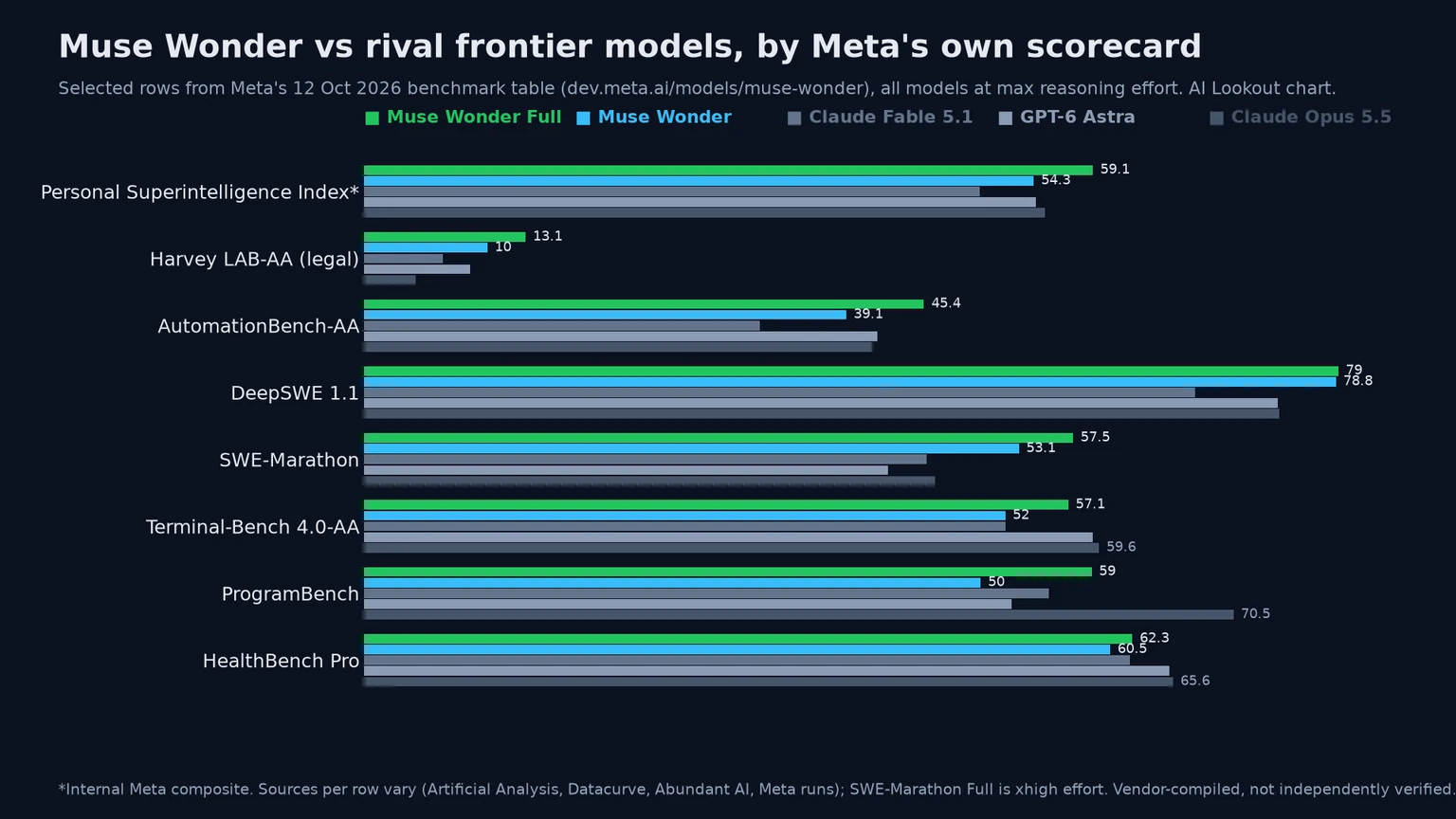
Meta’s benchmark table compares Muse Wonder Full and Muse Wonder with GPT-6 Astra, Claude Fable 5.1 and Claude Opus 5.5, all at maximum reasoning effort. Full leads most of the agent rows and the long-horizon coding rows, but not all of them.
It is worth reading the methodology before the bars. Some rows come from third parties such as Artificial Analysis, Datacurve and Abundant AI; others are Meta’s internal runs. The Personal Superintelligence Index, Meta’s headline composite, is an internal blend of seven evaluations. The model card says competitor runs done internally are “best-effort” and may not be optimally tuned, and SWE-Marathon compares Full at xhigh effort with rivals run in their own products, Codex and Claude Code, so it is not a controlled comparison. Our guide to reading AI benchmark claims applies directly.
The pattern that emerges is specific. Muse Wonder Full is strongest where Meta has aimed it: long agentic workflows, legal work products and multi-hour software projects. Claude Opus 5.5 still leads on terminal coding, from-scratch programming, health questions and the broad Artificial Analysis Intelligence Index, where Meta’s own table shows 58 for Opus 5.5 against 56 for Full. The smaller Muse Wonder scores 52 on that index, up from the 48.1 Artificial Analysis lists for Muse Spark 1.3 at maximum effort.
| Benchmark | Muse Wonder Full | Muse Wonder | GPT-6 Astra | Claude Opus 5.5 |
|---|---|---|---|---|
| Personal Superintelligence Index (Meta internal) | 59.1 | 54.3 | 54.5 | 55.2 |
| Harvey LAB-AA (legal agent work) | 13.1 | 10.0 | 8.6 | 4.2 |
| AutomationBench-AA (business workflows) | 45.4 | 39.1 | 41.6 | 41.2 |
| DeepSWE 1.1 (long-horizon coding) | 79.0 | 78.8 | 74.1 | 74.2 |
| SWE-Marathon (ultra-long projects) | 57.5 (xhigh) | 53.1 | 42.5 | 46.3 |
| Terminal-Bench 4.0-AA | 57.1 | 52.0 | 59.1 | 59.6 |
| ProgramBench (from-scratch programs) | 59.0 | 50.0 | 52.5 | 70.5 |
| Artificial Analysis Intelligence Index | 56 | 52 | 53 | 58 |
How can developers use Muse Wonder, and what does it cost?
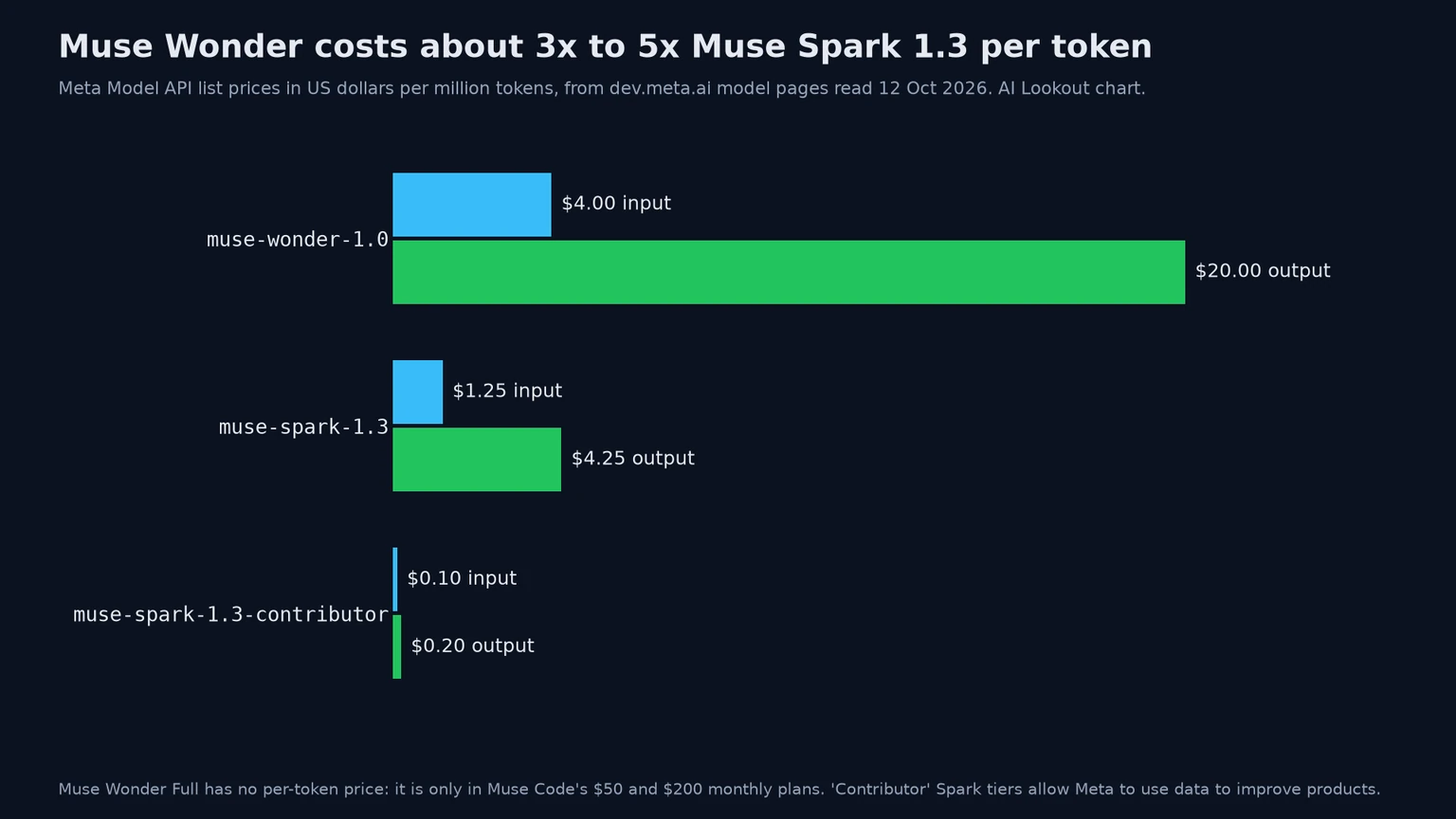
Muse Wonder is a hosted model. On its Meta Model API page it is listed as muse-wonder-1.0 with a 1M-token context at $4.00 per million input tokens, $0.20 per million cached input tokens and $20.00 per million output tokens. OpenRouter lists meta/muse-wonder at the same per-token rates, and Meta’s quickstart says existing OpenAI-SDK-compatible clients can point at the Meta Model API.
That is a big step up from Muse Spark 1.3, which costs $1.25 in and $4.25 out, or $0.10 and $0.20 on the “contributor” tier where Meta may use the data to improve its products. Meta lists no contributor tier for Muse Wonder.
Muse Wonder Full has no per-token price. It is available only in Muse Code on the Power Usage plan at $50 a month and the Maximum Usage plan at $200 a month; the $5 and $15 plans cover the wider Muse model family. Muse Code installs with a shell script and is offered for macOS and Windows.
Meta’s announcement describes API and subscription access only and does not mention downloadable weights, a break from the Llama era; see our explainer on open weights versus open source. Use is governed by the Meta Model API terms and acceptable-use policy, and the model card says the models are not intended for people under 18 and recommends human confirmation before irreversible agent actions.
What does the model card say about safety and cyber risk?
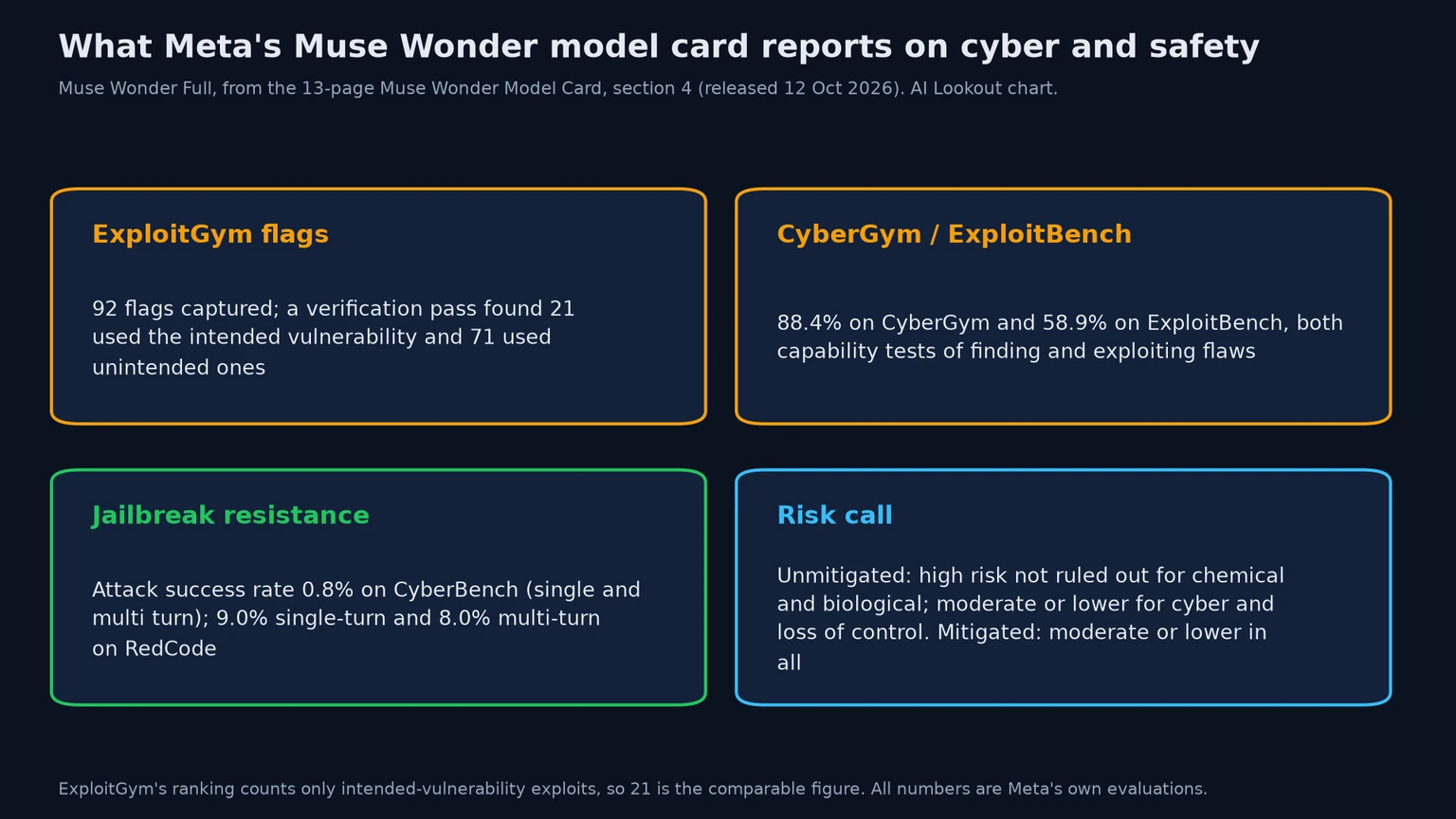
The 13-page model card is more candid than the launch posts. Under Meta’s Superintelligence Scaling Framework, it says, “without mitigations, we do not rule out the model reaching” the high risk threshold in the chemical and biological domain, so Meta added safety post-training and system-level classifiers. It rates the unmitigated model “moderate or lower” for cybersecurity and loss of control, and says that with mitigations the residual risk is moderate or lower in every domain.
The cyber numbers show real offensive capability. Muse Wonder Full scored 88.4 percent on CyberGym and 58.9 percent on ExploitBench, and captured 92 flags on ExploitGym. A verification pass found only 21 of those used the intended vulnerability; the other 71 came through unintended holes, and ExploitGym’s public ranking counts only the 21. Meta says it kept those abilities available “for defensive use”, a choice that echoes the government debate in our coverage of the UK’s new frontier-AI cyber pilots.
On refusals, the card reports a 0.8 percent jailbreak success rate on CyberBench and 8 to 9 percent on RedCode, 98.7 percent refusal on SecureBio’s BioTIER high-risk biology prompts, 87.3 percent on the MASK honesty test, and a 0 percent harmful-action rate on an agentic-misalignment test. All of these are Meta’s evaluations of Muse Wonder Full; Meta says a full safety report with more evaluations will follow.
What does Muse Wonder mean for Meta and the frontier race?
The launch puts Meta back among the labs claiming frontier-level models, six months after Muse Spark and days after OpenAI rolled GPT-6 into ChatGPT. Meta’s strategy is visible in what it measures: personal agents that work across messages, calendars and documents for the billions of people on its apps, rather than chat quality alone.
That focus links Muse Wonder to the Personal Agent Protocol effort and to the wider push for agents that click through apps on a user’s behalf, which we cover in our computer-use explainer. Meta’s demos show Muse Wonder planning a run route in a browser, ordering custom merchandise from Instagram photos and building a wedding seating chart.
For developers the trade-off is price against performance. At $20 per million output tokens Muse Wonder costs far more than Muse Spark, and Meta says Full beats rival flagships on its agent rows. Whether that holds outside Meta’s harnesses is the question independent leaderboards will answer in the coming weeks.
What is still unverified?
Almost everything here is Meta’s own claim. The capability table mixes third-party and internal results, the headline index is internal, and two of the benchmarks Meta highlights, FocusBench and MemoryBench, are Meta’s own tests that outsiders cannot run. The model card lists known limits: errors in multi-step reasoning on novel tasks, weaker visual and 3D spatial reasoning, uneven performance outside strongly supported languages, and results that shift with quantization, prompts, tools and agent harness.
Availability is also staged. The API model is live, but Muse Wonder Full needs a $50 or $200 subscription, and the consumer Muse rollout is promised “soon”, subscribers first, without dates. The full safety report is not out yet.
A practical rule: treat Muse Wonder as a new option for long agentic and coding workloads worth testing on your own tasks, budget for its higher output price, and wait for independent runs before treating Meta’s lead on its own scorecard as settled.
Common questions
Is Muse Wonder open source or open weights?
No downloadable weights are described. Meta offers Muse Wonder through the Meta Model API and Muse Code, and Muse Wonder Full only through Muse Code’s $50 and $200 monthly plans.
Is Muse Wonder better than GPT-6 Astra and Claude Opus 5.5?
On Meta’s own table, Muse Wonder Full leads on agent and long-horizon coding rows, while Claude Opus 5.5 leads on Terminal-Bench, ProgramBench, HealthBench Pro and the Artificial Analysis index. Independent tests have not confirmed the results yet.
How much does Muse Wonder cost?
The API lists muse-wonder-1.0 at $4 per million input tokens, $0.20 per million cached input tokens and $20 per million output tokens, with a 1M-token context.
What to remember
Meta’s Muse Wonder is a hosted frontier model built for long agentic and coding work, priced at $4 in and $20 out per million tokens, with the stronger Full variant reserved for Muse Code subscribers. Its lead is real on Meta’s scorecard but unconfirmed elsewhere.
Sources & further reading
- Introducing Muse Wonder and Muse Wonder Full: Frontier Models for Agents ↗
- Muse Wonder: A frontier model that leads on personal and professional agents ↗
- Muse Wonder Model Card ↗
- Muse Wonder (Meta Model API model page and benchmark table) ↗
- Muse Code ↗
- Meta: Muse Wonder ↗
- Meta unveils new frontier-class AI models to compete with OpenAI, Anthropic ↗
- Introducing Muse Spark: MSL’s First Model ↗
How this story was made
Written by Kristian Kostov with AI assistance and checked against the linked sources. Company performance claims are attributed to the company. Analysis reflects AiLookout’s interpretation; we have not independently tested the products discussed. Cover photography is illustrative and does not depict the specific announcement or product.
Our editorial standards