Announced 12 Oct 2026 · Sources checked
What did Z.ai release?
Z.ai, the Beijing lab formerly known as Zhipu AI, published GLM-Legal on Monday afternoon, 12 October, as a model for what it calls professional cowork: long, multi-step legal tasks that end in a document a lawyer could use. It is built on GLM-5.3-Flash, the small, fast model in the GLM-5.3 family Z.ai released in August, rather than on its flagship. The launch landed the same day Meta put out Muse Wonder and Muse Wonder Full, which also appear on the same legal leaderboard.
Z.ai’s argument is that legal work is a good stress test for agents. A model has to pull the relevant facts out of scattered source files, apply the right rules, build an argument that holds up and then deliver it in exactly the format the brief asks for. Getting most of that right is not enough, because a memo with one wrong citation or a missing clause still needs a lawyer to redo it.
The company makes three claims: a 19.2 percent all-pass rate on Harvey’s Legal Agent Benchmark (LAB), parity with frontier closed models on the LegalBench reasoning test, and parity on PLawBench, a Chinese-law benchmark covering consultation, case analysis and drafting. Only the first comes with a number in the post, and it is the only one we could check independently.
How does GLM-Legal score?
Harvey’s LAB gives an agent a set of documents, spreadsheets and presentations plus file tools, and asks for real law-firm deliverables across 24 practice areas, from M&A and capital markets to tax and bankruptcy. Each task is graded against a rubric of yes-or-no criteria, and the headline all-pass rate counts only tasks where every criterion is met. That is why scores look low: top models satisfy around 90 percent of individual criteria but finish only a quarter of tasks cleanly.
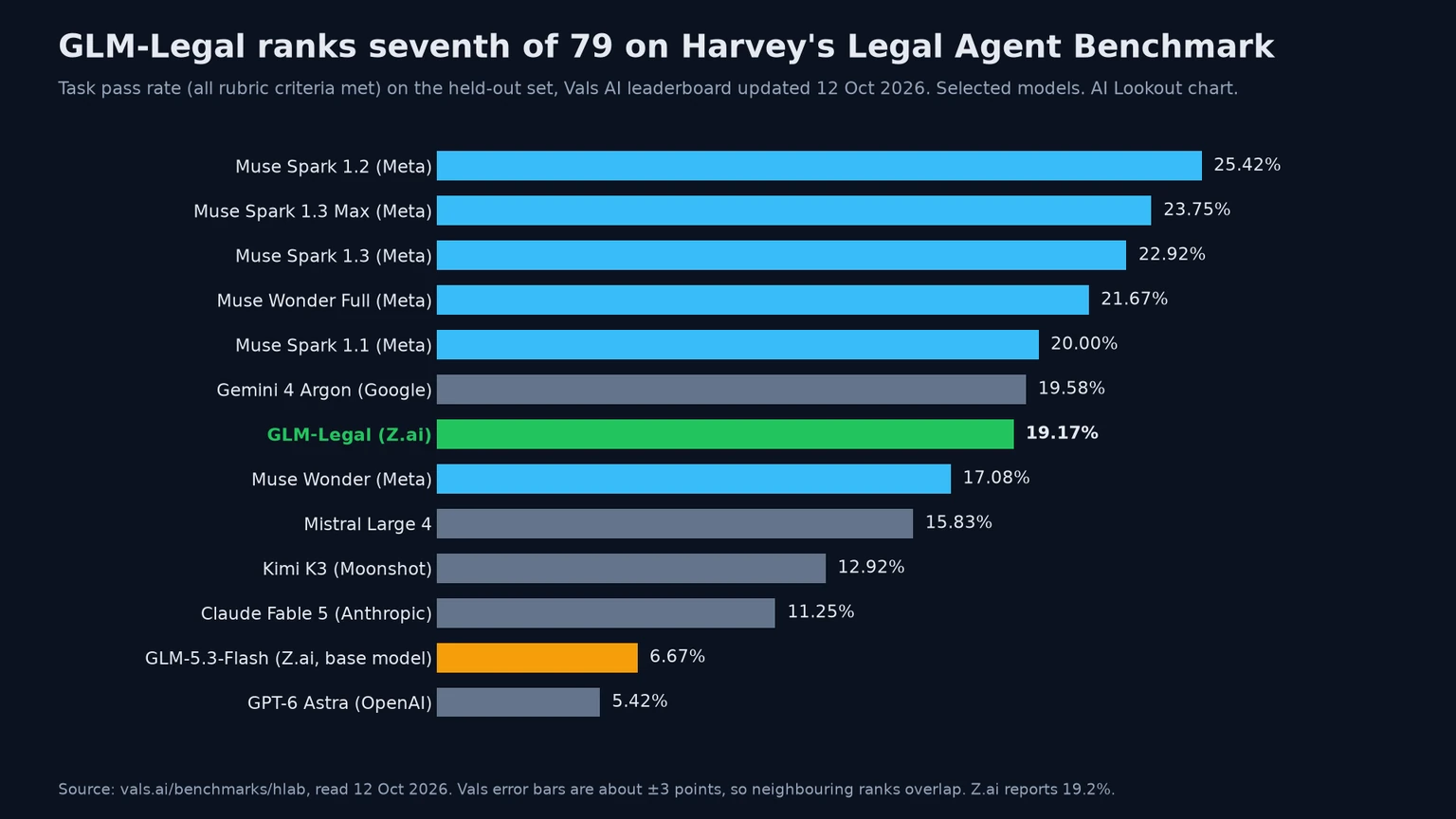
Vals AI, which runs the held-out version of the benchmark, lists GLM-Legal at 19.17 percent, matching Z.ai’s figure to rounding, and seventh of 79 models as of 12 October. Above it are Meta’s Muse Spark 1.2 at 25.42 percent, Muse Spark 1.3 Max, Muse Spark 1.3, Muse Wonder Full at 21.67 percent, Muse Spark 1.1 and Gemini 4 Argon at 19.58 percent. Vals shows error bars of about three points, so GLM-Legal and Argon are effectively level.
The gain over the base model is the clearest result. GLM-5.3-Flash scores 6.67 percent on the same leaderboard, so legal training added 12.5 points, roughly tripling the pass rate. GLM-Legal also finishes ahead of several far larger general models in this run, including Muse Wonder at 17.08 percent, Mistral Large 4 at 15.83, Kimi K3 at 12.92, Claude Fable 5 at 11.25 and GPT-6 Astra at 5.42.
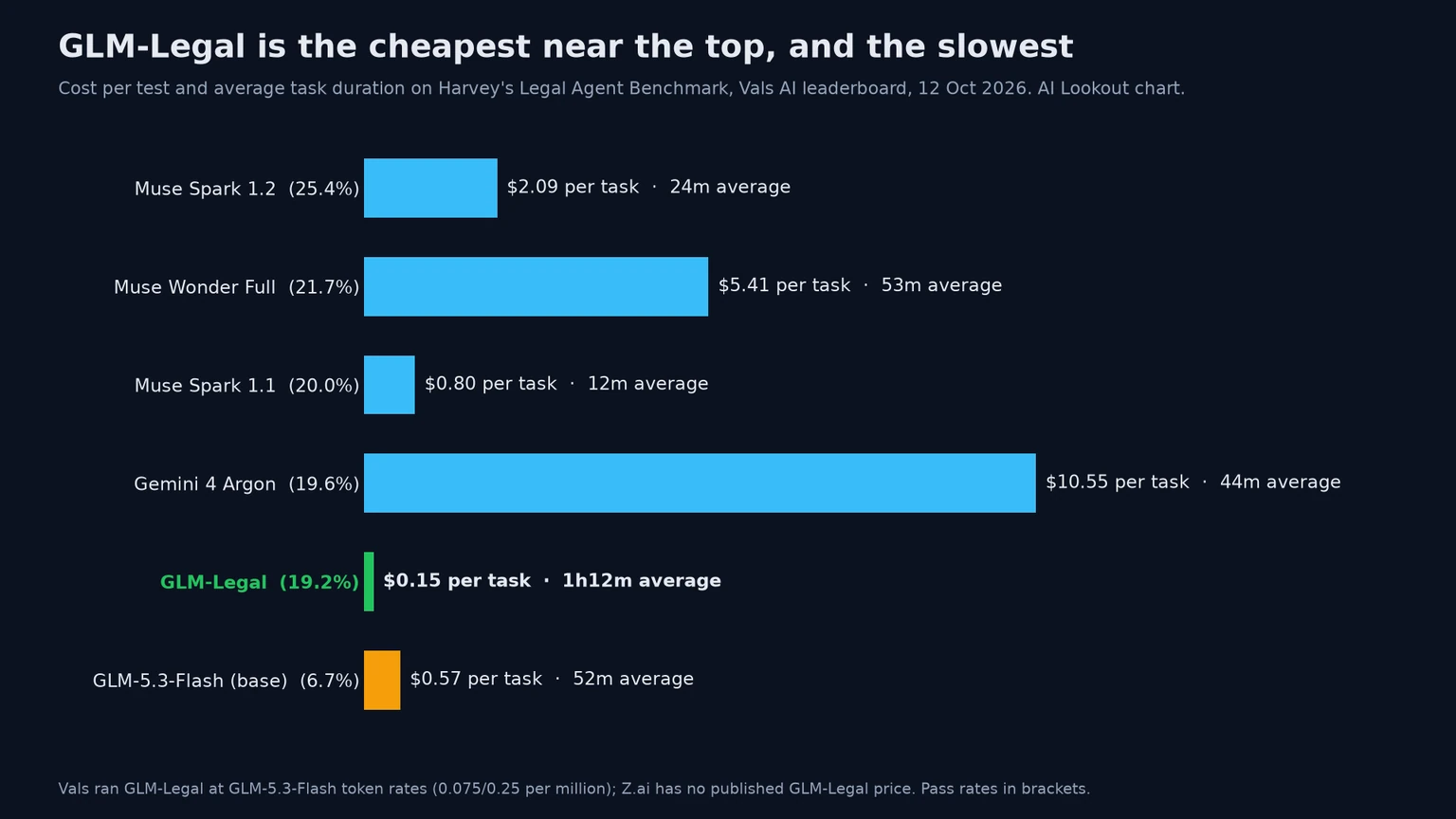
Cost and speed cut both ways. Vals ran GLM-Legal at GLM-5.3-Flash’s token prices of $0.075 per million input and $0.25 per million output tokens and measured about $0.15 per task, against $2.09 for the leader and $10.55 for Gemini 4 Argon. But GLM-Legal averaged 1 hour 12 minutes per task, three times the leader’s 24 minutes. Vals also lists it at 86.23 percent on LegalBench, 14th of 150, a strong result but short of the outright parity the launch post implies.
How was GLM-Legal trained?
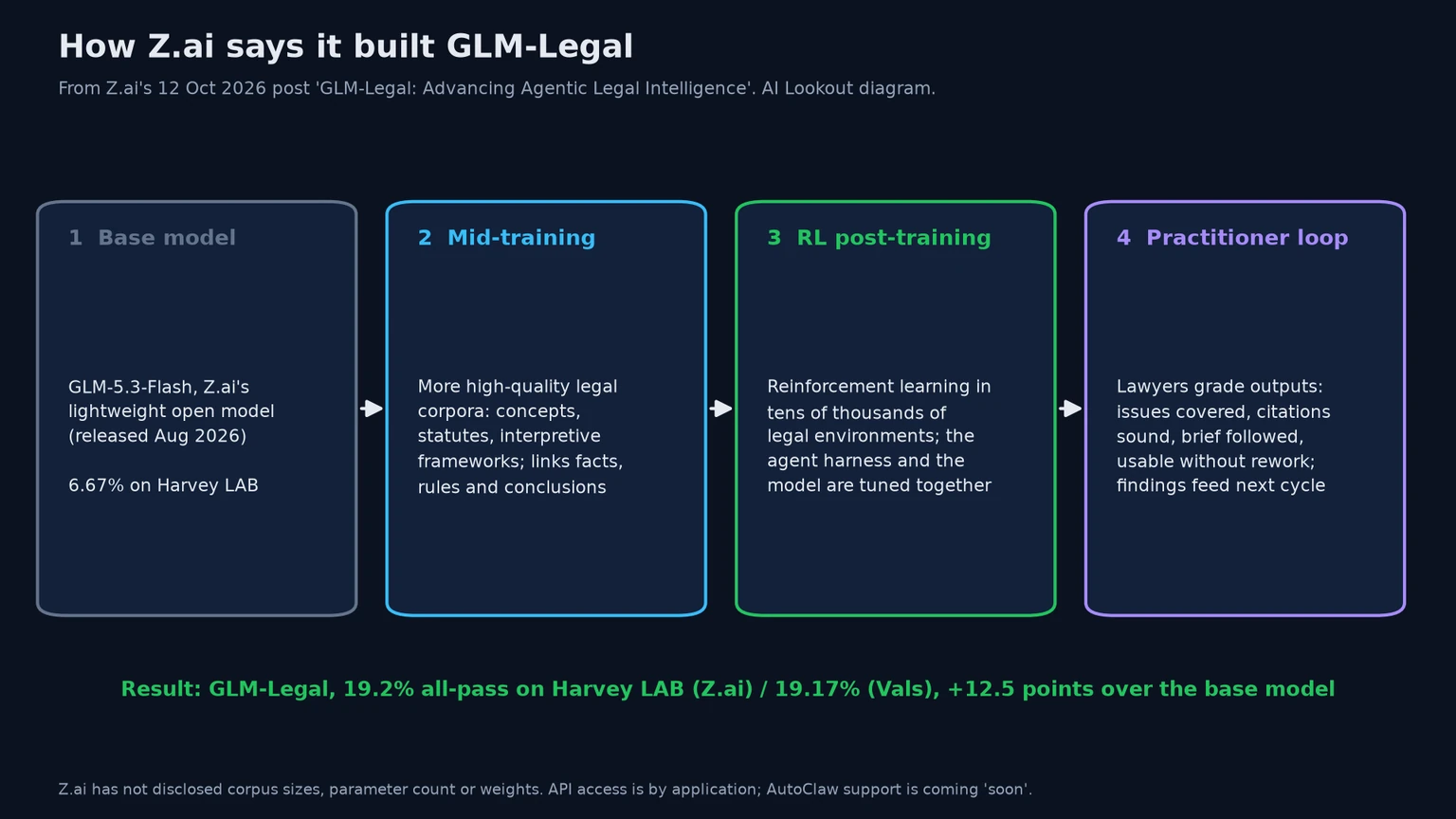
Z.ai describes three stages. Mid-training adds a larger volume of high-quality legal text so the model learns concepts, statutes and interpretive frameworks in dense context, and practises connecting facts, rules and conclusions. Post-training then uses reinforcement learning across what Z.ai calls tens of thousands of realistic legal environments, where the model is rewarded for planning an analysis, moving a workflow forward and producing a deliverable under constraints.
The more unusual part is that Z.ai trained the model and its agent harness together. The harness is the runtime that manages task context, connects tools and routes feedback, and Z.ai says problems found during training were used to fix the harness while harness changes exposed the model to more realistic constraints. In other words, the score belongs to a model plus its scaffolding, not to raw weights alone.
The third stage is a production loop. Lawyers grade outputs on four questions: are all critical issues covered, are the arguments and citations sound, does the deliverable follow the brief, and can a team use it without rework. Z.ai says it turns those judgments into training signals and new environments. It is the same specialist-over-generalist bet as Coinbase’s fine-tuned fraud model, applied to a profession rather than a single company’s data.
What does it do on real legal tasks?
The launch post shows three side-by-side examples against the base model. In a contract review for a client switching software providers, GLM-5.3-Flash gives general advice to shorten the notice period. GLM-Legal proposes cutting convenience termination from 60 to 30 days, removing the cure period for IP, confidentiality and data-security breaches, requiring return of all work in progress whether or not it has been paid for, and adding up to 90 days of transition help.
In an evidence review of 40 documents from a software project dispute, both models spot that a client report claimed 60 percent completion while an internal snapshot showed about 41 percent. GLM-Legal goes further, tying the report to an earlier internal warning and a chief executive’s instruction to keep invoicing, citing document numbers, and noting contract clauses saying payment does not waive rights, while flagging which elements still need testing.
The third example plans privacy compliance for a website launching in Singapore, Malaysia and Indonesia, and GLM-Legal returns a prioritised checklist with section references to each country’s data-protection law. Z.ai says AutoClaw will be able to write such edits straight into a Word file as tracked changes and comments. These are vendor-chosen demos, not test results; legal work has already been a proving ground for computer-use agents, as in OpenAI and Ironclad’s evaluation.
How can you get access?
GLM-Legal is in beta. Z.ai invites law firms, legal-tech companies, in-house teams and independent practitioners to apply for API access through a consultation form on its site, and says the model will soon be usable inside AutoClaw, its desktop agent platform. There is no self-serve sign-up, no published price list and no stated date for general availability.
Weights are a point of confusion. Z.ai has released GLM-5.3-Flash and earlier GLM models as open weights on Hugging Face, and Vals AI’s model page labels GLM-Legal open-weight. But the launch post mentions no download, and when we checked Z.ai’s Hugging Face organisation on 12 October the newest models were the GLM-5.3 family from August. For now, treat GLM-Legal as a gated hosted model.
That matters for law firms, which often cannot send client files to an outside service without vetting where data is processed and stored. A gated beta means those questions go through Z.ai’s sales process rather than a model card. Domain-specialist models are increasingly launching this way, as in security with the gated OrcaCyber Zero 1.5 model.
What should legal teams watch for?
The independent check is narrow. Only the Harvey LAB score has been reproduced outside Z.ai, by Vals AI, and the LegalBench and PLawBench parity claims come without numbers in the launch post. Harvey’s benchmark is also young and scores depend on the harness: Artificial Analysis runs its own implementation of LAB with a different setup, so figures from different leaderboards should not be mixed.
A 19 percent all-pass rate also means about four in five tasks still fall short of every criterion, so GLM-Legal drafts work for lawyers to check, not a substitute for one. The slow average task time could matter in practice, and how well it handles jurisdictions beyond those in its examples is untested in public. We have not used the model ourselves.
What the launch does show is that a small, cheap base model with focused legal training and a tuned harness can reach the top tier of a hard agentic benchmark at a fraction of the cost per task. If Z.ai publishes weights or pricing, or if the Muse and Gemini results shift as Meta’s new models get wider testing, that comparison will be worth rerunning.
Common questions
Is GLM-Legal open source?
Not as far as we can confirm. Z.ai’s launch post offers API access by application and AutoClaw support, and we found no GLM-Legal weights on Z.ai’s Hugging Face page on 12 October, although Vals AI lists it as open-weight.
How good is 19 percent on Harvey’s benchmark?
It is near the top. The benchmark only counts tasks where every rubric criterion is met; the leader on Vals AI’s board scores 25.42 percent, and GLM-Legal’s base model scores 6.67 percent.
How much does GLM-Legal cost?
Z.ai has not published a price. Vals AI ran it at GLM-5.3-Flash’s token rates and measured about 15 cents per benchmark task.
What to remember
GLM-Legal shows how far focused legal training can lift a small model: from under 7 percent to about 19 percent on Harvey’s agentic legal benchmark, close to Gemini 4 Argon at a fraction of the cost. It is a gated beta with only one independent check so far.
Sources & further reading
How this story was made
Written by Kristian Kostov with AI assistance and checked against the linked sources. Company performance claims are attributed to the company. Analysis reflects AiLookout’s interpretation; we have not independently tested the products discussed. Cover photography is illustrative and does not depict the specific announcement or product.
Our editorial standards