Announced 19 Oct 2026 · Sources checked
What Germany and NVIDIA signed
On 19 October 2026, at the Invest in Germany Summit in Berlin, Germany's Federal Ministry for Economic Affairs and Energy and its Federal Ministry for Research, Technology and Space signed a joint declaration of intent with NVIDIA. According to NVIDIA's account of the day, Chancellor Friedrich Merz was also part of the signing. The declaration commits the two sides to a joint initiative to advance cutting-edge AI models for physical AI.
The German government's own wording, reported by the dts news agency and by AFP via FOCUS online, is that the initiative will build on Germany's industrial data, manufacturing expertise and engineering know-how. It is part of the federal government's AI road map and of the Plattform Industrie 4.0, and its stated aim is to bring industrial AI into broad use and to build a state-of-the-art industrial AI ecosystem in Europe.
A special focus, the ministries said, is working together on specialised, open models for industrial AI. NVIDIA, in turn, will expand its work with German partners so that innovation spreads widely and the Mittelstand, Germany's small and medium-sized manufacturers, can benefit from advances in AI.
A declaration of intent is not a contract. It sets out goals and who will pursue them. Neither the ministries nor NVIDIA published a budget, a list of models to be built, or a timetable on the day.
What physical AI means here
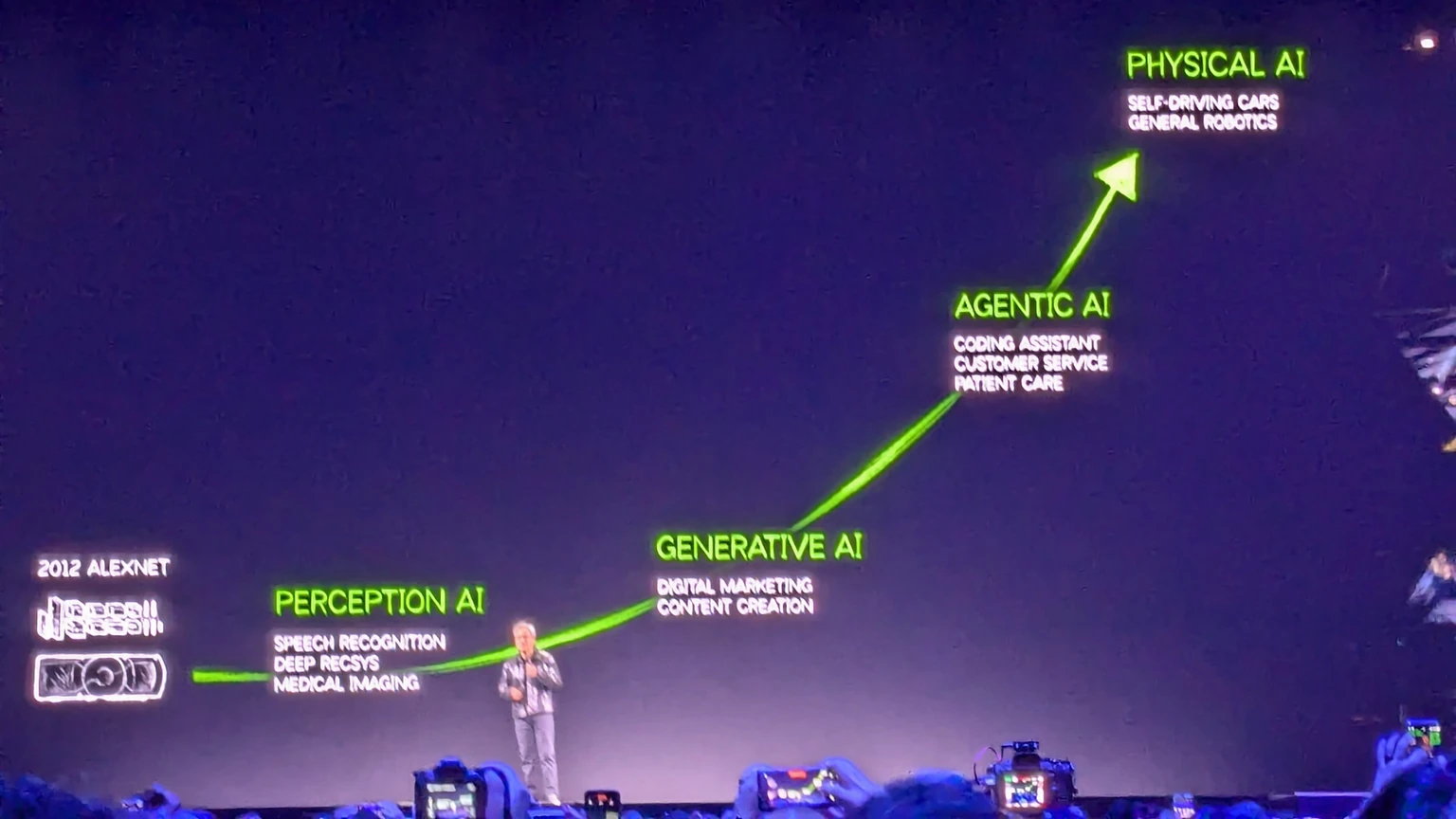
Physical AI is the term NVIDIA and others use for AI that acts in the physical world rather than on a screen: robots, autonomous vehicles, and models that plan and simulate factory work. The German reports describe it the same way, as AI built into physical systems such as robots.
The training problem is different from chatbots. A robot or a production line cannot learn from the open web. It needs sensor data, machine logs, CAD models and simulations of real plants, which are exactly the assets German manufacturers hold and have mostly kept to themselves. That is why the declaration leans on industrial data and engineering knowledge rather than on compute alone.
NVIDIA has been building toward this for years with its simulation and robotics software, and German industry is already among its closest partners. Earlier this month it expanded its automated-driving partnership with Mercedes-Benz, and Neura Robotics introduced its Neuron physical AI model. The declaration puts the federal government behind that direction.
Why the Industry 4.0 platform matters
The Plattform Industrie 4.0 is the vehicle. On 3 July 2026, the two ministries relaunched the platform around industrial AI, with the goal of making data-driven and AI-based applications standard in German industry by 2030. The ministry describes it as a network of more than 300 companies, associations, research bodies and policymakers, now led for industry by Rainer Brehm of Siemens Digital Industries and Stephan Mayer of Trumpf Machine Tools.
That July relaunch already set the tone for the NVIDIA deal. It said the platform's work would cover infrastructure, data, AI foundation models and applications, and that it would favour open, interoperable approaches and consistent use of open-source technology. The new declaration names the platform as the central strategy network for industrial AI, open to all companies and working with international partners.
Handelsblatt, which reported that it had seen the declaration, says the government believes AI is a basic precondition for German industry's long-term competitiveness, and that a task force with three focus areas is planned. The paper also reports that economy minister Katherina Reiche and research minister Dorothee Bär are to drive the work. The declaration text itself has not been published.
What Merz and Huang said on stage
In the evening, Merz and NVIDIA founder Jensen Huang sat down on stage at Kraftwerk, a former power station in Berlin. NVIDIA's post quotes Merz saying Germany is fully committed to being one of the most advanced places in the world to work with AI and to integrate it into industry, and that he is optimistic Germany can be one of the leading countries, if not the leading one, in spreading AI to its companies.
Merz addressed the Mittelstand leaders in the audience directly. “Please open your doors for AI to make use of your data,” he said, calling the data already sitting in German companies a real advantage. He also said he would like to meet Huang at least once a year to review progress.
Huang's message was that AI amplifies existing expertise rather than replacing it. “That knowledge belongs to you,” he told the audience. “It cannot be replaced. AI can only augment your capability, it will not replace your capability.” He called the moment a new industrial revolution and said Germany was being re-engineered.
The warm tone followed a sharper one. The German news agency dpa, as carried by Der Tagesspiegel, reported that Huang had told journalists in London days earlier that nothing pained him more than seeing one of the most technologically advanced countries fall so far behind, suggesting Europeans overthink things and urging Germany to get to work.
The four startups NVIDIA is backing
Huang also announced planned NVIDIA investments in four German startups, which NVIDIA describes as part of a nearly $10 billion commitment to companies, universities and research institutions across Europe. It did not give the size of any individual investment.
The four companies, as NVIDIA describes them:
- Agile Robots, a Munich robotics company that builds AI-powered robots from robotic arms to its Agile ONE humanoid for manufacturing, logistics and healthcare.
- Avelios Medical, a Munich startup building an AI-native hospital information system that serves as the core record for clinical and administrative work.
- Mirelo, which builds AI models that generate sound effects, speech and music matched to video.
- Reflex Aerospace, a Berlin space company that designs satellites it says can be ready for launch in about 12 months.
Siemens, JUPITER and the rest of the day
The Berlin stop is part of a run of national announcements on Huang's European tour, after new investments in French startups and a compute and research package in the UK the week before. Germany adds a government declaration to the startup cheques.
Earlier the same day, NVIDIA says, Siemens announced a partnership with it on AI-driven autonomous factories and showed new tools at its Erlangen plant. Siemens's claims are that a fully virtual production ramp-up cuts engineering effort by up to 85 percent and that agent-based production planning saves up to 20 percent in costs. Those are Siemens's figures and come without published methods.
NVIDIA researchers also used JUPITER, Europe's largest supercomputer at the Jülich Supercomputing Centre, to run what NVIDIA calls a record 104-qubit simulation of a fault-tolerant quantum computer, the largest and most detailed of its kind to date by its account. Huang's GTC Berlin keynote follows on Wednesday, 21 October, from 11 a.m. to 1 p.m. CEST.
What is missing from the declaration
The declaration answers the question of direction, not of scale. There is no public figure for how much money the government or NVIDIA will put in, how many GPUs the initiative will use, or where they will run. Neither side gave a figure on the day.
It is also unclear what open models for industrial AI means in practice: whose models, trained on whose data, under which licence, and how a mid-sized machine builder would get access. The phrase matches the July platform relaunch's emphasis on open source, but the text has not been released for outside review.
There is a sovereignty question too. Europe's AI debate has turned on whether to build its own frontier capabilities, a case Mistral's Arthur Mensch made bluntly last week. Germany's flagship industrial AI initiative is now tied to a US chip company whose hardware already dominates AI training. The declaration's stress on German data and open models is partly an answer to that, but it does not change where the chips come from.
AI Lookout has not seen the declaration itself. This account relies on NVIDIA's post, German government statements as reported by news agencies, and Handelsblatt's description of the document.
What comes next
The summit continues on Tuesday with Merz, vice-chancellor Lars Klingbeil and other ministers, and with a focus on energy, AI and semiconductors, infrastructure and defence, according to Deutschlandfunk. Huang's GTC Berlin keynote on Wednesday is the most likely place for NVIDIA to put specifics behind the declaration, such as named partners, models or data-centre plans.
For German manufacturers, the practical signal is that the government wants industrial AI run through the Plattform Industrie 4.0 and wants their data in play. Whether that turns into open models a small supplier can actually use will depend on the task force's work and on what NVIDIA brings to it.
Common questions
What did Germany sign with NVIDIA?
A joint declaration of intent, signed on 19 October 2026 by the federal economy and research ministries, to pursue an initiative on cutting-edge AI models for physical AI. It is a statement of goals, not a funded contract.
Which German startups is NVIDIA investing in?
Agile Robots, Avelios Medical, Mirelo and Reflex Aerospace. NVIDIA called these planned investments and did not disclose amounts.
What is the Plattform Industrie 4.0?
A network of more than 300 German companies, associations and research bodies backed by the economy and research ministries. It was refocused on industrial AI in July 2026 and is the planned home of the NVIDIA initiative.
Sources & further reading
- Germany Wants to Lead the World in Industrial AI: How NVIDIA Will Help ↗
- Bundesregierung unterzeichnet Absichtserklärung mit Nvidia ↗
- Merz vereinbart mit Nvidia Zusammenarbeit bei KI-Entwicklung ↗
- KI-Deal mit der Bundesregierung: Nvidia-Chef Huang sieht Deutschland als „so weit abgehängt“ ↗
- Bundesregierung, Wirtschaft und Forschung richten Plattform Industrie 4.0 auf industrielle KI aus ↗
- Künstliche Intelligenz: Bär und Reiche sollen KI-Pakt mit Nvidia vorantreiben ↗
- Investitionsgipfel soll Geldgeber nach Deutschland locken - Absichtserklärung für KI-Zusammenarbeit mit Nvidia ↗
How this story was made
Written by Kristian Kostov with AI assistance and checked against the linked sources. Company performance claims are attributed to the company. Analysis reflects AiLookout’s interpretation; we have not independently tested the products discussed. Cover photography is illustrative and does not depict the specific announcement or product.
Our editorial standards