Announced 8 Oct 2026 · Sources checked
What is CRIS-0?
Aether’s research post, Building a Real-world Autonomous Robotic System with Causality-driven Agent and World Model, dated 8 October 2026, introduces CRIS-0 as a system that “represents task progress through an explicit causal state and adapts its behavior as that state evolves.” The two named pieces are a Causality-guided Robot Agent and a Causal World Model.
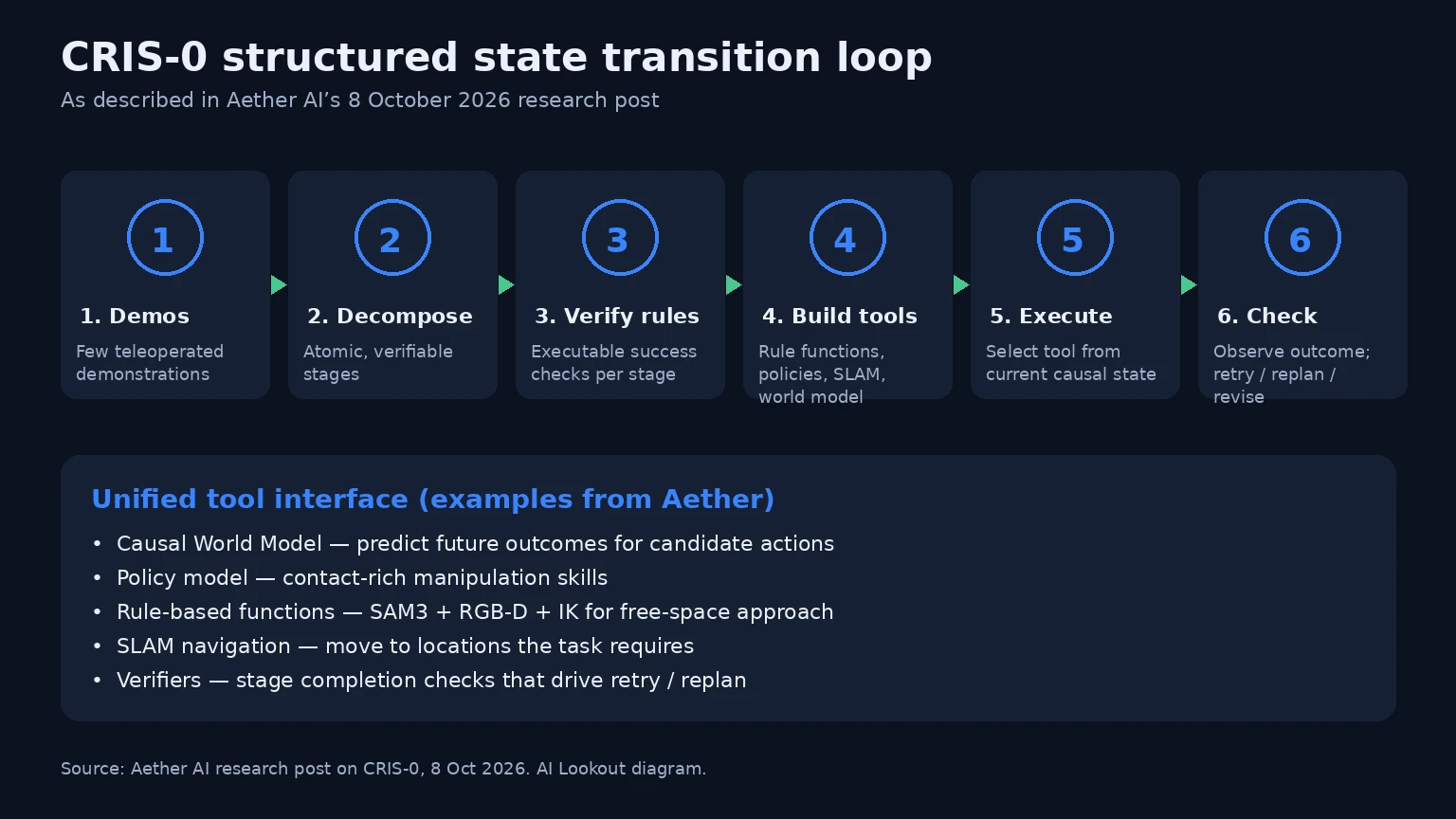
Given a new task, CRIS-0 is said to analyze a small set of demonstrations, identify task-relevant variables, decompose the work into stages, define verification criteria, and construct the tools or policies needed to run. During interaction it updates state from observations, verifies intermediate outcomes, and selectively calls rule-based tools, learned policies, navigation modules or the world model.
The author list on the post is long, with Lingjun Mao, Lukun He, Jinglin Cao and Wenpeng Xu marked as equal contributors and Kun Zhou and Biwei Huang as corresponding-style leads. Aether’s company site frames the same idea more bluntly: pattern-matching agents are not enough for robots that change irreversible physical state.
How does the causality-guided robot agent work?
The agent’s core data structure is a set of causal variables for the current stage—whether a cloth is grasped, how many centimetres a corner still sits from target, whether slippage occurred—updated from cameras and tool feedback. That state decides whether to pull, re-grasp or advance.
Tools share a unified interface. Aether’s drink example has the planner choose a beverage for a fitness goal, call a rule function to park the gripper near the can, then call a contact-rich grasp policy. Free-space approach is handled by generated functions that use SAM3 segmentation, RGB-D and inverse kinematics; contact-rich stages lean on a policy model inherited from the world-model backbone.
Task decomposition turns demos into an evolving graph: nodes are verifiable stages, edges are transitions. Each node gets a reference strategy and an executable verification script. The planner’s job is to identify the stage, pick a tool, check the outcome, and decide whether to continue, retry or revisit an earlier node. That is closer to a supervised workflow engine than to a single end-to-end vision-language-action policy.
What does the causal world model add?
The Causal World Model predicts future evolution through task-relevant causal variables rather than pixels alone: current state → causal variable transition → future observation. Aether argues that lets the agent ask whether an action will produce the intended state change, not only what the video might look like.
An action module turns the same backbone into a policy that emits robot controls while still reasoning about expected future causal state. The post shows model-generated video samples across handing a cup, folding a shirt, placing a bottle in a drawer, setting a table, moving a ball between shelves and bimanual handoffs—illustrations of imagined futures, not measured closed-loop scores.
That world-model-plus-policy pattern sits in a crowded 2026 lane next to latent approaches such as Meta FAIR’s RoboJEPA and long-horizon action models like NVIDIA’s Long-WAM. Aether’s differentiator is the explicit causal state machine wrapped around those predictions.
How does recovery work when something goes wrong?
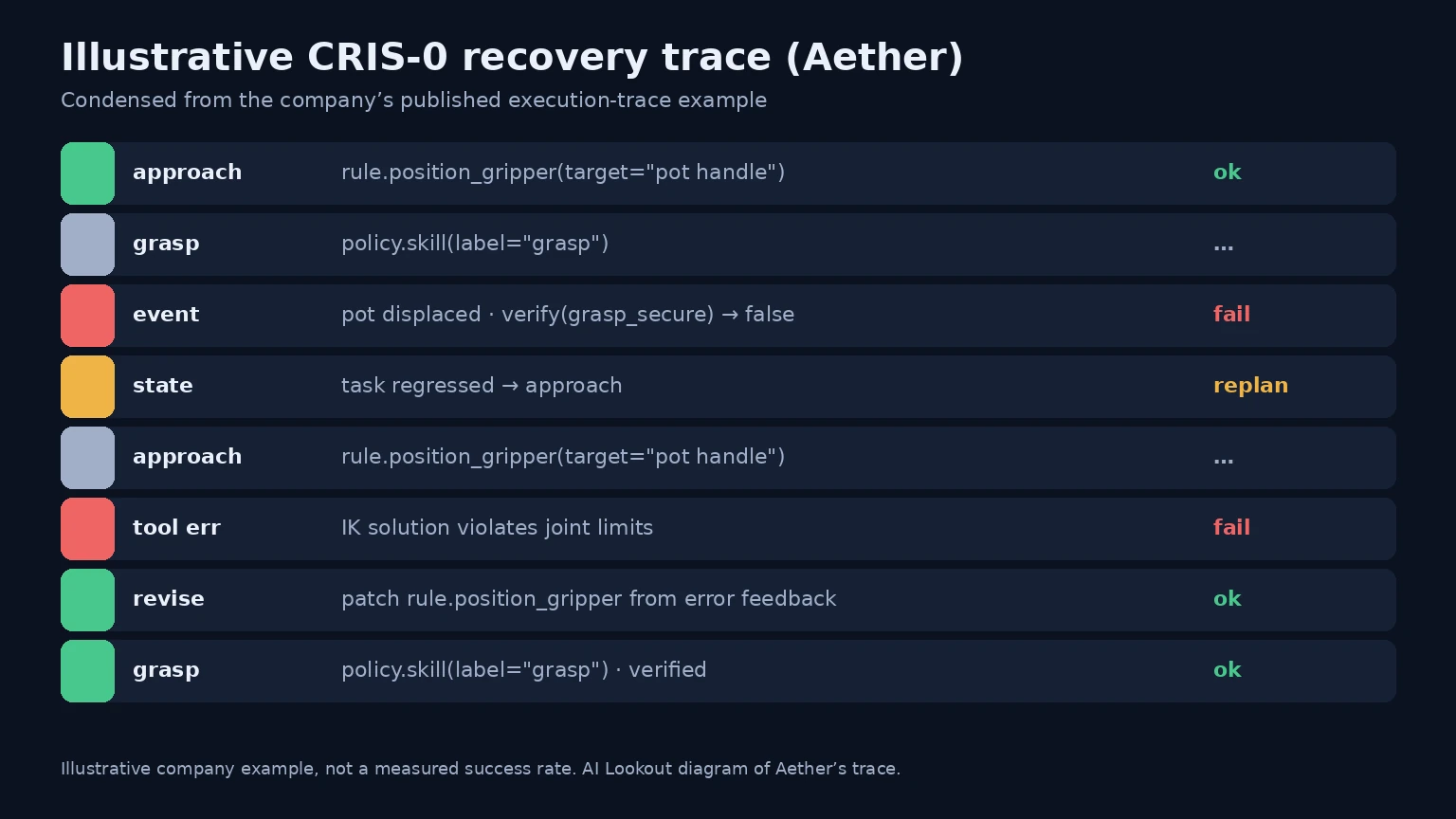
The post’s most concrete teaching examples are recovery traces. In one illustrative pot-grasp sequence, the agent approaches with a rule function, attempts a grasp, sees the pot displaced so verification fails, regresses to approach, hits an inverse-kinematics joint-limit error, patches the positioning function from that error, retries and keeps the revised tool after a verified grasp.
Other clips referenced in the post show discarding a tape-measure package and placing a pear in a bowl with retries. Aether’s claim is that errors do not silently accumulate because each stage is checked before the next begins, and that hard tasks become sequences of simpler tool calls.
Humanoids Daily’s CRIS-0 write-up, based on company information, adds that Aether described roughly 20,000 hours of pretraining data and only “hours” of robot-specific fine-tuning, and that contact-rich manipulation remains a stated challenge. Those figures are still Aether’s, relayed through secondary reporting.
What evidence has Aether published so far?
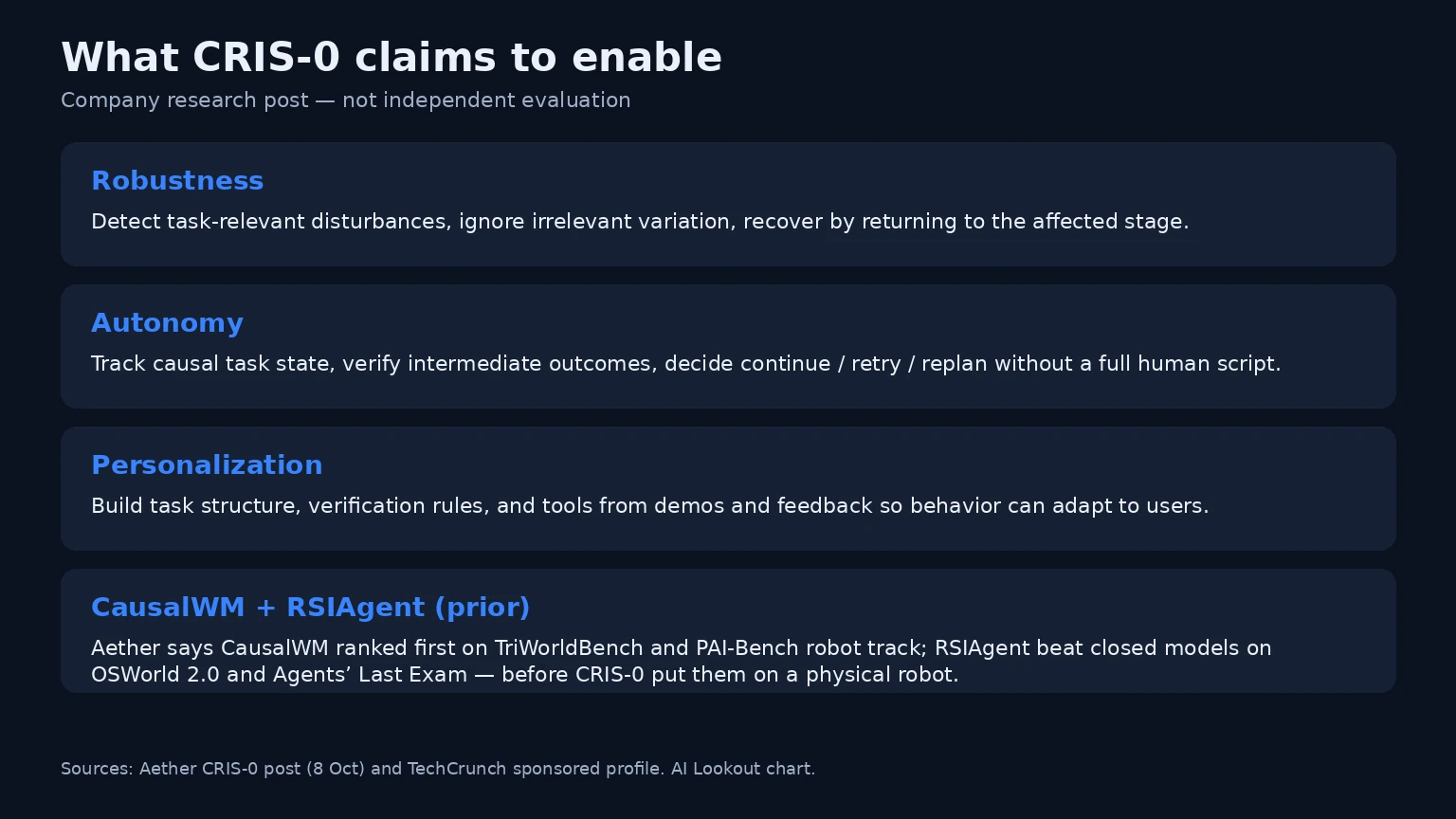
A TechCrunch sponsored profile says Aether released first public demonstration footage on 8 October, positioning CRIS-0 as the first time the company’s causal world model and agent ran together on a physical robot. It also repeats company benchmark claims for earlier components: CausalWM first on TriWorldBench and on the robot track of PAI-Bench as of September 2026, and RSIAgent ahead of frontier closed models on OSWorld 2.0 and Agents’ Last Exam without extra training.
Those leaderboard leads, if accurate, are still simulation or computer-use results. CRIS-0’s physical section in the research post lists evaluation themes—disturbances, long horizons, underspecified requests, complex manipulation, new objects—but the public HTML does not include a results table with success rates, trial counts or baselines on the robot.
Readers should therefore separate three layers: (1) the architecture description, which is detailed; (2) prior component benchmarks, which are company-cited; (3) household robot reliability, which is currently demo-and-narrative evidence.
Who is Aether AI, and what is the commercial context?
Biwei Huang is an assistant professor at UC San Diego and Aether’s founder. The TechCrunch sponsored piece says the company was founded in 2026 after about twelve years of her causal-discovery research, has raised roughly $20 million, and employs about twenty people. Humanoids Daily carries the same scale numbers.
Aether’s site positions the product as a “decision brain for Physical AI” between perception and control, with longer-term ambitions in scientific discovery where interventions and counterfactuals matter. CRIS-0 is the robotics embodiment of that thesis, not a consumer robot SKU with a ship date.
There is no pricing page, robot partner list or downloadable weights attached to the materials inspected for this article. The public artifacts are the research post, homepage and demo videos.
How does this compare with other physical-AI approaches?
Compared with large robot-hand foundation models trained mainly on human video—such as Nature Will’s Natura-1—CRIS-0 bets on structure: fewer demonstrations, explicit stages, and verification scripts. Compared with reflex-style closed-loop catching on humanoids like the UW Reflex Unitree G1 paper, Aether emphasises long-horizon household semantics (clear the cans before heating the plate) over millisecond motor reflexes.
The causal-state idea also differs from pure generative world models that dream pixels or latents without a planner that must pass executable checks. Aether wants the world model to propose futures and the agent to refuse progress when verification fails.
Whether that hybrid beats end-to-end policies on messy kitchens is exactly the open empirical question. Aether’s demos are designed to show recovery and underspecified goals; they are not yet a public leaderboard.
What should readers treat as unproven?
No peer-reviewed paper PDF, code release or third-party robot study accompanies the 8 October post in the sources reviewed. Benchmark rankings for CausalWM and RSIAgent are attributed to Aether’s sponsored and research pages without linked evaluation traces here.
Household clips remain controlled demonstrations. Humanoids Daily notes contact-rich manipulation and generalization limits as company-acknowledged frontiers. Success rates under continuous human clutter, novel kitchens or multi-hour autonomy are not published.
Funding and headcount figures come from sponsored or secondary profiles. Until Aether posts protocols, seeds and baselines—or an outside lab replicates the stack—CRIS-0 should be read as a well-documented systems thesis with promising demos, not as a measured leap in household robot reliability.
Common questions
Is CRIS-0 open source?
Not in the materials reviewed. Aether published a research post, demos and marketing pages. No public weights, code repository or paper PDF were linked from those pages on 13 October 2026.
When was CRIS-0 announced?
Aether’s research post is dated 8 October 2026, and TechCrunch’s sponsored profile ties the first public physical-robot demonstration footage to that period. Social attention continued into 13 October.
Does it run without cloud models?
Aether describes on-robot tool use, learned policies and a causal world model. The public post does not provide a full deployment bill of materials or latency budget comparable to a product datasheet.
What to remember
CRIS-0 is Aether’s bet that household robots need an explicit causal state, stage verifiers and repairable tools—not only a larger imitation policy. The architecture write-up is unusually concrete; the physical reliability evidence is still the company’s own demos.
Sources & further reading
How this story was made
Written by Kristian Kostov with AI assistance and checked against the linked sources. Company performance claims are attributed to the company. Analysis reflects AiLookout’s interpretation; we have not independently tested the products discussed. Cover photography is illustrative and does not depict the specific announcement or product.
Our editorial standards