Announced 13 Oct 2026 · Sources checked
What did Nature Will announce?
Nature Will published “Natura-1: The Will to Act”, a long research post introducing what it calls its first general foundation model for the physical world. The model takes language and camera images as input and outputs actions for two robot arms fitted with dexterous hands, each with 20 degrees of freedom.
The company’s core numbers are that Natura-1 is a 50-billion-parameter mixture-of-experts (MoE) transformer, pretrained on more than one million hours of egocentric human experience—video shot from a person’s point of view while they use their hands—and that it runs inside a strict 100-millisecond observation-to-action loop on real hardware.
Forbes contributor John Koetsier, writing on the launch day, described Nature Will as a physical AI lab with an office in San Francisco and quoted chief executive Ning Ding: “Natura-1 is our first step towards models that scale the connection between human experience and purposeful action.” The research post itself is signed by the Nature Will Team and carries a citation block dated 2026.
Why train a robot on human video?
Nature Will’s argument is about data supply. Robots can only collect training data where they already work, the post says, and they can only work where data already exists. People, by contrast, already handle almost every object in almost every setting, and much of that activity runs through their hands.
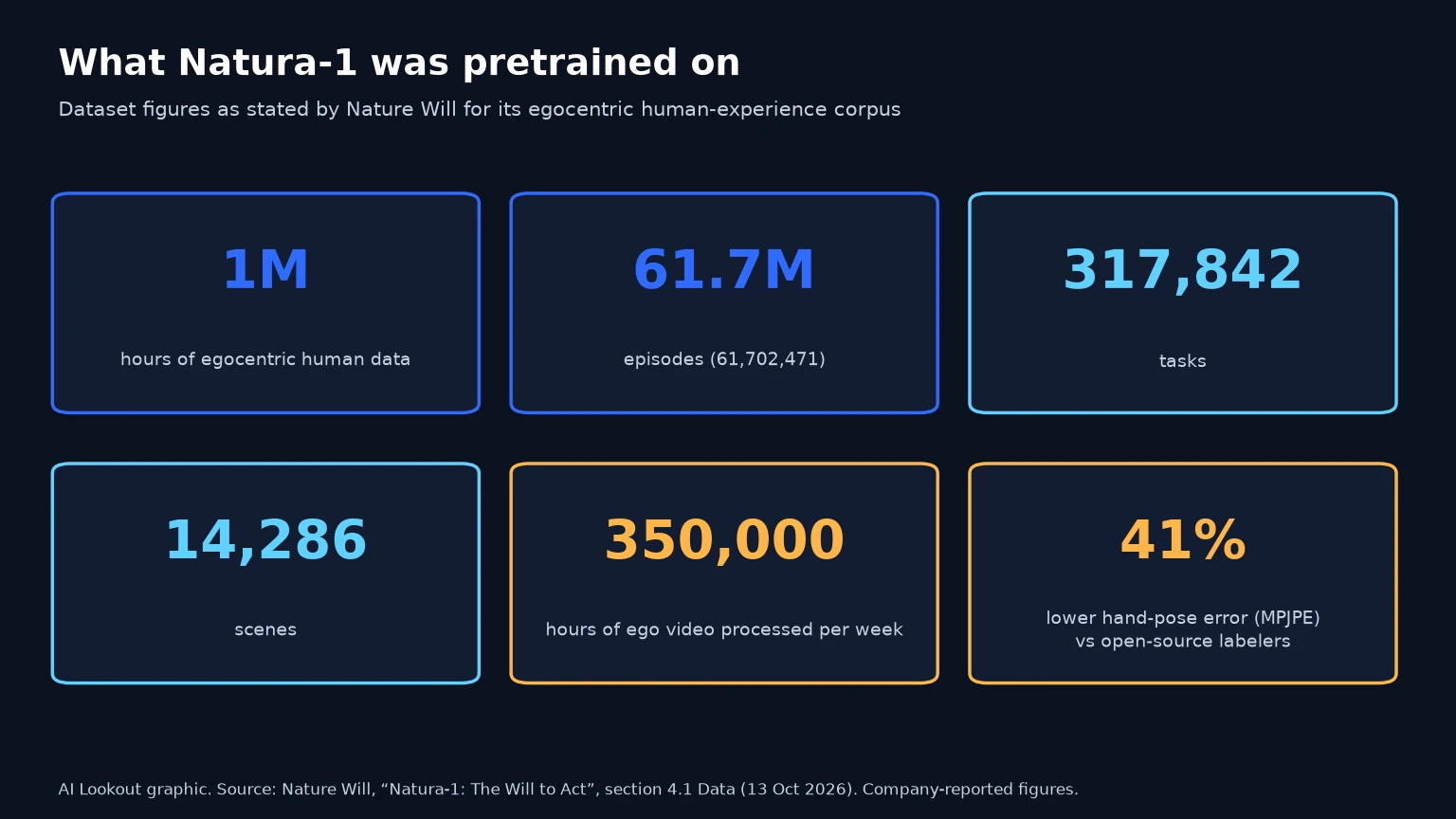
So the lab built a pipeline that turns first-person human footage into training trajectories. It says the corpus covers 61,702,471 episodes, 317,842 tasks and 14,286 scenes. Most of it comes from controlled collection through data vendors, organized against a task taxonomy, with internet egocentric video added for breadth. Recordings include monocular, stereo, multi-camera and wrist-mounted views.
Each clip is deduplicated, quality-checked and annotated from the overall goal down to individual steps. Dense 3D hand and body motion is reconstructed from the video; Nature Will claims its motion labels cut MPJPE, a standard hand-pose error measure, by 41% against open-source tools on an internal motion-capture benchmark. The system processes about 350,000 hours of egocentric video a week, according to the post.
How the model works
Natura-1 treats a whole episode as one autoregressive sequence of language, image, video and action tokens on a standard MoE backbone. The idea is that every training pass supervises every step of a trajectory instead of a sampled window, and that architecture stays out of the way of scaling.
The model learns to predict future video as well as actions, using flow matching and joint denoising with separate losses for each modality. Nature Will’s reasoning is that what the camera sees and what the hand does are two views of the same physical state, and video is far more plentiful than action labels. Pretraining is also shaped so that a different instruction produces a different predicted future, to stop the model from ignoring language when the scene alone predicts what happens next.
That puts Natura-1 in the same family of ideas as latent world-model work such as Meta FAIR’s RoboJEPA and long-context policies like NVIDIA’s Long-WAM, but with human hand video as the main fuel. On infrastructure, the company reports over 50% model FLOPs utilization on hundreds of GPUs, a Rust inference orchestrator and fused CUDA kernels to hold the 100 ms budget.
What the benchmark numbers say, and don’t
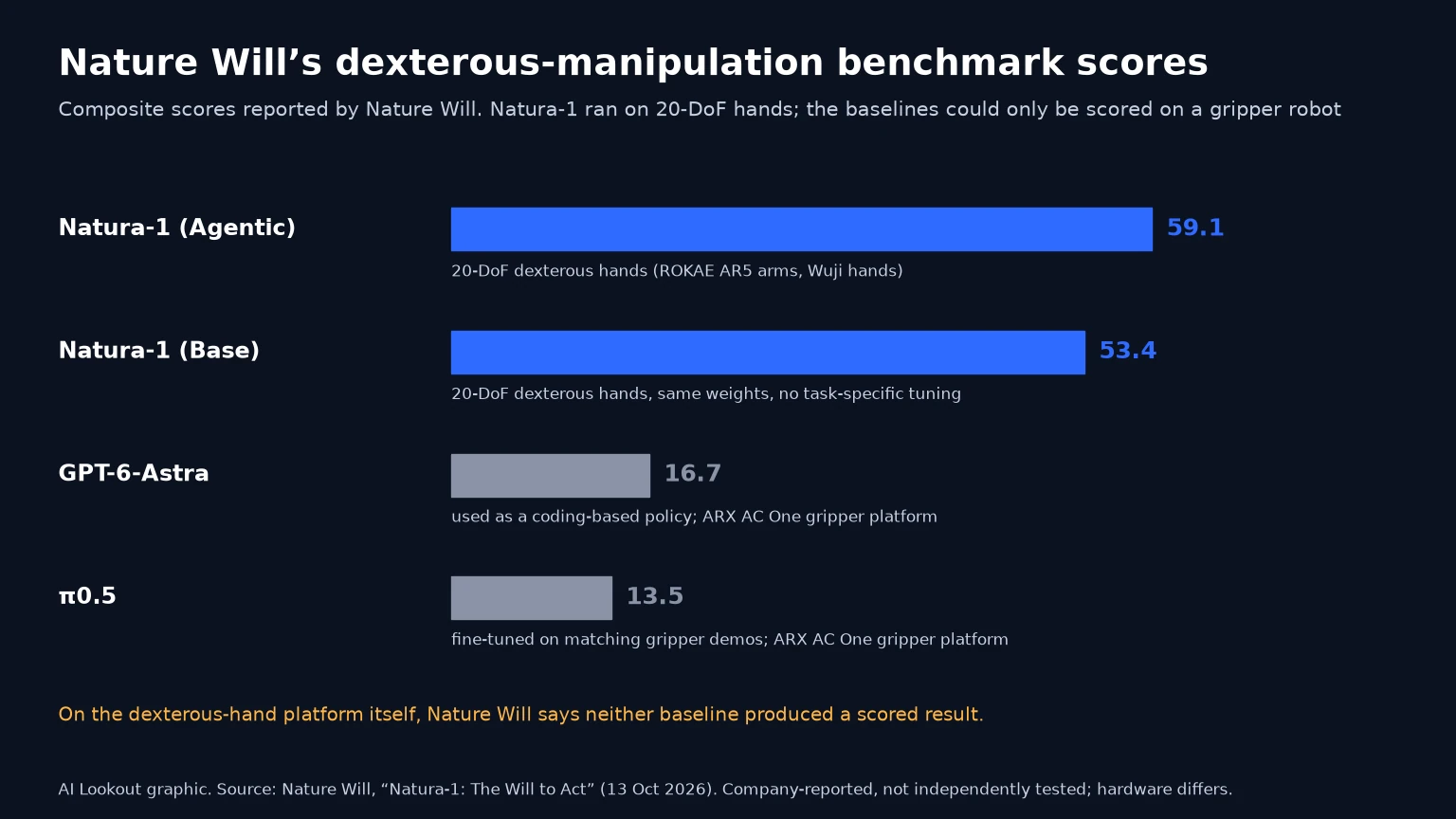
Nature Will built a benchmark that scores dexterous manipulation along twelve capability dimensions, with test tasks whose scenes, objects and action combinations do not appear in post-training data. Natura-1 scores 53.4 in its base form and 59.1 in an agentic configuration.
The baselines are where readers should slow down. The lab chose Physical Intelligence’s π0.5, a vision-language-action model, and GPT-6-Astra used as a code-writing policy. On the dexterous-hand platform—ROKAE AR5 arms with Wuji hands—neither baseline produced a scored result, the post says: π0.5 failed even after fine-tuning on the lab’s hand data, and GPT-6-Astra did not score within a 60-minute per-task limit.
The 13.5 (π0.5) and 16.7 (GPT-6-Astra) figures come from a different robot, the ARX AC One gripper platform, after fine-tuning π0.5 on matching gripper demonstrations. So the chart is not a like-for-like contest; it is Natura-1 on hands versus others on grippers, on a benchmark Nature Will designed. That is worth holding next to results like SpatialHarness lifting GPT-6 Astra on fine manipulation, which show how much setup choices move these numbers.
Long workflows and zero-shot instructions
Beyond the benchmark, the post shows six single-take workflows: making wontons, packing and taping a shipping box, serving tea, Chinese calligraphy, applying a phone screen protector and making a yogurt bowl. Several run for more than two minutes; the screen-protector clip lasts about three. Nature Will flags that these six use additional task-specific tuning on top of Natura-1, while other results share one set of weights.
A separate set of clips covers zero-shot instruction following recorded during researchers’ day-to-day use: choosing a bottle by ruling out six colors, putting items in a bin with a specified hand order or both hands at once, pushing a drawer shut with fingertips, and pressing a laptop spacebar even though keyboards never appeared in robot training data.
The lab also describes behaviors it says were not trained, such as sliding a playing card over a box edge to get fingers underneath, using a rod to pull a basket within reach, and rotating a wrist nearly 180 degrees to fix an upside-down grasp. These are curated videos, not statistics, and the company presents them as early signs rather than measured capabilities.
Can anyone use Natura-1?
Not yet. The research post announces the model and documents results, but it does not offer weights, an API, a developer program, pricing, a technical paper or a model card. There is no stated release date. For now Natura-1 is a research disclosure from a company, backed by video.
The hardware named in the post is a dual-arm setup with ROKAE AR5 arms and Wuji dexterous hands. Nature Will says nothing about locomotion or whole-body control; Forbes noted the model is for hands, not complete humanoids. That is a narrower target than the Robros humanoids South Korea just cleared for factory trials, which have to walk and work beside people.
Why it matters for physical AI
The bet behind Natura-1—pretrain on huge amounts of human video, then adapt with a little robot data—is one of the main competing recipes in robot learning. If it holds, robot companies would spend less on teleoperated demonstrations and more on collecting and labeling ordinary human activity, which is cheaper and far more varied.
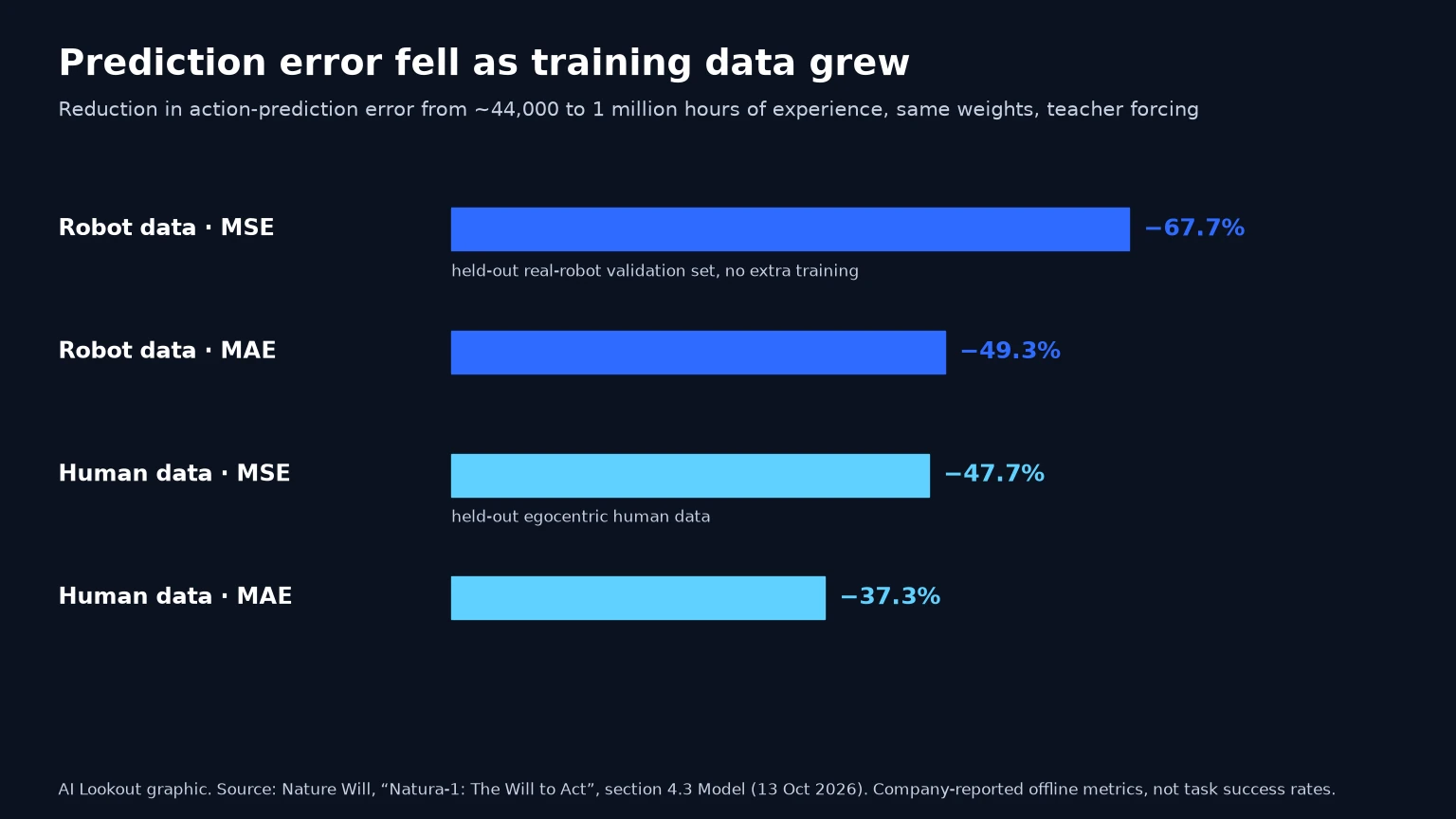
Nature Will also publishes a scaling result: from about 44,000 to one million hours of training experience, action-prediction error falls on both held-out human data and a held-out real-robot set, with robot MSE down 67.7% and MAE down 49.3% without extra training. That is the kind of curve investors and researchers want to see, though it measures offline prediction error under teacher forcing, not task success on a robot.
Forbes framed the launch as evidence that the middle layer of robotics—robot foundation models sitting between frontier AI models and specific robot deployments—is getting cheaper to enter, with value shifting toward post-training for particular jobs. For a sense of where research is heading on the same problems, see the Arc paper on action-grounded reasoning traces and the Reflex humanoid catching study.
What is still unproven?
Almost everything here is self-reported. The benchmark, its twelve dimensions and its scoring are Nature Will’s; the baselines ran on different hardware; and success rates per task, failure counts and the number of trials behind each demonstration are not given. Without a paper or released evaluation suite, outside researchers cannot reproduce the 53.4 or 59.1.
The data claims are large and unaudited. A million hours from vendors and internet video raises the usual questions about consent, licensing and who appears in the footage, and the post does not address them. The 41% motion-label improvement is measured on an internal benchmark.
Finally, the long-horizon showcase tasks used extra tuning, so they show how far a tuned skill can go rather than what the general model does out of the box. The honest reading is that Natura-1 is a credible, well-documented claim from a new lab, and the next useful evidence would be a paper, an open benchmark, or hands-on access for third parties.
Common questions
Is Natura-1 open source?
No. Nature Will’s post does not release weights, code, an API or a model card, and gives no release date.
Did Natura-1 beat π0.5 and GPT-6-Astra?
On Nature Will’s benchmark it scored 53.4–59.1 against 13.5 and 16.7, but the baselines were scored on a gripper robot because, the company says, they produced no scored result on its dexterous-hand platform. It is not a same-hardware comparison.
What robot hardware does it run on?
The post names a dual-arm platform with ROKAE AR5 arms and Wuji 20-degree-of-freedom dexterous hands, controlled in a 100-millisecond loop.
What to remember
Natura-1 is a large, carefully documented bet that human first-person video can teach robot hands general skills. The architecture and data story are detailed; the performance evidence is company-run, partly on mismatched hardware, and not yet open to outside testing.
Sources & further reading
How this story was made
Written by Kristian Kostov with AI assistance and checked against the linked sources. Company performance claims are attributed to the company. Analysis reflects AiLookout’s interpretation; we have not independently tested the products discussed. Cover photography is illustrative and does not depict the specific announcement or product.
Our editorial standards