
Announced 14 Oct 2026 · Sources checked
What NVIDIA released
NVIDIA has released Kumo Tabular, an open model that makes predictions from spreadsheet-style data without being trained on the task first. Announced in a Hugging Face blog post on 14 October 2026, it takes a table where some rows already have the answer, such as whether a customer churned or what a house sold for, and predicts the answer for the remaining rows in a single pass. There is no model fitting, no hyperparameter search and no feature engineering.
The weights are on Hugging Face in three sizes, about 28 million, 62 million and 215 million parameters, under the OpenMDW-1.1 licence, which allows commercial use. They run through a new open-source NVIDIA library called Structured Data Models, released under Apache-2.0 the same day. NVIDIA says Kumo Tabular ranks first on four public tabular benchmarks, and an independent comparison puts it in a statistical tie for the lead.
Kumo Tabular belongs to what NVIDIA calls its Kumo family of structured-data models, alongside Kumo Relational for multi-table databases. Those models have already started to show up in customer stories: Santander said on Monday that it uses NVIDIA Kumo inside the three-year AI deal it signed with NVIDIA, and Advantest has built Kumo-Anomaly into its chip-test analytics, as NVIDIA set out in its AI-defined fab announcement last week.
How Kumo Tabular reads a table
Tabular prediction has been dominated for two decades by gradient-boosted trees such as XGBoost, LightGBM and CatBoost. They work well, but each new question means collecting labels, building features, tuning and training a model that knows nothing about tables in general. Tabular foundation models borrow the in-context learning trick from large language models: the labelled rows act like the examples in a prompt, and the model answers for the new rows without changing its weights.
According to NVIDIA's description, Kumo Tabular is a transformer built around the shape of a table and works in three stages. First, groups of cells become tokens, with numbers and categories passed through learned Fourier features and missing values handled without a separate imputation step. Second, the model alternates column attention, which learns what a value means relative to the rest of its column, with row attention, which learns how features in one row interact. Four learned summary tokens then compress each row into a single embedding, so the final stage no longer depends on the number of columns.
Third, an in-context learning transformer lets each query row attend only to the labelled context rows, never to other queries. A prediction for one row therefore does not change depending on which other rows are scored with it, and the context can be encoded once and reused for later batches. Classification returns class probabilities; regression returns 999 quantiles, which gives a point estimate and an uncertainty range. NVIDIA also scales attention with the logarithm of the number of rows so that it stays sharp on tables far longer than those seen in training.
Trained only on made-up tables
Kumo Tabular never saw a real dataset during training. Every training table was generated from a random structural causal model: a randomly drawn graph of hidden variables connected by random functions, some of which become numeric or categorical columns and one of which becomes the target. NVIDIA says the generator deliberately adds real-world mess, including several patterns of missing values, coarsened features that make duplicate rows disagree, high-cardinality categories and heavy-tailed regression targets. A quick tree-ensemble check throws away tables with no learnable signal.
Training ran in three stages, starting with tables of 1,024 rows and up to 100 columns, then contexts of 400 to 10,240 rows, and finally up to 60,000 rows. In total the small, medium and large models saw about 35, 71 and 137 million synthetic tables. Classification and regression are separate models. NVIDIA's model card stresses that no private enterprise data or personal data was used, which matters for companies worried about what a model might have memorised. NVIDIA says the training recipe and data generators "will be released soon"; they were not public when AI Lookout checked on 19 October.
NVIDIA's benchmark claims
NVIDIA ran all three sizes with default settings against the full TabArena leaderboard, which includes tuned gradient-boosted trees, AutoGluon and recent tabular foundation models. It reports that Kumo Tabular ranks first overall with an Elo rating of 1950 while running 17 times faster than LimiX-2, a rival foundation model, on a single RTX 6000 Pro GPU.
On BeyondArena, which adds temporal and grouped splits, NVIDIA reports an Elo of 1418 and first place. On TALENT, a suite of 300 datasets, it reports the top overall ranking for classification accuracy, classification log-loss and regression error, with average ranks of 6.67, 3.98 and 4.22. On ScoringBench, which tests predicted distributions rather than single answers, the large and medium models rank first and second. These are NVIDIA's own runs. The model card lists the evaluation suites but marks the benchmark score field as undisclosed, so the blog post is the only place the numbers appear.
What an outside benchmark found
Research firm AIMultiple has run Kumo Tabular through its own tabular models benchmark, which compares 13 models on 19 public datasets using two NVIDIA B200 GPUs and each model's default settings. Its result is less clear-cut than NVIDIA's. LimiX-2 from StableAI had the best mean rank, 2.16, and won 11 of the 19 datasets outright. Kumo Tabular came second with a mean rank of 2.63 and finished in the top three on 16 of the 19 datasets.
The significance test AIMultiple used, a Friedman test followed by a Nemenyi critical difference, could not separate the top five: LimiX-2, Kumo Tabular, Prior Labs' TabPFN-3.5, TabFM and Causilo. All five beat every classical model, including LightGBM, CatBoost and XGBoost, by a statistically significant margin, and no gradient-boosted tree won a single dataset.
Speed is where Kumo Tabular stood out. AIMultiple measured an average of 7.6 seconds per cross-validation fold, against 111.9 seconds for LimiX-2, or about 15 times faster, close to NVIDIA's own 17-times figure. LimiX-2 also used about 124 GB of GPU memory on the largest datasets. AIMultiple puts the cost of Kumo Tabular's full benchmark run at $1.19, and notes that of the five leading models only Kumo Tabular's licence allows commercial use of the model and its outputs without a separate agreement.
How to use it
Kumo Tabular is installed through the Structured Data Models package with pip, and needs Python 3.11 and PyTorch 2.7 or later. The library downloads the weights from Hugging Face on first use. According to its release notes, version 0.1.0 shipped on 14 October with wrappers for TabICLv2, TabFM and Kumo Relational, and version 0.2.0 added Kumo Tabular less than half an hour later. The repository also lists time-series models, including Google's TimesFM-3, the same territory as compact forecasting releases such as Mistral's Timestral.
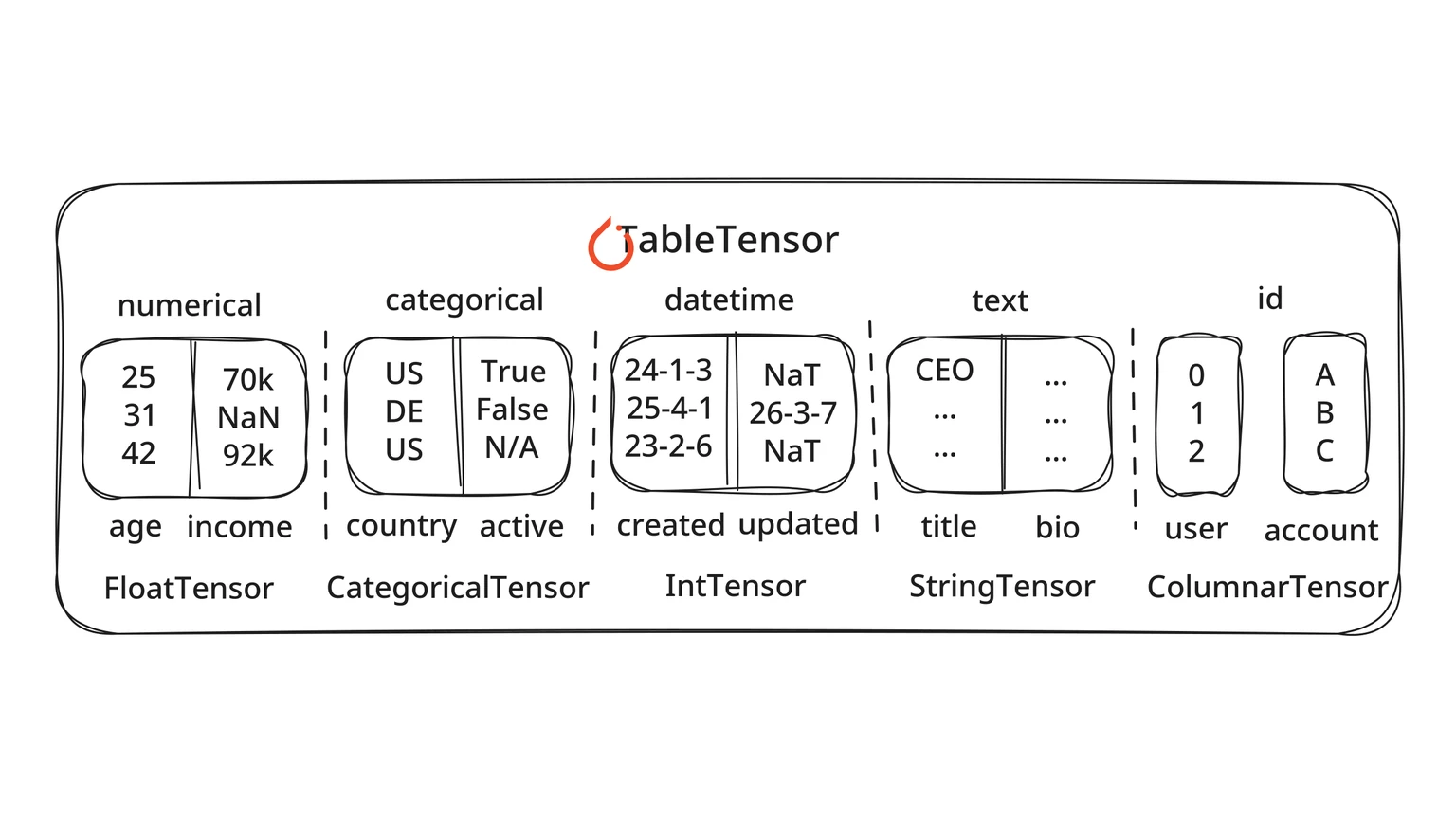
A user converts a pandas DataFrame into a typed TableTensor, passes the rows with known labels as context and the unlabelled rows as queries, and gets probabilities or quantiles back. The library also handles the preprocessing, ensembling and many-class tricks NVIDIA used in its evaluations. NVIDIA recommends installing its cuDF dataframe library so that data stays on the GPU. The model card lists support for Ampere, Hopper and Blackwell GPUs on Linux, and a hosted NVIDIA NIM version exposes prediction and session endpoints.
The model card gives a Hugging Face release date of 23 September, about three weeks before the public announcement, library release and benchmark results on 14 October. It is the second open NVIDIA model this month under OpenMDW-1.1 after the looped Dory1.0-4B language model.
Where it falls short
NVIDIA lists several limits. Kumo Tabular reads only numerical and categorical columns; text, images and timestamps have to be turned into features with the library's preprocessing recipes. A single forward pass handles up to 10 classes, and the library uses error-correcting output codes to go beyond that. Accuracy may fall on tables far outside the training ranges, which topped out at 60,000 rows and 100 columns, or when the rows to be predicted come from a different distribution than the labelled ones. NVIDIA advises checking accuracy and calibration on held-out data before deployment.
AIMultiple's results add practical caveats. LimiX-2 beat Kumo Tabular clearly on some datasets, for example 0.879 against 0.844 ROC-AUC on a diabetes task, and plain logistic regression remained hard to beat on one dataset with a very high-cardinality categorical column. Zero training also does not mean zero compute: the whole labelled table is processed at inference time, so cost scales with how many predictions a workload needs.
Why tabular foundation models matter
Most business machine learning still runs on tables of customers, transactions, claims and sensor readings. A model that can answer a new prediction question in minutes, without a training pipeline, changes who can build those systems and how quickly. Among the leaders in AIMultiple's test, the other models either need a separate agreement for commercial use or cost far more to run; Kumo Tabular pairs leaderboard-level accuracy with small models, fast inference and a permissive licence.
The open questions are how it performs on messy production data rather than curated benchmarks, and whether independent leaderboards keep it near the top as rivals update. NVIDIA's promised release of its training recipe and synthetic data generators would let others check how much of the result comes from the architecture and how much from the data. AI Lookout will update this article when those are published.
Common questions
What is NVIDIA Kumo Tabular?
An open tabular foundation model released on 14 October 2026. Given a table with some labelled rows, it predicts class probabilities or numeric values for the unlabelled rows in one forward pass, without training a model for the task.
Can Kumo Tabular be used commercially?
Yes. The weights are released under the OpenMDW-1.1 licence, which permits commercial use, and the Structured Data Models library that runs them is Apache-2.0. The hosted NIM container has separate NVIDIA terms.
Does Kumo Tabular beat XGBoost?
In NVIDIA's runs and in AIMultiple's 19-dataset benchmark it outperformed tuned or default gradient-boosted trees on average. Results vary by dataset, and NVIDIA advises validating on your own held-out data.
Sources & further reading
How this story was made
Written by Kristian Kostov with AI assistance and checked against the linked sources. Company performance claims are attributed to the company. Analysis reflects AiLookout’s interpretation; we have not independently tested the products discussed. The cover places the companies’ own logos, taken from public-domain or openly licensed files credited in the caption, on a plain background. It is not a product photograph, a screenshot, or an endorsement.
Our editorial standards