Announced 15 Oct 2026 · Sources checked
What Mistral released
Mistral announced Timestral in a research post on 15 October 2026, calling it “our first family of time-series foundation models.” It is a departure for a company known for language models such as Mistral Large 4 and its Voxtral speech models: Timestral does not read or write text at all. It takes columns of numbers recorded over time and predicts what comes next.
There are four checkpoints, with 5 million, 28 million, 123 million and 209 million parameters, each in its own Hugging Face repository; the largest is Timestral-209M. Mistral also published a GitHub repository with standalone inference code that needs only PyTorch, NumPy, safetensors and huggingface_hub. A technical report “will follow,” the company says.
The models' main features are listed plainly in Mistral's spec box: probabilistic forecasts as 21 quantiles, multivariate targets, past-only and known-future covariates, a context of 32,768 time steps, and deployment on premises, in a private cloud or air-gapped.
Why forecasting needs its own foundation models
Time series are everywhere in business: machine telemetry, server metrics, energy load, sales, cash flows. Mistral's post notes that classical tools such as ARIMA are usually fitted to one series and learn only from its history, while deep-learning models such as PatchTST learn across related series but are still trained from scratch for each dataset, so what they learn does not transfer.
Foundation models borrow the language-model recipe: pre-train once on a huge, varied corpus, then forecast new series zero-shot, without retraining. That matters most where data is scarce, such as a new product line or a newly installed sensor. Google's TimesFM, Amazon's Chronos and Datadog's Toto are established examples, and Timestral is Mistral's entry into the same race.
It joins a busy week for open forecasting models on the science side too, with Microsoft open-sourcing PBC to correct two-to-six-week weather forecasts and Ai2's HiRO-ACEv2 emulating storms at 3 km. Timestral is general-purpose rather than built for weather, and aimed at enterprise data.
Four sizes, and a CPU is enough
All four sizes share one architecture and training recipe; bigger is more accurate and smaller is faster. Mistral says every size sits on the Pareto front of accuracy against model size, meaning no public model of the same size forecasts better on its benchmarks. It claims its 28M model beats Chronos-2, about four times larger, on GIFT-Eval and TIME, and that the 209M model beats TimesFM-3 and Falcon-2.0 with fewer parameters.
The practical headline is that no GPU is needed. On a standard server CPU with eight threads, forecasting one day ahead from three weeks of 15-minute readings takes 10 milliseconds with the 5M model and 140 milliseconds with the 209M model, according to Mistral. The 28M model is five times faster than the 209M, and the 123M model comes within 0.2% of the 209M's score at three-quarters of its latency.
That makes it plausible to run forecasts beside existing monitoring software on ordinary servers, or to forecast thousands of sensor streams without renting accelerators. The 209M model's weights are 837 MB in fp32 and the 5M model's just 21 MB, according to the repository.
The benchmark claims
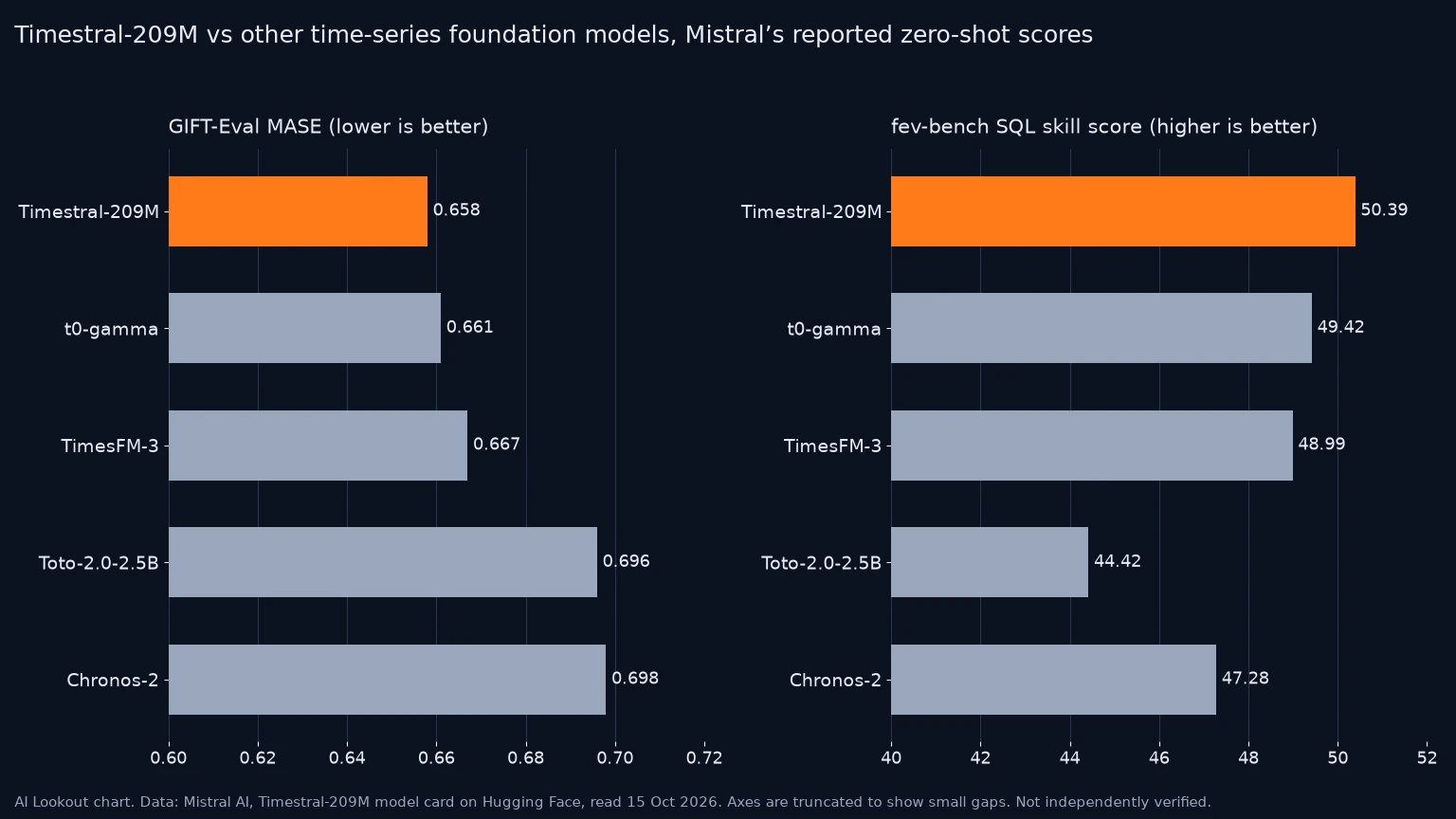
Mistral evaluated Timestral on the three main public forecasting benchmarks, GIFT-Eval, TIME and fev-bench, using a single checkpoint without ensembling. On its model card, Timestral-209M scores 0.658 MASE on GIFT-Eval, where lower is better, against 0.661 for t0-gamma, 0.667 for TimesFM-3, 0.696 for Toto-2.0-2.5B and 0.698 for Chronos-2. On fev-bench its SQL skill score is 50.39, against 49.42 for t0-gamma and 48.99 for TimesFM-3.
The pattern holds on TIME, where Timestral's MASE of 0.626 edges t0-gamma's 0.637. These are real but narrow leads: a few thousandths of a point separate the top three on GIFT-Eval. Mistral says the results have been submitted to the GIFT-Eval and TIME leaderboards, so for now they are its own runs rather than verified listings.
Benchmarks also average over many datasets. Mistral itself warns that “production data can be significantly different in behavior and structure” and drifts over time, which is why it pitches fine-tuning as the lasting value rather than leaderboard rank.
How Timestral works under the hood
The 209M model is a patch-based transformer with 24 layers, an embedding size of 768, and separate attention across time and across variates. It reads data in patches of 32 steps, up to 1,024 patches of history, and forecasts up to 1,024 steps in one pass; longer horizons are forecast block by block, feeding each block's median back in as context.
Mistral highlights four ideas. Decoupled Horizon Forecasting keeps the full history in the sequence and uses learned forecast tokens to read it, so values to be predicted are not masked out and lost as context. Covariate-aware attention gives each input a role, target, past-only covariate or known-future covariate, so a holiday calendar or weather forecast can inform a target without leaking that target's own future.
Most training data was synthetic: univariate processes with trends, seasonality and varied noise, combined into multivariate series with nonlinear dependencies. Training ran in two stages, pre-training on purely synthetic data with an 8,192-step context, then post-training on real and synthetic data with a context four times longer, using a pinball loss over 21 quantiles.
Mistral also sketches how Timestral fits with its language models: Timestral watches a plant's sensor streams and flags an anomaly, and an agent then searches past failures, runs root-cause analysis over maintenance logs and manuals, and drafts a diagnosis for the plant manager.
The licence: open weights with a $20 million revenue cap
The licensing has two layers. The GitHub code is Apache-2.0. The weights use a Modified MIT licence that reads like MIT, with one major addition: no rights apply if “the global consolidated monthly revenue of your company (or that of your employer) exceeds $20 million” in the preceding month. Larger organisations must ask Mistral for a commercial licence or use its hosted services.
That cap covers derivatives and fine-tunes too. It means Timestral is open in the sense of downloadable weights, not in the sense of the OSI definition, a difference explained in our guide to open weights versus open source. For startups, researchers and smaller manufacturers it is effectively free; the enterprises with the largest sensor fleets are the ones Mistral steers toward paid licences.
Those customers are offered Mistral Forge, the training pipeline the company uses for its language models. Mistral says it supports zero-shot use, architectural extensions such as domain covariates, fine-tuning on proprietary data, control over training data mixes, and deployment on clients' own hardware, including air-gapped sites.
How to try it, and what to watch
Trying it takes a pip install from GitHub on Python 3.10 or later with PyTorch 2.4 or later. TimestralForecaster.from_pretrained downloads a checkpoint, and a forecast call on a NumPy array returns quantiles, a median and helpers for any quantile level. Missing values are passed as NaN, and categorical covariates are passed as numeric codes.
The release is hours old. Each Hugging Face repository showed 11 or fewer downloads and the GitHub repository about 29 stars when AI Lookout checked, so there is no independent experience yet. The promised technical report and the leaderboard listings are the next checkpoints, along with tests on messy real-world data, which public benchmarks only approximate.
Teams already using TimesFM or Chronos should benchmark Timestral on their own history before switching, and check the revenue clause with legal counsel before any production use. For smaller companies, a forecaster that runs on a CPU in milliseconds is worth an afternoon's test.
Common questions
Does Timestral need a GPU?
No. Mistral says all four models run on CPU; on an 8-thread server CPU a one-day forecast from three weeks of 15-minute data takes 10 ms with the 5M model and 140 ms with the 209M model. A GPU can be used if available.
Can my company use Timestral commercially for free?
Only if your company's, or your employer's, consolidated revenue is $20 million a month or less. Above that the Modified MIT licence grants no rights, and Mistral offers commercial licences or hosted use. The inference code itself is Apache-2.0.
How is Timestral different from Mistral's chat models?
It is a numerical forecasting model, not a language model. It takes time-series data and returns probabilistic forecasts; Mistral suggests pairing it with its language models in agent workflows.
Sources & further reading
How this story was made
Written by Kristian Kostov with AI assistance and checked against the linked sources. Company performance claims are attributed to the company. Analysis reflects AiLookout’s interpretation; we have not independently tested the products discussed. The cover places the companies’ own logos, taken from public-domain or openly licensed files credited in the caption, on a plain background. It is not a product photograph, a screenshot, or an endorsement.
Our editorial standards