Announced 14 Oct 2026 · Sources checked
What did Microsoft Research publish?
Microsoft Research and collaborators published “Advancing subseasonal forecasting with machine learning” in Nature on 14 October 2026. The 13 authors, with Hannah Guan listed first and Lester Mackey of Microsoft Research New England listed last, come from Microsoft, MIT, ECMWF and other institutions. The paper is open access, and an earlier version has been on arXiv since April 2026.
Alongside the paper, Microsoft published a research story and released the method as open-source software in the mouatadid/pbc repository on GitHub under the MIT license. The Verge, which reported the release, noted that Microsoft joins Google, NVIDIA and others in AI weather work, but with a different approach: it does not build a new forecast model at all.
Why two-to-six-week forecasts are so hard
Forecasts today are reliable out to roughly two weeks, and seasonal climate outlooks are improving, but there is a stubborn gap in between. The paper says skill drops precipitously at subseasonal timescales, two to six weeks ahead, because of compounding errors, systematic model biases and the chaotic nature of the atmosphere. Operational ensembles and even state-of-the-art probabilistic AI models routinely do worse than simply forecasting the climatological average at those lead times, especially outside the tropics.
That window is exactly when many decisions are made: when to plant, how to allocate water and energy, and how to prepare for floods or heat. The authors point to Kenya’s 2018 floods, which long-lead seasonal forecasts missed but subseasonal rainfall forecasts flagged early enough to prepare. Lester Mackey told The Verge that both physics-based and AI models lean on approximations that turn into systematic bias, and that those errors compound the further ahead they forecast.
How Probabilistic Bias Correction works
The core idea is that part of a model’s error is predictable. PBC takes the raw ensemble of deterministic forecasts from any dynamical, AI or hybrid model, converts it into an initial probability forecast over climatological quantile bins, and then applies two cheap machine-learning models. One, called Debias, shifts the forecast using location-, date- and quantile-specific corrections learned over adaptively chosen training periods. The other, Persistence, draws on lagged observations of recent weather. The output is a corrected probability for each bin.
Mackey summarized it in Microsoft’s story: “Our new pipeline (PBC) takes your favorite model as input and learns in what ways it tends to make errors. It then corrects those errors, yielding a better output forecast for the sub-seasonal range.” An example he gave The Verge is climate change itself: a model calibrated on historical records can be biased toward temperatures colder than today’s.
In the paper the team follows the conventions of ECMWF’s AI Weather Quest: weekly average 2-meter temperature and total precipitation over land, plus mean sea-level pressure, on a global 1.5-degree grid with five quintile bins, scored for week 3 (days 19 to 25) and week 4 (days 26 to 32) using the ranked probability skill score against ERA5 reanalysis. Because it is so light, PBC is retrained every day using only data that would have been available on each forecast date.
The results: ECMWF, AI models and a live competition
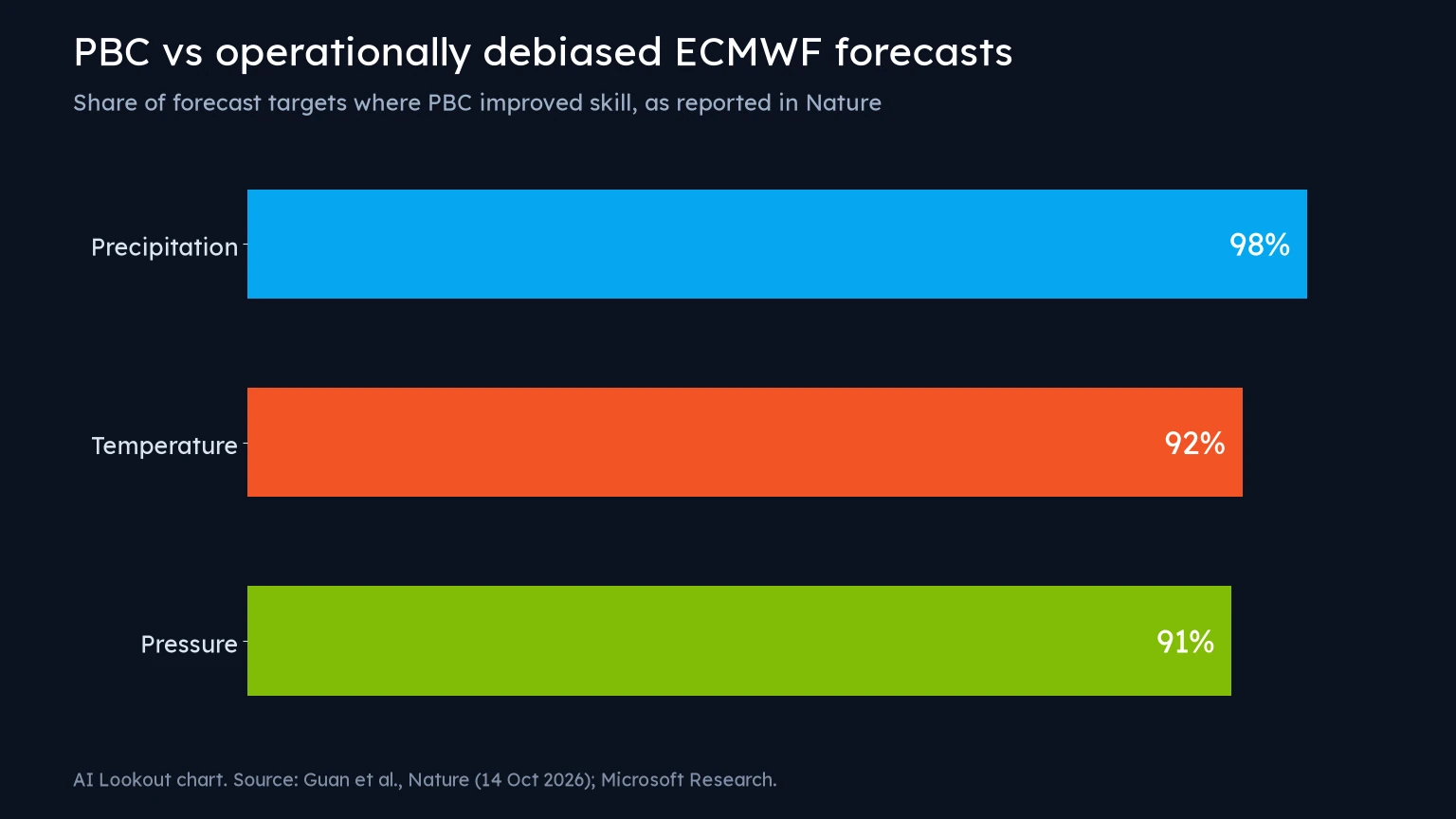
Against ECMWF’s raw dynamical ensemble over 2016 to 2024, PBC tripled the positive precipitation skill and turned negative-skill temperature and pressure forecasts into ones that beat climatology. Against ECMWF’s own operational debiasing, which forecasting centres already apply, it improved skill for 91% of pressure, 92% of temperature and 98% of precipitation targets, lifting temperature skill by 26 to 37 percent and pressure by 16 to 32 percent from low baselines.
Applied to ECMWF’s AI Forecasting System in 2025, PBC doubled its mean skill across all variables and lead times. On the hybrid POET model, which already post-processes ECMWF with transformers, it still added 68 to 98 percent for precipitation, 15 to 23 percent for pressure and 5 to 7 percent for temperature in 2024. These are relative gains on small absolute skill scores, a point worth keeping in mind when reading the headline numbers.
The live test came in ECMWF’s first AI Weather Quest. The team’s entry, MicroDuet, an ensemble of PBC-ECMWF and PBC-POET, placed first for every variable and lead time in the September to November 2025 season. It beat the debiased forecasts of six operational centres (ECMWF, NOAA, ECCC, HMCR, KMA and JMA), their multimodel ensemble, three ECMWF AI models and the systems of 34 teams. It also led the December to February season and was the top model across the full year, according to the paper.
Extreme weather and the Kenya pilot
When trained to target extremes, defined as events above the 95th or below the 5th percentile, PBC improved week-3 extreme forecast skill over operational debiasing in 96% of grid cells for precipitation, 89% for pressure and 85% for temperature. For floods catalogued by GDACS from 2016 to 2026, the paper reports that operational debiasing often reduced raw ECMWF flood-forecast skill while PBC improved it. Microsoft says MicroDuet anticipated two severe US winter storms in early 2026 between 19 and 26 days ahead.
The first real deployment is in East Africa. Genevieve Flaspohler, a co-author who worked on PBC as a Microsoft intern and now runs the nonprofit Rhiza Research, is helping the Kenya Meteorological Service Authority test it during the current rainy season. Phillip Okello, a principal meteorologist at the authority, said in Microsoft’s story that “PBC corrects the probabilities themselves, and across the Greater Horn of Africa it improved our forecasts more than any other method we tested,” while adding that heavy-rain and dry-spell forecasts still need sharpening.
Open source, cheap to run, and a Microsoft Weather product
The practical appeal is cost. Mackey told The Verge the tool can run on CPUs, unlike supercomputer physics models or GPU-hungry generative AI. The repository README describes installation finishing in under three minutes and a demo running in 13 seconds on an eight-core Linux machine with 80 GB of RAM. That makes it a different proposition from training a model such as Ai2’s HiRO-ACEv2 storm emulator, and closer to a layer agencies can bolt onto forecasts they already receive.
Microsoft is also turning the research into a product. Its story says Microsoft Weather, the team behind forecasts in Windows, Bing, Copilot, Edge and MSN, now runs a sub-seasonal-to-seasonal model that gives weekly probabilistic guidance up to six weeks ahead. It is operational in real time and in private preview for select customers. The open-source PBC repository includes examples for generating the paper’s PBC-ECMWF forecasts for the 2016 to 2024 test period.
It fits a broader push to make AI weather and Earth tools usable by agencies, alongside efforts such as Google’s Earth AI geospatial agents.
What PBC does not do
The authors are explicit that PBC is a post-processing tool, not a replacement for better models. It targets predictable errors rather than relearning atmospheric dynamics, so it can only be as good as the signal in its input. Absolute subseasonal skill remains modest: many of the baseline scores the gains are measured against sit between 0.03 and 0.19 on a scale where zero equals climatology.
Operational use is a further step. ECMWF’s Matthew Chantry told The Verge the paper is a good example of new ideas for the community, but that turning ideas into an operational process is the most challenging step. The Kenya pilot is early in its season, and Microsoft describes initial reports as promising rather than proven. We have not run the code ourselves.
Common questions
What is Probabilistic Bias Correction?
A lightweight machine-learning framework from Microsoft Research and collaborators that learns from a weather model’s historical forecasts and observations to correct its systematic errors, producing better probability forecasts two to six weeks ahead.
Is PBC open source?
Yes. The code is on GitHub at mouatadid/pbc under the MIT license, with examples for generating the paper’s PBC-ECMWF forecasts.
How well did PBC do in ECMWF’s AI Weather Quest?
Its MicroDuet entry placed first for every variable and lead time in the September to November 2025 season, beating six operational forecasting centres and 34 teams, and was the top model across the full year, according to the Nature paper.
Sources & further reading
How this story was made
Written by Kristian Kostov with AI assistance and checked against the linked sources. Company performance claims are attributed to the company. Analysis reflects AiLookout’s interpretation; we have not independently tested the products discussed. The cover places the companies’ own logos, taken from public-domain or openly licensed files credited in the caption, on a plain background. It is not a product photograph, a screenshot, or an endorsement.
Our editorial standards