Announced 14 Oct 2026 · Sources checked
What did Ai2 release?
Ai2, the Allen Institute for AI, introduced HiRO-ACEv2 in a Hugging Face blog post dated 14 October 2026. It is the second version of HiRO-ACE, a system that produces kilometre-scale weather detail from a much coarser AI climate simulation. The accompanying paper, 'Extreme events and statistics in an AI emulator of a global storm-resolving model', was submitted to arXiv on 13 October by Anna Kwa and nine co-authors and is licensed CC BY 4.0.
The allenai/HiRO-ACEv2 model repository ships both checkpoints, the ACE2S-X-SHiELD coarse emulator and the HiROv2 downscaler, plus forcing data, initial conditions and inference configs under Apache-2.0. Ai2 also published tutorial notebooks and a web demo that shows pre-generated output beside the reference simulation.
The target it imitates is X-SHiELD, a global storm-resolving model run by NOAA's Geophysical Fluid Dynamics Laboratory (GFDL) at about 3 km resolution. Models like that explicitly simulate thunderstorms and other small-scale weather, which makes them valuable for studying extremes and very expensive to run for many years or many ensemble members.
How does HiRO-ACEv2 work?
HiRO-ACEv2 has two stages. ACE, the Ai2 Climate Emulator, steps the atmosphere forward autoregressively at roughly 100 km resolution. The new ACE2S-X-SHiELD checkpoint is stochastic, so repeated runs give different but plausible weather, and the model card says it exactly conserves global dry air mass and moisture. Ai2 reports that a year of coarse simulation takes under five minutes.
HiRO, short for High Resolution Output, then sharpens selected regions to 3 km. It is a diffusion model: a deterministic base prediction is refined with generated high-resolution residuals, producing an ensemble of fine-scale fields for each coarse snapshot. Predictions are made on 16 by 16 degree patches, and larger areas are stitched together from several patches.
The headline change in version 2 is scope. HiROv1 produced only rainfall. HiROv2 generates six-hourly mean surface precipitation together with instantaneous 10 m eastward and northward winds and sea-level pressure, so it can represent storms, wind events and pressure systems rather than rain alone. The paper credits several training changes, including log-uniform noise sampling, separate denoisers for high and low noise levels at inference, and oversampling tropical latitudes, with better reproduction of the most intense values.
How well does it capture hurricanes and extremes?
Ai2's main goal was extremes. When HiROv2 is fed coarsened X-SHiELD data, which the paper calls perfect prediction, the blog says it matches the target's high-resolution statistics to within 3%, even for events that occur once in a million data points. The paper's abstract says precipitation and near-surface wind distributions match out to the 99.9999th percentile.
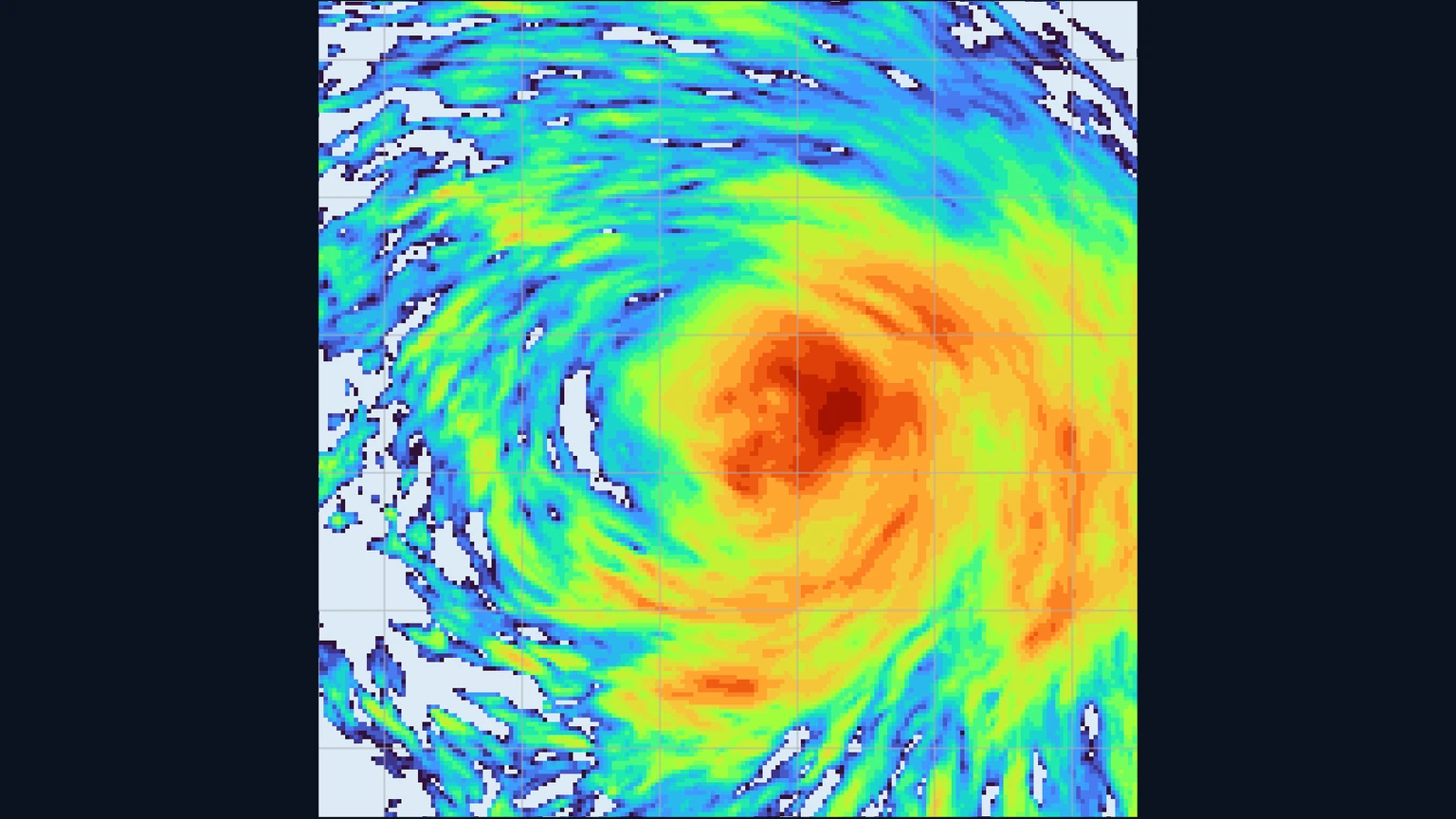
For tropical cyclones, Ai2 says HiROv2 accurately estimates total storm energy, including for storms it never saw during training, and generates hurricanes with realistic eyes and rain bands. It is candid about a flaw: winds and pressure around the eye are more lopsided than in X-SHiELD.
The bigger test is the free-running system, where HiRO downscales weather that ACE invented rather than real X-SHiELD fields. Over a ten-year run, Ai2 reports that hurricane energy is comparable to X-SHiELD's. The paper's own counts show the coarse emulator is not a perfect copy: over ten years it produced fewer weak cyclones than the reference (281 against 365) and slightly more strong ones (409 against 388). The cover image above comes from that ten-year run.
How does it handle wind over mountains?
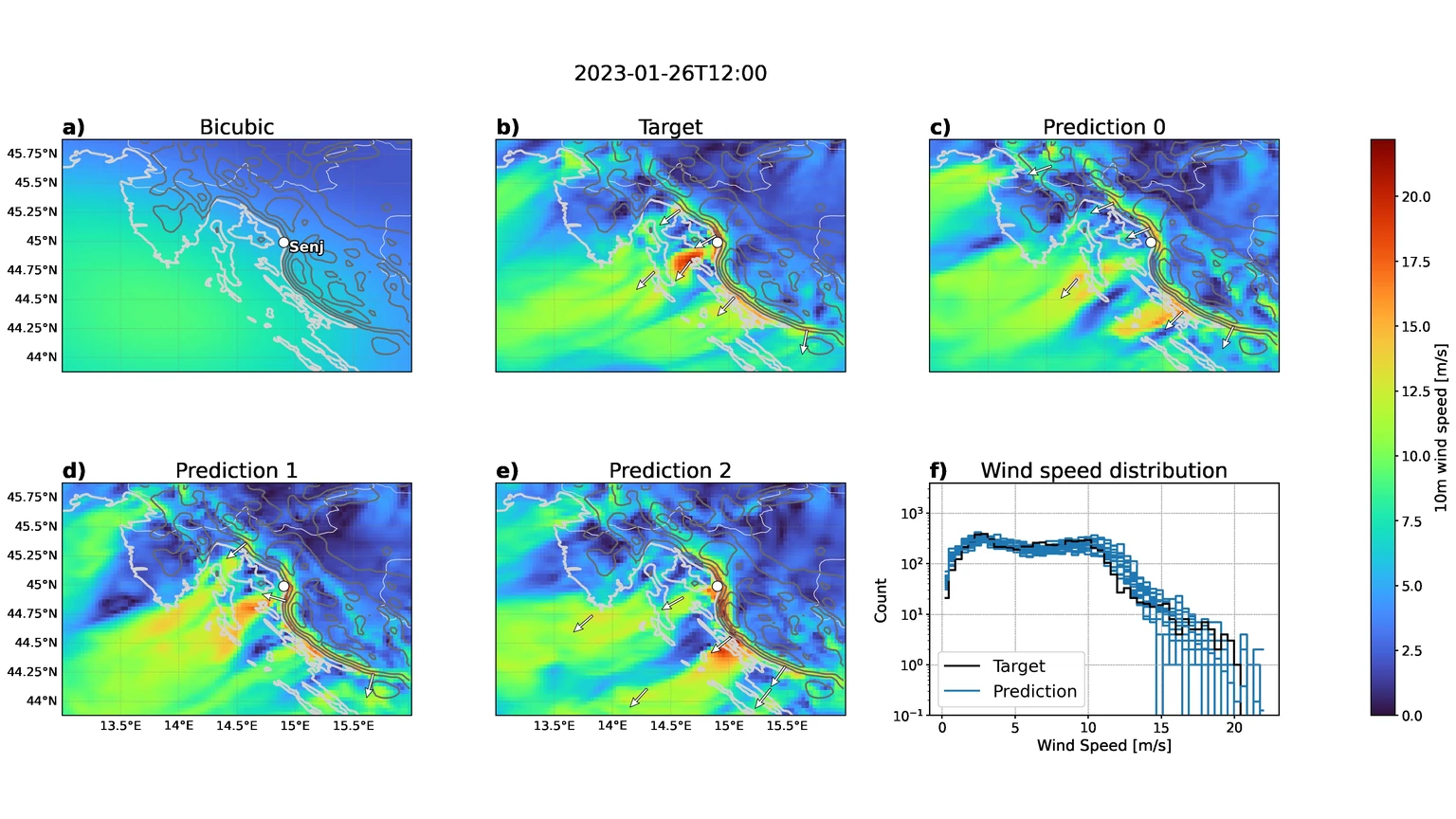
Hurricanes are not the only extreme that needs fine resolution. The paper's case study is a Bora event over Croatia, when cold katabatic winds pour down the coastal mountains into the Adriatic. At 100 km those winds are a smear; at 3 km the terrain-driven jets appear.
Ai2 says the locations of peak winds vary across HiRO's generated samples, as expected for an ensemble, but that the distribution of wind speeds over the region agrees well with the reference. The paper also compares ten-year wind roses for Senj, a coastal town known for Bora winds, and reports that free-running HiRO-ACEv2 gives a similar local wind climate to X-SHiELD.
That kind of local, multi-year statistic is what planners for wind energy, coastal infrastructure or flood risk often want, and it is exactly what a storm-resolving model is too expensive to produce in quantity.
How cheap is it, and how do you run it?
Cost is the selling point. Ai2 says producing global 3 km data with HiRO-ACEv2 costs roughly 300 times less than running X-SHiELD, and that the savings can be more than a hundred times greater again when only one region is needed. The paper puts numbers on it: downscaling a year of global data takes about 2.75 days on a single NVIDIA B200, roughly 0.3% of the energy needed to produce the same year with X-SHiELD. On eight B200s, wall-clock time is about 33 times faster than X-SHiELD on 27,648 AMD EPYC 9654 cores.
For a single 16 by 16 degree patch, a year of downscaled data takes about 12 minutes on a B200, 15 on an H100 and 30 on an L40S, according to the paper. Ai2 says it is exploring distillation that could make HiROv2 more than ten times faster again.
To run it, the model card's quickstart is to download the repository, install the fme package with pip, point the ACE and HiRO config files at the checkpoints and data, and run the provided script. Code lives in the ai2cm/ace repository. It is part of a run of Ai2 open releases that includes its GPU time-budget scheduler and byte-level Bolmo models.
Why emulators like this matter
Climate risk work increasingly needs large ensembles of high-resolution extremes, not a single expensive run. AI emulators trade some fidelity for orders of magnitude in cost, which lets researchers generate many plausible decades of storms. Funders are leaning in: Google.org recently backed 17 AI-for-science groups, including storm work, and ESA has released its own open Earth-observation model.
HiRO-ACEv2's contribution is to make the extreme tails, which matter most for damage, a first-class training target, and to release the whole pipeline openly. Its paper also discloses that AI coding assistants, including Claude models and Cursor Composer, helped write code and analysis scripts.
Limits Ai2 spells out
Ai2 is clear that HiRO only works with the version of ACE tuned to match X-SHiELD. It cannot yet generate high-resolution data for other climates, such as a warmer future or the historical record in reanalysis datasets like ERA5. The model card adds that the coarse emulator was trained on nine years of X-SHiELD output (2014 to 2022), is not suited to weather forecasting, and may not give fully independent samples in runs much longer than that.
HiROv2 was not trained or tested outside 66 degrees south to 70 degrees north and cannot run beyond 88 degrees, and very large regions can show seams where patches meet. It also reproduces X-SHiELD, not observations, so any bias in the reference simulation carries through. Next, Ai2 plans to train on new X-SHiELD runs, including one for a world 4 degrees Celsius warmer, and to add near-surface temperature, snow and ice.
We have not run HiRO-ACEv2. Performance and cost figures come from Ai2's blog post, model card and arXiv paper, read on 15 October 2026, and are the authors' own results.
Common questions
Is HiRO-ACEv2 a weather forecast model?
No. Ai2's model card says the coarse emulator is not suitable for weather forecasting; it generates plausible climate statistics like those of the X-SHiELD simulation.
What hardware does it need?
Ai2 reports a year of global 3 km downscaling in about 2.75 days on one NVIDIA B200, and a single 16 by 16 degree region in 12 to 30 minutes per year on a B200, H100 or L40S.
Can I use it commercially?
The weights are released under Apache-2.0 and the paper under CC BY 4.0. Ai2 says the model is intended for research and educational use in line with its Responsible Use Guidelines.
Sources & further reading
How this story was made
Written by Kristian Kostov with AI assistance and checked against the linked sources. Company performance claims are attributed to the company. Analysis reflects AiLookout’s interpretation; we have not independently tested the products discussed. The cover is a cropped example output published by the developer in its openly licensed repository, credited in the caption. It is not an AiLookout test or screenshot.
Our editorial standards