Announced 14 Oct 2026 · Sources checked
What did NVIDIA announce for chipmakers?
NVIDIA published “NVIDIA and Semiconductor Leaders Advance AI Across Chip Design and Manufacturing for AI-Defined Fabs” on 14 October 2026 and pointed readers to its presence at SEMICON West. The release does two things. It introduces a new library, cuPotential, and it rounds up how chip-equipment makers, design-software vendors and test companies say they are using NVIDIA’s CUDA-X libraries, Nemotron open models, Omniverse and PhysicsNeMo in their own products.
NVIDIA’s framing is the “AI-defined fab”: a semiconductor factory where AI helps engineers optimize processes, solve production problems and improve efficiency. The company argues that as demand for advanced chips rises, fabs have to expand output while managing increasingly complex processes, so engineers need faster ways to model materials, analyze inspection data and try process changes in digital twins before touching a production line.
Tim Costa, NVIDIA’s vice president and general manager of industrial and computational engineering, put it this way in the release: “The semiconductor industry made the AI revolution possible. Now, AI is transforming how chips are built.” He said CUDA-X and Omniverse libraries give AI agents accelerated simulation and inspection tools to help engineers manage complexity and improve yield.
What cuPotential does
Understanding how atoms and molecules interact is central to modeling semiconductor materials and processes such as deposition and etching. NVIDIA notes that these calculations can take a long time even in software that already runs on GPUs. cuPotential is a set of specialized GPU-accelerated functions that developers add to existing simulation software, to model electrical forces and other interactions across large numbers of atoms.
The agent angle is the new part. NVIDIA says that by making these modeling functions available to AI agents, cuPotential lets an agent run, evaluate and iterate on molecular simulations itself, rather than waiting for an engineer to set up each run. In early-access testing, the company says the library accelerated already GPU-optimized workflows by an additional 2-3x. It does not name the workloads, hardware or baseline software behind that figure.
cuPotential sits alongside two other CUDA-X libraries that the release ties to materials and device modeling: cuEST, for modeling electronic behavior, and cuDSS, a direct sparse solver for large engineering simulations. Synopsys is named as an early adopter of all three.
Who is using the libraries, and for what?
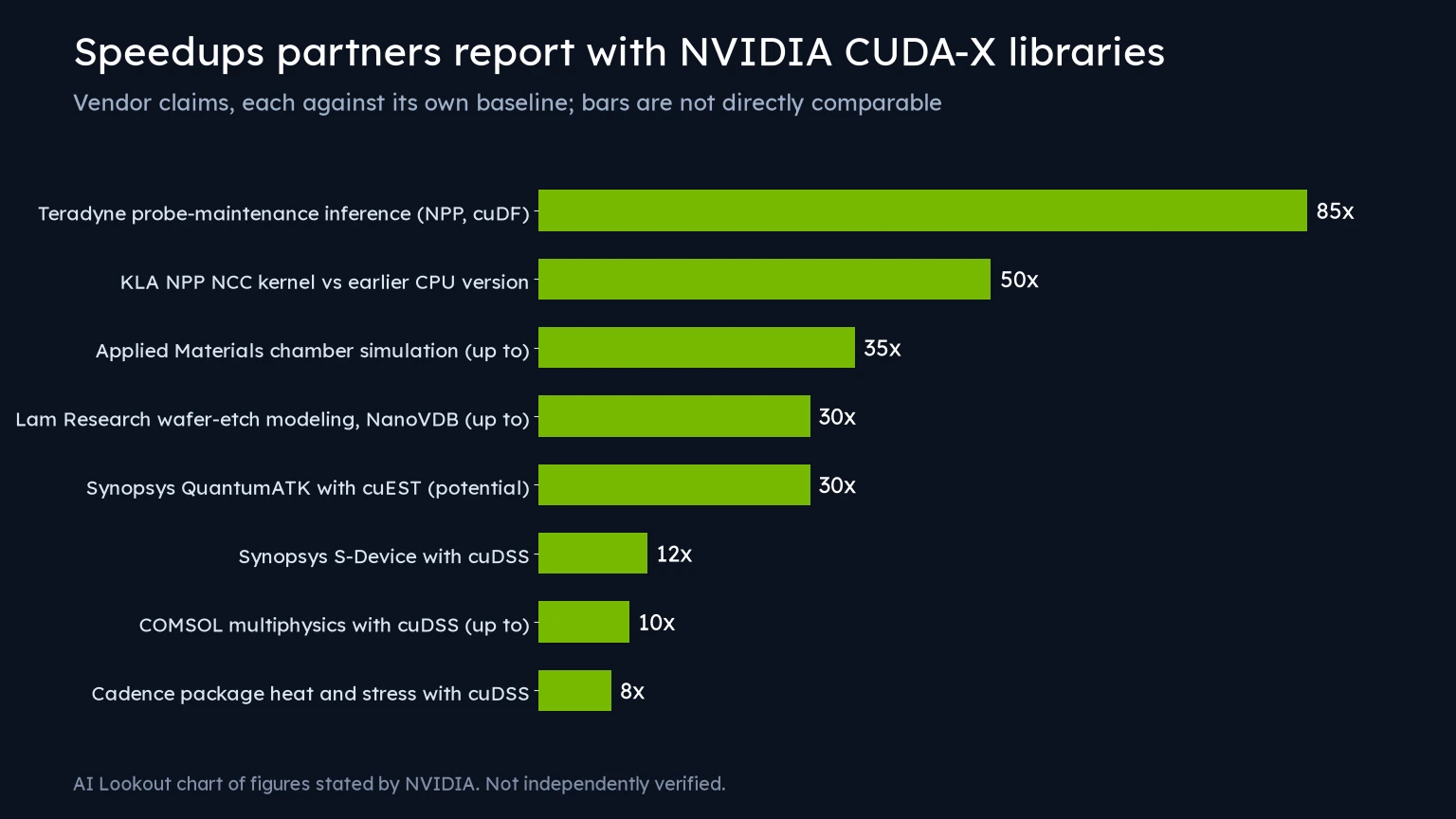
Synopsys is using cuPotential, cuEST and cuDSS in semiconductor simulation, with early QuantumATK results showing a potential 30x speedup using cuEST and S-Device benchmarks showing 12x with cuDSS. Its AgentEngineer products work with Nemotron open models and NeMo to support agents for chip design and verification. Cadence says its AuraStack AI Super Agent optimizes advanced packages for heat and stress 8x faster using cuDSS with its Celsius solver, and it pairs Nemotron with its ChipStack AI Super Agent for design and verification.
COMSOL reports up to 10x faster semiconductor multiphysics simulations with cuDSS, and says an upcoming COMSOL MCP Server will use the Nemotron Ultra open model for AI-assisted modeling. Voltai says its Voltaire platform for 3D-IC design compresses electro-thermal-mechanical simulation workflows from months to a day. ChipAgents is developing chip-design models on NVIDIA infrastructure and working with NVIDIA on Build-A-Chip Bench, a benchmark that tests agents across the whole flow from specification to graphic data system, the layout file format used to make photomasks.
On the manufacturing-prep side, Siemens is using the cuLitho library to speed up Calibre for chip-pattern refinement and mask preparation. Lam Research intends to integrate NanoVDB, an open-source library for 3D data, into its SEMulator3D process-modeling platform, which it expects to speed up select wafer-etch modeling by up to 30x. Luminary is training PhysicsNeMo models on package design and says engineers can explore 100x more designs in the same schedule. NVIDIA has been pushing similar open tooling elsewhere in engineering, such as its open-source SMLib CAD kernel.
Inspection, test and the factory floor
Inspection and test are where fabs catch defects before they cost yield. NVIDIA points to NPP, its library for processing images on GPUs, and RAPIDS cuDF for large datasets. KLA, the inspection equipment maker, applied lessons from its own production kernels to a new NPP NCC kernel (normalized cross-correlation, a common image-matching step) that NVIDIA says runs 50x faster than earlier CPU versions and is comparable with KLA’s hand-tuned code.
Teradyne says NPP, cuDF and CuPy give it approximately 85x faster probe-maintenance inference, which helps spot degrading test probes before they affect yield. imec is denoising scanning electron microscope images used for sub-nanometer measurements and using cuLitho for process-window optical proximity correction, which it says improved the lithography process window by 30 percent. Advantest has built Nemotron and NVIDIA Kumo-Anomaly into its ACS RTDI analytics running on Grace Blackwell systems, and is using NeMo Switchyard agents to cut test-workflow response times from hours to minutes.
Further out on the factory floor, Applied Materials says Omniverse and CUDA-X libraries enable up to 35x faster chamber simulations and fab digital twins for layout and material flow. FANUC and Foxconn are connecting robot models to the Mega Omniverse Blueprint, Analog Devices is pairing Synopsys physics simulation with Isaac Sim for sensor testing, and OMRON is using Cosmos world models and the Metropolis video search blueprint inside inspection equipment.
What is available now, and what is still coming
Availability is mixed, and worth reading carefully. NVIDIA says cuPotential is available in early access, not general release. NanoVDB is available today as open source within the OpenVDB project, and NPP ships in the CUDA Toolkit. Lam Research’s NanoVDB-accelerated SEMulator3D capability is targeted for release by the end of this year, and COMSOL’s MCP Server is described as upcoming.
The release does not list pricing for cuPotential or say how developers apply for early access, beyond pointing to NVIDIA’s presence at SEMICON West. Most of the partner products, such as Synopsys QuantumATK, Cadence Celsius and Siemens Calibre, are commercial tools sold by those vendors, so access to the speedups depends on their own licensing and release schedules.
Why NVIDIA wants AI agents inside the fab
Chips are the bottleneck for the whole AI build-out, and NVIDIA sits on both sides of that problem. It needs fabs to produce more advanced silicon for its own GPUs, such as the Vera Rubin systems it showed at OCP, and it wants to sell more GPUs and software into those fabs. Making its libraries the default accelerator for materials simulation, lithography, inspection and test serves both goals.
The agent framing matters too. Rather than only speeding up a solver, NVIDIA is positioning CUDA-X as the toolset AI agents call when they run simulations, check results and try again. That mirrors what has happened in software, where coding agents run tests in a loop, and it fits a wider push to bring AI into how hardware is made, from startups such as Atomic Machines, which pitches an AI-driven fab for micro-machines, to cloud providers building their own inference chips, like Microsoft’s Maia 300.
For fab engineers, the practical promise is shorter loops: if an etch model that took hours runs in minutes, more process variants can be tried before committing wafers. Whether that shows up as better yield or faster ramps will only be clear when chipmakers report results from production, not demos.
Caveats: vendor numbers and early access
Every number in the release is supplied by NVIDIA or its partners, and they are not measured the same way. KLA’s 50x is against earlier CPU versions; Synopsys’s 30x for QuantumATK is described as a potential speedup from early results; Lam’s 30x applies to select wafer-etch modeling and is expected, not shipped; and cuPotential’s 2-3x is on top of workflows already running on GPUs. None of these figures comes with published benchmark details, and we have not tested any of the libraries.
The release also bundles existing products, such as cuLitho, PhysicsNeMo, Omniverse and Cosmos, with the genuinely new cuPotential, so it reads as both a launch and a customer showcase. And “AI-defined fab” is NVIDIA’s term, not an industry standard. The concrete news is narrower: a new early-access atomic-simulation library, an open-source 3D library heading into Lam’s production tools, and a list of named partners willing to attach their products to NVIDIA’s stack.
Common questions
What is NVIDIA cuPotential?
A new CUDA-X library of GPU-accelerated functions for simulating how atoms and molecules interact, which developers add to existing software and which AI agents can call to run and iterate on simulations. NVIDIA says it added 2-3x on already GPU-optimized workflows in early-access tests.
Is cuPotential available now?
Only in early access, according to NVIDIA’s 14 October 2026 release. NanoVDB is open source within OpenVDB and NPP ships in the CUDA Toolkit.
Which companies are using NVIDIA’s fab stack?
NVIDIA names Applied Materials, Cadence, KLA, Lam Research, Siemens and Synopsys, plus Advantest, Analog Devices, ChipAgents, COMSOL, FANUC, Foxconn, imec, Luminary, OMRON, Teradyne and Voltai.
Sources & further reading
How this story was made
Written by Kristian Kostov with AI assistance and checked against the linked sources. Company performance claims are attributed to the company. Analysis reflects AiLookout’s interpretation; we have not independently tested the products discussed. The cover places the companies’ own logos, taken from public-domain or openly licensed files credited in the caption, on a plain background. It is not a product photograph, a screenshot, or an endorsement.
Our editorial standards