Announced 15 Oct 2026 · Sources checked
What NVIDIA released on 15 October
NVIDIA announced the models in a company blog post published at 15:00 UTC on 15 October 2026 and a longer developer blog deep dive. The release has three parts. Nemotron 3.5 Super VL is an open 120-billion-parameter model for what NVIDIA calls “specialized always-on agents.” Nemotron 3.5 Bolt 74B-A9B 24GB is a local model tuned to balance intelligence and speed per gigabyte. Nemotron 3.5 Bolt E4B 4GB, a much smaller model for voice assistants and embedded agents, is promised for 23 October.
NVIDIA positions them alongside two models it already ships: Lightning, released in August for high-throughput text work and now free on Vercel's AI Gateway, and Nemotron 3 Ultra for the hardest reasoning. The pitch is that any organisation running agents on NVIDIA hardware now has an open model for its tier, from a data-centre rack down to a laptop.
The weights went public on Hugging Face with the announcement. A Hugging Face search AI Lookout ran for Bolt at about 16:40 Skopje time, 20 minutes before the post, returned nothing; by about 17:40 the Super VL BF16 and NVFP4 checkpoints, the Bolt 24GB checkpoint and a GGUF build were all listed.
Super VL: a 120B multimodal model for agents
According to its model card, Super VL interleaves Mamba-2, mixture-of-experts and attention layers, with a C-RADIO vision encoder attached. It has 120 billion parameters in total, activates 12 billion per token and supports contexts of up to one million tokens. It takes text, images and video and returns text, with a switch in the chat template to turn step-by-step reasoning on or off. The full-precision BF16 version needs four H100s or two GB200s; an NVFP4 version is meant for DGX Spark and data-centre GPUs.
NVIDIA says the model was distilled from Nemotron 3 Ultra, trained on about 26 trillion tokens across pretraining and continued pretraining, then post-trained with roughly 3.8 million samples and reinforcement learning across dozens of environments. A continued-pretraining stage added 10 billion tokens of Indic text, and NVIDIA is releasing a dataset of about 2.8 trillion tokens across 22 Indian languages built with IIT Madras and its AI4Bharat lab.
The vision training targets what agents meet at work: charts, tables, scanned text, multipage documents and video. NVIDIA reports 80.8% on the CharXiv chart-reasoning benchmark, against 63% for Nemotron 3 Nano Omni, and 84% when the model can run Python. On Hermes Bench it scores 63.44% against 56.33% for Nemotron 3 Ultra, and 87.05% against 84.3% on LangChain's behavioural evaluations.
Speed is the main sales point. NVIDIA calls Super VL “5x faster than the next best” open model in its class and says it delivered over 600 tokens per second on Artificial Analysis agentic tasks via a Baseten endpoint. Inference tricks include multi-token prediction, a new open speculative-decoding method called LiLiCorr that NVIDIA says speeds token generation by up to 2.3x on DGX Spark, and NVFP4 weights refined with quantization-aware distillation.
Bolt: a 2-bit 74B model sized for 24GB
Bolt is the more unusual release. Its model card describes a 74-billion-parameter vision-language model with 9 billion active parameters, built as a Mamba-2 and Transformer hybrid “LatentMoE” with a C-RADIO v4-H vision encoder. Its 2-bit IQ2 format comes from quantization-aware training rather than simple after-the-fact compression, and the packed model fits in 24GB and can run alongside other applications. Context length is up to 256,000 tokens.
NVIDIA built it for the RTX Spark Windows laptops that go on sale on 16 October, and says it also runs on GeForce RTX PCs, DGX Spark, DGX Station and RTX PRO workstations. The intended use is handing everyday projects, such as web research, writing and debugging, to local agent harnesses without sending the work to the cloud. NVIDIA claims Bolt is the top open model in its class on PinchBench and second among open models on BrowseComp.
The model card lists its development period as December 2025 to May 2026, with post-training data cut off in May 2026. The smaller Bolt E4B 4GB, due on 23 October, targets GeForce RTX cards, Jetson modules and Spark machines for fast voice assistants, interactive characters and embedded interfaces.
What NVIDIA's own benchmark tables show
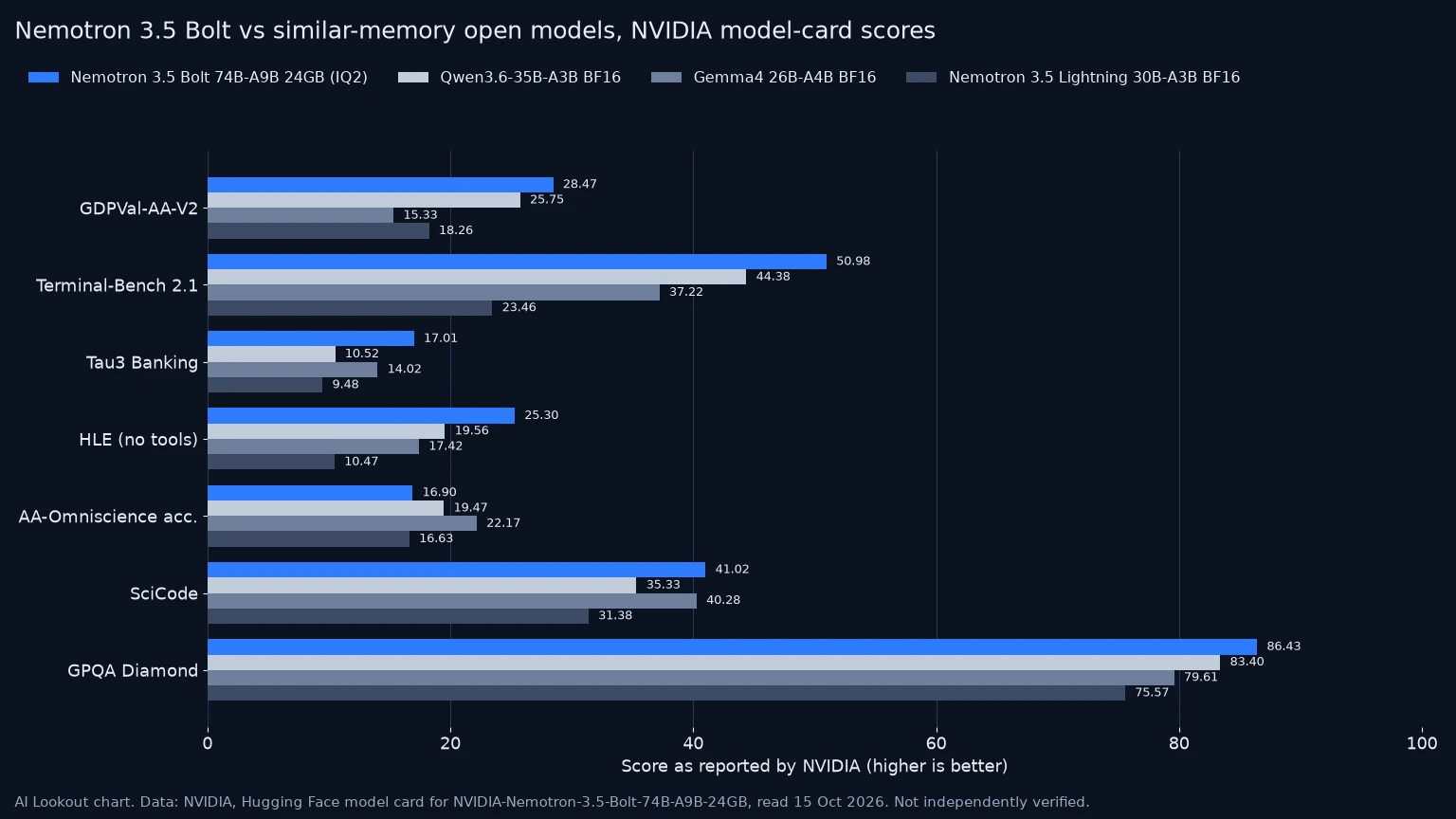
Bolt's card compares the 2-bit model with three models of similar memory footprint run at full BF16 precision: Qwen3.6-35B-A3B, Gemma4 26B-A4B and Nemotron 3.5 Lightning 30B-A3B. Bolt leads six of seven rows, scoring 50.98 on Terminal-Bench 2.1 against 44.38 for Qwen, 86.43 on GPQA Diamond against 83.40, and 25.30 on Humanity's Last Exam without tools against 19.56. Gemma4 leads the AA-Omniscience knowledge test at 22.17 to Bolt's 16.90.
Super VL's card is more revealing because it includes a stronger rival. Against Qwen3.8-Flash-Next, Super VL trails on SWE-bench Verified (71.10 against 78.7), Terminal-Bench 2.1 (66.70 against 85.80), BrowseComp (78 against 89) and GPQA Diamond (89.52 against 92.7). It beats the older Qwen3.5-122B-A10B on most text and agent rows, though not on most vision rows, and its AA-Omniscience hallucination rate of 30.0 is far lower than the 84.5 listed for that model and 95.9 for DeepSeek-V4-Flash, though higher than Nemotron 3 Ultra's 22.1.
So the honest reading of NVIDIA's own numbers is that Super VL is not the most accurate open model of its size; it is a fast one that hallucinates less than several peers and comes with its data and recipes. NVIDIA says all its results were produced with published NeMo Gym recipes, apart from eight vision benchmarks run on official or internal scaffolding it plans to open later.
Who is already customising Super VL
NVIDIA lists a long roster of early adopters, all describing their own projects. Scale AI post-trained Super VL for a vendor credit agent at Skydance and an M&A due-diligence agent at EY; NVIDIA's developer post says the Skydance workload's inference cost “will decrease by 40x and latency by 5x.” Ramp is turning receipt images into structured data and “expects up to 50% higher throughput and 10x lower latency.” AI21 tuned the model for Alice's threat-intelligence work and reports 40% higher accuracy.
Others named include AfterQuery building a credit-agreement agent for Hebbia, Mercor training for coding agents, and software companies integrating the model: Atlassian for search across Jira and Confluence, CrowdStrike for agentic blue-teaming, Dassault Systèmes, Perplexity, Salesforce and Synopsys. Perplexity and Prime Intellect also contributed training data and environments through the Nemotron Coalition, NVIDIA's group of partner labs.
Many of these figures are expectations rather than measured results, and none has been audited. They do show where NVIDIA sees the model's value: as a base that companies post-train on their own documents and tools, which an open licence and released training data make easier than a closed API.
How to get and run the models
Super VL is available on Hugging Face in BF16 and NVFP4, on ModelScope, as an NVIDIA NIM microservice and through OpenRouter, which listed a free Super VL endpoint with a one-million-token context when AI Lookout checked. Bolt 74B-A9B is on Hugging Face now, with support NVIDIA lists for llama.cpp, Ollama, LM Studio, Unsloth and vLLM; a GGUF build sits alongside the main checkpoint. Tools such as Hugging Face's Llama Windows tray app are the kind of llama.cpp front ends Bolt is aimed at.
Both models use the OpenMDW-1.1 licence, which grants permission to use the weights, data and documentation “without restriction,” asks only that redistributors keep the licence and notices, ends the grant for anyone who sues claiming the materials infringe a patent or copyright, and imposes no conditions on outputs. That is looser than many “open” model licences, a distinction covered in our explainer on open weights versus open source.
Running Bolt today is not quite plug-and-play. The vLLM quick start pins a nightly container, downloads custom kernels and serves one request at a time, and NVIDIA lists A100, H100 and Blackwell GPUs for that route. Consumer users will mostly depend on the llama.cpp-based apps catching up.
Limits and what to watch
Every benchmark, speed and customer figure in the launch comes from NVIDIA or its partners. The one outside reference, an EXO Labs evaluation NVIDIA says placed Super VL on the accuracy-versus-time frontier on DGX Spark, is reported in NVIDIA's own post. A Nemotron 3.5 technical report is linked from the developer blog, and independent leaderboards will be the first real check.
Bolt's bet on 2-bit weights is the claim most worth testing. Aggressive quantization usually costs accuracy on long or unusual tasks even when headline scores hold, and the card compares a 2-bit Bolt with rivals at full precision, not with their own quantized versions that people actually run on 24GB cards.
The timing ties the release to hardware: RTX Spark laptops on 16 October, the 64GB DGX Spark later this month and Jensen Huang's GTC Berlin keynote on 21 October. Watch for third-party Bolt tests on those machines, Artificial Analysis and LMArena placings for Super VL, and whether Bolt E4B ships on 23 October as promised.
Common questions
Can I run Nemotron 3.5 Bolt on a 24GB graphics card?
That is what it is designed for: the 2-bit packed model is 24GB. NVIDIA targets RTX Spark laptops, GeForce RTX PCs and DGX Spark, with support in llama.cpp, Ollama, LM Studio, Unsloth and vLLM. Context length and other apps will compete for the same memory.
Is Nemotron 3.5 Super VL free for commercial use?
Yes. NVIDIA says it is ready for commercial use, and the OpenMDW-1.1 licence lets you use, modify and redistribute the weights without fees or output restrictions, provided you keep the licence and notices.
Is Super VL the most accurate open model of its size?
Not on NVIDIA's own model card, which shows Qwen3.8-Flash-Next ahead on most coding and agent benchmarks. NVIDIA's main claims are speed, lower hallucination rates than several rivals, and openness of data and recipes.
Sources & further reading
- Open From Data Center to Desktop: NVIDIA Expands Nemotron Family With Highest Efficiency Super VL and Bolt Models ↗
- NVIDIA Nemotron 3.5 Super VL Powers Specialized Agents with Multimodal Reasoning ↗
- NVIDIA-Nemotron-3.5-Super-VL-120B-A12B-BF16 model card ↗
- NVIDIA-Nemotron-3.5-Bolt-74B-A9B-24GB model card ↗
- OpenRouter models API: NVIDIA Nemotron listings ↗
- OpenMDW License Agreement, version 1.1 ↗
How this story was made
Written by Kristian Kostov with AI assistance and checked against the linked sources. Company performance claims are attributed to the company. Analysis reflects AiLookout’s interpretation; we have not independently tested the products discussed. Cover photography is illustrative and does not depict the specific announcement or product.
Our editorial standards