Announced 15 Oct 2026 · Sources checked
What Multiverse released
Multiverse Computing, a company based in San Sebastian, Spain, that sells AI model compression, has released Comet 60B, an open-weight multimodal model made by cutting NVIDIA's Nemotron 3.5 Super VL to half its size. The company announced the model on 15 October 2026, the same day NVIDIA released Nemotron 3.5 Super VL itself. Multiverse says it had early access to NVIDIA's model, as it did for its earlier Pulsar 16B, a compressed version of Nemotron 3 Nano released in June.
NVIDIA's original has 124.5 billion parameters, of which about 12.8 billion are active for each token. According to the Comet 60B model card, Multiverse's version has 61.1 billion parameters with about 12.3 billion active. It keeps all three input types of the original, text, images and video, produces text, and supports the same switchable reasoning mode and tool-calling format, so it can drop into existing agent software built for Nemotron.
"Nemotron 3.5 Super VL is an excellent multimodal model. With Comet 60B we have cut its size in half while keeping accuracy within 5% of the original, so companies can run it on less hardware and at lower cost," said Enrique Lizaso, co-founder and chief executive of Multiverse Computing, in the press release.
How CompactifAI halved the model
Multiverse's compression framework, CompactifAI, runs in four stages, described in a technical post. First, a profiler based on tensor networks, a family of mathematical methods from physics that the company calls quantum-inspired, analyses where the model's parameters carry redundant information. Several candidate compressions are generated, each gets a short repair run, and the one that recovers best goes forward.
For Nemotron, the compression worked on the mixture-of-experts layers, where most of the parameters live. Each of the 40 expert layers, and the extra layer used for multi-token prediction, was cut from 512 routed experts to 256, and each expert's internal width was trimmed from 2,688 to 2,432. The Mamba2 and attention layers, the shared experts, the embeddings and the vision encoder were left at full size. Because the router still sends each token through 22 experts, the active parameter count barely changes even though the total halves.
A model cut this way is damaged, so the third stage heals it by distillation: the original Nemotron writes training responses and Comet learns to match its output distribution. The healing data covered maths, science, code and multilingual chat, multi-turn terminal, software and tool-use sessions, and images and video. A final reinforcement learning stage, of the GRPO type, targeted multi-turn conversation, multi-step tool use and hallucination, while keeping reasoning length in check.
Benchmarks against the original
Multiverse ran both models through the same harnesses, mostly NVIDIA's NeMo Gym, with identical prompts, judges and sampling settings. Across 28 scores in 16-bit precision, Comet stays within three points of the original on 22 and within five points on 26. It is ahead on several of the agent tests the reinforcement learning targeted: on tau2-Bench it scores 79.28 against 76.75 in the telecom domain and 85.09 against 82.79 in retail, and on AutomationBench-AA 33.18 against 31.16. It is also ahead on SciCode and SWE-bench Pro.
The most interesting change is in hallucination. On AA-Omniscience, which rewards a model for declining to answer rather than guessing, Comet's hallucination rate is 13.4 percent, less than half the original's 29.1 percent. It gets there by abstaining more, so it also answers fewer questions correctly and its overall Omniscience Index is slightly lower, 2.83 against 5.08. The largest losses are on GDPval-AA, down 5.5 points, and the V* visual search test, down 5.8. Image, document and video scores stay within three points on seven of ten.
Fewer GPUs and faster serving
The practical case for Comet is hardware. The 16-bit checkpoint is 122.3GB, against about 249GB for Nemotron 3.5 Super, so it runs on two NVIDIA H200 GPUs instead of four with the full 256,000-token context. Multiverse also ships an FP8 version of 66.3GB that fits on one H200, and an NVFP4 version of 40.5GB for Blackwell GPUs. NVIDIA's own NVFP4 release of Super VL is 75.1GB. On a single B300, Multiverse says, the NVFP4 weights take 37GB and leave room for about 85 concurrent full-length requests.
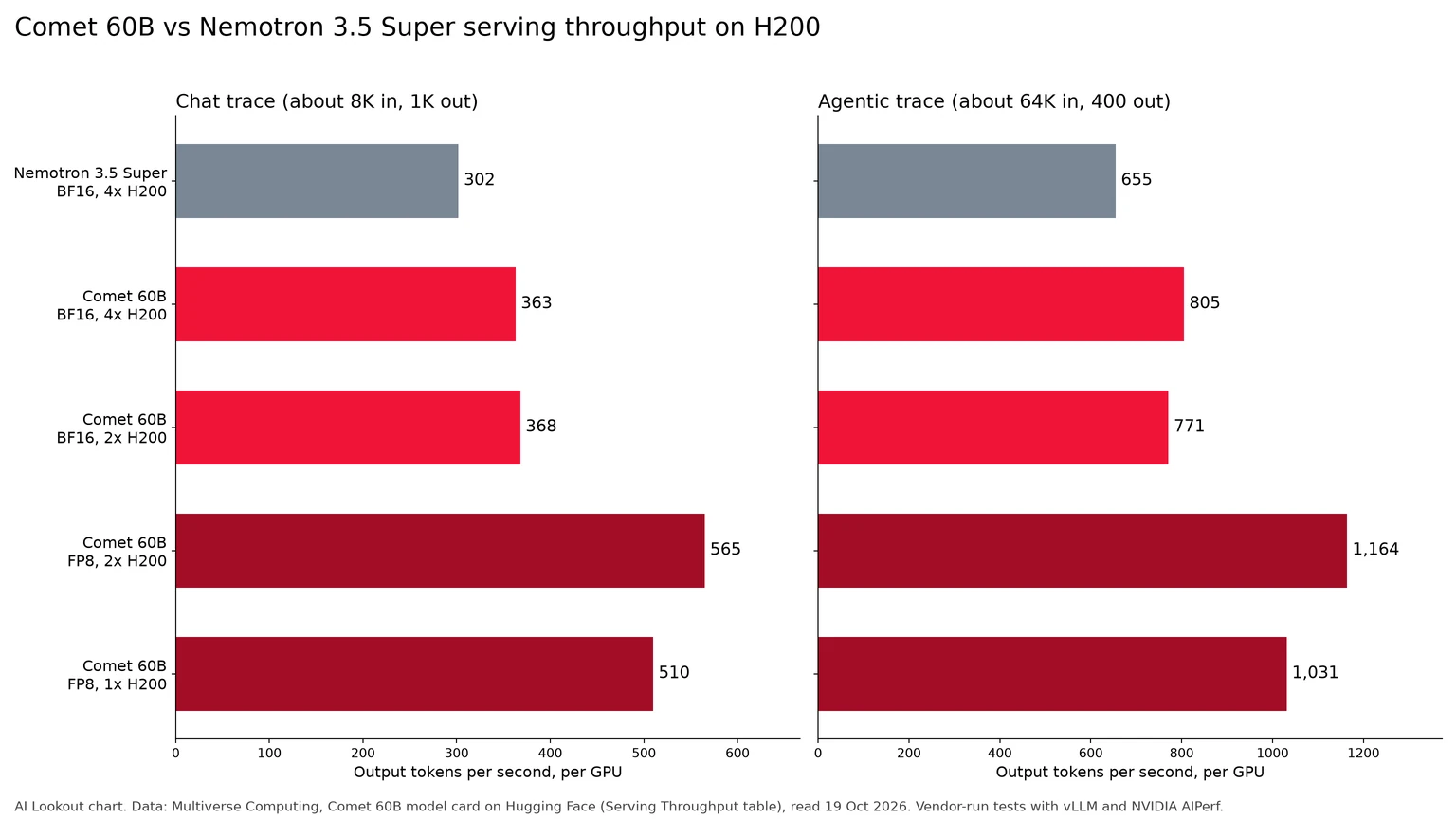
Smaller models also serve faster, because fewer weights have to be read from memory. Replaying NVIDIA's own chat and agent traffic recordings with the vLLM server, Multiverse measured 363 output tokens per second per GPU for Comet on four H200s against 302 for Nemotron, and 805 against 655 on the agent trace, roughly 20 percent more. The FP8 version on two GPUs reached 565 and 1,164, up to 87 percent more per GPU than the original. Typical time between tokens fell from about 23 milliseconds to 12 in FP8.
How to get and run it
The three versions are on Hugging Face as BF16, FP8 and NVFP4 repositories. One trap: the links inside the model card point to repositories named Comet-1.0-60B, which did not resolve when AI Lookout checked them on 19 October; the working names are Comet_60B_A12B_BF16, _FP8 and _NVFP4. The card's own release-date field still reads TBD and its citation block contains placeholders.
Multiverse recommends serving with a recent vLLM nightly build, using the same reasoning and tool-call parsers as Nemotron and multi-token prediction for speculative decoding. NVFP4 needs Blackwell for full speed; on Hopper it falls back to slower weight-only kernels. For readers new to the formats, our explainer on model quantization covers how lower-precision weights trade accuracy for memory.
A licence question
The licensing is less clear than it should be. NVIDIA's Nemotron 3.5 Super VL model card lists the OpenMDW-1.1 licence, a permissive licence for model weights. Comet's card instead says it is governed by the NVIDIA Nemotron Open Model License, a different NVIDIA agreement, and calls it ready for commercial use under those terms. Multiverse calls Comet open source.
Both licences permit commercial use, so for many users the difference will not matter. Companies with legal reviews should still check which terms apply to the derivative, since Multiverse received the model before its public release and may have done so under different terms. The bundled model code is NVIDIA's under Apache 2.0.
Caveats
Every number above comes from Multiverse's own tests. Some judges and simulated users differ from NVIDIA's, so its Nemotron scores are not directly comparable with NVIDIA's published ones, and the Artificial Analysis-style benchmarks it uses are public test sets rather than the official leaderboards. The healing data was mainly English, and the company says it has not systematically evaluated other languages. There is no audio input, although some audio settings remain in the processor files.
Multiverse also warns that compression and healing can change behaviour, including on safety-relevant prompts, and tells users to keep the base model's guardrails and run their own evaluations. Benchmarks within a few points can hide larger shifts on narrow tasks that no public test measures.
Why compression matters for agents
Mixture-of-experts models have made frontier-level quality cheaper per token, but they still need enough memory to hold every expert. That makes total parameter count, not active count, the cost that decides how many GPUs a company has to rent. Comet tests a simple idea: many experts in a large model are redundant, and a model with half of them can be healed back to nearly the same quality. Similar pressure is pushing small-model work such as PrismML's ternary Bonsai models in the other direction, towards running on a laptop.
If independent tests confirm Multiverse's numbers, Comet offers a way to run NVIDIA's multimodal agent model on half the hardware, with fewer hallucinations, within days of its launch. The things to watch are third-party benchmarks, a clarified licence, and whether NVIDIA or other model makers start shipping smaller expert counts themselves.
Common questions
What is Comet 60B?
An open-weight multimodal model from Multiverse Computing, made by compressing NVIDIA's Nemotron 3.5 Super VL from 124.5 billion to 61.1 billion parameters. It accepts text, images and video and outputs text.
How many GPUs does Comet 60B need?
Multiverse says the BF16 version runs on two H200 GPUs with a 256K-token context, the FP8 version on one H200, and the NVFP4 version on a single Blackwell GPU such as a B300.
Is Comet 60B as good as Nemotron 3.5 Super VL?
In Multiverse's own tests it stays within three points on 22 of 28 scores and is ahead on several agent benchmarks, with its biggest losses around five to six points. No independent evaluation has been published yet.
Sources & further reading
How this story was made
Written by Kristian Kostov with AI assistance and checked against the linked sources. Company performance claims are attributed to the company. Analysis reflects AiLookout’s interpretation; we have not independently tested the products discussed. The cover places the companies’ own logos, taken from public-domain or openly licensed files credited in the caption, on a plain background. It is not a product photograph, a screenshot, or an endorsement.
Our editorial standards