Announced 19 Oct 2026 · Sources checked
What Cloudflare released
Cloudflare released a preview of Clairic on 19 October 2026, a model that reads text or images and returns typed values instead of generated prose. In its launch post, signed by Alex Reneau, Michelle Chen and Kevin Flansburg of the Workers AI team, the company calls it the first in a new class of what it terms System One extraction models. It is hosted on Workers AI, Cloudflare's serverless inference platform, under the name @cf/cloudflare/clairic.
Clairic is built to answer the kind of question developers now hand to large language models thousands of times a day with a JSON template: what is the invoice total, when was this delivered, how many days late is it, what will this repair cost. Cloudflare says Clairic can extract, compute, estimate and forecast such values at significantly higher accuracy, lower latency and lower cost than a traditional LLM. Those are Cloudflare's claims, backed in the post by worked examples and one pipeline test rather than by a published benchmark suite.
The company says it intends to release Clairic with open weights soon, but gives no date, licence or parameter count. For now the only way to use it is the hosted preview endpoint, which Cloudflare describes as an early checkpoint that it expects to improve.
Extraction models, decision models and LLMs
The framing borrows from Daniel Kahneman's book Thinking, Fast and Slow. A System One model is meant to be fast and precise, while a System Two model, like a chat LLM, reasons deliberately and writes one token at a time. Cloudflare credits the idea to TypeSafe, whose Jev model popularised it about a month ago, and AI Lookout covered TypeSafe's $870 million Series A on the back of that pitch.
Until now every model sold under that label has been a decision model. Cloudflare's own Clef and Clef-omni take an input and a list of questions and return a probability for each allowed answer, and Liquid AI's d1-ultra does the same for photos and text. Clairic is different because the answer is not picked from a list you wrote. It is a value read from the input, worked out from it, or predicted beyond it.
Cloudflare sums up the split this way. Numbers and typed values go to an extraction model. A choice from a fixed set goes to a decision model. Open-ended writing and reasoning go to an LLM. Both System One types answer in a single forward pass, charge only for input tokens and typically respond in under a second, the company says, where an LLM that reasons through the same step takes several seconds.
How a Clairic request works
A request has two parts. The state is the text to read, plus up to four optional images. The fields are a map of named outputs, each with a type and, if needed, plain-language instructions. Supported types are text spans, numbers, dates, times, datetimes, durations, lists, estimates and forecasts. All fields are answered in one parallel pass, and Cloudflare says there is no limit on how many you ask for: if they do not fit next to the input, the server splits them into parallel passes that each see the whole input.
Every scalar answer comes back with a confidence score and a p_null value, the model's probability that the answer is not in the input at all. Text answers include the character offsets of the span they were copied from, so an application can highlight the source. Because Clairic generates no tokens, Cloudflare says, it cannot return malformed JSON or a value of the wrong type; it returns a value of the declared type or null. The company is careful to add that it can still be wrong.
Its first example is a short support email about a cracked screen. Clairic returns the order number as an exact span, the delivery date, an amount paid of $701.10 that is not written anywhere because it adds the $649.00 price and $52.10 tax, an 11-day gap worked out from two dates, and a list of both kinds of damage. A tracking number the email never mentions comes back null, with the model's rejected guess shown beside it. A second example reads a photo of a receipt taken at an angle and pulls out the order number, time, quantity, unit price, subtotal, tax and tip, and correctly reports that no discount was shown.
Estimates and forecasts
The estimate type is the part with no LLM equivalent. You give a minimum, a maximum, a step and a linear or log scale, and Clairic returns a point value, a median and an 80 percent interval, with all 99 percentiles on request. Cloudflare's example values a house from five comparable sales and gets $418,000 with an interval of $370,000 to $470,000. The width is the signal: a narrow range means the input strongly informs the answer, and a wide one tells you to route the item for another check.
Forecasts work the same way for a series pasted in as plain text. Cloudflare asked Clairic for the next day's count of people screened at US airport checkpoints by the Transportation Security Administration, every day for 21 days. On one day it predicted a median of 2,419,283 against an actual 2,419,474. Across the run it was off by 3.3 percent on average, and 17 of 21 actual counts fell inside its 80 percent interval. Three of the four misses fell on the Columbus Day weekend, a holiday the series itself does not show.
Cloudflare does not oversell this. The post says Clairic is not meant to replace a dedicated time-series model trained on specific data, and should be used for non-critical pattern matching rather than detailed long-horizon forecasting.
Cloudflare's pipeline test
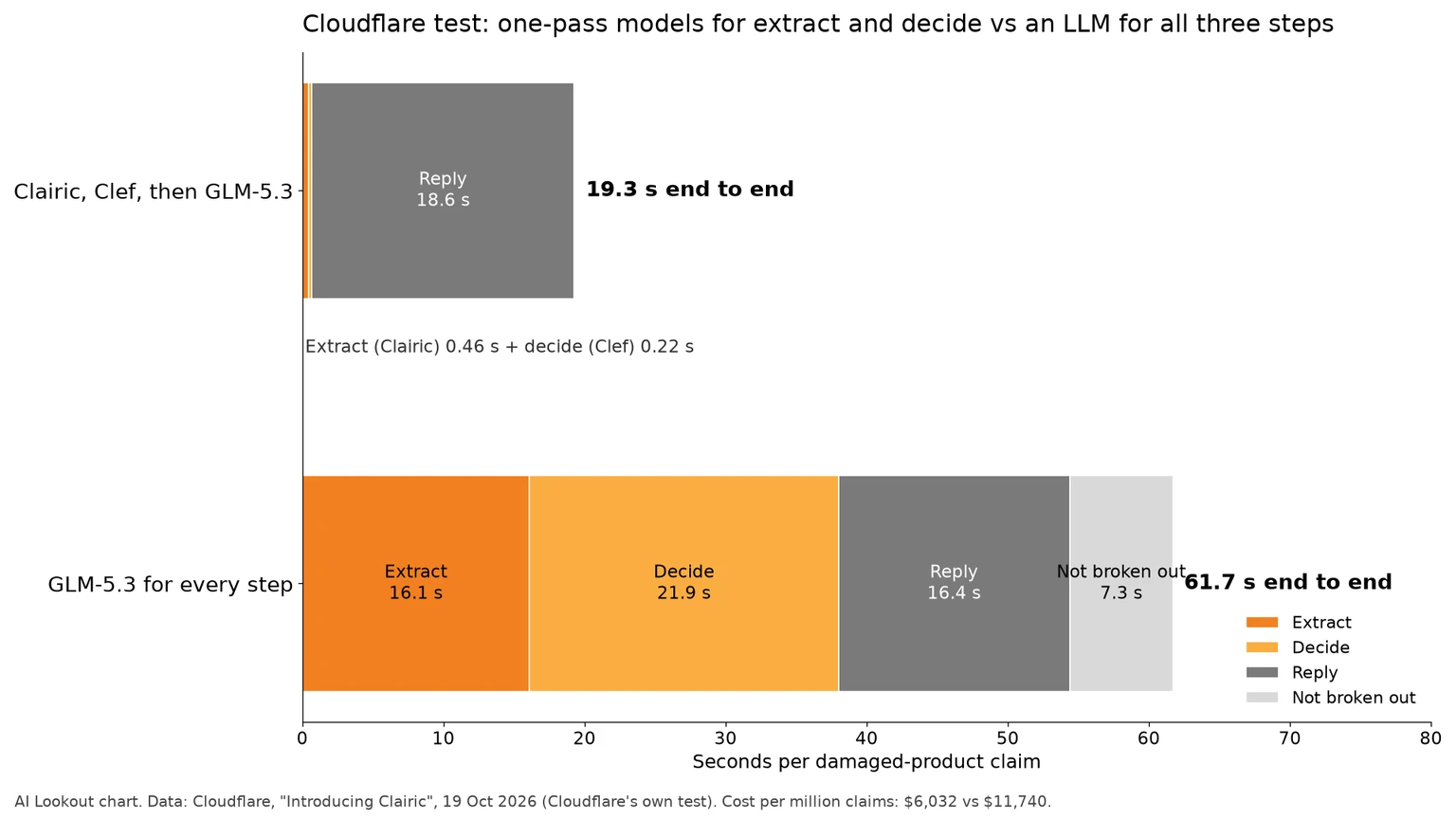
The main evidence is a three-step claims pipeline, which Cloudflare also published as a live demo. Clairic turns the damage email into typed facts, including an estimated repair cost. Clef then picks refund or repair from those facts and a written policy. Finally GLM-5.3, a model from Z.ai, writes a short reply using only the decision and the facts it needs. Cloudflare compared that with GLM-5.3 doing all three steps from the same email, policy and prompts.
The cascade finished in 19.3 seconds against 61.7 seconds, about 3.2 times faster. Clairic and Clef took 0.46 and 0.22 seconds for extraction and the decision, where GLM-5.3 took 16.1 and 21.9 seconds. Cost per million claims was $6,032 against $11,740, 49 percent less, almost all of it the reply step's output tokens. Both pipelines got the facts and the decision right in every run, Cloudflare says, but Clairic's repair estimate was identical each time while GLM-5.3 gave $250, $250 and $220.
Cloudflare also says that in the all-LLM version Gemma 4 and Qwen failed the task outright, unable to deduce values such as the repair cost. It does not say which Qwen model or how many runs. There is a safety argument too: because the LLM never sees the raw email, the post says, there is less room for a prompt injection hidden in customer text to steer the decision.
Price and how to try it
Cloudflare's model page lists Clairic as Cloudflare-hosted with vision support, a 65,536-token context window and a price of $0.10 per million input tokens. There is no output price because there are no output tokens. In the claims test, the 701 input tokens across Clairic and Clef worked out to $184 per million claims.
Developers can call it from a Worker with env.AI.run or from anywhere through Cloudflare's REST API with an account ID and API token. The response carries a usage block that counts state tokens. Cloudflare has also published an explainer on extraction models describing the field types and response format. The company frames Clairic as one piece of an agent workflow rather than a standalone product: extraction models turn raw input into values, decision models turn values into decisions, and LLMs turn decisions into words.
Limits Cloudflare admits
The launch post lists its own weaknesses. Reading is strong, it says, but multi-step arithmetic is not yet: one- and two-step calculations such as totals, differences and date arithmetic seem reliable, while longer chains and aggregation across many table rows are hard for any one-pass model without a scratchpad. Cloudflare's advice is to let Clairic predict the value and let code do the maths.
Estimates need evidence in the input, such as comparables or history. Calibration is measured, not guaranteed: the intervals are trained to be calibrated and are on most held-out sets, but can run narrow on unfamiliar data. And the architecture makes every answer well formed, not necessarily correct, so Cloudflare tells users to rely on confidence, p_null and the intervals to decide what to automate.
There are also gaps the post does not fill. It gives no model size, training data, architecture details or evaluation on a public extraction benchmark, and every number in it comes from Cloudflare's own examples. AI Lookout did not run Clairic.
Why it matters
Structured extraction is one of the most common jobs given to frontier LLMs, and one of the most annoying to make reliable, because teams wrap it in parsing, schema checks and retries. A model that cannot emit a malformed answer and says when it is unsure targets that cost directly. The System One idea is spreading fast: Perplexity open-sourced its pplx-decider models days ago, and Clairic now extends it from choosing to reading and estimating.
Whether the approach holds up will depend on things Cloudflare has not yet shown: independent accuracy tests on messy real documents, behaviour on long multi-step calculations, and what developers can do once the open weights appear.
Common questions
What is Cloudflare Clairic?
A preview model on Workers AI that extracts, computes, estimates and forecasts typed values from text or images in one forward pass, returning confidence scores instead of generated text.
How is Clairic different from Clef?
Clef is a decision model that returns probabilities for answers you list. Clairic returns values it reads from or works out from the input, such as totals, dates or price estimates.
How much does Clairic cost and is it open source?
Cloudflare lists $0.10 per million input tokens with no output charge. It says it intends to release open weights soon but has not given a date or licence.
Sources & further reading
How this story was made
Written by Kristian Kostov with AI assistance and checked against the linked sources. Company performance claims are attributed to the company. Analysis reflects AiLookout’s interpretation; we have not independently tested the products discussed. The cover places the companies’ own logos, taken from public-domain or openly licensed files credited in the caption, on a plain background. It is not a product photograph, a screenshot, or an endorsement.
Our editorial standards