Announced 19 Oct 2026 · Sources checked
What GoTo released
Indonesian technology group GoTo, the company behind ride-hailing app Gojek and marketplace Tokopedia, has released a 27-billion-parameter language model trained for Bahasa Indonesia and four regional languages. The model was announced at Bali Tech Week in Sanur on Monday 19 October 2026, according to TNGlobal and Suara.com, and the weights are public on GoTo's Hugging Face page under the name gemma3-27b-cpt-gotoai-v3-instruct.
The model card lists six supported languages: English, Indonesian, Javanese, Sundanese, Batak Toba and Balinese. It is an instruction-tuned chat model with a 128,000-token context window, which means it can take a long contract, report or conversation history in a single request. GoTo says businesses, universities, researchers and public institutions can use, study and adapt it, including on their own servers, rather than building a model from scratch.
GoTo Group chief executive Hans Patuwo framed the release as a question of building local capability. "Indonesia has made good use of AI technology made abroad. But we also need to develop our own AI to answer local challenges and needs," he said in a company statement quoted by Suara.com (translated from Indonesian by AI Lookout). He argued that models designed for a global market do not always understand local context, including everyday abbreviations and the regional languages Indonesians use at home.
Built on Gemma 3 and SEA-LION work
The release is the third generation of GoTo's open model work. In November 2024 GoTo and telecoms operator Indosat Ooredoo Hutchison launched Sahabat-AI, a set of 8-billion and 9-billion-parameter Indonesian models built on Meta's Llama 3 and Google's Gemma 2, and in May 2025 GoTo published a 70-billion-parameter Sahabat-AI v2 model based on Llama. The new model moves to Google's Gemma 3 architecture at 27 billion parameters, smaller than the 70B flagship but newer.
The model card names GoTo as the initiator and both GoTo and AI Singapore, the Singapore national programme behind the SEA-LION family of Southeast Asian models, as developers. GoTo's organisation page says its models use SEA-LION-based foundations, continued pre-training on curated Indonesian data, and fine-tuning with supervised and preference methods. A merge configuration file in the repository shows how the final weights were assembled: a linear merge of Google's gemma-3-27b-it with two internal GoTo models whose file paths point to Balinese and Sundanese training runs, on top of a base whose path describes a merge of Sahabat and SEA-LION models.
On data, GoTo said in its announcement that it trained the model on Indonesian-language text from media partners and public-sector websites, plus regional-language data. For Batak, it worked with Universitas Sumatera Utara to collect text that reflects how the language is used today. The model card lists further university partners, including Universitas Indonesia, Gadjah Mada, IPB, ITB and Udayana, and media groups including Kompas Gramedia, Republika, Tempo and Hukumonline. None of these descriptions of the training corpus have been independently audited, and GoTo has not published the data itself.
What GoTo's own scores show
The model card describes its tests, IndoMMLU for school-exam knowledge in an Indonesian context and the SEA-HELM suite for tasks such as question answering, sentiment, translation, summarisation, reasoning and instruction following, but prints no numbers. The scores sit in a GoTo-AI leaderboard Space updated a few hours before the announcement. Its data file covers 28 models, mostly from 2024 and 2025, and every score in it comes from GoTo's own runs.
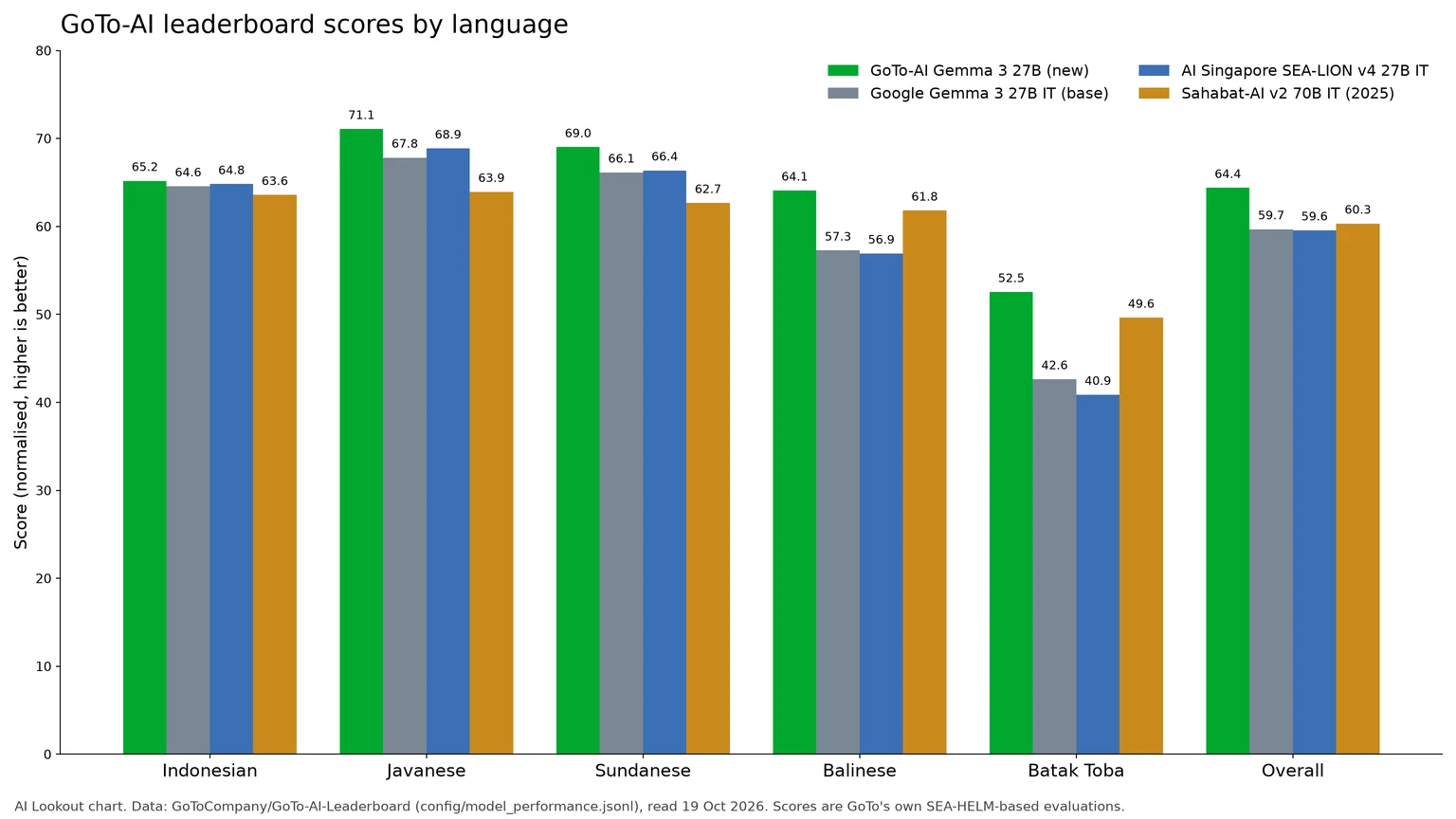
On that leaderboard the new model has the highest overall score, 64.39, ahead of Google's Gemma 3 27B instruct model at 59.69, AI Singapore's Gemma-SEA-LION v4 27B at 59.57 and GoTo's own Sahabat-AI v2 70B at 60.33. The gains are not spread evenly. In Indonesian the new model scores 65.19 against 64.57 for Gemma 3 27B, a difference small enough to vanish on a different sample. Alibaba's Qwen3-32B scores higher in Indonesian, at 66.99, though it trails badly in the regional languages.
The large improvements come where global models are weakest. In Balinese the new model scores 64.09 against 57.27 for Gemma 3 27B, and in Batak Toba 52.55 against 42.64. Javanese and Sundanese rise by about three points each. Multi-turn conversation in Indonesian improves sharply over the 70B model, from 37.31 to 53.75, while instruction following dips slightly, from 93.62 to 90.48. On IndoMMLU the new model scores 58.48, below the 70B model's 62.56, and its weakest IndoMMLU category is local languages and cultures, at 39.83.
| Model | Overall | Indonesian | Javanese | Balinese | Batak Toba | IndoMMLU |
|---|---|---|---|---|---|---|
| GoTo-AI Gemma 3 27B (new) | 64.39 | 65.19 | 71.09 | 64.09 | 52.55 | 58.48 |
| Gemma 3 27B IT (Google) | 59.69 | 64.57 | 67.83 | 57.27 | 42.64 | 57.13 |
| Gemma-SEA-LION v4 27B IT | 59.57 | 64.82 | 68.87 | 56.93 | 40.87 | 56.72 |
| Sahabat-AI v2 70B IT | 60.33 | 63.59 | 63.94 | 61.81 | 49.63 | 62.56 |
How to run it
The model runs with the Hugging Face Transformers library. In full 16-bit precision it needs roughly 54 to 60 gigabytes of GPU memory, and the card suggests one 80GB Nvidia A100, two L40S cards or three RTX 4090s. That puts the unmodified model beyond an ordinary laptop. Smaller organisations will need cloud GPUs, a dedicated server, or a quantised version that trades some accuracy for memory. GoTo has not published quantised files, but the Gemma 3 architecture is widely supported by community tools that produce them.
One practical snag for developers: the example code on the model card loads a repository called GoToCompany/GoTo-AI-Gemma-3-27B-IT, with a comment telling users to update the path. The weights actually live at GoToCompany/gemma3-27b-cpt-gotoai-v3-instruct, so copied code needs that name. The repository is a standard Gemma 3 checkpoint split into 12 files, about 27.4 billion parameters in total, and keeps Gemma's own tokenizer.
The licence is Gemma's, not open source
GoTo and much of the local press describe the model as open source. The model card is more precise: it is released under the Gemma Terms of Use, the licence Google applies to Gemma and to models built from it. The terms allow commercial use and modification, but they are not an open-source licence in the usual sense. They carry a prohibited-use policy that passes on to anyone who builds on the model, and Google reserves the right to restrict use that breaks it.
For most startups and universities that difference will not block adoption. It matters more for government bodies and large companies with legal reviews, and for anyone planning to redistribute a modified version, because the Gemma terms travel with every derivative. Organisations used to Apache-licensed models should read them before building a product on this one.
Why local-language models matter
Indonesia has more than 700 living languages, and Javanese and Sundanese alone have tens of millions of speakers. Global models are trained mostly on English and a few large languages, and their quality falls away quickly for languages with little text online. The leaderboard shows this pattern: Meta's Llama 3.1 8B instruct model scores 15.91 in Batak Toba, against 52.55 for GoTo's new model.
GoTo's release is part of a wider push to build national and regional models that are owned locally and can run on local infrastructure. In the Gulf, MBZUAI and Inception42 recently opened Jais 3, a family of Arabic models, and in India NVIDIA and AI4Bharat described a 2.8-trillion-token corpus for 22 Indian languages. The common argument is that a country should not depend entirely on foreign models for public services, education and commerce in its own languages, and that open weights let local developers inspect and adapt the model.
For GoTo there is also a commercial logic. Its apps serve millions of Indonesian users who write in informal, mixed and regional language, and a model it controls can be tuned for that traffic without sending data abroad. Publishing the weights earns goodwill and outside testing at little extra cost.
Limits and open questions
The main caveat is that every published number comes from GoTo's own evaluation, run on samples of 100 to 1,000 items per dataset. Independent groups have not yet tested the model, and the comparison set is dated: it includes Qwen3 and Gemma 3 but no current frontier models or newer open models. Research also shows that safety behaviour can shift in lower-resource languages; one recent study found that models refuse more harmful requests when told they are being tested in Indic languages, a reminder that results in one setting do not carry over automatically.
The card itself warns that the model can hallucinate, may be inconsistent in reasoning-heavy tasks, and has only general safety alignment, so developers must add their own safeguards. GoTo has not said whether it will publish a base model, quantised versions, a technical report, or details of the training data. Those would make it much easier for outside researchers to check its claims. For now, the release gives Indonesian developers a newer, smaller and apparently stronger starting point than the 2025 Sahabat-AI models, with the largest gains in exactly the regional languages that global models handle worst.
Common questions
Is GoTo's 27B model open source?
The weights are free to download and use, including commercially, but they are released under Google's Gemma Terms of Use, which include a prohibited-use policy that applies to derivatives. That is open weights rather than an open-source licence.
Which languages does the GoTo-AI model support?
English, Indonesian, Javanese, Sundanese, Batak Toba and Balinese, according to the model card. GoTo worked with Universitas Sumatera Utara on Batak-language data.
What hardware does it need?
About 54 to 60GB of GPU memory in 16-bit precision, for example one 80GB A100, two L40S cards or three RTX 4090s. Quantised versions from community tools would need less.
Sources & further reading
- GoToCompany/gemma3-27b-cpt-gotoai-v3-instruct model card ↗
- GoTo-AI Leaderboard data (config/model_performance.jsonl) ↗
- PT GoTo Gojek Tokopedia Tbk organisation page ↗
- GoTo releases 27B Indonesian language model ↗
- GoTo Rilis AI 27 Miliar Parameter Gratis, Bisa Pahami Bahasa Jawa hingga Batak ↗
- GoToCompany/Llama-Sahabat-AI-v2-70B-IT model metadata ↗
How this story was made
Written by Kristian Kostov with AI assistance and checked against the linked sources. Company performance claims are attributed to the company. Analysis reflects AiLookout’s interpretation; we have not independently tested the products discussed. The cover places the companies’ own logos, taken from public-domain or openly licensed files credited in the caption, on a plain background. It is not a product photograph, a screenshot, or an endorsement.
Our editorial standards