Announced 16 Oct 2026 · Sources checked
What Perplexity released
Perplexity published two new open-weight decision models on 16 October 2026: pplx-decider-v1.2, a 27-billion-parameter model, and pplx-decider-flash-v1.2, a new 4-billion-parameter version. Both are on Hugging Face under the Apache 2.0 license, both accept text and images, and both are served through Perplexity's Decisions API, OpenRouter and Vercel's AI Gateway.
A decision model does not write prose. It reads a piece of content, which Perplexity calls the state, and returns a probability for each answer to a typed question: a yes or no, a choice from a list, or a position on a rubric. Application code then acts on those numbers, for example to route a support ticket, rank search results or flag a risky message.
The 27B model replaces pplx-decider-v1.1-27b, released on 5 October on the same Qwen3.8-27B backbone. Perplexity says two things changed: the request format and the training data. Flash is built on the smaller Qwen3.5-4B. The Perplexity Developers announcement summarised the release as better text and vision scores and inference up to five times faster, because all the questions in a request now run in one pass.
How the joint request format works
Version 1.1 answered one question per forward pass and read its answer from the last token. Version 1.2 reads a whole request as a single sequence: the state first, then every question. Each question gets its own readout at a marker token placed right after that question's options, so asking five questions about the same document costs about as much as asking one.
The full-attention layers are noncausal across the request, which means every question can see the state and every other question. Perplexity says this helps when the questions are facets of one decision and hurts when they are competing candidates. Its card gives numbers: grouping adds 11.3 points on SATA-Bench, a select-all-that-apply test, 7.8 on aspect sentiment and 5.1 on the PhishNChips phishing set, but costs 4.8 points on tool retrieval and 2.9 on reasoning-heavy document retrieval.
The practical advice in the card is to put related questions in one request and score independent candidates separately. Perplexity says one candidate per request is never more than about 0.4 points worse, while grouping unrelated candidates can cost about 3. The checkpoint ships as a backbone plus a separate readout head of 255 rows rather than a normal language-model head, so a serving stack has to support both the noncausal attention and the per-marker readout.
The scores, and what the public board shows
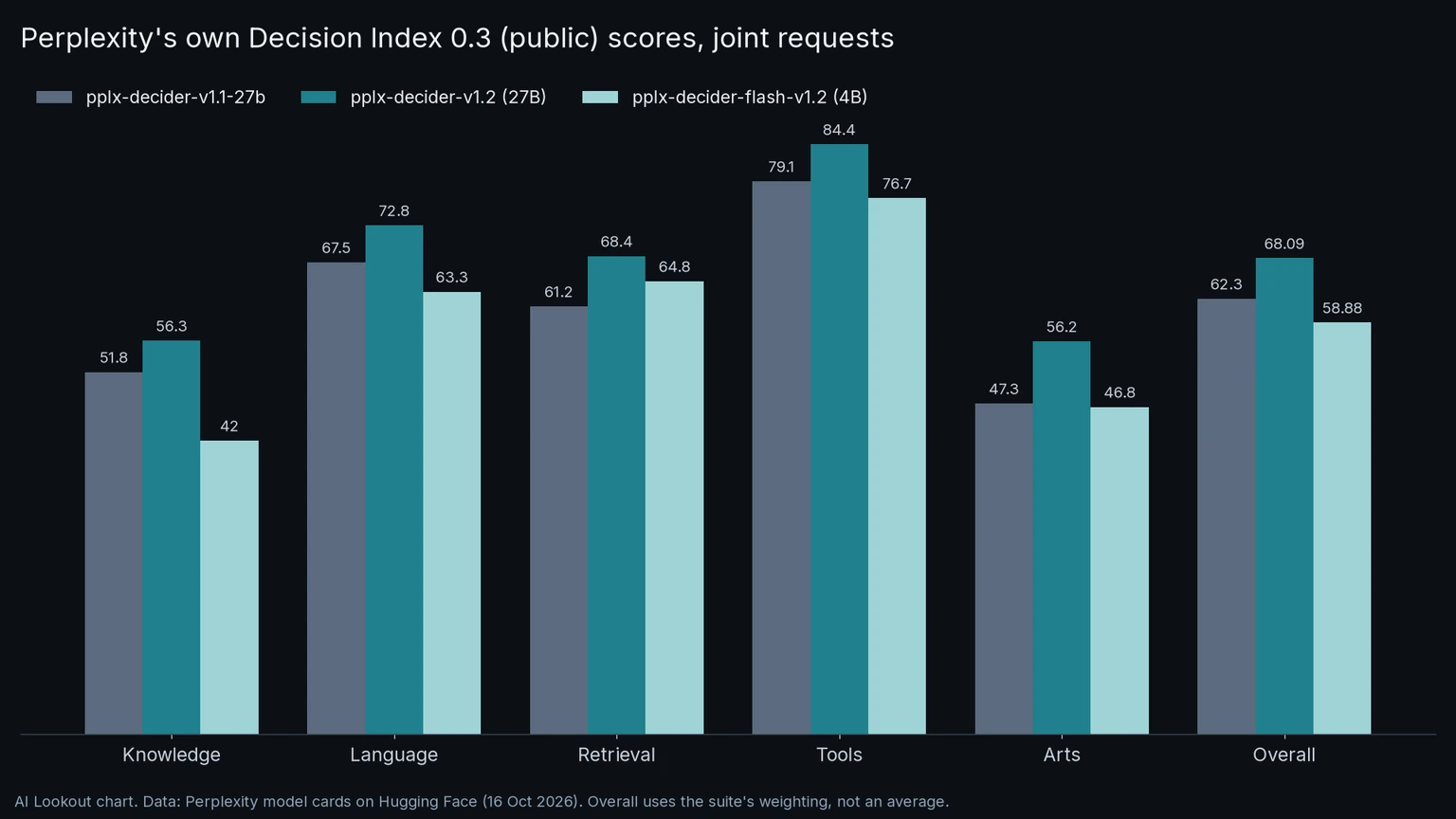
On Perplexity's own run of the public part of Decision Index 0.3, the 27B model scores 68.09 overall with joint requests, up from 62.30 for v1.1. Every category improves, with the biggest gains in Arts, up 8.9 points, and Retrieval, up 7.2. On the vision version of the index, with images up to 1.6 megapixels, the score rises from 73.22 to 77.43.
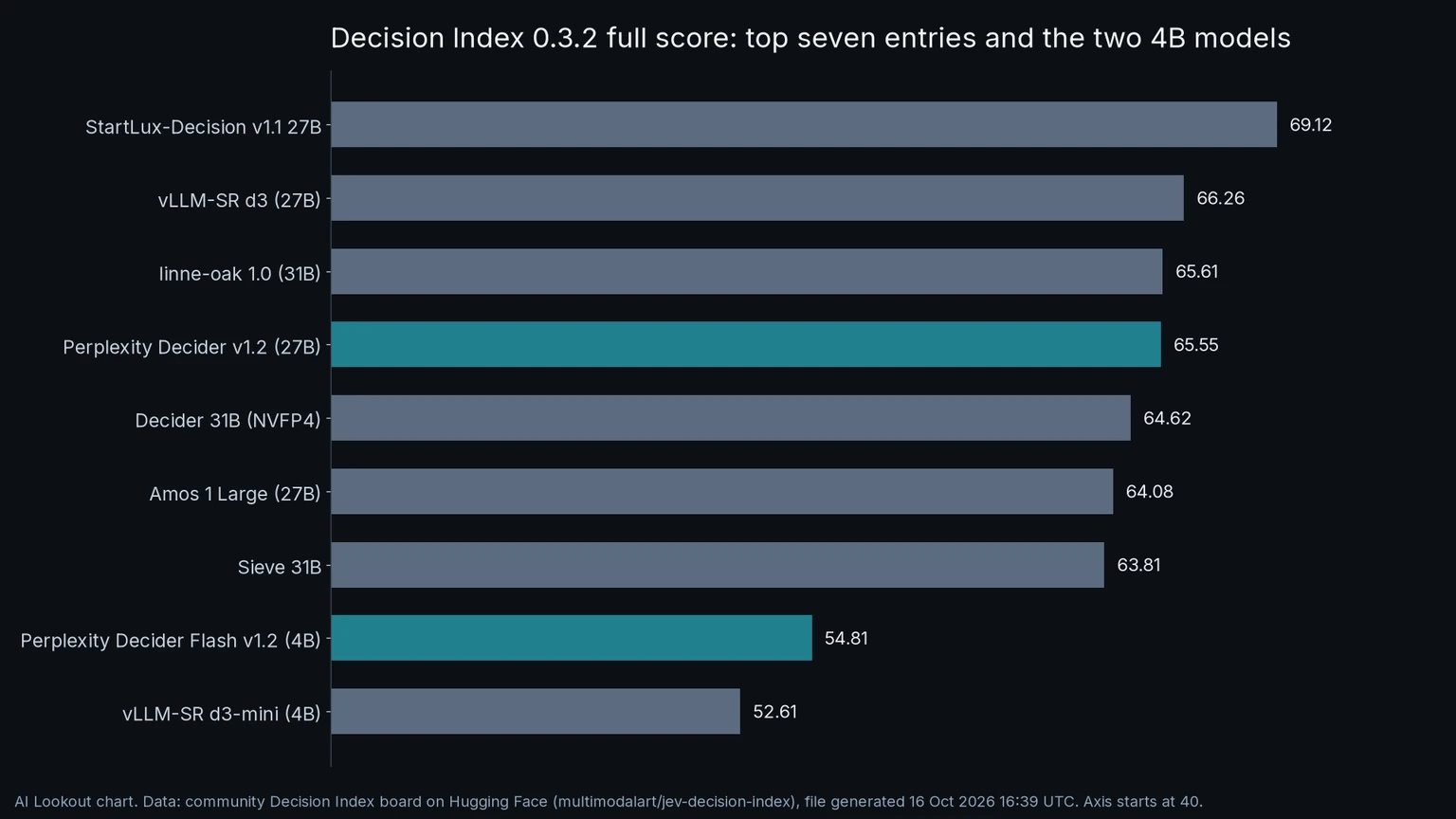
Perplexity chief executive Aravind Srinivas said the 27B model is second overall on the Decision Index. AI Lookout read the data file behind the community-run Decision Index board on Hugging Face, generated on 16 October at 16:39 UTC. It lists 173 configurations. Decider v1.2 has a full score of 65.55, which blends public benchmarks with private tests. That is fourth by raw score, behind StartLux-Decision v1.1 at 69.12, vLLM-SR d3 at 66.26 and linne-oak 1.0 at 65.61. The board groups it in its second tier with the latter two, which is where the second-place claim comes from.
The board's public-benchmark figure for the model is 67.74, close to the 68.09 Perplexity reports. The Decision Index is a community board hosted in a personal Hugging Face Space rather than run by a standards body, and it changes every few days as entrants are added.
Flash: a 4B model distilled from the 27B
Flash is about one seventh the size of the 27B model. Perplexity says it was distilled from the 27B decision models on their training requests, learning their full probability distributions rather than just their final answers, and then combined from several training runs by weight averaging.
Its public Decision Index score is 58.88 with joint requests and 60.05 with one question per request. Unlike the larger model, Flash is more accurate when questions are sent separately on most multi-question tasks. On the vision index it scores 72.53, against 77.43 for the 27B model.
Srinivas called Flash the top 4B model on the Decision Index. On the board data AI Lookout checked, it has a full score of 54.81, the highest of the entries labelled 4B, ahead of vLLM-SR d3-mini at 52.61. It sits 47th overall, behind many larger models, so it is a cost and latency option rather than a replacement for the 27B.
Price, access and hardware
Perplexity's API changelog lists pplx-decider-v1.2 at $0.02 per million input tokens and Flash at $0.01. Output tokens are free and there is no per-request fee. New aliases, pplx-decider-latest and pplx-decider-flash-latest, follow the newest version of each model, and requests that still name v1 or v1.1 now select v1.2.
The models also appeared on OpenRouter and Vercel's AI Gateway on launch day. Srinivas wrote that at one cent per million tokens a customer could consume a trillion tokens a month for $10,000, and that Perplexity would keep optimizing serving to push the price lower.
Self-hosting needs a CUDA GPU with room for about 52 GiB of BF16 weights for the 27B model and about 9 GiB for Flash, plus Python 3.12. The card's optional fast path packs requests, compiles decoder layers and replays CUDA graphs. On one Nvidia GB200 Perplexity measured 19.8 Decision Index requests per second with the default fast path, 2.18 times its reference path, and a median of 96 milliseconds for a single request.
Calibration and the limits Perplexity lists
Each checkpoint stores a temperature fitted on held-out data to calibrate its probabilities. On a 1,497-question development set Perplexity reports 91.3% accuracy and an expected calibration error of 0.014 for the 27B model, and 88.8% and 0.021 for Flash. On decision datasets held out from all training, the card says probabilities remain somewhat over-confident, at a calibration error of about 0.05, though less so than v1.1.
A question can have between one and 255 options. The context limit is 262,144 tokens, but training used sequences of about 32,000 tokens, and Perplexity says it has only spot-checked longer inputs, such as finding one fact in a 243,000-token log. Requests that exceed the limit are split recursively, which means they are no longer fully joint.
One oddity: the usage section of both cards still says the repository is private and needs a token with access. When AI Lookout checked on 17 October, the cards and file listings were publicly readable without a login. We did not download or run the weights.
Why decision models matter for agents
Decision models have become a busy niche this month because agents make many small judgments: which tool to call, whether a page answers the question, whether a message is a scam. Using a full chat model for each is slow and expensive, and its free-text answers are hard to threshold. OpenAI opened a Decisions API beta earlier this month, and Microsoft put Decision-1 in Foundry.
Other entrants have followed quickly, including Liquid AI's hosted d1-ultra and the open vLLM Semantic Router d3 models, one of which sits near the top of the same board. Perplexity's angle is price and openness together: Apache 2.0 weights that anyone can run, and a hosted price of one or two cents per million tokens for teams that do not want to.
The joint format is the more interesting technical change. Pricing that charges only for input rewards packing several questions about one document into a single call, and the card is unusually candid that doing so can lower accuracy when the questions compete.
What is still unclear
The benchmark figures in the cards are Perplexity's own. Some Decision Index tasks ship official training splits, and Perplexity says v1.2 now trains on those splits, decontaminated against the test sets. That makes comparisons with other entrants that do the same fairer, but it also means part of the gain over v1.1 comes from being in-domain for the benchmark. Perplexity says the model also improves on decision tasks held out from all training, without publishing those numbers in full.
Perplexity has not published a paper or a breakdown of the new training data. The Decision Index itself is young and community-run, and its top spot has changed hands more than once in October. Teams choosing a decision model should test it on their own labels, especially beyond 32,000 tokens, where the card says behaviour is less validated.
Common questions
What is a decision model?
A model that reads content and returns probabilities for typed answers, such as yes or no, one option from a list, or a rubric score, instead of writing text. Code then acts on those numbers for routing, ranking, moderation or verification.
How much does pplx-decider-v1.2 cost?
Perplexity's API lists $0.02 per million input tokens for the 27B model and $0.01 for Flash, with output tokens free and no per-request fee. The weights are free to download under Apache 2.0.
Is it really number two on the Decision Index?
On the board data AI Lookout read, generated on 16 October, it scored 65.55, fourth by raw score and in the board's second tier alongside vLLM-SR d3 and linne-oak 1.0. StartLux-Decision v1.1 led at 69.12.
Sources & further reading
- perplexity-ai/pplx-decider-v1.2 model card ↗
- perplexity-ai/pplx-decider-flash-v1.2 model card ↗
- Perplexity API changelog: Decisions API pplx-decider-v1.2 and pplx-decider-flash-v1.2 ↗
- Decider V1.2 API pricing and providers ↗
- Perplexity's Decider V1.2 models now available on AI Gateway ↗
- Decision Index 0.3.2 board data (data/index.json) ↗
How this story was made
Written by Kristian Kostov with AI assistance and checked against the linked sources. Company performance claims are attributed to the company. Analysis reflects AiLookout’s interpretation; we have not independently tested the products discussed. The cover places the companies’ own logos, taken from public-domain or openly licensed files credited in the caption, on a plain background. It is not a product photograph, a screenshot, or an endorsement.
Our editorial standards