Announced 15 Oct 2026 · Sources checked
What Liquid AI released on 15 October
Liquid AI, the MIT-born company known for its compact Liquid Foundation Models, published a launch post for d1-ultra on 15 October 2026. It calls d1-ultra its new multimodal decision model and its most capable decision model so far, and says it was built for harder, messier real-world cases than earlier models in the category, such as spotting a defect on a circuit board against its specification or checking a damage claim against the customer's photo.
The model went live the same day on Liquid's own API at $0.042 per million input tokens. Vercel posted a changelog entry the same day saying d1-ultra is available on its AI Gateway, and OpenRouter's model page lists it with a 15 October release date, so the developer routes Liquid described as coming soon were already open when we checked on 16 October.
This is the second d1 release in eight days. On 7 October Liquid published two small open-weight d1 models for edge devices, d1-3B and d1-omni-600M. d1-ultra is a different kind of product: a larger hosted model offered through an API, and Liquid's post does not mention downloadable weights.
How a decision model differs from a chatbot
A decision model answers questions about a situation with a probability for each possible answer, rather than writing a reply. Liquid's description of d1-ultra is precise: it takes unstructured input (text, images or both) and one or more questions, reads the input in one forward pass, and returns the probabilities without generating any tokens. That makes the output easy to plug into software. A program can act when the probability of 'defective' is above a threshold and send the case to a person when it is not.
d1-ultra answers the same three question types as the original d1. A yes/no question, which Liquid's API calls a 'noul', comes back as a probability between 0 and 1. A Choice question picks one label from a set and returns a probability for each label. A Score question places the input on an ordered scale, such as the severity of a bug. Liquid's documentation lists the usual jobs for this: ticket routing, intent detection, content moderation, urgency scoring, guardrails and visual inspection.
Liquid's code sample shows the shape of a call. A request to its decisions endpoint names the model, attaches a base64 image, gives a short 'state' such as 'Camera image of a circuit board on the production line', and asks one question: 'Does this circuit board have a defect?' The answer comes back as a probability. Several questions can be asked about the same input in one request, which Vercel's changelog notes is useful for deciding when to automate an action and when to ask for human review.
Liquid AI's d1-ultra benchmark numbers
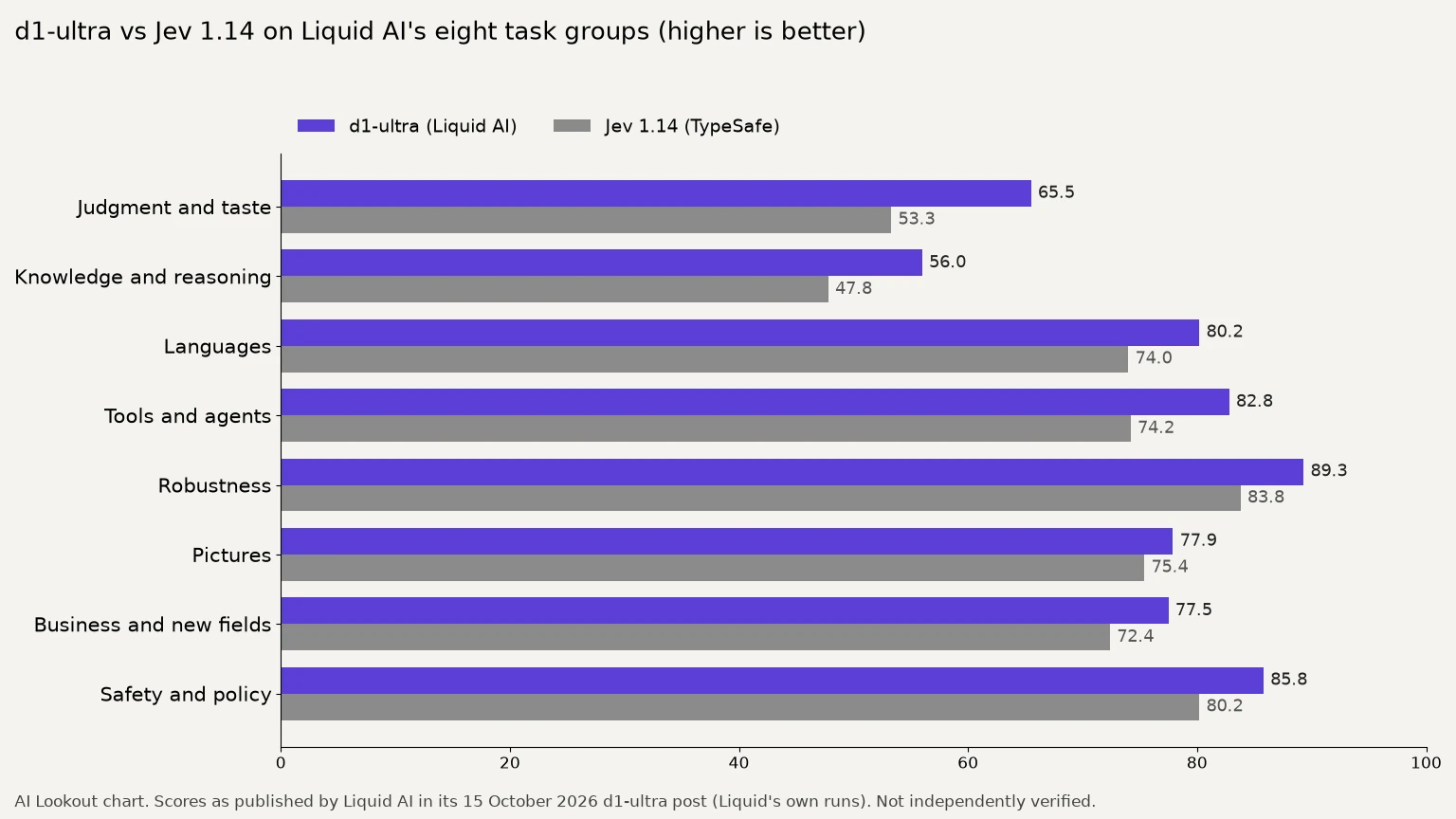
Liquid says d1-ultra is based on a larger open-weight model than d1, with what it calls a series of Liquid-specific heavy customizations, and that the gains are largest on knowledge-related tasks. It does not name the base model. It compared d1-ultra with d1 and with TypeSafe's Jev 1.14 across 112 evaluations, grouped into eight task areas.
In Liquid's table, d1-ultra averages 76.7 across the eight groups. The next best is vLLM Semantic Router's d3 at 73.5, followed by Perplexity's pplx-decider v1.1 at 70.3, Jev 1.14 at 69.4, Cloudflare's Clef at 67.0, Microsoft-Decision-1 at 66.6 and GPT-6 Luna through OpenAI's Decisions API at 60.9. The widest gaps over Jev are in judgment and taste, 65.5 against 53.3, and knowledge and reasoning, 56.0 against 47.8. The narrowest is pictures, 77.9 against 75.4, which matters because image checks are the headline use case. Microsoft-Decision-1 and GPT-6 Luna have no pictures score in the table.
Liquid also shows d1-ultra on the Artificial Analysis Decision Index, an independent benchmark that weights four tests equally: a decision version of AA-Omniscience for knowledge and hallucination, the text-only multiple-choice questions from Humanity's Last Exam, NVIDIA's When2Call tool-calling test, and the WildGuardTest safety classifier test. In the chart Liquid reproduces, d1-ultra scores 65, Jev 1.14 57, and GLIDE and Microsoft-Decision-1 54 each, which is the basis for Liquid's claim that it leads every other decision model by at least 8 points. Artificial Analysis's own index page already lists d1-ultra.
Calibration: why the probabilities matter
Liquid argues that accuracy is not enough for this kind of model, because the probability is the product. If a model says it is 95 per cent sure and is right only 85 per cent of the time, any threshold built on that number will let through more mistakes than the team expected. Liquid says most decision models it tested are overconfident in exactly this way, and that it trained d1-ultra specifically to produce more reliable probabilities.
Its calibration chart measures the average gap between stated confidence and actual accuracy. Liquid puts d1-ultra at 1.5 points, ahead of d3 at 2.6, Jev 1.14 at 2.7, Clef at 4.4, d1 at 4.6, Microsoft-Decision-1 at 4.7, pplx-decider-v1.1 at 5.2 and GPT-6 Luna's Decisions API at 7.2. The accompanying curve shows most rivals sitting below the line, right less often than they claim, while d1-ultra sits slightly above it, which means it is a little underconfident at mid-range confidence levels rather than overconfident.
For a business, that is the practical claim to test. A well-calibrated model lets a team set a cut-off, say auto-approve above 0.9, and know roughly how many errors will slip through. It is also the claim most likely to shift on a company's own data, because calibration measured on public benchmarks does not automatically carry over to a new product line or a new kind of claim photo.
d1-ultra pricing, API access, Vercel and OpenRouter
d1-ultra is billed on input tokens only, at $0.042 per million. Images are counted at the same rate as text, at 1.5 tokens per 32x32-pixel patch, so a 1024x1024 photo costs 1,536 tokens. Each question is billed as its own prompt, including its text and all the images, so asking five questions about one photo costs roughly five times as much as asking one. At the list price, one 1024x1024 image with a single question comes to well under a hundredth of a cent.
Vercel's AI Gateway lists the model as liquid/d1-ultra with a 32,768-token context window. Vercel shows three ways to call it: an experimental decide function in its AI SDK, an OpenAI-compatible Decisions API, and a TypeSafe-compatible API, and says it passes on provider pricing with no markup. OpenRouter lists the same price, $0 for output, a 33K context and one provider, Liquid, and runs it on its Decisions API rather than the chat completions endpoint, so ordinary chat SDKs will not work with it. Its page showed a median latency of 0.21 seconds when we checked.
Developers can also try the model in Liquid's Console and its d1 Playground, which Liquid says hosts more demos running on d1-ultra. The full API reference sits in Liquid's decision models documentation.
Where d1-ultra fits in a crowded decision-model market
Decision models have become one of the busiest corners of AI this autumn. TypeSafe's Jev, the model d1-ultra is measured against, is the category's best-known product, and TypeSafe announced an $870 million Series A on 9 October. Its earlier Jev 1.13 was also listed at $0.042 per million input tokens, and Liquid says d1-ultra beats Jev 1.14 at the same price, so the pitch is better answers at Jev's price rather than a cheaper model.
The same day as d1-ultra, Respan released Span-02, an open-weight decision model that returns its best answer by a deadline you set. Earlier in October, Microsoft opened Decision-1 in Foundry, and Cloudflare, Perplexity and vLLM Semantic Router all shipped decision models of their own. For buyers, that means real choice: hosted or open weights, text-only or multimodal, and different trade-offs between speed and accuracy.
Liquid's angle is the combination of images and calibration in one cheap hosted call. Visual checks against a reference, such as whether a product photo matches its listing or whether a part matches its specification, are common in manufacturing, insurance and e-commerce, and today they are often done with a general vision-language model asked to write an answer that then has to be parsed.
What we do not know yet
Every benchmark and calibration figure in this article comes from Liquid's post. The 112 evaluations are Liquid's own selection, run by Liquid. The Artificial Analysis Decision Index is an independent benchmark, but the score we quote is the one shown in Liquid's chart. AI Lookout has not tested d1-ultra on any task.
Liquid does not say which open-weight model d1-ultra is built on, how large it is, or whether weights will follow, as they did for d1-3B. It gives no latency figures of its own. And the pictures score, the smallest lead in the table, is the one most relevant to the circuit-board and damage-claim examples in the launch, so teams with visual workloads should run their own samples before relying on it.
Common questions
How much does d1-ultra cost?
Liquid lists d1-ultra at $0.042 per million input tokens with no output-token charge. Images count at 1.5 tokens per 32x32 patch, so a 1024x1024 image is 1,536 tokens, and each question is billed as a separate prompt.
Where can I use d1-ultra?
On Liquid's API, Console and d1 Playground, and as liquid/d1-ultra on Vercel AI Gateway and OpenRouter. Liquid's post does not mention downloadable weights.
What questions can d1-ultra answer?
Yes/no questions with a probability from 0 to 1, Choice questions that pick one label from a set, and Score questions that place the input on an ordered scale. It reads text, images or both.
Sources & further reading
How this story was made
Written by Kristian Kostov with AI assistance and checked against the linked sources. Company performance claims are attributed to the company. Analysis reflects AiLookout’s interpretation; we have not independently tested the products discussed. The cover places the companies’ own logos, taken from public-domain or openly licensed files credited in the caption, on a plain background. It is not a product photograph, a screenshot, or an endorsement.
Our editorial standards