Announced 10 Oct 2026 · Sources checked
What is Decision 3.0?
Decision 3.0 is the third family of decision models from vLLM Semantic Router, an Apache-2.0 subproject of the vLLM inference engine that decides, before an expensive model runs, which model a request should go to. The Decision 3.0 collection on Hugging Face holds six models. The flagship d3 was created on 10 October at 09:38 UTC, d3-flash, d3-mini, d3-nano and d3-lite followed that afternoon, and d3-edge arrived just before midnight UTC.
The sizes, as the model cards list them: d3 has 26.09 billion parameters on Qwen3.8-27B, d3-flash 8.39 billion on Qwen3.5-9B, d3-mini 4.54 billion on Qwen3.5-4B, d3-nano 2.21 billion on Qwen3.5-2B, d3-lite 0.85 billion and d3-edge 0.59 billion, both listing Qwen3.5-0.8B as their base. Each count includes a vision encoder of 0.10 to 0.46 billion parameters. The cards say the models were trained on AMD Instinct MI325X GPUs.
The family arrives in a crowded month. Decision models became a category in September with TypeSafe’s Jev, and since then we have covered Microsoft’s Decision-1, OpenAI’s Decisions API and Liquid AI’s d1 edge models. The same team’s Decision 2.0 came out at the end of September; its cards describe text inputs only.
How does a decision model answer without writing text?
A decision model treats a closed question as classification. You send a state, such as a support message or a JSON record, plus named questions. Each question is a choice among labelled options, a yes/no (written noul in the API), or a score on a scale. The model reads the input once per question and returns a probability for every option, so there is nothing to parse and no chance of a free-text answer drifting off format.
The d3 card’s example routes a damaged-delivery complaint. In one call it asks which team should handle it (returns, billing or technical), whether the customer has a receipt, and how urgent it is (routine, soon or today). Add a photo of the receipt and you can also ask whether it lists the blender and how the order was paid.
That is why the format suits routers and agents. Choosing a model tier, deciding whether a request needs multi-step reasoning, or checking a policy rule are all closed questions. The same idea underpins GUI-Decisions’ slot-reading click models, which read a computer-use action from token probabilities instead of writing it out.
How does d3 score against Jev and the other decision models?
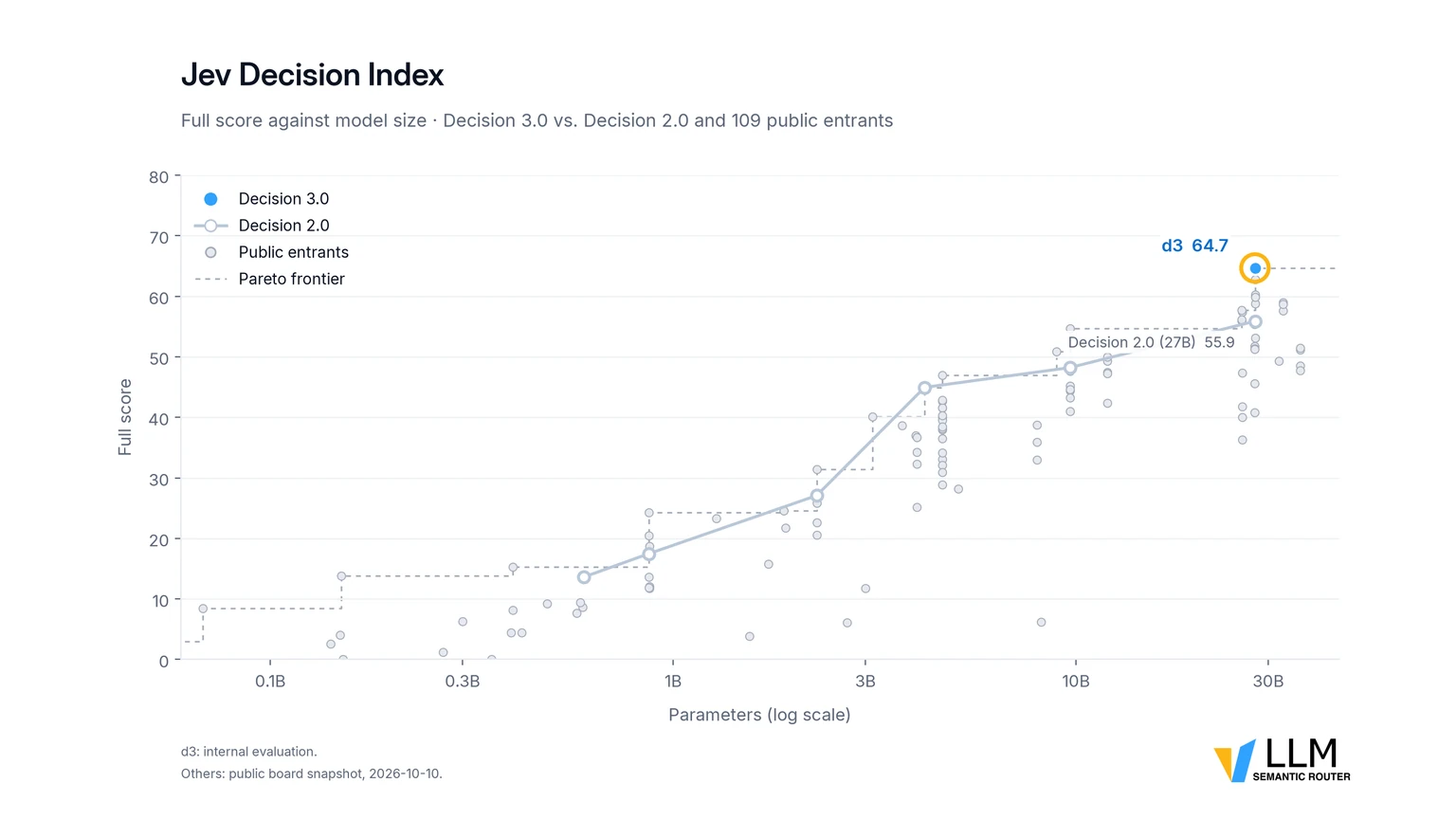
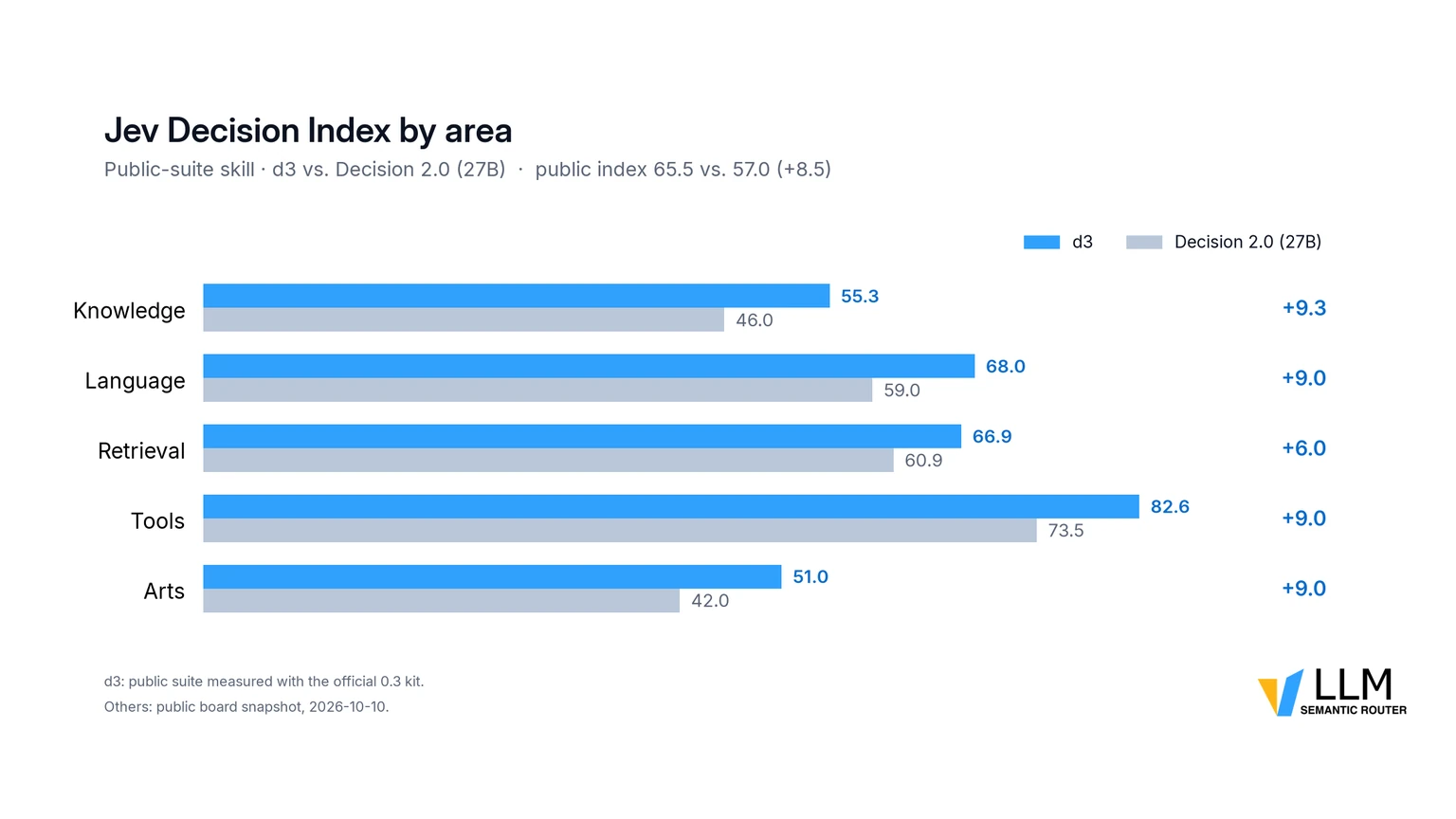
The team reports d3 at 65.45 on the public suite of the Jev Decision Index 0.3, measured with the official 0.3 kit on the released weights, with all 140,178 public requests answered. That is 8.5 points above its own Decision 2.0 27B model’s 56.97 on the board.
On the full 0.3.1 index, d3 scores 64.7, with 62.8 on same-skill tests and 56.6 on new-domain tasks. The live-board rows it compares against, captured on 10 October, are Perplexity Decider v1.1 (27B) at 62.8, Fastino’s GLiDE without thinking (28B) at 60.2, Jev at 60.1, Torchcast Decision 27B at 59.9 and Decision 2.0 at 55.9. Torchcast is close on the public suite, 65.1 to d3’s 65.5; d3’s lead comes from the same-skill and new-domain parts.
The smaller models trail as you would expect. Public-suite scores are 57.79 for d3-flash, 54.90 for d3-mini, 42.22 for d3-nano, 36.93 for d3-lite and 28.82 for d3-edge. By area, d3 gains between 6.0 points (retrieval) and 9.3 points (knowledge) over Decision 2.0, and scores highest on tool-related questions at 82.6.
| Model | Index | Public | Same-skill | New-domain |
|---|---|---|---|---|
| d3 (27B) | 64.7 | 65.5 | 62.8 | 56.6 |
| Perplexity Decider v1.1 (27B) | 62.8 | 62.3 | 61.1 | 55.6 |
| Fastino GLiDE no-thinking (28B) | 60.2 | 59.1 | 59.5 | 52.9 |
| Jev | 60.1 | 58.0 | 58.0 | 55.0 |
| Torchcast Decision 27B | 59.9 | 65.1 | 58.1 | 50.8 |
| Decision 2.0 (27B) | 55.9 | 57.0 | 55.7 | 47.9 |
What changes with images and video?
Every d3 size accepts several images (PNG, JPEG or WebP) and several videos (MP4, WebM, MOV or MKV) per request, and every question sees all of them. Images are read at up to 1.6 megapixels each. Videos are sampled at two frames per second, up to 32 frames spread over the clip at about 0.2 megapixels each.
On the Jev Decision Index vision board, d3 scores 71.6 against 70.6 for Perplexity Decider v1.1 and 69.6 for JEV-27B-VL. On Perception Test, a multiple-choice video benchmark with three options per question, d3 gets 77.4% across 19,140 questions in the team’s internal run, against 33.3% for chance.
The card also lists weak spots. d3 reaches 96.7 on an approximate InfographicVQA rebuild and 97.7 on receipt and form extraction, but only 43.9 on Hateful Memes moderation, 47.0 on MMMU-Pro vision and 33.0 on R-Bench-M. Anyone planning to use it for content moderation should test on their own data first.
Which size should you run, and where?
Speed scales with size. On one AMD Instinct MI325X, one request at a time, d3 takes a median 55 ms for text, 273 ms with an image and 553 ms with a 10-second video. d3-flash takes 19.1, 149.4 and 407.6 ms, d3-mini 17.5, 96.2 and 371.5 ms, and d3-edge 6.7, 41.9 and 308.3 ms. Video time is dominated by reading frames, so the gap between sizes narrows there.
You can load any size with Hugging Face transformers 5.17 and trust_remote_code, which runs the Python files shipped in the model repository, so pin a revision and review them. The alternative is vLLM Semantic Router’s Engine mode, which serves one model behind a /v1/systemone endpoint on port 8899 on CPU, CUDA or ROCm. Its documentation caps each image at 8 MB and each video at 32 MB and 300 seconds, and Engine mode is only in the development channel until a stable release includes it.
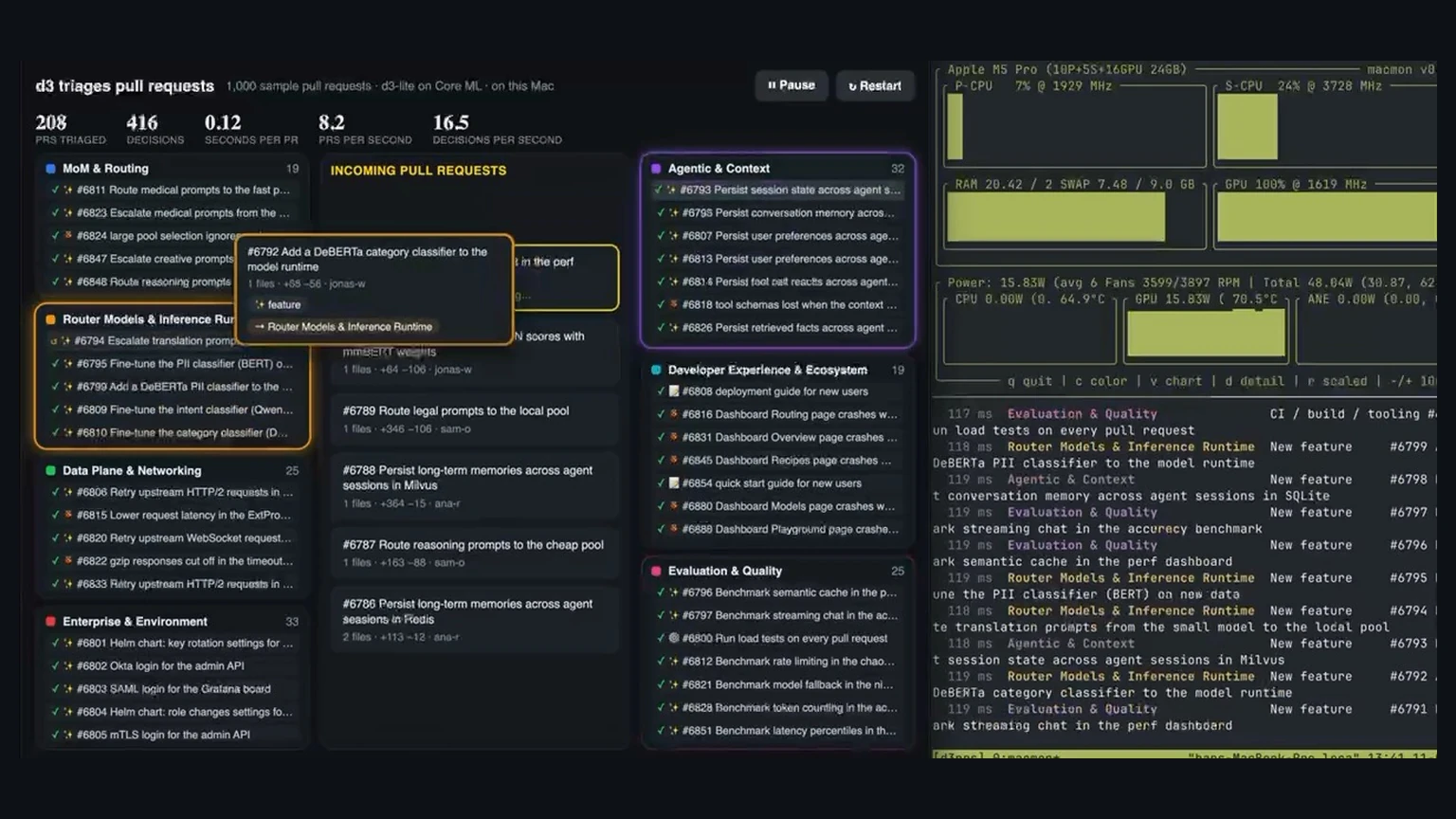
For Macs, a post on the project’s blog dated 11 October describes Core ML conversions of d3-lite, d3-nano and d3-mini by Alex Wengg of FluidInference. On an M5 Pro MacBook Pro, median requests took 53, 69 and 169 ms, two and a half to four times faster than PyTorch, at matching accuracy. In demos, d3-lite triaged sample pull requests at 0.12 s each, and d3-mini matched maintainers’ workgroup labels on 134 of 168 real ones.
What are the caveats?
The headline numbers are the team’s own. The d3 rows are internal evaluations measured with the public kit, not results certified on a sealed leaderboard, and several vision benchmarks are marked as approximate rebuilds. The board entries for rival models are a snapshot from 9 and 10 October and may have moved.
There was no launch blog post for the model family itself. The sources are the six model cards, the collection, the repository’s pull requests and the Apple Silicon post, which says its author had early access. Release-day decision models have tended to see their claims revised within days, as with Microsoft’s Decision-1 update, so treat the ranking as provisional.
Licensing is the clean part: Apache-2.0 on every card, matching the Apache-2.0 Qwen bases. The open question is fit. A decision model is only as good as the questions you write, so the sensible first step is to run d3-mini or d3-flash on a few hundred of your own labelled cases. If your stack already uses typed decisions, the Jev background explains the API shape these models copy.
We read the six model cards, the d3 LICENSE, NOTICE and manifest, the Hugging Face API records, the Engine-mode documentation and the Apple Silicon post on 12 October 2026. We did not run the models.
Common questions
Is Decision 3.0 free for commercial use?
Yes, by its licences. All six model cards are Apache-2.0, and the d3 NOTICE says it is built on Qwen3.8-27B, also Apache-2.0. Loading through transformers runs code from the repository, so review it and pin a revision.
How is a decision model different from a chat model?
It does not write an answer. You define closed questions (a choice, yes or no, or a score) and the model returns a probability for each option in one pass per question, which is faster and easier to parse than generated text.
Can d3 run on a laptop?
The smaller sizes can. Community Core ML conversions of d3-lite, d3-nano and d3-mini ran on a 24 GB M5 Pro MacBook Pro at median request times of 53 to 169 ms, according to the project’s blog post.
What to remember
Decision 3.0 extends single-pass typed decisions to images and video in six Apache-2.0 sizes, with the 27B d3 leading the Jev Decision Index on the team’s own measurement.
Sources & further reading
How this story was made
Written by Kristian Kostov with AI assistance and checked against the linked sources. Company performance claims are attributed to the company. Analysis reflects AiLookout’s interpretation; we have not independently tested the products discussed. Cover photography is illustrative and does not depict the specific announcement or product.
Our editorial standards