
Announced 15 Oct 2026 · Sources checked
What did StepFun put on Hugging Face today?
StepFun’s product page for Step 5 Preview has said for days that the model would ship with open weights on 15 October. That date is today, and the official stepfun-ai Hugging Face organization now lists the matching repositories. We confirmed public, ungated listings for stepfun-ai/Step-5-Preview, stepfun-ai/Step-5-Preview-BF16 and stepfun-ai/Step-5-Preview-NVFP4. Earlier in the morning, only third-party mirrors such as SHSLab and TypeSafeAI held BF16 copies; those are still community uploads, not StepFun’s release.
The BF16 model card we read shows a 604B-parameter safetensors tree, a LICENSE.txt, serving notes for vLLM and SGLang, and a Transformers offline path. The repositories are marked private: false and gated: false. Commit activity on the BF16 README continues into 15 October. That is the material change from prior hourly checks, which repeatedly found Step-3.7-Flash as the newest public StepFun model on the org.
StepFun had already opened the hosted path. The product page and platform docs describe Step 5 Preview as available through StepFun products and an OpenAI-compatible API under the model id step-5-preview. The open-weight drop is therefore a distribution event for self-hosting and research, not the first time outsiders could call the model.
How is Step 5 Preview built, and what can it take as input?
StepFun describes Step 5 Preview as a sparse mixture-of-experts model with 600B total parameters and 27B active per token. The context window is up to 1 million tokens. The Hugging Face card lists text and image as inputs and text as output; the product page and docs also advertise native video input for short clips (MP4, QuickTime, Matroska, under 128 MB, under five minutes recommended).
The company’s framing is agentic work rather than chat alone. The card highlights repository-level software engineering, long-horizon tool loops, professional document analysis, and a deliberate push on finance tasks that mix quantitative reasoning with filings and charts. Reasoning effort can be set to low, medium or high (docs also mention xhigh in places). Tool calling and JSON schema output are called out as first-class features.
Hardware notes on the card are blunt about size. FP8 serving examples start at four B300 GPUs or eight H200 GPUs. BF16 examples go up to eight B300 GPUs on one node or sixteen H200 GPUs across two nodes. Dedicated Docker tags exist for vLLM (vllm/vllm-openai:step-5-preview) and SGLang (lmsysorg/sglang:step-5-preview). The 1M-token context is a combined input-plus-output ceiling; the docs separately cap maximum output at 64k tokens on the API.
What do StepFun’s own benchmarks claim?
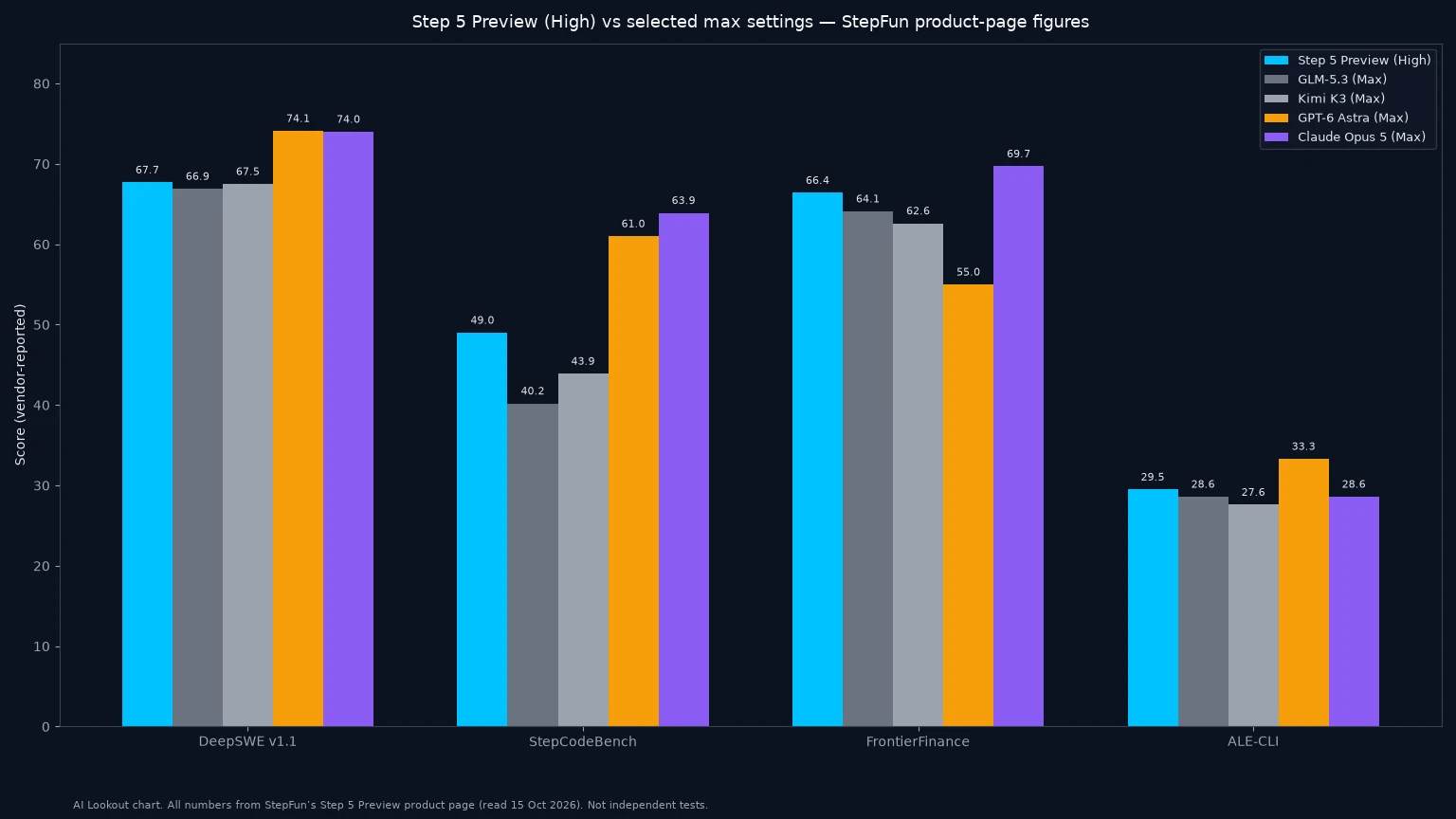
StepFun publishes a large scoreboard on the product page. The numbers below are the company’s High-reasoning runs unless noted. They are not independent replications. On DeepSWE v1.1, Step 5 Preview High scores 67.7, just above Kimi K3 Max (67.5) and GLM-5.3 Max (66.9), and behind GPT-6 Astra Max (74.1) and Claude Opus 5 Max (74.0). On StepFun’s own StepCodeBench, it leads the open-weight peers it lists at 49.0, still well below Claude Opus 5 Max at 63.9 and GPT-6 Astra Max at 61.0.
Finance is where StepFun leans hardest in marketing. FrontierFinance shows Step 5 Preview High at 66.4, ahead of GLM-5.3 Max (64.1), Kimi K3 Max (62.6) and GPT-6 Astra Max (55.0), and behind Claude Opus 5 Max (69.7). Internal FinStepBench rows for live search, corporate valuation and deep research are similarly mixed: competitive with Chinese open peers, sometimes trailing Claude or GPT-6 Astra on valuation. Agents’ Last Exam (ALE-CLI) has Step 5 Preview High at 29.5, above GLM-5.3 and Kimi K3, below GPT-6 Astra’s 33.3.
Artificial Analysis’s Intelligence Index is listed at 44 for Step 5 Preview. StepFun uses that score, with a cost-per-task chart, to argue it sits on a favourable intelligence-versus-price frontier. GDPval-AA v2.1 is cited as of 20 September 2026. Recommended sampling settings on the card are temperature 1.0, top_p 0.95, top_k 0. Treat the whole table as vendor evaluation until third-party harnesses publish matching runs on the new checkpoints.
How do you run the open weights, and what does the API cost?
Self-hosters can pull the official repos and serve with the Step 5 Preview container images. The BF16 card walks through tensor, expert and data-parallel layouts, MegaMoE on Blackwell, and MTP or EAGLE speculative decoding flags. Offline Transformers generation is documented, with an explicit caveat that the full BF16 convert-then-generate file-shard path has not yet been validated end to end. For teams that want the model without racking GPUs, StepFun’s API remains the path of least resistance; list prices on the pricing page are $1.00 per million input tokens on a cache miss, $0.10 on a cache hit, and $2.70 per million output tokens. Output billing includes reasoning tokens.
That API rate is the figure third-party roundups have been quoting since the hosted launch. It is materially cheaper per token than many frontier closed models at max settings, which is the core of StepFun’s Pareto-frontier pitch. Rate limits on the Open Platform still scale with cumulative cash top-ups for individual accounts, from a V0 tier under $15 up to V4 at $1,500 and above.
Open weights do not automatically mean a free-for-all commercial stack. As with other recent large Chinese MoE drops such as Ant Group’s Ling-3.1-flash, you still have to read the license before embedding the model in a product. StepFun’s card also points builders at Claude Code integration notes and the usual OpenAI-compatible chat completions shape, which lowers the switching cost for agent frameworks that already speak that protocol.
What does the StepFun Model License 1.0 actually allow?
The LICENSE.txt in the BF16 repo is StepFun Model License 1.0. StepFun describes it as Apache-2.0-style with extra conditions. You get a perpetual, worldwide, royalty-free copyright and patent license to use, copy, distribute, modify and create derivative works, subject to redistribution notices and attribution. That is the open-weight half of the deal.
Two commercial triggers matter. First, if a commercial product that uses the model or a derivative exceeds 100 million active users or $20 million in revenue in a calendar month, you must prominently display “Powered by StepFun AI” (or a designated model name). Second, a separate commercial license is required before you ship the model’s capabilities as a feature of hardware devices you manufacture for end users, or before you run a Model-as-a-Service business once your group’s trailing twelve-month revenue exceeds $20 million. Internal use that never exposes the model to third parties is carved out.
Section 3 also withholds trademark rights. That is why this article’s cover is a labeled AI Lookout illustration rather than a StepFun wordmark. The same line is why we treat open weights as distinct from open source here: the weights are downloadable under a custom model license, not under a pure OSI-approved grant without field-of-use and branding conditions.
Why an official open-weight release matters now
An official org upload closes a week of ambiguity. Builders who refused third-party mirrors now have a canonical checksummed source, matching Docker tags, and a license text StepFun itself published. That matters for compliance reviews, for vLLM and SGLang maintainers who wire model-specific parsers, and for evaluators who want to attach scores to a named checkpoint rather than an anonymous BF16 dump.
It also adds another large open MoE to a crowded mid-October shelf beside Ling-3.1-flash, Liquid’s on-device LFM2.5-24B-A2B, and free hosted paths such as Vercel’s Nemotron 3.5 Lightning gateway. Step 5 Preview is aimed higher up the agent stack: long-horizon coding, finance research and 1M-token workflows, at an API price designed to undercut closed frontier list rates while the weights let labs keep inference on their own metal.
For StepFun, the open drop is a credibility play as much as a distribution play. The company has been scoring itself against Claude Opus 5 and GPT-6 Astra in public tables; putting the weights where anyone can download them invites outsiders to confirm or puncture those claims. That is the useful pressure open weights create even when the license is not pure Apache.
What is still unverified
We have not downloaded multi-hundred-gigabyte shards or run the model. We have not verified that every safetensor file matches a published hash beyond what Hugging Face’s UI shows, and we have not reproduced DeepSWE, StepCodeBench or FrontierFinance. Video input appears on the product page and docs but is listed only as text and image on the BF16 card’s specification table; treat modality support as card-plus-docs, not card alone.
The product page still carried the schedule line “The model will be released with open weights on October 15” when we read it, even after the official repos were visible. That is consistent with a same-day cutover, but it also means the marketing page can lag the Hugging Face org by minutes or hours. Prefer the stepfun-ai repositories and LICENSE.txt as the source of truth for what is actually downloadable.
Commercial readers should get counsel on Section 2(c) before shipping device-bundled or MaaS products near the revenue thresholds. Attribution triggers under Section 2(b) are automatic once the monthly user or revenue floors are crossed. None of StepFun’s benchmark leads should be read as settled rankings until independent harnesses publish matching evaluations on these checkpoints.
Common questions
Are the SHSLab or TypeSafeAI Step-5 mirrors the official release?
No. They are third-party uploads. Use repositories under the stepfun-ai organization on Hugging Face, plus the StepFun Model License 1.0 file in those repos.
Is Step 5 Preview free to use commercially?
You can download and run it under StepFun Model License 1.0, but hardware OEM features and large MaaS deployments above the license’s revenue threshold need a separate commercial agreement, and very large commercial products must show StepFun attribution.
What is the hosted API price?
StepFun’s pricing docs list step-5-preview at $1.00 per million input tokens on a cache miss, $0.10 on a cache hit, and $2.70 per million output tokens, with reasoning tokens counted as output.
Sources & further reading
How this story was made
Written by Kristian Kostov with AI assistance and checked against the linked sources. Company performance claims are attributed to the company. Analysis reflects AiLookout’s interpretation; we have not independently tested the products discussed. The cover is an AI-generated editorial illustration, not a photograph or evidence of an actual event.
Our editorial standards