Announced 14 Oct 2026 · Sources checked
What did Ant Group release?
On 14 October 2026 Ant Group’s Ling team announced on X that Ling-3.1-flash is now open source. The weights sit in the inclusionAI/Ling-3.1-flash repository on Hugging Face, which was created on 13 October and lists the MIT licence in its metadata. inclusionAI is the Ant Group organisation that publishes the Ling, Ring and Ming model families.
The model was not new to developers. Hosted access had been available for about two weeks: Vercel’s AI Gateway and Kilo Code offered it free until 13 October, OpenCode also offered free access, and OpenRouter lists it as a paid model. What changed on 14 October is that the checkpoint itself became downloadable, with code, configuration and a chat template, under one of the most permissive licences in common use.
Ant pitches the model at real work rather than chat. The model card highlights general-purpose agents, search, office productivity and software engineering. The launch thread adds design: Ant says the model can turn a rough brief into a web page, a React Native screen, an editable SVG or an interactive 3D prototype, and that it ranks third to fifth among open-weight models in four Design Arena categories.
How is Ling-3.1-flash built?
Ling-3.1-flash is a hybrid-linear mixture-of-experts model. According to the model card it has 560B total parameters and 25B active per token. Its transformer stack interleaves 63 Kimi Delta Attention layers with 9 gated Multi-head Latent Attention layers, a 7-to-1 ratio, plus 4 dense layers. Each MoE layer has 512 routed experts and one shared expert, with 8 experts active per token. The hidden size is 4,096 and the vocabulary has 157,184 tokens.
The hybrid design is the interesting part. Linear-attention layers such as Kimi Delta Attention keep a running state instead of attending over every past token, which makes long contexts cheaper. The occasional full-attention MLA layers restore precise recall. Ant says the 3.1 version improves the architecture over Ling-3.0-flash, though the card does not list each change.
The published checkpoint uses FP8 E4M3 weights in 128-by-128 blocks with dynamic activation quantization, according to SGLang’s cookbook. It supports a reasoning mode, which is on by default and can be switched off per request, and structured tool calling through a dedicated ling3 parser. It also ships a multi-token prediction head used for speculative decoding.
Ant also points to a public training-content summary for the model. That document covers what kinds of data went into training, not the technical recipe, and the card says it does not replace the licence or usage terms.
What do Ant’s benchmark charts claim?
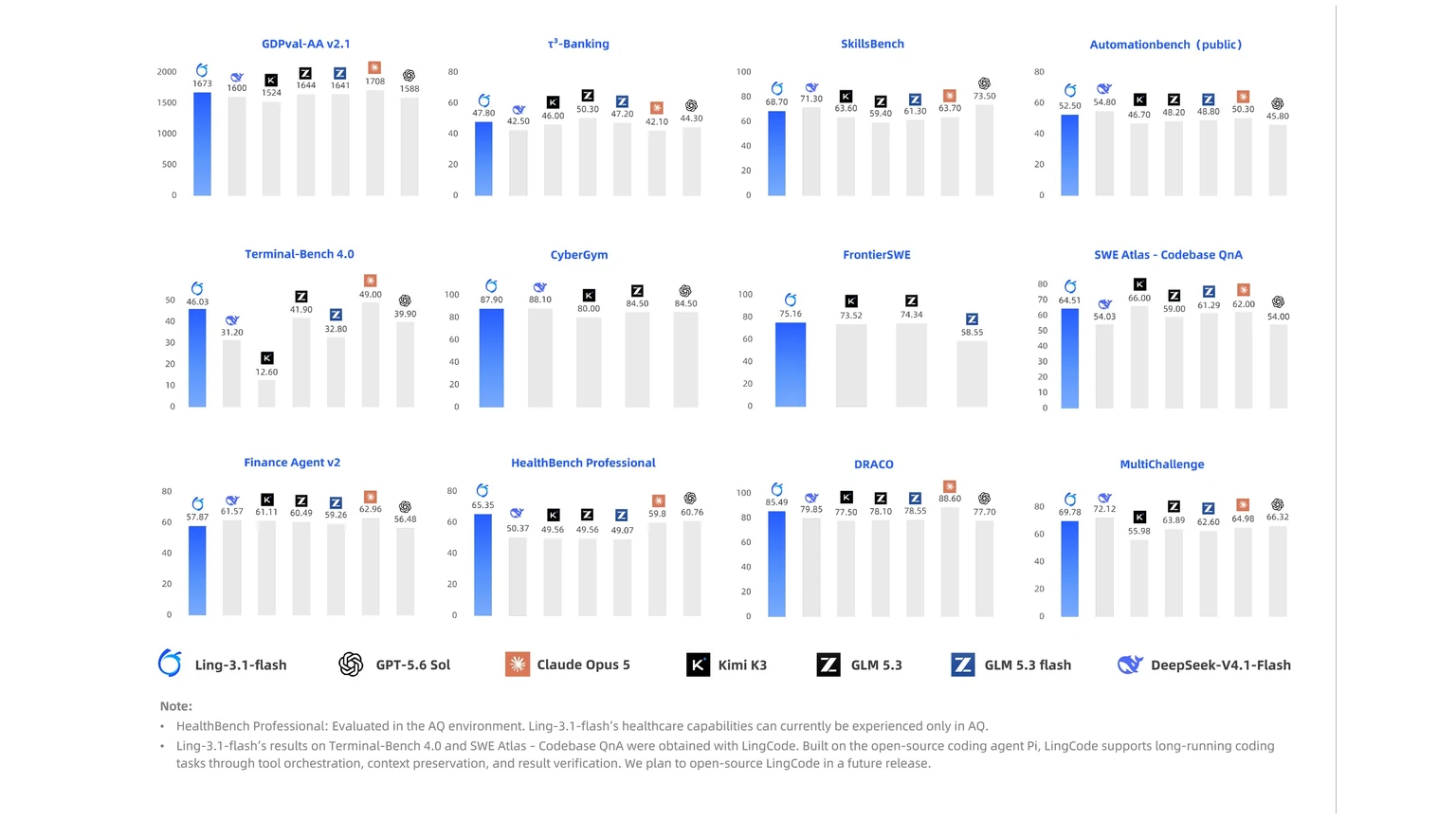
The model card’s main chart compares Ling-3.1-flash with GPT-5.6 Sol, Claude Opus 5, Kimi K3, GLM 5.3, GLM 5.3 flash and DeepSeek-V4.1-Flash on twelve benchmarks. Ant’s figures put it first on HealthBench Professional at 65.35, against 60.76 for GPT-5.6 Sol and 59.8 for Claude Opus 5. On FrontierSWE it shows 75.16, ahead of GLM 5.3 at 74.34 and Kimi K3 at 73.52.
Other rows are closer or go the other way. On Terminal-Bench 4.0 the chart gives Ling 46.03, behind Claude Opus 5 at 49.00 but well ahead of GPT-5.6 Sol at 39.90. On GDPval-AA v2.1 it scores 1,673, behind Claude Opus 5’s 1,708. On SkillsBench GPT-5.6 Sol leads 73.50 to 68.70, and on MultiChallenge DeepSeek-V4.1-Flash leads 72.12 to 69.78. A longer table on the card shows Claude Opus 5 well ahead on Humanity’s Last Exam, 54.90 against 37.44.
The footnotes change how to read several headline rows. Ant says its Terminal-Bench 4.0, SWE-bench Pro, DeepSWE and SWE Atlas results were obtained with LingCode, its own harness built on the open-source Pi coding agent and tuned for hours-long tasks with repeated context compaction. LingCode is not public yet; Ant says it is considering open-sourcing it. HealthBench Professional was run in Ant’s AQ health app environment, which the chart says is the only place the healthcare capability can currently be used.
On X, Ant also cites Artificial Analysis, where it says Ling-3.1-flash has an Intelligence Index of 41 and about 210 output tokens per second, with a blended price of about $0.19 per million tokens. Ant notes that provider prices may differ from that benchmark measure.
How do you run it, and what does it cost?
The fastest path is SGLang. Its day-zero Ling-3.1-flash cookbook ships a dedicated Docker image and verified recipes for eight H200 GPUs with tensor and expert parallelism of 8, or four GB300 GPUs. With speculative decoding on, SGLang measured 251.2 output tokens per second at batch size 1 on H200 and 180.0 on GB300. Average acceptance length ranged from 2.13 to 2.61 tokens per step depending on the workload. The first launch spends a few minutes compiling kernels.
vLLM support currently means building from a vllm branch named in the model card, then serving with the ling3 tool-call and reasoning parsers and multi-token prediction for speculative decoding. Ant recommends temperature 1.0, top_p 0.95 and top_k 20 with thinking enabled.
For smaller clusters, Ant says a variant with MXFP4 experts and block-FP8 dense layers cuts the weights from about 534GB to about 292GB, and that a tested Hopper setup went from eight GPUs to four. It reported 604 milliseconds average time to first token on eight GPUs and about 1.36 queries per second on four, in different workloads.
If you would rather not host it, OpenRouter listed the model on 14 October at $0.075 per million input tokens and $0.225 per million output tokens, with a 262,144-token context. For a smaller open model built for agents on local hardware, compare AI Lookout’s coverage of Liquid AI’s LFM2.5-24B-A2B.
Why this release matters
Open-weight models from Chinese labs have been the default choice for many teams that want to self-host a large model. Ling-3.1-flash adds another option with a clean MIT licence, which is simpler than the custom community licences attached to some competitors. For companies that need legal clarity before deploying, that matters as much as a few benchmark points.
It also shows how much model releases now depend on the harness. Ant’s best coding numbers come from LingCode, not from a generic agent, and the company says the model works across Claude Code, Kilo Code, Qwen Code, Hermes Agent and OpenClaw. That echoes the argument in AI Lookout’s report on the Reason Agent 1.1 coding agent index: the same model can score very differently depending on the scaffold around it.
The release lands on the same day as Paper Instruments’ Ultramarine 1 Flash, which post-trains another open base for office work. Both releases aim open models at professional tasks rather than chat, and both lean on vendor-run evaluations to make the case.
What the documents disagree on, and what to verify
The documents disagree on two numbers. Ant’s model card and launch post say 25B active parameters and up to 1M tokens of context. SGLang’s cookbook describes about 17B active parameters and a 262,144-token context limit, and OpenRouter lists the same 262,144 tokens. The gap may reflect different counting conventions or a serving default, but neither document explains it. Test the context you need before you design around it.
Treat the benchmark chart as Ant’s. Several rows depend on an unreleased harness or a private app environment, and comparison models were not necessarily run under identical conditions. Independent runs on public harnesses will be more useful than any single chart.
Check the hardware maths for your own workload. Eight H200s is a serious commitment, and the smaller MXFP4 variant’s speed figures came from different workloads. Watch for a public LingCode release, an explanation of the context discrepancy and third-party evaluations as the next material updates.
Common questions
Can I use Ling-3.1-flash commercially?
The Hugging Face model card lists the MIT licence, which permits commercial use with attribution. Read the card and the separate training-content summary before shipping, since licence metadata can change after this article’s check date.
Does it really have a 1M-token context window?
Ant’s model card and launch post say up to 1M tokens. SGLang’s day-zero cookbook and OpenRouter both list 262,144 tokens. Plan around the limit your serving stack actually exposes.
What hardware does it need?
The recommended SGLang recipes use eight H200 GPUs with tensor and expert parallelism of 8, or four GB300 GPUs. Ant says an MXFP4 expert variant shrinks the weights from about 534GB to about 292GB and let a tested Hopper setup drop from eight GPUs to four.
Sources & further reading
How this story was made
Written by Kristian Kostov with AI assistance and checked against the linked sources. Company performance claims are attributed to the company. Analysis reflects AiLookout’s interpretation; we have not independently tested the products discussed. The cover places the companies’ own logos, taken from public-domain or openly licensed files credited in the caption, on a plain background. It is not a product photograph, a screenshot, or an endorsement.
Our editorial standards