Announced 14 Oct 2026 · Sources checked
What did Paper Instruments release?
On 14 October 2026 Paper Instruments published a technical report on Ultramarine 1 Flash, which it calls an agentic model for professional knowledge work. The model is not trained from scratch. It takes GLM-5.3 Flash, an open base model from Z.ai, and applies large-scale reinforcement learning on tasks that look like the work of bankers, lawyers, consultants and operations staff: diligence memos, board updates, spreadsheet models, litigation chronologies and changes inside live business systems.
In his launch post, co-founder Daanish Khazi said the model was post-trained by a team of five for about $300,000 all-in, that it is available through the company’s API now, and that weights will be released in about two weeks. Paper Instruments is a Y Combinator Spring 2025 company whose earlier work includes the Kos-1 models, the DiligenceBench evaluation and a set of agent-safe Office libraries released in September.
The headline claim in the report is about cost. On the company’s internal PI Knowledge Work suite, Ultramarine scores 59.3 at $0.13 per task. The report lists Claude Fable 5 at 57.8 for $8.19 per task and GPT-5.6 Sol at 55.1 for $2.09, all at maximum reasoning. It puts Ultramarine 2.6 points behind Claude Opus 5.5 ($6.96) and 2.0 points behind GPT-6 Sol ($1.26). The roughly 60-times-cheaper comparison circulating on social media comes from that single internal suite.
How was Ultramarine trained without a unit test to check the answer?
Most reinforcement learning for agents so far has leaned on verifiable tasks, where a unit test or a regex can say whether the answer is right. Coding dominates those mixes for that reason. Paper Instruments argues that most professional work has no such check: whether a board memo is good depends on judgment, completeness and how caveats are handled. Its answer is to pair every synthetic task with a weighted rubric and let a language-model judge score each criterion as met or unmet.
The report spends a long section on how those criteria are written. A criterion copied too closely from one model answer rejects other valid answers. A vague one, such as asking for an appropriate recommendation, rewards plausible-sounding mistakes. Each criterion is meant to test one proposition, name the facts and thresholds needed to check it, and stay separate from other accomplishments so partial credit still works.
The team chose fully synthetic data over production traces and expert-written tasks. Production traces, the report says, bake in a user’s unstated assumptions, and expert tasks are expensive to scale. The curriculum instead spans four domains, 19 practice areas and 88 environment types, from buy-side M&A deal rooms and Chapter 11 debtor rooms to patent prosecution and supply-chain engagements. Each environment mounts realistic files, such as SEC filings, press releases, analyst snapshots and synthetic contracts, plus live systems of record reached through MCP, HTTP or a CLI.
Training itself is modest by frontier standards. The report lists a modified CISPO objective, AdamW, batches of 64 tasks with 8 rollouts each, LoRA rank 64, a 131,072-token context window and up to 250 agent turns, with automatic context compaction. Each rollout runs in an isolated E2B sandbox, and the agent loop, credentials and grader sit outside anything the model can modify. A length penalty discourages long outputs, extra turns and malformed tool calls.
What do the benchmark tables show?
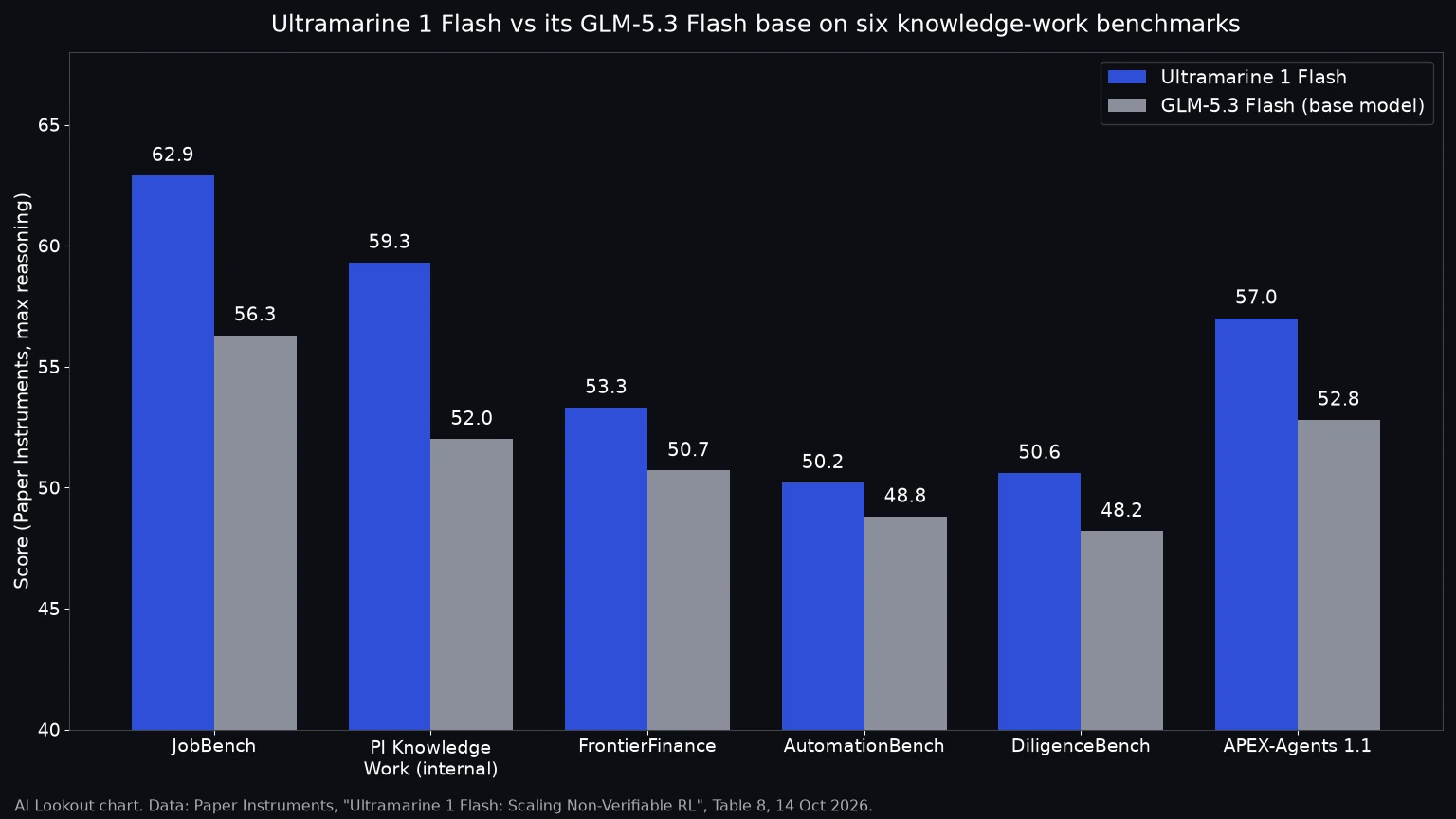
The report’s Table 8 compares Ultramarine with its base model and five other systems on six knowledge-work benchmarks and two coding benchmarks. Against GLM-5.3 Flash, Ultramarine improves on every knowledge-work row: JobBench 62.9 versus 56.3, PI Knowledge Work 59.3 versus 52.0, FrontierFinance 53.3 versus 50.7, AutomationBench 50.2 versus 48.8, DiligenceBench 50.6 versus 48.2 and APEX-Agents 1.1 57.0 versus 52.8. That is the 4.1-point average gain the company quotes, and it says the tuned model also used 6.5% fewer tokens across those runs.
Against other models the picture is mixed, which the table shows plainly. Ultramarine leads JobBench, PI Knowledge Work and FrontierFinance. DeepSeek V4.1 Flash edges it on AutomationBench, 51.3 to 50.2. Gemini 3.8 Flash and Claude Fable 5 beat it on DiligenceBench, 53.1 and 52.9 against 50.6, and on APEX-Agents 1.1, 64.3 and 63.6 against 57.0. In plain terms, the model is strongest on the suites closest to its own training mix.
Coding is reported for reference and is not a strength. Ultramarine scores 83.2 on Terminal-Bench 2.1 and 61.5 on DeepSWE 1.1, slightly below its own base model at 84.3 and 63.4, and well below the best rows in the table. The company does not claim otherwise; the point of the release is office deliverables, not repositories.
The notes to the table matter. JobBench was run on the leaderboard’s own harness with a Grok 4.3 judge, and Paper Instruments ran some comparison models itself while taking others from public leaderboards. PI Knowledge Work is internal and runs in the company’s Feather harness. Costs are per task at each developer’s official API price as of October 2026. Of 39 other model-and-setting runs on that suite, the report says 27 cost more and score lower.
How can you use it today, and what is open?
Access today is through the Ultramarine API. The documentation says you can call it with the OpenAI or Anthropic SDKs, including the Claude Agent SDK and Claude Code, and that usage is charged against a prepaid balance. The company has not published the weights yet, so anyone who wants to self-host has to wait for the promised release.
The prompting guide is unusually specific about the runtime. The model was trained in a sandbox built from the python:3.13-slim Debian image with paper-docx, paper-pptx and paper-xlsx, the company’s forks of python-docx, python-pptx and openpyxl, plus PDF, pandas and HTML tooling. The forks keep the original import names and raise a typed error instead of silently corrupting a file. The guide also warns that the model has stronger prose and aesthetic habits than typical models, so prompts need tuning.
Some of the training stack is already public. The rubric grading library and the Feather harness and training integrations are MIT-licensed repositories under the paper-instruments GitHub organisation. Feather was designed by surveying the tool contracts of Claude Code, Codex, Cursor, OpenCode, OpenHands and others, so that one harness could stand in for many at training time.
Why a five-person knowledge-work model matters
The release is a data point in a debate about who can still build competitive models. Ultramarine is a post-training project on top of someone else’s base, not a new pretrained model. That is the same base Z.ai itself uses for legal work, as AI Lookout covered in GLM-Legal’s Harvey benchmark results. If a five-person team can lift an open base on office tasks for about $300,000, the expensive part of specialised models shifts from pretraining to environments, rubrics and graders.
It also pushes on the idea that reinforcement learning only works where answers are checkable. Rubric rewards have known risks, including judges that can be gamed and criteria that drift toward one style. Paper Instruments says it added classifiers for answer leakage and reward hacking as failures appeared. Compare that with the verifiable environments in FineEnvs’ Harbor-format math environments, which use the same task packaging but can check answers mechanically.
For buyers, the practical question is cost per finished deliverable rather than price per token. The report frames everything per task, which is the right unit for a model that edits workbooks over dozens of turns. A cheap model that needs two retries is not cheap, and only your own tasks can show that.
What to check before you rely on the numbers
The strongest comparison, the one against Claude Fable 5, comes from an internal suite that Paper Instruments built, ran in its own harness and grades with its own rubric method. That does not make it wrong, but it is the case most likely to favour a model trained on similar tasks. The public APEX-Agents and DiligenceBench rows are a useful check, and there Ultramarine trails the leaders.
The open-source label is a promise until the weights appear. When they do, check the licence, the exact checkpoint and whether it matches the API model. Until then, nobody outside the company can reproduce the numbers on their own hardware.
Run it on your own documents. The training sandbox assumes specific package versions and the company’s Office forks; a different runtime may behave differently. Watch for the weight release, independent JobBench or APEX-Agents runs and any pricing page changes as the next material updates to this story.
Common questions
Is Ultramarine 1 Flash open source today?
Not yet in a way you can download. On 14 October the model was available through Paper Instruments’ API, and co-founder Daanish Khazi said weights would be released in about two weeks. The rubric grader and the Feather harness repositories are already public under MIT.
Does it really match Claude Fable 5 at a sixtieth of the cost?
On Paper Instruments’ internal PI Knowledge Work suite it scores 59.3 at $0.13 per task against 57.8 at $8.19 for Claude Fable 5. On the public APEX-Agents 1.1 and DiligenceBench rows in the same table, Fable 5 scores higher. Treat the headline as one suite, not a general ranking.
What kind of work is it built for?
Deliverables such as Excel models, PowerPoint decks, Word memos and PDFs, plus tasks inside live business systems such as CRM and ledgers. It was trained across 19 practice areas in finance, law, consulting and operations.
Sources & further reading
How this story was made
Written by Kristian Kostov with AI assistance and checked against the linked sources. Company performance claims are attributed to the company. Analysis reflects AiLookout’s interpretation; we have not independently tested the products discussed. The cover is an AI-generated editorial illustration, not a photograph or evidence of an actual event.
Our editorial standards