Announced 17 Oct 2026 · Sources checked
What DeepSeek released
DeepSeek has replaced the model behind its Flash tier. In its API change log dated 17 October 2026, the company said DeepSeek V4.1 Flash "has been upgraded to DeepSeek-V4.1-Flash-1017" and that the official web and app models had been switched as well. The API name does not change: requests to deepseek-flash now reach the new snapshot, at the same prices.
The weights are public. DeepSeek posted DeepSeek-V4.1-Flash-1017 on Hugging Face and ModelScope under the MIT License, the same terms as the September release, and announced the update in a four-post thread on X that called it "a Pareto improvement in performance and cost." The Hugging Face card describes it as "a minor update" with "substantial improvements across reasoning, coding, agentic tasks, and visual benchmarks."
Earlier the same day the name had surfaced briefly in DeepSeek's API model list, as we noted when the company opened its Search and Fetch APIs. The release is now confirmed in DeepSeek's documentation, its pricing page and its official accounts.
The benchmark gains, and how they stack up
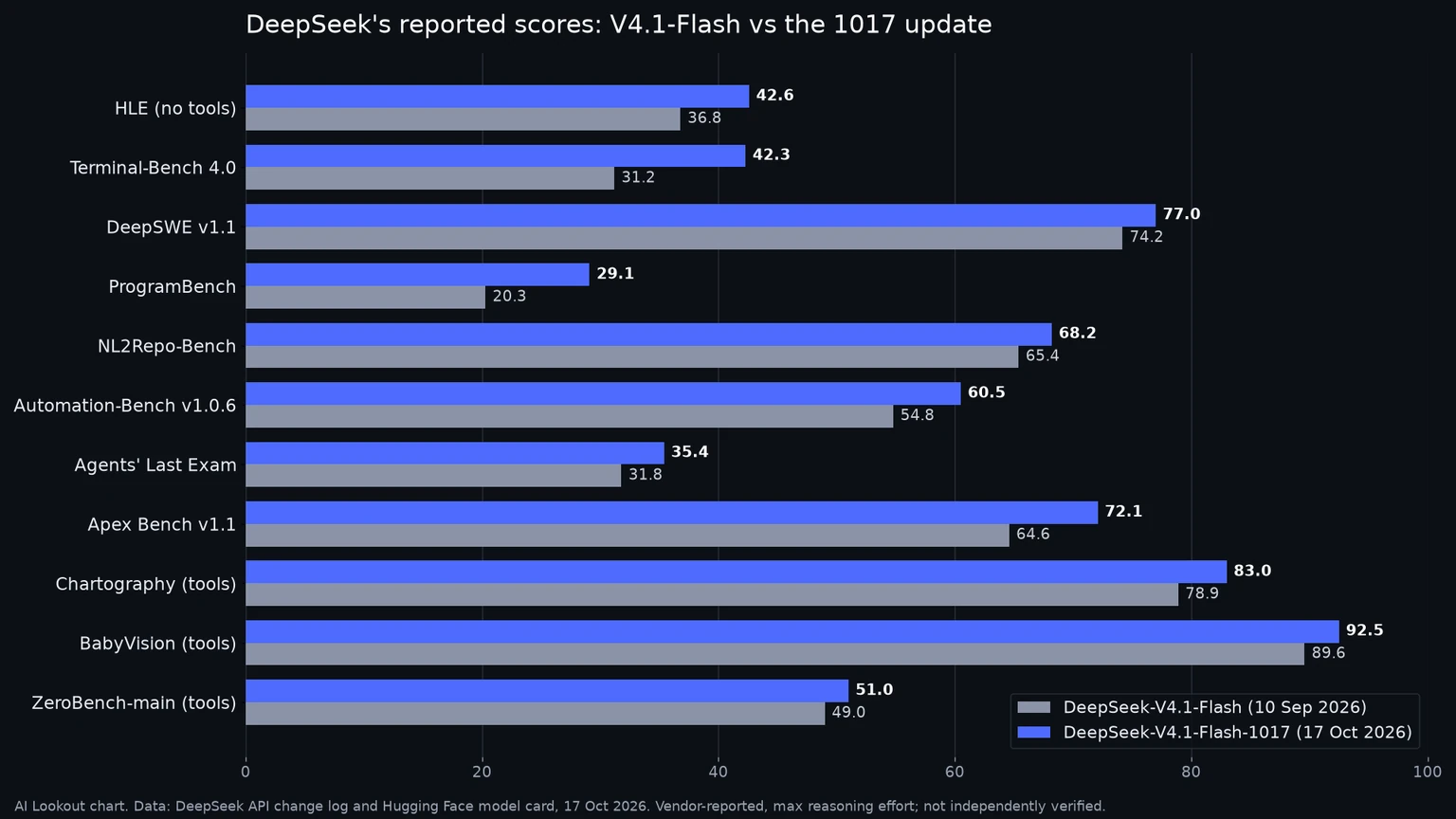
DeepSeek published eleven scores for the new snapshot next to the September version. Every one went up. The biggest jumps are in agentic coding: Terminal-Bench 4.0 rose from 31.2 to 42.3 and ProgramBench from 20.3 to 29.1. Apex Bench v1.1 climbed from 64.6 to 72.1, Automation-Bench from 54.8 to 60.5 and Humanity's Last Exam without tools from 36.8 to 42.6. The vision tests moved less, for example ZeroBench-main from 49.0 to 51.0.
The table also lists Kimi K3, GLM-5.3, GPT-5.6 Sol and Claude Opus 5. On DeepSWE v1.1, a software engineering test, DeepSeek reports 77.0 for the new model against 74.0 for Opus 5 and 73.0 for GPT-5.6 Sol, and it puts the snapshot first on Automation-Bench, Agents' Last Exam and Apex Bench. Opus 5 still leads by a wide margin on Humanity's Last Exam, 56.3 to 42.6, on Terminal-Bench 4.0, 51.8 to 42.3, and on ProgramBench, 37.0 to 29.1.
Two caveats matter. The closed models in the table are not the newest: Anthropic's Opus 5.5 and OpenAI's GPT-6 family are missing from the main comparison. And harnesses differ by test. DeepSeek says it ran Terminal-Bench 4.0 inside the Claude Code harness, DeepSWE inside Mini-SWE-V2, and scored ZeroBench-main as pass@5, meaning a task counts if any of five attempts succeeds.
Faster and cheaper per task, by DeepSeek's measure
The headline claim is not only higher scores but shorter work. DeepSeek says the snapshot cuts "task runtime and output length," so the same jobs finish sooner and use fewer billed output tokens, and that it was tuned for DeepSeek Harness, Tencent's CodeBuddy and WorkBuddy, among other agent tools.
A chart in the announcement thread plots DeepSWE pass rate against average cost per task. By our reading of its log scale, the new model reaches 77 percent at roughly $0.20 per task at maximum effort, while the September version at the same setting sat near 74 percent at roughly $0.50. On the same chart, most Claude Opus 5 and Claude Fable 5 points sit between about $2 and $20 per task. The comparison mixes DeepSeek's runs with a public leaderboard snapshot from 22 September and OpenAI's own chart for its models, so treat it as a rough guide, not a controlled test.
DeepSeek also says it trained the update with "reinforcement learning with self-feedback" to improve end-to-end project work, and showed clips of the model building games and 3D scenes from scratch. It did not publish the training details or how much shorter outputs became on average.
What is under the hood
The 1017 snapshot keeps the architecture of DeepSeek-V4.1-Flash, which DeepSeek released on 10 September. That model is a mixture-of-experts design with 552 billion backbone parameters and a one-million-token context window. Each expert layer has 384 routed experts and one shared expert, and only six routed experts fire per token. DeepSeek says the model activates about 8 billion parameters while reading a prompt and 16 billion while writing.
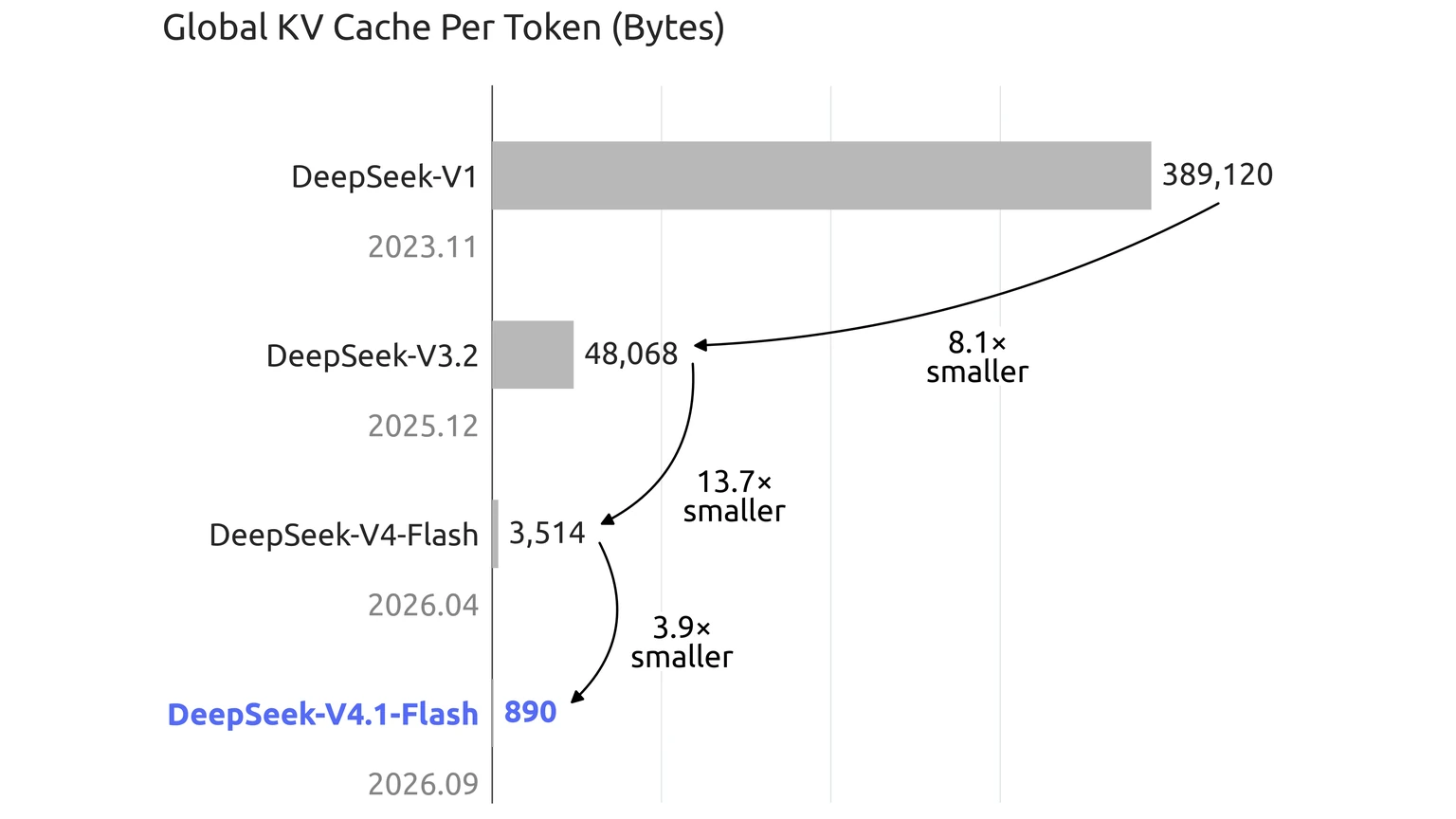
That split helps agent work, where prompts are long and answers are short. The model card credits a causal encoder-decoder layout, in which the decoder builds its long-range memory from the encoder's output, for that split, and says shared sparse attention plus 4-bit key-value caching shrink that memory to 890 bytes per token, about a quarter of V4-Flash. A separate Engram memory module adds 196 billion sparsely used parameters, which helps explain why Hugging Face counts about 763 billion parameters across the 48 weight files, stored mostly in FP8 with FP4 experts.
Reasoning effort is set on a scale from 1 to 100 rather than in a few fixed levels, and DeepSeek's scores use the maximum.
How to use it
Most developers do not need to change anything. The pricing page now lists DeepSeek-V4.1-Flash-1017 as the model version behind deepseek-flash, still at $0.15 per million input tokens on a cache miss, $0.003 on a cache hit and $0.60 per million output tokens off-peak, doubling during weekday peak windows of 01:00 to 04:00 and 06:00 to 10:00 UTC. Context stays at one million tokens with up to 384,000 output tokens. Old names such as deepseek-v4-flash are now served by the new snapshot too.
DeepSeek recommends upgrading its own coding agent to DeepSeek Harness version 0.2.1-rc.1 or later. Vercel added the snapshot to its AI Gateway the same day as deepseek/deepseek-v4.1-flash-1017, a pinned name for teams that do not want the alias to move under them.
Running the weights locally is a data-centre job. The release ships no Jinja chat template; instead an encoding folder holds a Python reference for the prompt format, and DeepSeek points production users to deepseek-recipe, Rust libraries with Python bindings that convert chat, Messages and Responses API requests into its format. Recommended settings are temperature 1.0, top_p 1.0 and a max_tokens budget of at least 256,000.
Why a dated snapshot matters
Open-weight releases this month have mostly been new models, such as Reflection's Beam 1.0, Meta's Muse Spark Open and Ant Group's MIT-licensed Ling 3.1 Flash. DeepSeek's update is different: a dated refresh of a model people already run, published as weights on the day it went live in the API.
That makes the alias change a double-edged convenience. Anyone calling deepseek-flash got a different model on 17 October without touching their code, which is good news if the scores hold and a risk for teams whose prompts or evaluations were tuned to the September behaviour. Because the September weights remain on Hugging Face, those teams can still self-host the old version, one practical benefit of open weights over an API-only model.
What is still missing
All of the numbers come from DeepSeek, and AI Lookout has not run the model. There is no new technical report for 1017; the model card still cites the September V4.1-Flash paper. DeepSeek did not say how much shorter outputs became, which data the reinforcement learning used, or whether the update changed safety behaviour, and the change log has no safety notes.
The cost chart's competitor points come from different sources and dates, and the main table compares against older closed models. Independent runs on public leaderboards, and reports from teams that switched overnight, will show whether the gains survive outside DeepSeek's own harnesses.
Common questions
Do I need to change my code to use DeepSeek-V4.1-Flash-1017?
No. Requests to deepseek-flash, and to legacy names such as deepseek-v4-flash, are now served by the 1017 snapshot at the same prices. Vercel's AI Gateway also offers a pinned name, deepseek/deepseek-v4.1-flash-1017.
Is DeepSeek-V4.1-Flash-1017 open source?
Its weights and repository are released under the MIT License on Hugging Face and ModelScope. DeepSeek has not published the training data or the reinforcement-learning recipe for the update.
Can I run DeepSeek-V4.1-Flash-1017 on a single GPU?
No. The model has 552 billion backbone parameters and about 763 billion stored parameters in total, so local use needs multi-GPU server hardware; most people will use the API.
Sources & further reading
How this story was made
Written by Kristian Kostov with AI assistance and checked against the linked sources. Company performance claims are attributed to the company. Analysis reflects AiLookout’s interpretation; we have not independently tested the products discussed. The cover places the companies’ own logos, taken from public-domain or openly licensed files credited in the caption, on a plain background. It is not a product photograph, a screenshot, or an endorsement.
Our editorial standards