Announced 15 Oct 2026 · Sources checked
What Meta released on 15 October
Meta announced Muse Spark Open on its AI research blog on 15 October 2026, saying it is releasing the weights of “the most capable US open-weight model to date.” It is the first time Meta has opened a model from its Muse Spark line, which until now was available only through Meta's own apps and hosted APIs.
The model is aimed at coding and agentic work. Meta says it “excels at long-horizon tasks, complex software engineering, and multi-step reasoning.” It arrives three days after Meta introduced Muse Wonder and Muse Wonder Full, its closed frontier models, and two months after it released the much smaller Muse Glimmer 30B under Apache-2.0.
The launch came with an unusual partner. Meta says Muse Spark Open is “the first model in its class to run on your desktop using two Apple M5 Ultra Mac Studios,” and Apple published its own benchmark write-up the same day. Mark Zuckerberg wrote on X that the model “runs great on new Mac Studios thanks to work with” Apple, according to Engadget.
Inside the model: 816 billion parameters, 42 billion at a time
According to the model card, Muse Spark Open is a mixture-of-experts transformer with 816 billion total parameters, of which about 42 billion are used for each token. It has 62 layers and 256 experts, with eight experts activated per token, plus grouped-query attention with 128 query heads and 16 key-value heads.
It is natively multimodal. A 1.8-billion-parameter perception encoder handles images, and the card lists text, image, video and audio as inputs, with text as the only output. The context window is 1 million tokens at inference, and Meta says training data covered more than 100 languages.
The model has a reasoning-effort setting with four levels, low, medium, high and xhigh, and defaults to xhigh. Meta recommends high or xhigh for coding and agent tasks and a temperature of 1.0. It also says this open version received “additional safety post-training” so it holds up better as a standalone model without the system-level filters Meta runs around its hosted products.
Two Mac Studios as one terabyte machine
Meta's argument for the Mac is memory. “Apple's unified memory architecture lets the M5 Ultra's integrated GPU use up to 512 GB per Mac Studio, so two machines can hold an entire model,” the blog says, and the chip's 1.2 TB/s of memory bandwidth is fast enough to read the small slice of weights each token needs. “The result is two Mac Studios behave like one supercomputer with a terabyte of unified memory.”
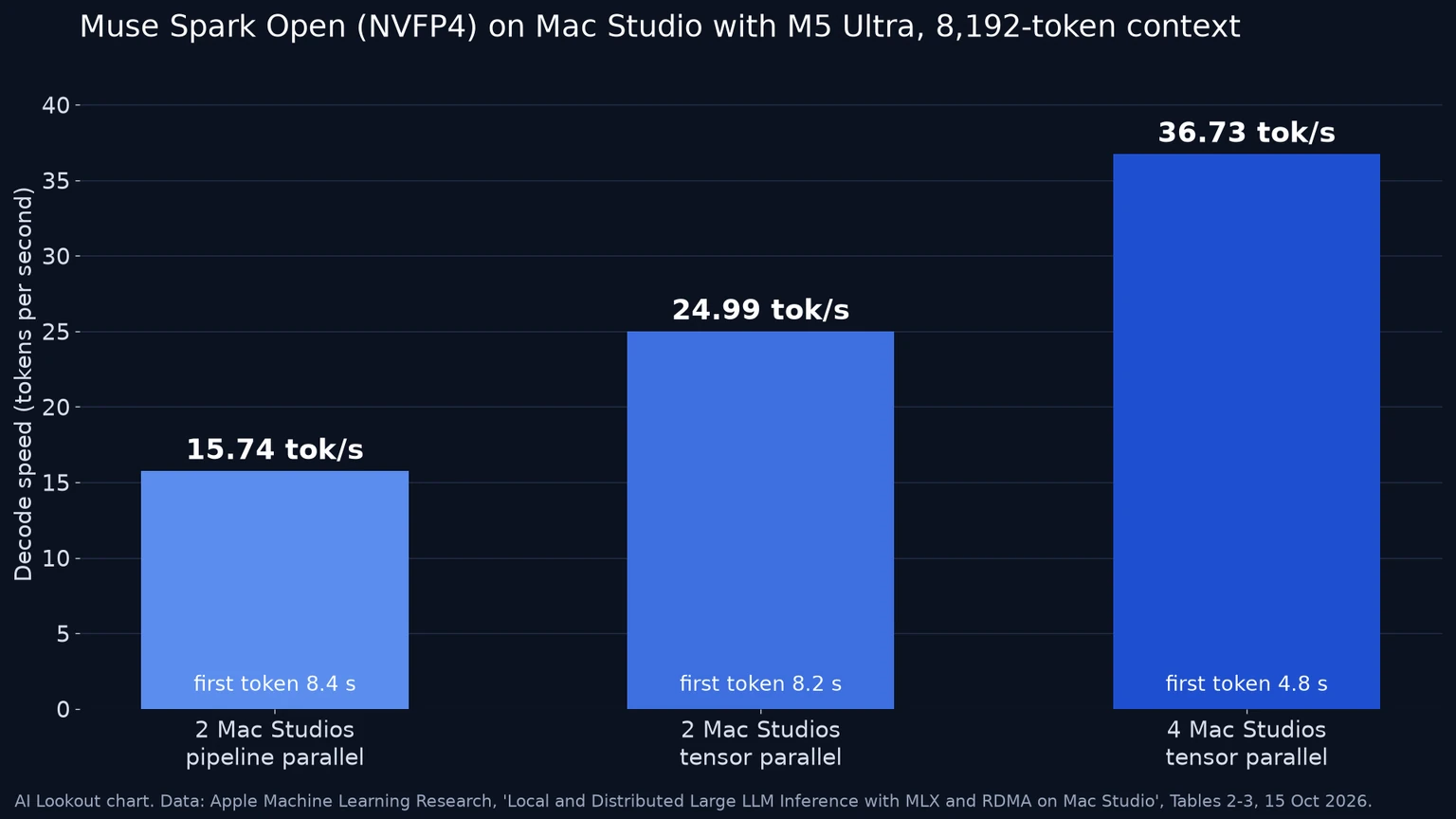
Apple's post fills in the numbers. In BF16 the weights alone would need more than 1.6 TB; in NVFP4 they shrink to about 493 GB, still too much for one machine once working memory is added. Apple linked Mac Studios with RDMA over Thunderbolt 5, two cables per link, using MLX, its open-source machine learning framework, and a new MLX release published the same day.
At an 8,192-token context, two machines splitting the model by layers produced 15.74 tokens per second. Two machines splitting each layer, called tensor parallelism, reached 24.99, and four reached 36.73, faster than most people read. Time to the first token fell from 8.4 to 4.8 seconds. At a 65,536-token context, four machines took about 40.6 seconds to start answering.
Meta says it tested agent workflows entirely on-device with its Muse Code tool, including shipping bug fixes and features to Ice Cubes, an open-source Mastodon client for iOS, and driving DaVinci Resolve to find and crop video highlights. It is a different route to local AI from Apple's own Minions project, which pools idle Macs, but it leans on the same unified-memory idea.
How Muse Spark Open compares on Meta's benchmarks
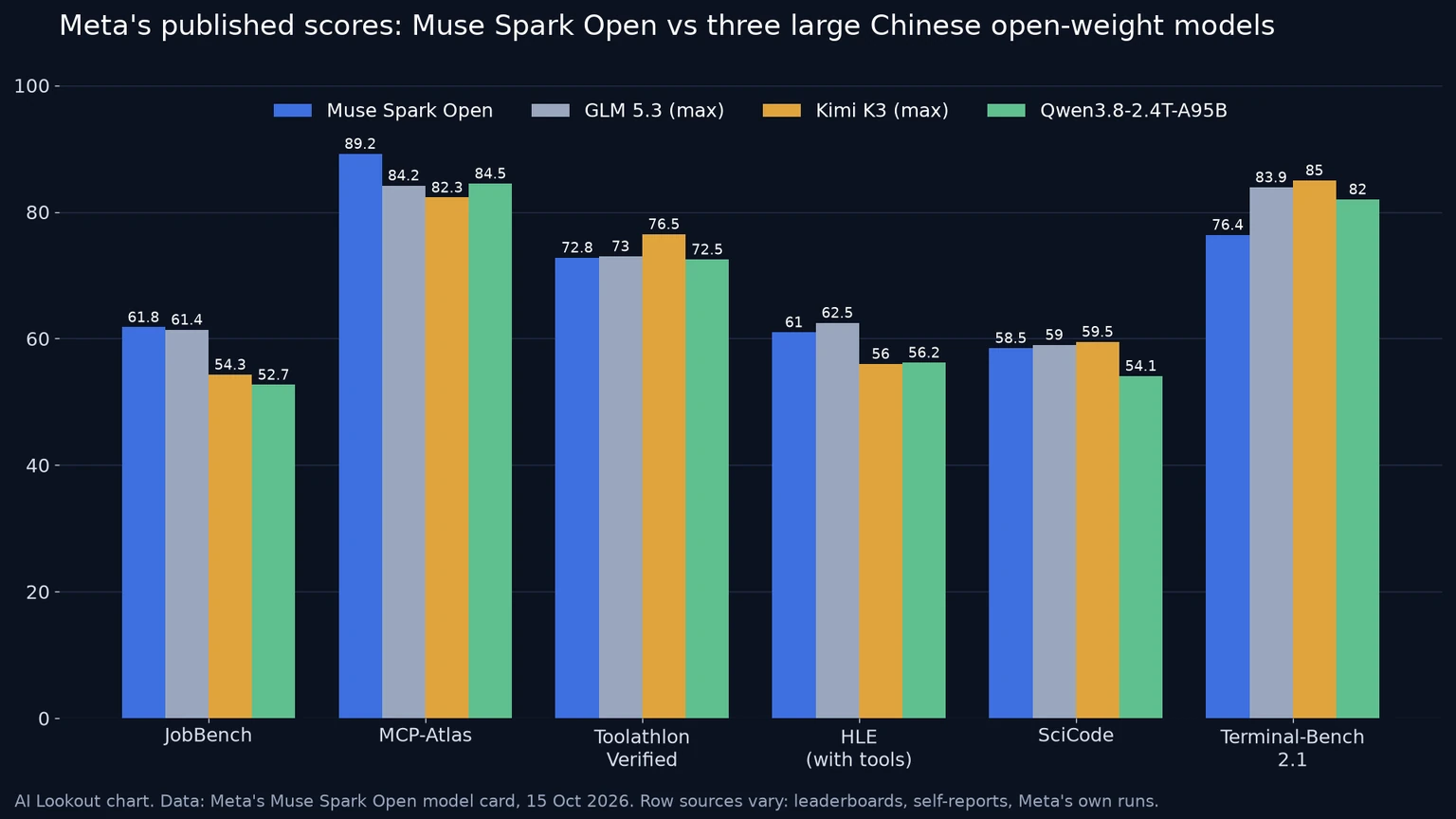
Meta compares the model with open-weight peers rather than closed frontier models. On its table, Muse Spark Open scores 89.2 on MCP-Atlas, a test of tool use across real Model Context Protocol servers, and 61.8 on JobBench, 65 professional tasks across 35 occupations. Both are the best figures in the table. It also posts 26.1 on Humanity's Last Exam Diamond without tools and 80.4 on OSWorld Verified computer use.
The “most capable US” framing matters, because Chinese models beat it on several rows. Z.ai's GLM 5.3 scores 45 on the Artificial Analysis Intelligence Index to Muse Spark Open's 39, and leads GDPval-AA v2 at 1653 to 1401. Moonshot's Kimi K3 leads Terminal-Bench 2.1 at 85.0 to 76.4, DeepSWE 1.1 at 68 to 60 and OSWorld Verified at 84.8. Alibaba's much larger Qwen3.8 also edges it on the index, 40 to 39.
Among US models the gap is wide. Thinking Machines' Inkling scores 26 on the index and NVIDIA's Nemotron 3 Ultra 23. Mistral Large 4, from France, scores 38. Meta lists self-reported numbers for Reflection's Beam and Mistral Large 4 because their weights were not broadly available for testing.
Meta's evaluation methodology says scores come from official leaderboards where possible, otherwise from Meta's own runs or the providers' self-reports, and that its harnesses were not tuned for third-party models. Independent re-runs will matter.
Safety tuning, and the over-refusal trade-off
The safety rows are the most striking. On StrongREJECT v2, an adaptive jailbreak test where lower is better, Muse Spark Open scores 0.5, against 62.9 to 86.4 for every other model listed. On the FORTRESS adversarial set its attack-success score is 5.8, far below GLM 5.3's 28.2.
There is a cost. FORTRESS also measures over-refusal, how often a model turns down harmless requests, and there Muse Spark Open scores 17.4, the highest in the table, compared with 2.7 for Kimi K3 and 3.2 for GLM 5.3. Developers should expect a more cautious model, and the card warns that fine-tuning can weaken its safeguards.
Meta says it tested chemical, biological, cyber and loss-of-control risks under its Meta Superintelligence Scaling Framework and that the model met its release thresholds. The card reports refusing 99.2 percent of jailbreaks on an internal cyber benchmark and a 98.1 percent honesty rate on MASK. A full evaluation report is promised “soon.”
The Muse Model License: free for most, with strings
Muse Spark Open is open-weight, not open source in the strict sense, a distinction we explain in our open weights guide. The Muse Model License, dated 15 October, grants broad rights to use, modify, fine-tune, distill and sell copies, and Meta claims no ownership of outputs.
The conditions are specific. Products built on the model or anything derived from it must display “Built with Muse Spark Open.” A company that sells model access through an API, and whose group revenue tops $20 million over any 12 months, must notify Meta and sign a separate agreement first. Internal use, research and using the model inside your own product are exempt.
Use must also follow Meta's usage policy, and the card says the model is not meant for people under 18. On Hugging Face the weights sit behind a gate that requires an access request, which the site marks for manual review.
Where to get it and what it costs to run
Weights are on Hugging Face and, Meta says, Amazon SageMaker AI, Google Cloud Model Garden and Microsoft Foundry Models. Hosted access is listed through Baseten, Fireworks AI, Groq, Modal, Nebius, OpenRouter and Together AI. When AI Lookout checked OpenRouter's public model list on the evening of 15 October, it did not yet show the model, and no partner prices were published.
Running it yourself is expensive. The card asks for at least 700 GB of GPU memory for NVFP4 and 2 TB for BF16. Engadget notes that Apple has not priced the 512 GB Mac Studio, due in late October, and estimates four 256 GB models at roughly $38,000. Community 3-bit MLX and GGUF conversions appeared within hours.
Meta also shipped auto-tuned Helion GPU kernels in SGLang, claiming 1.03 to 3.95 times kernel-level speedups on NVIDIA and AMD GPUs but only a 3 percent end-to-end gain on AMD's MI350.
What is still unverified
Every benchmark here comes from Meta or Apple. Neither the full evaluation report nor an Artificial Analysis listing of the open weights was available at publication. 9to5Mac reports that Meta and Apple worked on the port for months, but Apple has not said when the 512 GB Mac Studio ships or what it costs.
The questions to watch are whether independent tests confirm the agent scores, whether the high over-refusal rate shows up in practice, and how hosting partners price a model this large. For now, Muse Spark Open gives US developers a large open-weight option close to the Chinese leaders, at the price of a restrictive licence and a hefty hardware bill.
Common questions
Is Muse Spark Open open source?
It is open-weight. Meta publishes the weights under its own Muse Model License, which is free for most uses but requires a 'Built with Muse Spark Open' notice and a separate agreement for model-hosting businesses with more than $20 million in annual revenue.
What hardware does Muse Spark Open need?
Meta's model card asks for at least 700 GB of GPU memory for the 4-bit NVFP4 weights and 2 TB for BF16. Meta and Apple say two M5 Ultra Mac Studios with 512 GB each can run it; Apple measured 15.74 tokens per second on two and 36.73 on four.
Is it better than Chinese open-weight models?
Mixed, on Meta's own table. It leads MCP-Atlas and JobBench, but GLM 5.3 scores higher on the Artificial Analysis Intelligence Index and Kimi K3 leads several coding and computer-use tests.
Sources & further reading
- Introducing Muse Spark Open, The Most Capable US Open-Weight Model to Date ↗
- Muse Spark Open model card (Muse-Spark-Open-816B-A42B, as reproduced in unsloth/Muse-Spark-Open-816B-A42B-GGUF) ↗
- meta-models/Muse-Spark-Open-816B-A42B (gated repository, Muse Model License text) ↗
- Muse Spark Open Evaluation Methodology ↗
- Local and Distributed Large LLM Inference with MLX and RDMA on Mac Studio ↗
- Meta built a huge open-weight AI model for Macs, but you'll need 1TB of RAM to run it ↗
- Meta launches new Muse Spark Open model, optimized to run on Mac Studio ↗
How this story was made
Written by Kristian Kostov with AI assistance and checked against the linked sources. Company performance claims are attributed to the company. Analysis reflects AiLookout’s interpretation; we have not independently tested the products discussed. The cover places the companies’ own logos, taken from public-domain or openly licensed files credited in the caption, on a plain background. It is not a product photograph, a screenshot, or an endorsement.
Our editorial standards