Announced 13 Oct 2026 · Sources checked
What did Fish Audio release on 13 October?
Fish Audio published Drama 3 on its research blog on 13 October 2026 and mirrored the launch across product docs, the fish.audio Text to Speech product, iOS and Android apps, and a hosted API. The company positions Drama 3 as its most emotive speech model so far, meant for lines you render once and keep rather than for throwaway chat replies.
The pitch is direction, not just reading. Fish says the same square-bracket instructions you would give S2.1 Pro now produce more feeling: forced smiles that crack, anger held through gritted teeth, laughs that break a straight face. A companion technical report in the fish-speech repository describes a 35-billion-parameter mixture-of-experts backbone that activates about 3 billion parameters per token, initialized from Qwen3.5-35B-A3B.
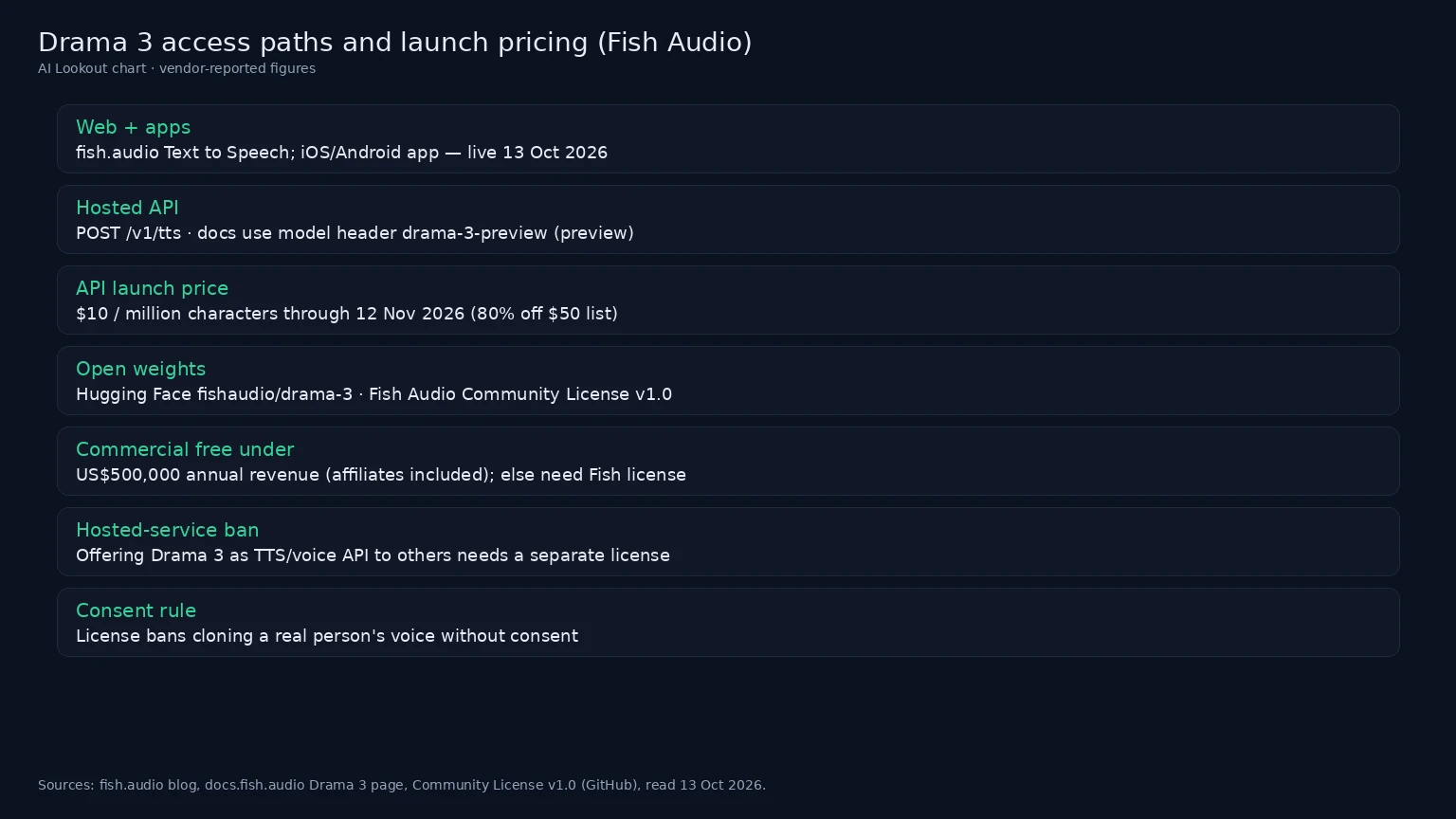
Open weights land on Hugging Face as fishaudio/drama-3 with inference code in fishaudio/fish-speech. Fish also published a new Fish Audio Community License v1.0 dated 13 October 2026. The older S2 line stays on Fish’s research license.
How do you direct a Drama 3 performance?
Directions sit in square brackets in the script, written the way you would talk to an actor: emotion, pacing, who the character is talking to. New brackets mid-line change the read from that point; sound cues such as a shaky breath or a small laugh fire where you place them.
Paired tags limit a delivery to a few words. The docs list emphasis-style tags you can apply from the Tags menu in Text to Speech, and the launch post shows an emphasis wrap around the final words of a door-threat line. Directions can be written in a different language from the spoken line; Fish’s examples use Chinese, Spanish and Japanese directions over the same English sentence.
Multi-speaker dialogue uses the existing speaker-tag pattern: pass an array of voice IDs and prefix each turn with a speaker marker. Fish’s docs ship three public English voices (Adrian, Delia, Sheila) for the examples and mark Drama 3 as preview behaviour that can still change. For API callers the docs currently set the model header to drama-3-preview; the launch blog’s curl sample uses drama-3. Treat the docs as the safer integration note while the preview is live.
What does Fish claim on pronunciation and feeling?
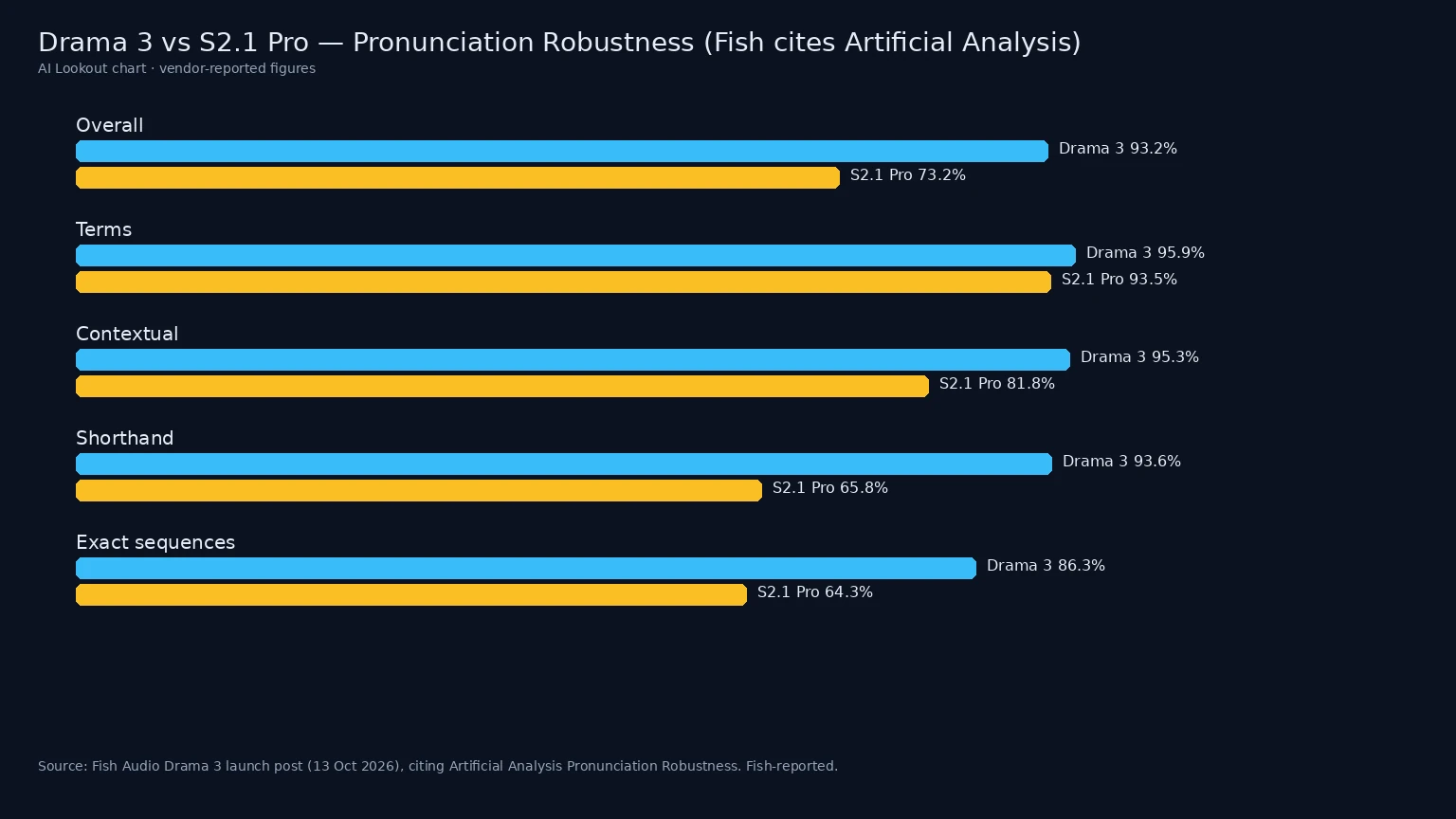
Fish’s headline quality claim is independent pronunciation, not a private listening test. The blog says Drama 3 scores 93.2% on Artificial Analysis’s Pronunciation Robustness benchmark—the top score on that leaderboard by Fish’s account—against 73.2% for S2.1 Pro. Category splits Fish publishes are 95.9% on brand and place names, 95.3% on context-dependent readings, 93.6% on shorthand such as numbers and units, and 86.3% on exact sequences such as paths and emails.
Artificial Analysis’s methodology page describes how that benchmark works: fixed English sentences with highlighted hard spans, human reviewers judging whether each span was pronounced correctly, and at least three reviewers on most clips. That matches the story Fish tells. Separately, the public Artificial Analysis TTS models listing we inspected on 13 October 2026 still showed Fish’s earlier S2 / S2.1 Pro rows and did not yet expose a Drama 3 row in the HTML we fetched, so treat the ranking as Fish-reported pending Artificial Analysis’s own public listing.
On feeling, Fish is more qualitative. Side-by-side clips in the blog contrast the same directed lines on S2.1 Pro and Drama 3. There is no third-party emotion leaderboard cited. Fish’s CEO quote frames the product as putting creators in the director’s chair for long-form and multilingual dubbing, where regenerating a whole chapter for one wrong word is expensive.
| Category | Drama 3 | S2.1 Pro |
|---|---|---|
| Overall | 93.2% | 73.2% |
| Brand, place and technical terms | 95.9% | 93.5% |
| Context-dependent readings | 95.3% | 81.8% |
| Shorthand (numbers, dates, units) | 93.6% | 65.8% |
| Exact sequences (codes, paths, emails) | 86.3% | 64.3% |
How is Drama 3 built?
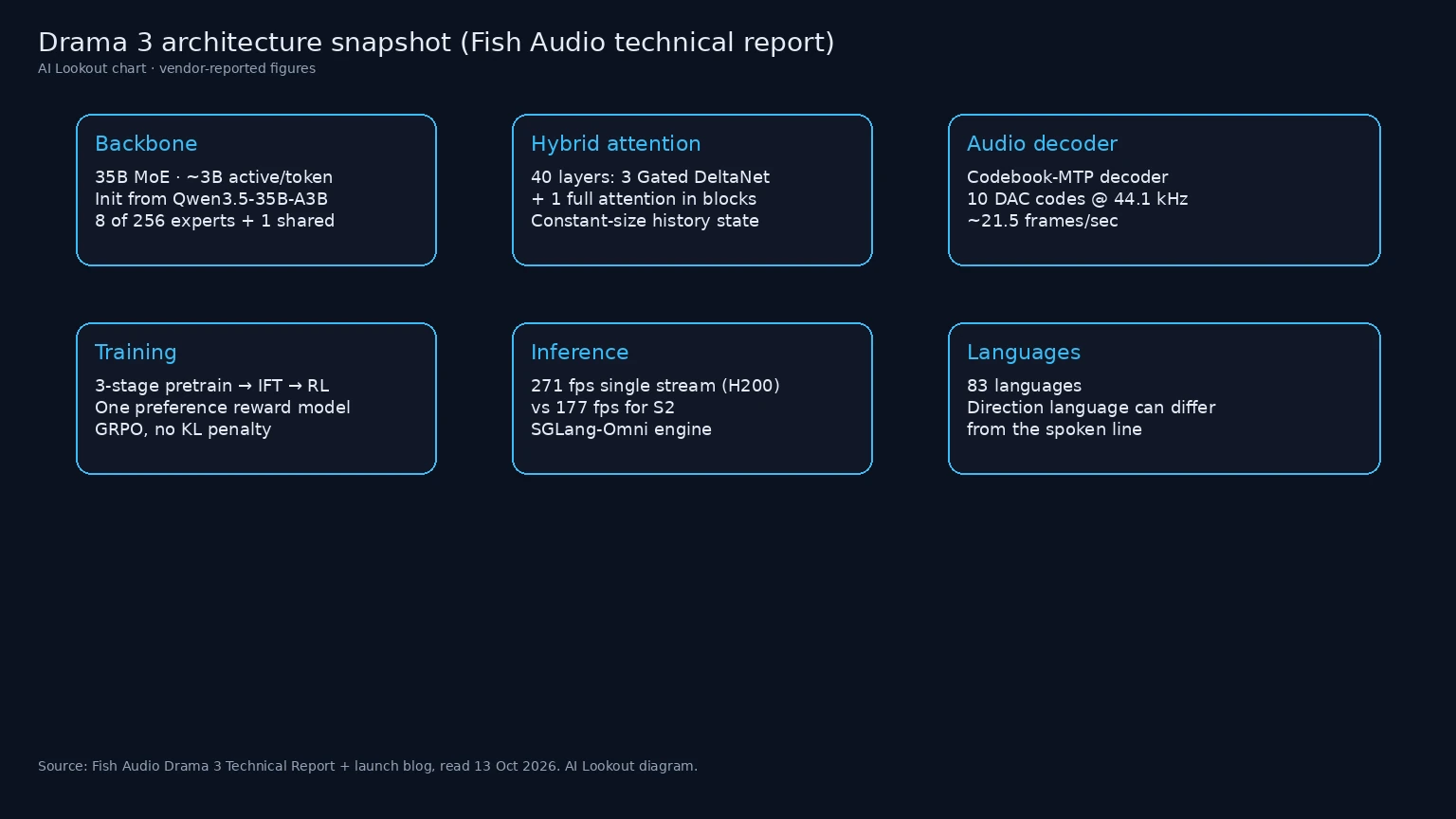
The technical report is unusually concrete for a commercial voice launch. Drama 3’s backbone is a 35B MoE with about 3B active parameters per token (eight of 256 routed experts plus one shared), initialized from the language model of Qwen3.5-35B-A3B. Attention is hybrid: forty layers in blocks of three Gated DeltaNet layers and one gated full-attention layer, so most history lives in a constant-size state.
A new codebook multi-token-prediction audio decoder replaces S2’s per-frame Fast AR path. Four shared layers feed nine full-width layers, one per acoustic codebook, and every layer attends causally over the whole sequence including reference audio. Only codebooks 0 and 1 feed back into the backbone; codes 2–9 go straight to the decoder. The tokenizer is S2’s Descript Audio Codec stack at 44.1 kHz with ten codebooks and about 21.5 frames per second.
Training runs three pre-training stages, instruction fine-tuning, then reinforcement learning. Fish says RL uses a single learned human-preference reward model and no rule-based rewards, optimized with GRPO without a KL penalty on 1,536 prompts times eight takes per step. That design choice is the company’s explanation for why tears and laughs are not punished the way transcription-oriented rewards would punish them.
On one NVIDIA H200, Fish reports the inference engine decodes a single stream at 271 frames per second versus 177 for S2, even though Drama 3 has more than seven times as many parameters. Inference is offered through SGLang-Omni.
Where can you run it, and what does it cost?
Hosted access is live today on fish.audio Text to Speech and in the Fish Audio mobile apps. Developers call the same POST /v1/tts endpoint as S2.1 Pro; switching is a model-header change once you pick the preview or production name Fish documents.
From 13 October through 12 November 2026, Fish prices the Drama 3 API at $10 per million characters—80% off a $50 list price—and advertises 50% off new creator plans. After the window, expect the list rate unless Fish extends the offer.
Self-hosting uses the open weights and fish-speech code. Fish’s blog and report both point at Hugging Face for weights and GitHub for code. Local operators still need hardware that can run a 35B MoE with a 3B active path; Fish’s published decode speed is an H200 single-stream figure, not a laptop claim.
What does the Community License allow?
The Fish Audio Community License v1.0 is new with this release. Research and non-commercial use are free. Commercial use is also free while you and your affiliates stay under US$500,000 in annual revenue. Above that threshold, or to offer Drama 3 to others as a TTS, voice-cloning or inference service or API, you need a separate license from Fish (business@fish.audio).
The license text is careful about agencies: delivering finished audio to a client is allowed under the community commercial grant, but handing clients self-serve access to the model is a hosted service that needs a paid deal. It also bans cloning a real person’s voice without consent, bans deceptive impersonation, and bans using the materials to train a competing foundational speech model.
S2 remains under Fish’s older research license. If you were shipping on S2 weights, Drama 3 is not a drop-in license upgrade; read the new agreement before you swap models in production.
What is still invite-only or unverified?
Two editing features Fish showed at launch—interactive editing that revises a take from a relative note, and audio inpainting that regenerates one changed word inside an approved take—are still invite-only. An editing API is “coming soon,” not shipping today.
Drama 3’s docs explicitly mark the model as preview: behaviour can still change, and a misspelled model header silently falls back to s2.1-pro rather than failing the request. That is a footgun for anyone scripting A/B tests.
We have not run Drama 3 ourselves. Feeling claims rest on Fish’s demos; pronunciation claims rest on Fish’s citation of Artificial Analysis. Independent Emotion or Preference Elo numbers for Drama 3 were not on the Artificial Analysis pages we fetched for this article.
How does Drama 3 sit next to other voice models?
Drama 3 sits in a crowded voice stack. Open-weight converters such as LAION’s Humaneness Voice Converter and realtime ASR/TTS packs like Mistral’s Voxtral Mini Realtime Arabic line solve adjacent problems. Fish is betting specifically on director-style control for scripted media.
Emotion datasets such as Basis Global Emotions and product demos such as HeyGen’s voice-controlled Arena show how hard it still is to measure “feeling” beyond pronunciation. Drama 3’s preference-only RL is one vendor answer; it is not a public emotion benchmark.
For product teams, the practical fork is license and latency: use the discounted API while the preview is cheap, or self-host under the revenue cap if you need offline or high-volume generation without sending scripts to Fish.
Common questions
Is Drama 3 open source?
No. It is open-weight under the Fish Audio Community License v1.0. Research and non-commercial use are free; commercial use is free under a US$500,000 annual-revenue cap. Offering it as a hosted TTS/API service needs a separate Fish license.
Which model header should API callers send?
Fish’s docs currently document drama-3-preview for the preview API and warn that a missing or misspelled header falls back to s2.1-pro. The launch blog’s sample uses drama-3. Prefer the docs header while the preview label is live.
Does Drama 3 support languages beyond English?
Fish says Drama 3 speaks 83 languages and that direction text can be written in a different language from the spoken line. Language tags for mid-line switches are marked experimental in the docs.
What to remember
Drama 3 is a directed-performance TTS release with open weights, a revenue-capped community license and a temporary cheap API. Take Fish’s pronunciation ranking as vendor-cited until Artificial Analysis lists Drama 3 publicly, and keep interactive editing on the waitlist.
Sources & further reading
How this story was made
Written by Kristian Kostov with AI assistance and checked against the linked sources. Company performance claims are attributed to the company. Analysis reflects AiLookout’s interpretation; we have not independently tested the products discussed. Cover photography is illustrative and does not depict the specific announcement or product.
Our editorial standards