Announced 12 Oct 2026 · Sources checked
What did Basis release?
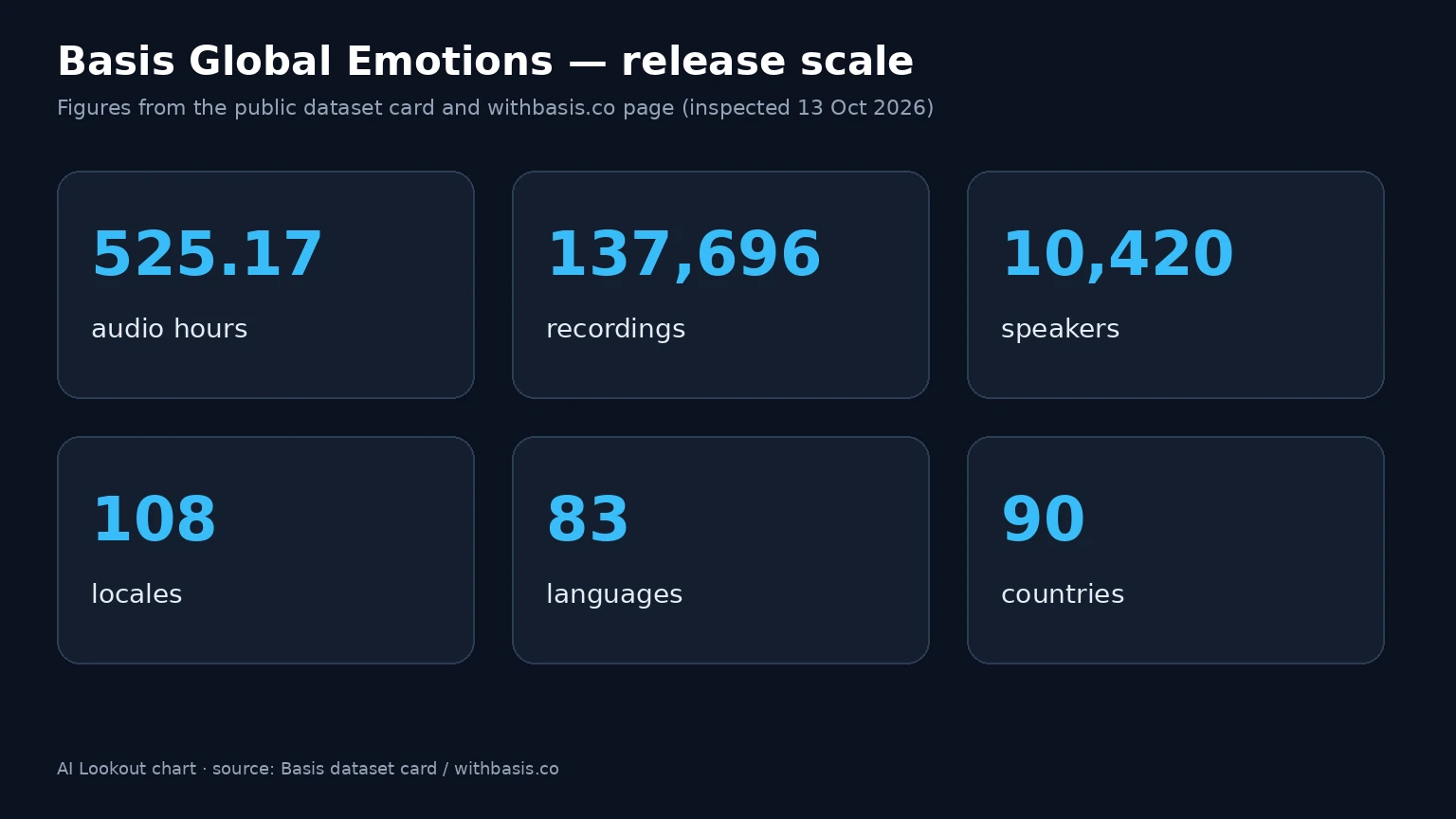
Basis, the speech data company also behind Basis Conversations 1500, published Global Emotions as a gated Hugging Face dataset with a public card and a companion page at withbasis.co. The card’s headline numbers are 525.17 hours, 137,696 recordings, 54,575 series, 10,420 speakers and 108 locales.
Unlike conversational corpora that capture overlapping talk, this release is scripted expressive speech. Each recording is one native speaker performing a line in a described situation according to a steer—an emotion such as frustrated or proud, or a delivery such as whispering or screaming. The product page invites listeners to hear samples before requesting access, and says requests are reviewed by a person.
The timing sits next to Basis’s earlier Conversations 1500 release of multi-party dialogue. Global Emotions fills a different gap: controlled emotion and delivery variation with speaker identity held constant inside a series.
How is a series different from a recording?
The unit that matters is the series, not the single file. An emotion series has three readings of the same line by the same speaker—neutral, medium and full intensity. A delivery series has two—neutral and full—for styles such as whispering or laughing. Every reading ships; `series_id` groups them and `intensity` orders them.
That design is aimed at training and evaluation where you need emotion or delivery to change while lexical content and speaker stay fixed. The card tells users to join `speaker_id` to `speakers.jsonl` for speaker-disjoint splits, and notes that demographics are self-reported rather than inferred from audio.
For speech teams that already work with models such as Whisper-class recognizers or expressive converters like LAION’s Humaneness Voice Converter, the series structure is the practical difference from dumping unrelated emotional clips into one folder.
How big is the collection, and where?
Locales are named configurations such as `ja-JP` or `pt-BR`. The public table lists hours, recordings, series and speakers per locale; the largest shown blocks include Brazilian Portuguese, Japanese, Polish, US English and Ukrainian, each in the roughly 8–10 hour range, with a long tail of lower-resource locales down to under an hour.
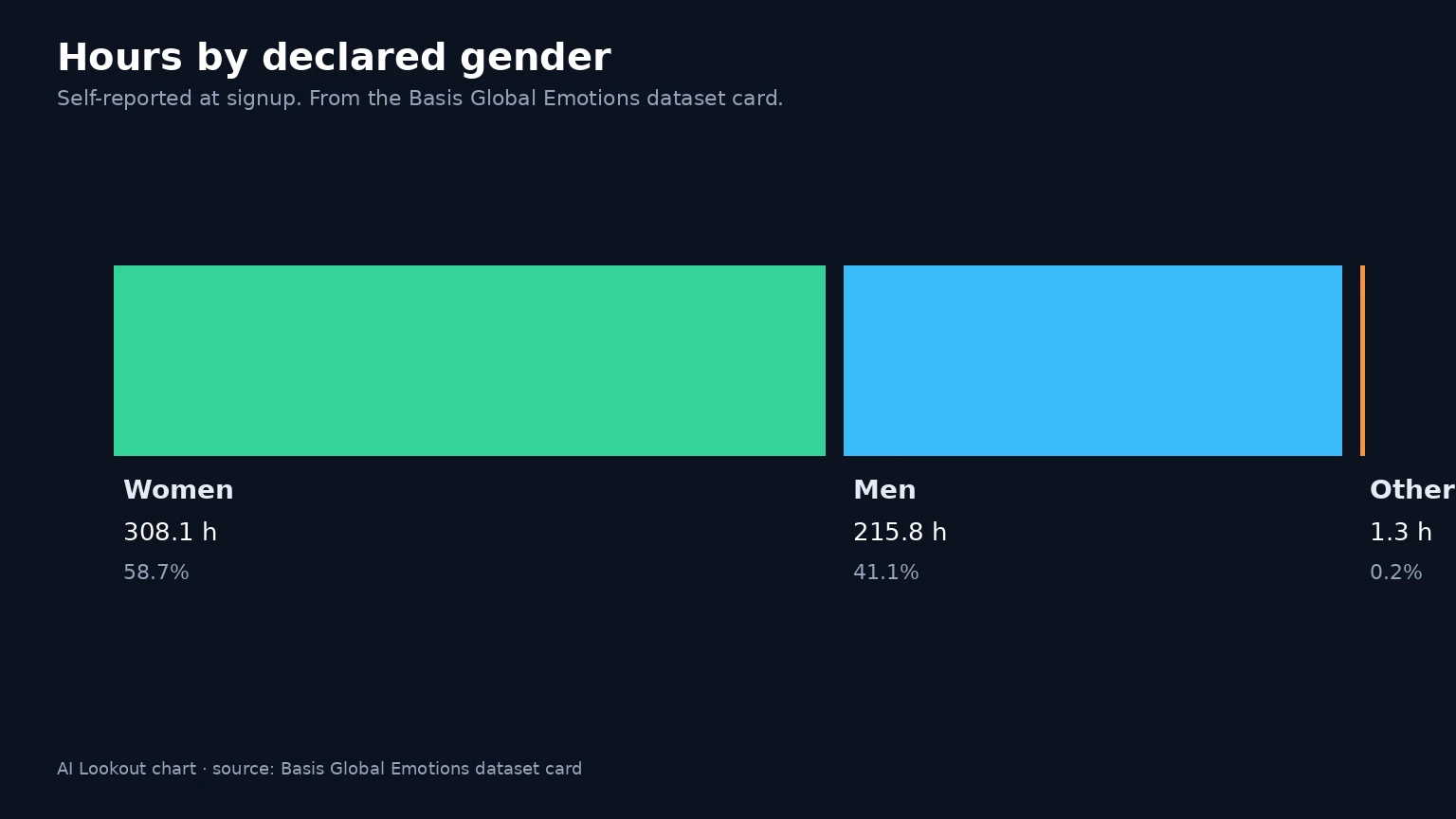
Aggregate gender hours on the card are 308.1 for women, 215.8 for men and 1.3 for other. Speakers may appear in more than one locale of the release; identifiers are salted and stable, with no names or contact data.
Each locale ships as parquet shards under `data/<language>-<COUNTRY>/` with sixteen columns, including the audio bytes, steer, given line, situation, nonverbal cue list, duration and NISQA scores. The repository’s total file size is listed around 168 GB on Hugging Face.
What steers and non-verbal cues are covered?
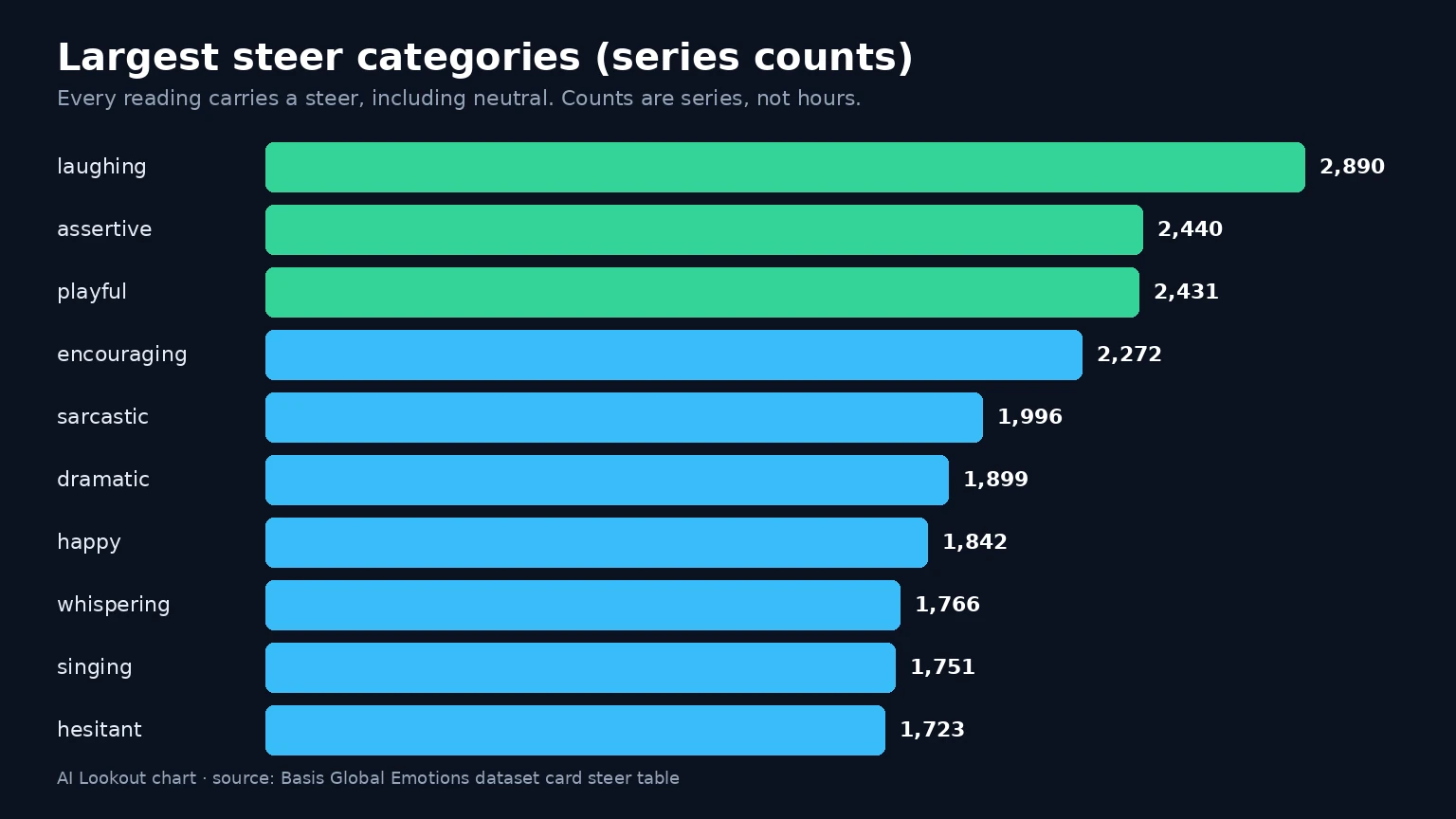
The steer table on the card spans dozens of labels. The largest series counts include laughing (2,890), assertive (2,440), playful (2,431), encouraging (2,272), sarcastic (1,996) and dramatic (1,899), with familiar emotion labels such as happy, sad, angry and afraid also present, plus delivery extremes such as screaming and shouting at smaller counts.
About 8.82% of recordings (12,141 of 137,696) include a scripted non-verbal cue written into the line in square brackets—laugh, sigh, scoff, tongue click, gasp and others—with `nonverbal_cues` listing the English kinds in order. The card stresses that `given_line` is the instructed script, not a human transcription or ASR output; speakers may have departed from the line, and validated transcripts are available only on request.
How was quality and consent handled?
Native speakers record on Basis’s consumer apps and are paid. All audio in a locale is rated by native speakers from that locale; series are then chosen by a blend of pairwise ratings and internal models for steer following and microphone quality, balanced across steers and genders, with caps of 35 minutes per speaker and ten series per line. `rank` orders that pick within the locale.
Quality gates use NISQA MOS and background-noise scores. Typical minima are 3.80 / 3.90, with a few locale exceptions noted on the card; whisper and laughing deliveries use their own acoustic check instead. Audio is WAV, 16-bit PCM, 48 kHz mono, kept as recorded—no post-hoc denoising, enhancement, loudness normalization or resampling.
Consent language on the card says participants agreed at signup to license recordings for AI training, including resale to third parties and training of ASR, TTS and voice-cloning systems, and waived publicity rights for AI training. Lines are scripted so personal details are not spoken. Suspected minors are filtered by declared age, an offline underage-voice detector and human review of flagged speakers.
What does the Basis Data License allow?
The Basis Data License 1.0 is labeled free for commercial and research use. It grants a worldwide, royalty-free, perpetual license to download, store, process, annotate, modify and combine the data, and to pretrain, fine-tune, distill, evaluate and benchmark models—including commercial products, hosted inference and APIs—with no royalties and no obligation to publish code or weights.
Two prohibitions are explicit: you may not resell or redistribute the recordings themselves (or derivatives that still contain them), and you may not identify, locate or contact speakers, impersonate a specific person, or reconstruct removed information. Custom licenses are offered via data@withbasis.co.
Access is gated: Hugging Face shows an access-request flow, and the license text says acceptance through that process (or another Basis-authorized process) is required before the license takes effect. A preview alone does not create a license. That is stricter than an Apache-2.0 weight dump, even though the training permissions are broad once access is granted.
How do you load and use it?
After access, the card’s recipe is to install `datasets[audio]` and FFmpeg, then `load_dataset("basis-ai/basis-global-emotions", "ja-JP", split="train")` (or another locale code). Group rows by `series_id` and order `intensity` as neutral → medium → full for emotion series. For all locales, loop configurations or read the parquet tree directly.
Builders working on multilingual speech stacks—for example dialect ASR work such as Mistral and Morocco’s Voxtral Arabic release, or audio-capable decision models like Cloudflare’s Clef-omni—get a controlled emotion axis that conversational dumps rarely provide.
Checksums are published as `CHECKSUMS.sha256` for root files, and Hugging Face’s file listing exposes parquet shard hashes. The card’s citation block is the `@misc{basis2026globalemotions}` entry pointing at the Hub URL.
What are the limits?
There is no research paper attached to the card we inspected—only the dataset documentation, license and product page—so claims about downstream model gains are not part of the primary release. Human-validated transcripts are absent from the download; `given_line` is not a guarantee of what was spoken.
Gating means reproducibility for readers without access is limited to the public statistics and samples. Locale coverage is uneven by hours, and self-reported demographics can be incomplete or strategic. Voice-cloning risk is acknowledged in the consent text itself; the license’s anti-identification clauses are the contractual counterweight, not a technical watermark.
Finally, Global Emotions is complementary to Conversations 1500 rather than a replacement: one is steered monologue for emotion control, the other is multi-party dialogue. Teams that need both will still be stitching two licenses and two access grants.
Common questions
Is Global Emotions free to download without an account?
No. The Hub listing is gated; Basis says access requests are reviewed by a person. The license takes effect when Basis grants access through that process.
Can I train a commercial TTS model on it?
The Basis Data License text allows commercial training and products built from models trained on the data, but forbids redistributing the recordings themselves and identifying speakers. Read the LICENSE file for the full terms.
Does each emotion have the same amount of data?
No. Series counts vary widely by steer—laughing and assertive are among the largest on the card, while screaming and shouting are much smaller—and locale hours also vary.
What to remember
Global Emotions is a large, license-clear, series-structured emotion speech release aimed at controllable TTS and expressive modeling. The useful claim is the design—same speaker, same line, steered intensity—not a benchmark score.
Sources & further reading
How this story was made
Written by Kristian Kostov with AI assistance and checked against the linked sources. Company performance claims are attributed to the company. Analysis reflects AiLookout’s interpretation; we have not independently tested the products discussed. Cover photography is illustrative and does not depict the specific announcement or product.
Our editorial standards