Announced 8 Oct 2026 · Sources checked
What did Mistral and Morocco release?
On 29 September 2026 Morocco’s Ministère de la Transition Numérique et de la Réforme de l’Administration (MTNRA) announced the first results of its partnership with Mistral AI: a classifier that can recognise Arabic dialects including Moroccan Darija, and a Voxtral speech recognition model for Darija that also handles switching between Arabic, French and English. The ministry said both would be released as open source soon.
They appeared on Hugging Face on 8 October as Voxtral Mini 4B Realtime Arabic and LIDstral Arabic, published by Mistral under the Apache 2.0 licence. Neither got a launch post on Mistral’s own site. The speech model is broader than the ministry’s description: it covers Modern Standard Arabic and 15 dialects spanning the Maghreb, the Gulf, the Nile Valley, the Levant and Chad.
The ministry signed a memorandum of understanding with Mistral chief executive Arthur Mensch in Rabat on 12 September 2025, covering skills, applied research and responsible AI; the model card instead refers to a strategic partnership signed in January 2026. The ministry calls the models deliverables of a multi-year partnership and says more are in development for generative AI, language processing, speech recognition and public services.
How does the streaming model work?
Voxtral Mini 4B Realtime Arabic is fine-tuned from Voxtral Mini 4B Realtime 2602, the open streaming model Mistral released in February. That base pairs a roughly 3.4-billion-parameter language model with a roughly 970-million-parameter audio encoder trained from scratch with causal attention, so it only looks at sound it has already heard. Both parts use sliding-window attention, which lets a session run for hours.
The Arabic model has about 4.4 billion parameters in BF16. It takes 16 kHz audio and emits text as the audio arrives, rather than waiting for a whole recording. You choose a transcription delay: a shorter wait gives faster captions, a longer one gives the model more context. The model card reports results from 80 ms to 720 ms and recommends 480 ms; the base model’s card says delays can be set in 80 ms steps.
Training focused on Arabic code-switching, the habit of moving between languages mid-sentence that is routine in Morocco and across the Arab world. Mistral says it also saw improvements on code-switching involving languages outside that focus.
How accurate is it?
Mistral measures character error rate, the share of characters a transcript gets wrong, across seven test sets: established benchmarks such as MGB-2, SADA, Casablanca, FLEURS and MASC, plus two new sets made with the ministry. ISMA has 357 clips across topics from business and engineering to history and tourism; Darija in the Wild has 109 clips weighted towards everyday and technical code-switching, tricky names, noise and silence.
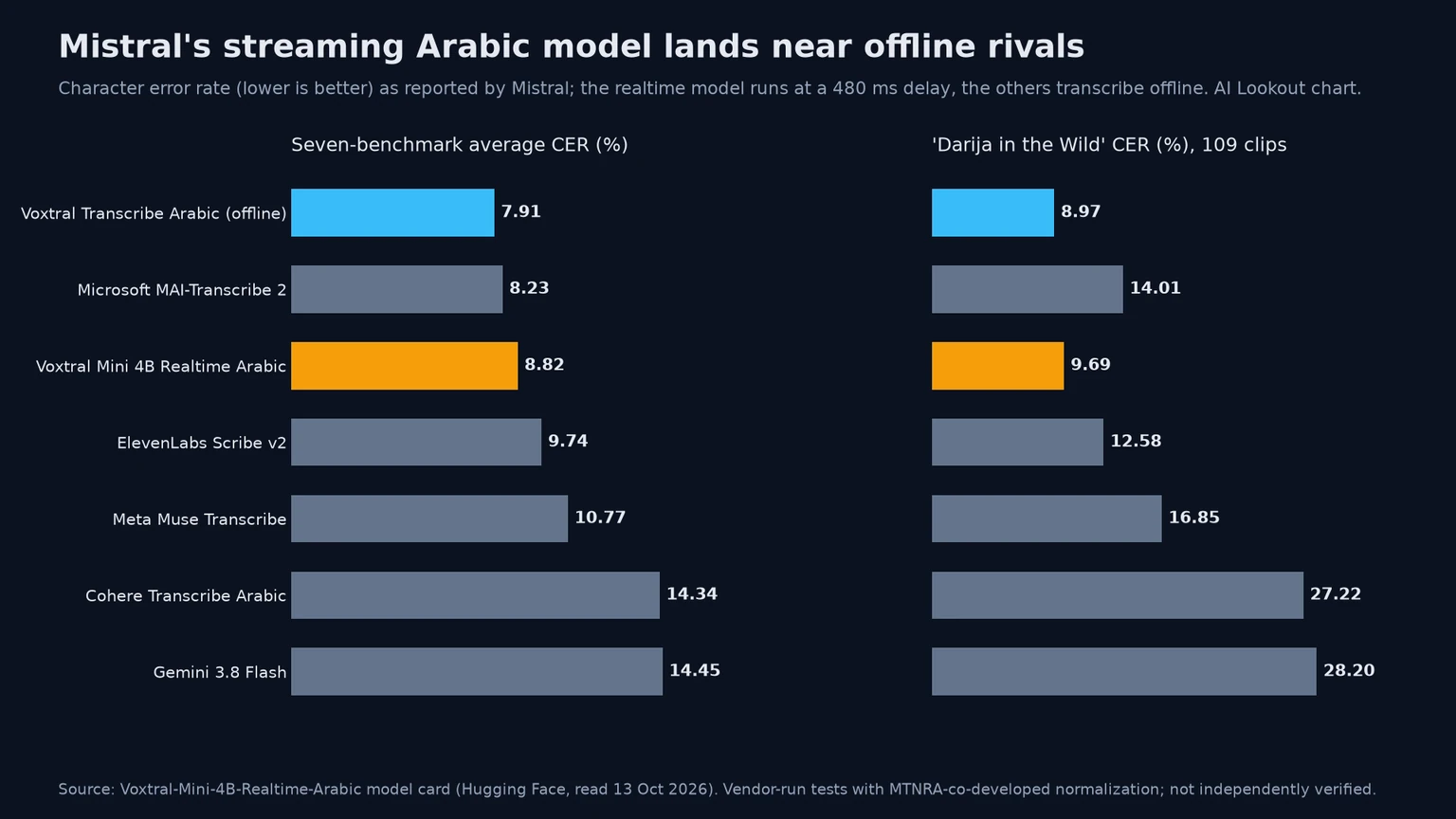
At 480 ms the streaming model averages 8.82%. Mistral’s offline Voxtral Transcribe Arabic does best at 7.91%, followed by Microsoft’s MAI-Transcribe 2 at 8.23%. The realtime model beats offline systems from ElevenLabs (Scribe v2, 9.74%), Meta (Muse Transcribe, 10.77%), Cohere (Transcribe Arabic, 14.34%) and Google’s Gemini 3.8 Flash (14.45%). On Darija in the Wild it scores 9.69%, second only to Voxtral Transcribe Arabic, where MAI-Transcribe 2 scores 14.01%.
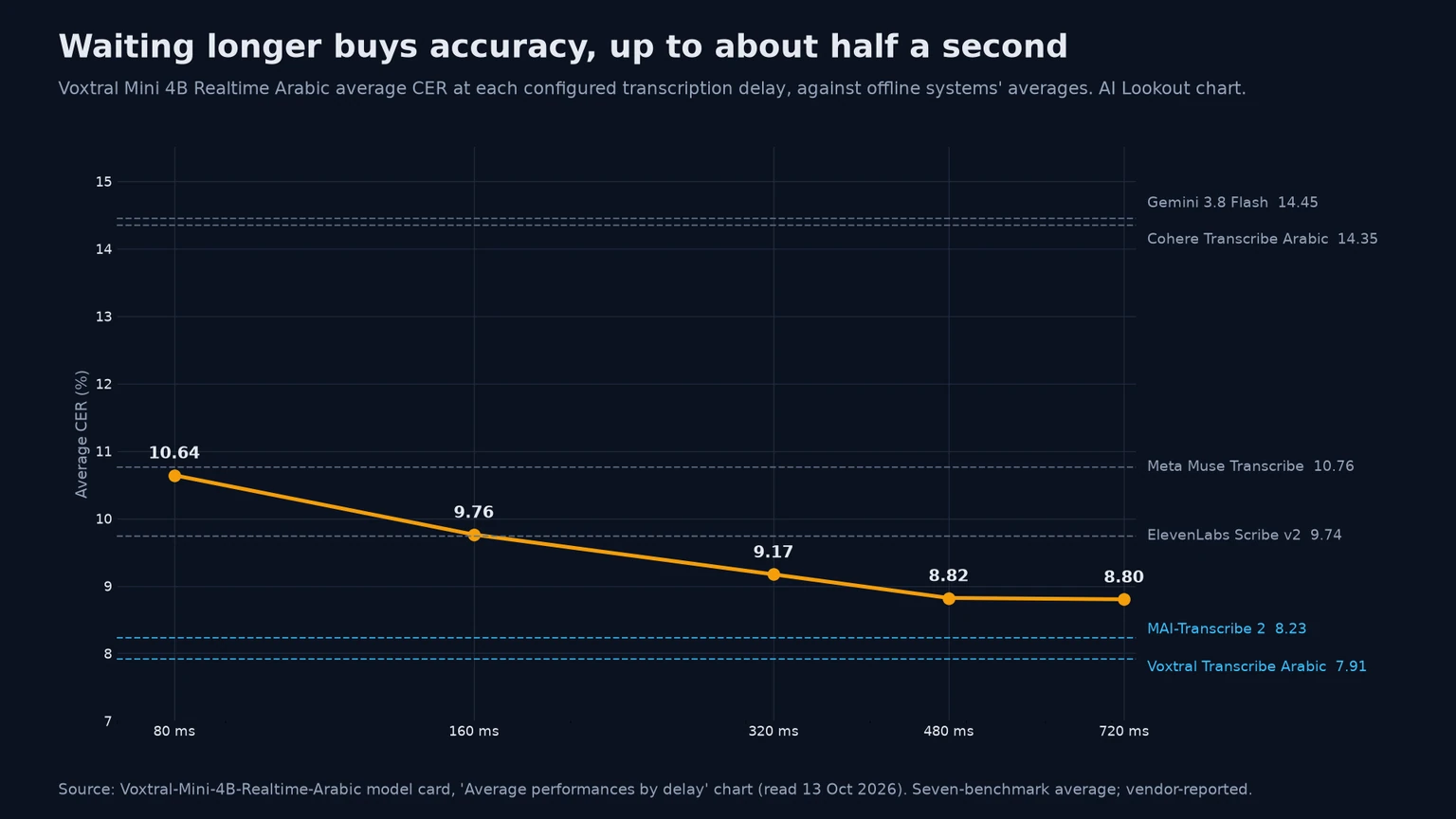
Results vary by test set. Microsoft’s model is better on SADA, Casablanca, FLEURS and MASC, and ElevenLabs leads MGB-2. The delay matters too: error falls from 10.64% at 80 ms to 9.76% at 160 ms and 8.82% at 480 ms, then barely moves at 720 ms.
What does LIDstral Arabic do?
LIDstral Arabic is a text classifier, not a speech model. Given a sentence in Arabic script, it predicts which of 51 classes it belongs to: Modern Standard Arabic, country-level Arabic dialects, or a different language that uses the same script, such as Persian, Urdu, Pashto, Hausa or Malay written in Jawi. Including those languages stops it from calling text Arabic just because of the alphabet. Its language list also includes Standard Moroccan Tamazight in Tifinagh.
It is deliberately light: a fastText one-vs-all classifier, a small 64-unit neural network that turns those scores into probabilities, and a calibration step for each class. It runs on CPU and returns a label, a confidence and probabilities for every class. On 84,870 test examples drawn from public datasets including NADI, MADAR, QADI, Casablanca and FLEURS, Mistral reports 88.67% F1 on Moroccan Darija, against 72.65% for the strongest tested baseline in the card’s text, and 71.28% for GlotLID v3.
For speech pipelines, a classifier like this is the routing step: decide which dialect a caller or document uses, then pick the right model, prompt or human team.
How can developers use them?
Both repositories are public and ungated. The speech model runs in vLLM, which serves a realtime WebSocket endpoint at /v1/realtime for streaming audio, and natively in Hugging Face Transformers from version 5.2.0. Mistral says the base realtime model fits on a single GPU with at least 16 GB of memory, and it recommends a temperature of 0. The ONNX community has published a converted checkpoint, and a browser demo runs it with WebGPU.
LIDstral Arabic ships as three model files and a classify.py script that reads single strings or JSON Lines files. It needs no GPU. The card still tells users to log in to download what it calls a private repository, a leftover from before release; the repository was public when we checked.
Mistral also publishes the text normalisation code used for scoring, which handles dialect spelling, clitics, loanwords and spoken numbers. That matters, because Arabic error rates swing with normalisation choices. Developers who have used Whisper for Arabic can test the new model against their own audio with the same script.
Why does it matter for Arabic speech AI?
Arabic speech recognition has long been good at formal Modern Standard Arabic and much weaker on the dialects people actually speak at home, at work and on customer-service lines. Open streaming models for those dialects are rare. Last week the Abu Dhabi institute TII released Falcon-ASR alongside Falcon-Emirati and Falcon-OCR-Arabic; Mistral’s release adds a permissively licensed realtime option built for code-switching.
For Morocco, it is a test of whether government partnerships with model makers produce something usable. The ministry frames the models as sovereign AI assets for administrations, start-ups and researchers, and lists uses such as public services, education, media, customer support and document processing. Because the weights are Apache 2.0, anyone can run them locally without sending audio to a cloud service.
What are the caveats?
Every number here comes from Mistral, on benchmarks it chose, including two new sets built with its partner and scored with normalisation it co-developed. The card warns that scores may differ under other normalisation, and that Gemini’s safety filters blocked some FLEURS samples, which may affect Gemini’s figures. We have not tested either model.
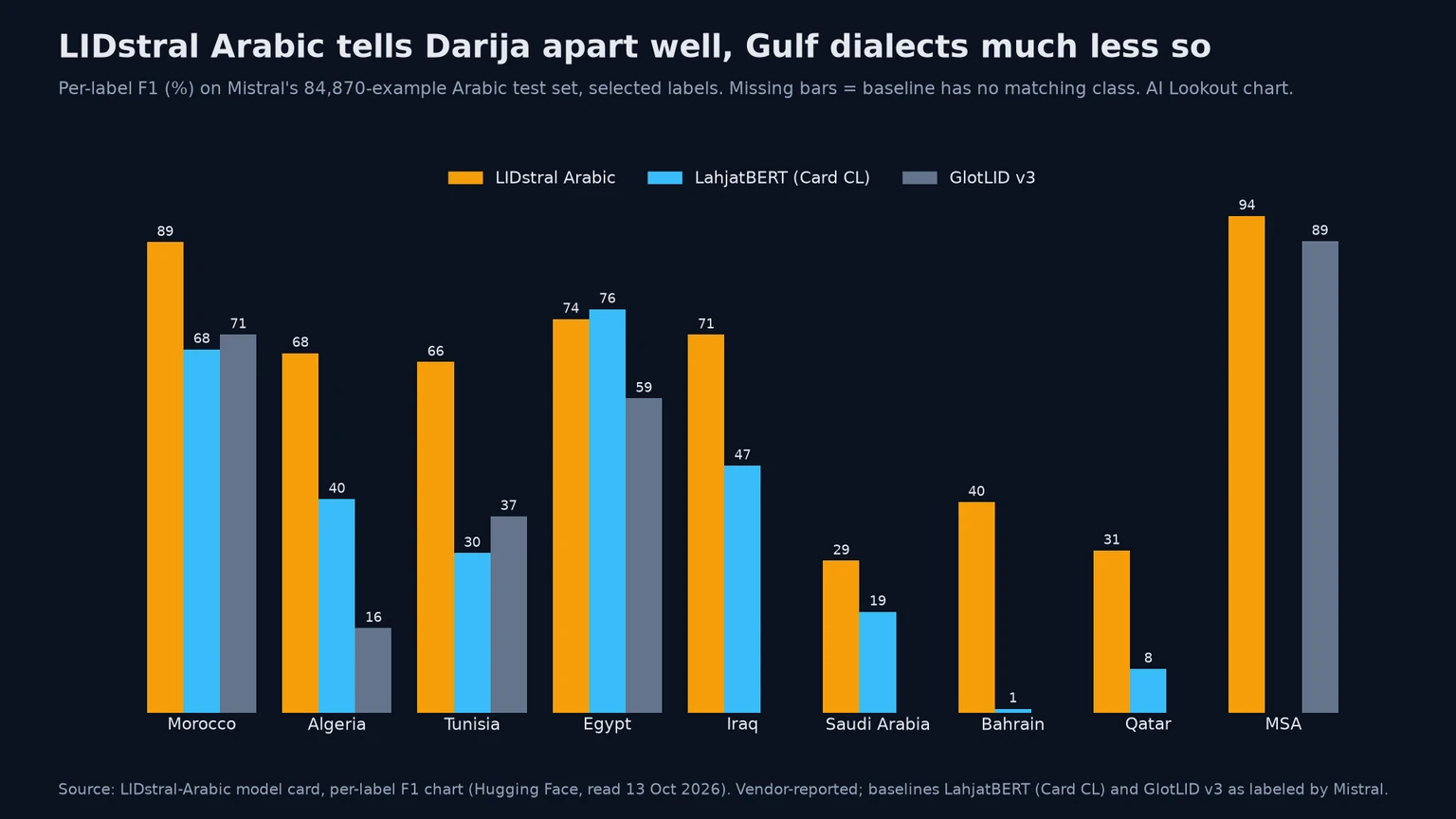
LIDstral’s own chart shows the hard cases: F1 is 29% for Saudi Arabia, 31% for Qatar and 40% for Bahrain, so Gulf dialects are often confused. Its card also gives two different figures for the best Darija baseline. The speech model targets Arabic only; Mistral says to use the original realtime model for other languages. The ministry announced a Darija model, and some Moroccan users have asked why the result covers many dialects instead; how much Moroccan data went into training has not been disclosed.
Common questions
Is Voxtral Mini 4B Realtime Arabic free to use commercially?
Yes. Mistral publishes it under the Apache 2.0 licence, which allows commercial use, and the weights can be downloaded from Hugging Face.
Does it understand Moroccan Darija?
Yes. Darija is one of 15 listed dialects, and on Mistral’s Darija in the Wild test the streaming model reports a 9.69% character error rate.
What is LIDstral Arabic for?
It identifies which Arabic dialect, or which other Arabic-script language, a piece of text is written in, so applications can route it to the right model or team.
What to remember
Mistral and Morocco’s digital ministry have released an Apache 2.0 streaming transcriber for Modern Standard Arabic and 15 dialects, plus a dialect classifier. Mistral’s tests put the speech model near the best offline systems, but the figures are vendor-reported.
Sources & further reading
- Voxtral Mini 4B Realtime Arabic (model card) ↗
- LIDstral Arabic (model card) ↗
- Le Ministère de la Transition Numérique et de la Réforme de l’Administration du Royaume du Maroc et Mistral AI annoncent les premières briques d’IA développées dans le cadre de leur partenariat ↗
- Le MTNRA et Mistral AI unissent leurs efforts pour l’innovation digitale ↗
- Voxtral Mini 4B Realtime 2602 (model card) ↗
How this story was made
Written by Kristian Kostov with AI assistance and checked against the linked sources. Company performance claims are attributed to the company. Analysis reflects AiLookout’s interpretation; we have not independently tested the products discussed. Cover photography is illustrative and does not depict the specific announcement or product.
Our editorial standards