Announced 11 Oct 2026 · Sources checked
What did LAION release on 11 October?
LAION, the non-profit research network best known for the LAION-5B image-text dataset, uploaded a new model repository called laion/Humaneness-Voice-Converter to Hugging Face on 11 October 2026. Hugging Face's API records the repository's creation at 09:09 UTC that day, and a companion demo Space, Humaneness-Voice-Converter-Demo, was created a few minutes earlier. The model card calls it LAION's recommended default Chatterbox-based voice-conversion checkpoint.
Voice conversion is different from text-to-speech. Instead of typing words and choosing a voice, you supply a spoken recording, the source, plus a short recording of another person, the target. The model keeps what was said and how it was performed, and replaces the voice. LAION describes the release as research voice conversion for speech and dataset augmentation, and the card stresses repeatedly that the target speaker must be different and consenting.
The release is unusually complete. Rather than a set of adapters, the repository includes the merged model weights, the speech tokenizer, speaker encoder, vocoder and a frozen scoring model needed at inference, plus an infer.py command, reproducibility notes, measured speed notes and snapshots of the training scripts. LAION's own additions are licensed CC BY 4.0, while the bundled Chatterbox components keep Resemble AI's MIT license and attribution, recorded in a NOTICE file.
How does the converter work?
The pipeline has four stages, according to the model card. First, Chatterbox's speech tokenizer turns the source recording into roughly 25 semantic tokens per second, which carry content and timing without any transcript. Second, the target clip supplies a CAMPPlus speaker embedding and a short acoustic prefix, which tell the model whose voice to produce.
The third stage is LAION's main change. A frozen model called Humaneness Ears Medium predicts 99 scores for the audio: 40 emotions, 57 voice attributes, plus measures of genuineness and vocal-burst blending. Scores that change over time, such as style and emotion, are taken from the source, while relatively stable traits such as timbre, age and gender are taken from the target. A small projection layer feeds those scores into Chatterbox's flow generator alongside the speaker vector. Finally, the flow decoder produces mel features in 10 steps and the HiFT vocoder renders a 24 kHz waveform.
Training happened in several stages on LAION's cluster: a 300-hour supervised pilot, reinforcement-learning adapters, a mixed reward adapter, and then full training of all 112,620,864 flow-generator parameters for 40,000 further groups of 16 candidates. The reward compared candidates within each group and weighted predicted content enjoyment at 40%, closeness to the source's two strongest emotions at 30%, and similarity to the target speaker at 30%. LAION calls this a group-relative objective for continuous flow models, inspired by GROW, rather than ordinary token-level GRPO.
How does it score against original Chatterbox?
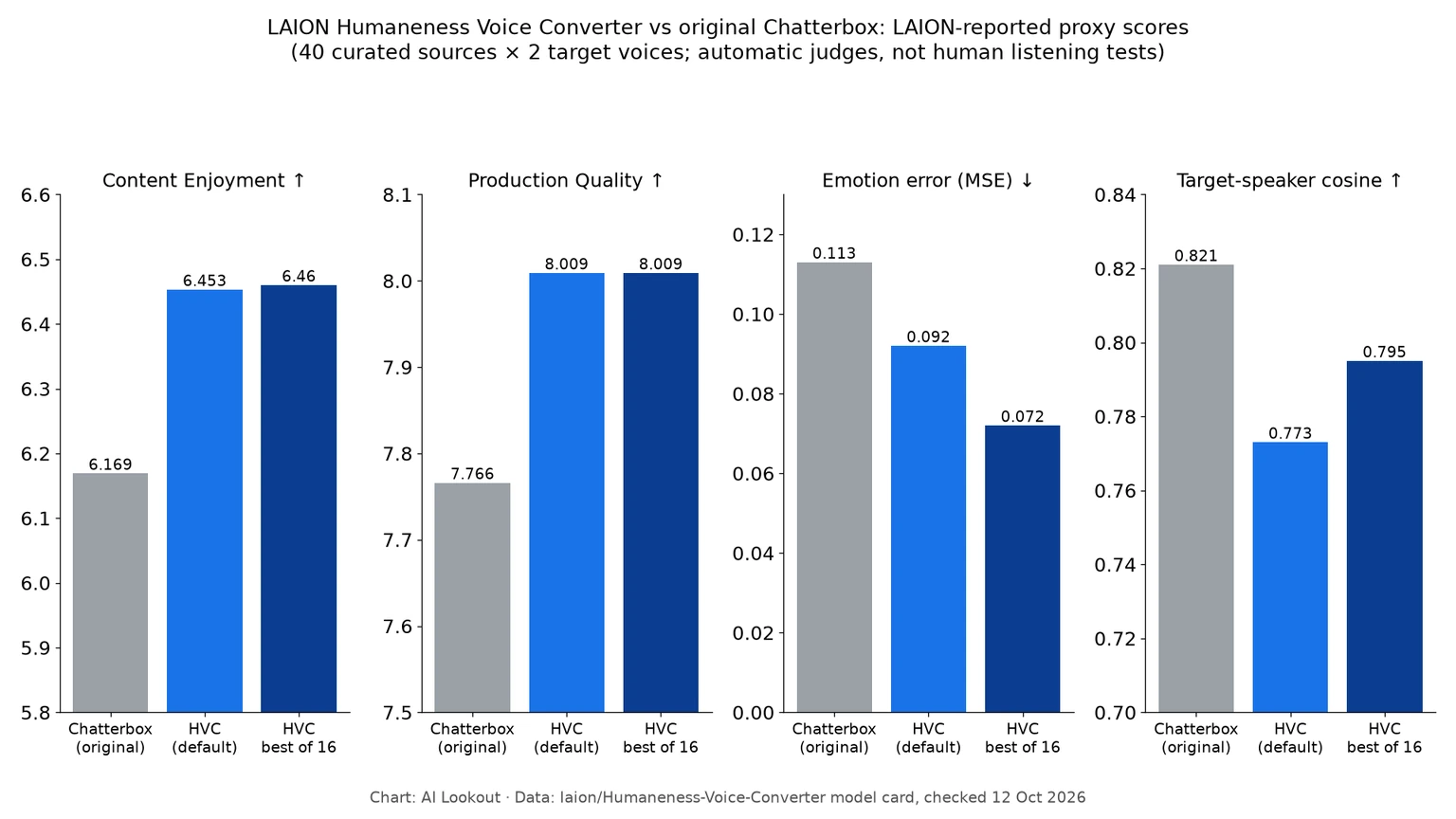
LAION evaluated the converter on 40 curated source clips, each converted into two fixed target voices. Compared with untouched Chatterbox, the default model raised predicted content enjoyment from 6.169 to 6.453 and production quality from 7.766 to 8.009, and cut the error against the source's top two emotions from 0.113 to 0.092. The cost is speaker similarity: the cosine score against the target voice fell from 0.821 to 0.773. Generating 16 takes and keeping the best recovered some of that, to 0.795, and lowered emotion error to 0.072.
The card is candid about what these numbers are. Enjoyment, quality and emotion are predicted by the same family of scoring model used as the training reward, the test sources were selected partly on input quality, 10 of them overlap the reinforcement-learning source list, and speaker-level separation between training and test data has not been proven. A separate 93-clip comparison against an earlier checkpoint showed small quality gains but a worse emotion score. There is no independent human mean-opinion score or word-error-rate result for this release.
| Decoder | Content enjoyment | Production quality | Emotion error | Speaker cosine |
|---|---|---|---|---|
| Original Chatterbox | 6.169 | 7.766 | 0.113 | 0.821 |
| Humaneness VC (default) | 6.453 | 8.009 | 0.092 | 0.773 |
| Humaneness VC, best of 16 | 6.460 | 8.009 | 0.072 | 0.795 |
How fast is it, and how do you run it?
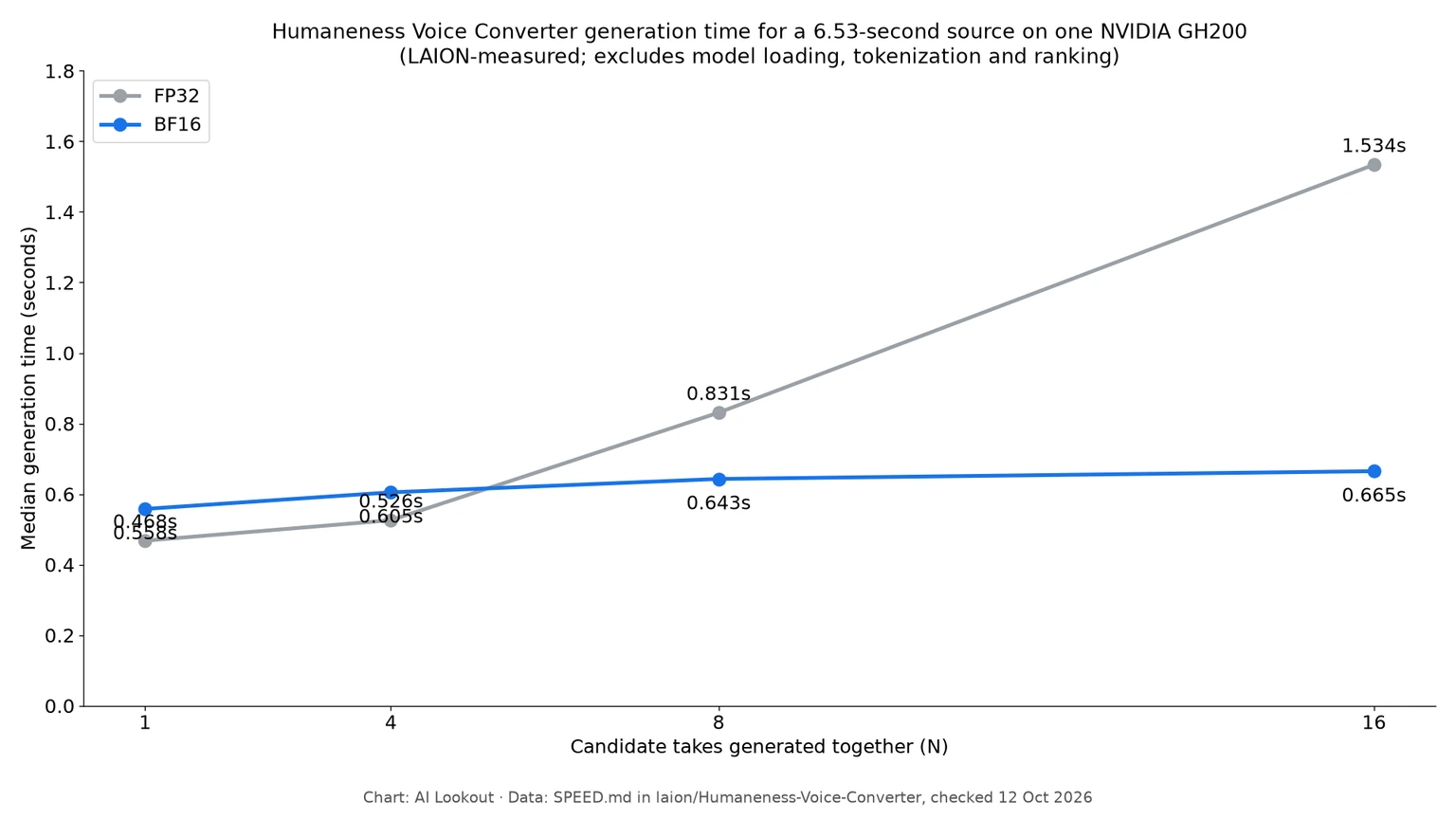
LAION measured speed on a single NVIDIA GH200. For a 6.53-second source, generating one take took a median 0.468 seconds in FP32 and 0.558 seconds in BF16; generating 16 takes together took 1.534 seconds in FP32 but only 0.665 seconds in BF16. Those timings exclude loading the model, tokenizing audio and ranking candidates. In a first-use smoke test, preparation alone took about 6.3 seconds, so the end-to-end time for a single request is several seconds, not sub-second.
To try it, you can listen first: the demo Space plays the same 40 sources through original Chatterbox, the new converter, best-of-N picks and other external converters, including German clips. To run it, LAION's quick start installs the requirements and chatterbox-tts 0.1.7, downloads the repository with the Hugging Face CLI, and calls infer.py with a source WAV, a target WAV and an output path. Optional flags generate four, eight or 16 candidates and keep the best by a fixed proxy reward. Inputs should be mono audio between 1 and 30 seconds. LAION notes it tested with Python 3.13 and PyTorch 2.9.1 in its own environment, not across platforms.
Why does an emotion-first voice converter matter?
Most open voice converters are judged on how closely they match the target voice, and expressive delivery often flattens in the process. LAION is openly optimizing for the performance instead and publishing the trade-off. That makes the model interesting for dubbing experiments, game and animation prototypes, accessibility research and building varied speech datasets, the same areas where commercial voice products compete, as with HeyGen Voice topping Artificial Analysis's controlled-voice board.
The licensing also matters. CC BY 4.0 permits commercial use with attribution, and the bundled Chatterbox parts are MIT, so teams can inspect, retrain and ship derivatives, subject to the rights of any voices they use. Because weights, training code and evaluation scripts are all public, this is closer to genuinely open AI than many releases, in the sense we described in open weights versus open source. It joins a run of permissively licensed generative media releases this month, including Kandinsky 6.0 Video.
What are the limits and risks?
Quality evidence is limited. All headline numbers come from automatic scorers, one of which shares a family with the training reward, so the model was partly graded by the kind of judge it learned to please. LAION says the demo is not a blinded listening study. English and German were the only languages in training and evaluation; other languages may run but carry no quality promise. The card also warns of artifacts, content changes, unexpected emotion and identity drift.
Misuse is the larger concern. Any tool that re-voices speech from a few seconds of target audio can be used for impersonation and fraud. LAION's card asks users to obtain consent, disclose converted speech and avoid impersonation, but it notes these are ethical recommendations, not legal restrictions on the license. Nothing in the release adds a watermark, so detection tools such as Google's public SynthID Detector will not flag its output by design. We did not download or run the model for this article; everything here is drawn from LAION's repository and demo listing.
Common questions
Is Humaneness Voice Converter free for commercial use?
LAION's additions are licensed CC BY 4.0, which allows commercial use with attribution, and the bundled Chatterbox components are MIT. You still need rights and consent for any voices you convert, and LAION asks users not to impersonate anyone.
Is this a text-to-speech model?
No. It converts one recording into another speaker's voice. It needs a spoken source clip and a 5 to 10 second target clip, and outputs 24 kHz audio. LAION's separate Humaneness Voice Small model handles text-to-speech.
How good is it compared with Chatterbox?
On LAION's 40-clip set it scores higher on predicted enjoyment, production quality and emotion match, but lower on target-speaker similarity. These are automatic proxy scores reported by LAION, with no human listening test yet.
What to remember
LAION's Humaneness Voice Converter is a complete, openly licensed voice-conversion checkpoint that trades a little speaker similarity for better-preserved emotion; the release is well documented and easy to try, but its quality claims rest on LAION's own automatic metrics.
Sources & further reading
How this story was made
Written by Kristian Kostov with AI assistance and checked against the linked sources. Company performance claims are attributed to the company. Analysis reflects AiLookout’s interpretation; we have not independently tested the products discussed. Cover photography is illustrative and does not depict the specific announcement or product.
Our editorial standards