Announced 19 Oct 2026 · Sources checked
What Viggle released
On 19 October 2026, Viggle published Introducing Viggle JST-2, calling JST-2 a physics-native world foundation model that keeps scenes, characters and motion in one shared 3D representation. The company's verified X account announced the release the same day, saying it built the full model stack in 3D instead of learning the world only in pixel or video space.
JST stands for Joint Space-and-Time. On the launch page, Viggle says the model represents the world as persistent atoms in 3D space: each atom keeps an identity as it moves or deforms, with an explicit xyz position plus learned vectors for attributes and dynamics, encoded as Physics-Native Tokens. The same token stream can be inferred from real images or generated from a multimodal prompt, then decoded into images or 3D Gaussian splats for a chosen viewpoint.
Viggle says it founded the company in 2022, spent the first two years on JST-1 for character generation and animation that powered its meme-making app (which it says has since reached more than 50 million users), and developed JST-2 from 2024 to 2026 to cover scenes, characters and motion together. The launch page lists free access in the browser through PINOC, plus an API and MCP path for agents.
How a physics-native world model differs
Most recent world-model demos still learn appearance and motion from 2D video frames. That is the approach behind products such as Noiz AI and HKUST's Helix World and Odyssey-3. Viggle's claim is different: it says physical structure should be modelled directly as persistent 3D atoms, so that looking away from an object does not erase it and moving the camera does not require re-solving the whole scene from scratch.
In the interactive schematic on the launch page, the JST encoder maps one or more images to those tokens; the JST generator produces tokens from a prompt; and the JST decoder combines tokens with a viewpoint and optional motion or force inputs to emit an image or a splat cloud. Viggle says the feed-forward path produces the 3D representation directly, without the slow per-scene optimisation loop that many 3D reconstruction tools still use.
That design choice is why the company leans on Gaussian splats for local browser rendering after the first generation. Once the tokens exist, exploring another angle of the same room is a decode step, not another full model run—unless the user asks for new content that expands the world.
Scenes in about one second
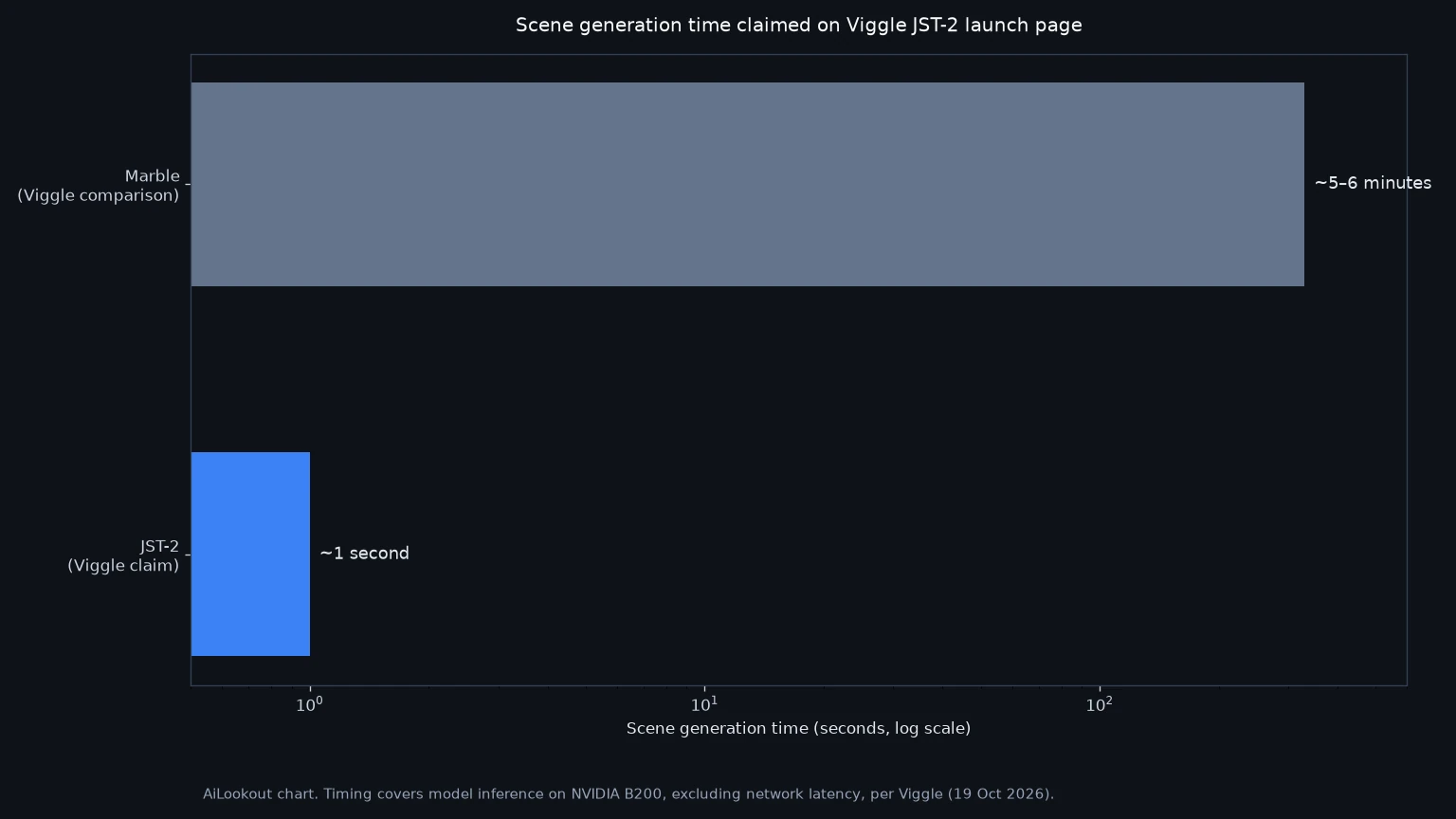
Viggle's headline speed claim is concrete and should be read as a vendor measurement. The launch page says JST-2 generates a 3D scene in about one second at an inference cost below one US cent, with timing measured as model inference on an NVIDIA B200 and excluding network latency. In the same comparison, it puts Marble at about five to six minutes.
The spatial context window is up to 64 input views. As a user expands a world one view at a time, each new view is added to the context for what comes next. Viggle also shows sparse real-world reconstructions—kitchen, warehouse, studio, hallway—where it says novel viewpoints match structure and appearance more closely than point-cloud reconstructions that only sketch rough geometry.
For game-art and agent workflows that already stage editable scenes before rendering, that interactive loop is the practical hook. It sits next to tools such as Topview's open-source 3D Builder, though Viggle is selling a generative world model rather than a local scene-staging agent.
Characters and motion without a separate rig
Supporting research pages published under Viggle Research expand the character and motion halves of the stack. The JST-2 Character page (dated 22 September 2026 on the site, framed as the benchmark behind the launch) says the model builds full-body 3D characters from text or from a single image, including cropped or partly occluded photos, with motion dynamics already stored in the tokens so a separate rigging and skinning pass is not required.
The JST-2 Motion page says full-body motion can come from text or from video. For video, the model reconstructs visible movement and uses learned dynamics to infer unseen body parts. Motions can be applied directly to JST-2 characters without a retargeting step, and Viggle says they are also compatible with standard 3D character rigs.
On the launch page, Viggle is explicit about what is still rule-based. Character motion uses learned dynamics, but scene collisions and object interactions still rely on classical physics rules. That is the gap JST-3 is meant to close.
What Viggle's blind tests claim
All of the preference scores below are Viggle's own blind human evaluations, not independent replications. For character generation, evaluators compared JST-2 with Meshy 7.1 and Tripo H3.1. Viggle reports average scores of 58.4 percent versus Meshy and 73.2 percent versus Tripo, with the strongest margins on face quality (63.0 percent and 82.0 percent). Score means win rate plus half the draw rate; 50 percent would be a tie.
For animation readiness on the same baselines, Viggle reports 73.8 percent versus Meshy and 88.9 percent versus Tripo, with large gaps on deformation quality and hand rigging. It says upcoming releases will improve complex clothing and hair motion.
Motion comparisons used the same untextured MetaHuman rig so judges were scoring motion rather than appearance. Against Cartwheel Swing and HY-Motion-1.0 on text-to-motion, Viggle reports average scores of 74.8 percent and 80.0 percent. Against Cartwheel Comic 4 and DeepMotion Animate 3D on video-to-motion, it reports 58.1 percent and 89.1 percent, with especially high hand-tracking preference versus DeepMotion (95.0 percent).
How to try it and what JST-3 will change
Viggle says anyone can open PINOC in the browser for free, pick Scene mode for 3D scenes or Agent mode to combine scenes, characters and motion, then describe what they want. The launch page also points builders to API docs and MCP so coding agents such as Codex or Claude Code can call the same stack.
JST-3 is described as the next step toward learned physics: replacing rule-based collisions and object interactions with learned dynamics that predict how interactions change the world. Viggle frames the long-term product as an experience engine for physical AI, where agents learn by acting in simulated worlds and watching the consequences—closer to robotics training data than to meme video alone.
The company's research index also lists earlier open-weight work such as Viggle-Animate and Meridian, which are separate from the JST-2 product launch and should not be confused with full open weights for JST-2 itself. As of the 19 October launch page, JST-2 is offered as a hosted model through PINOC, API and MCP, not as a downloadable checkpoint.
Limits and open questions
Several limits are stated by Viggle and several more follow from what is missing. Scene object interaction is still rule-based in JST-2, so the "physics-native" label does not yet mean the model has learned cup-spilling or multi-object contact the way it has learned character deformation. The company itself says JST-3 is needed for that.
All human preference numbers are vendor evaluations with named commercial baselines; they are useful as a directional claim, not as a third-party leaderboard. Timing and cost figures depend on an NVIDIA B200 inference setup and exclude network latency, so browser users will see additional delay. AI Lookout has not run PINOC, the API or any blind comparison.
Rights and safety questions that usually follow generative character and motion tools—likeness, copyrighted environments, and deepfake-style video-to-motion—are not spelled out in detail on the launch page. Builders should read Viggle's terms before shipping customer-facing avatars or reconstructing real people from video.
Why it matters
If the speed and shared-token claims hold up outside Viggle's lab setup, JST-2 is a meaningful product bet: one representation for environment, body and action, cheap enough to expand interactively, and wired for agent harnesses through MCP. That is a different wedge from video-only world models that dream the next frame but do not hand you a persistent 3D asset.
The honest reading for today is narrower. Viggle has shipped a hosted full-stack demo with strong internal preference margins and a clear roadmap to learned scene physics. Independent timing, quality and robustness tests—and any future open weights—will decide whether "physics-native" becomes a category other labs have to answer, or stays a vendor slogan attached to a fast splat generator.
Common questions
Is JST-2 open weight?
Not on the 19 October launch page. Viggle offers JST-2 through PINOC, an API and MCP. Its research index lists other open-weight projects such as Viggle-Animate, which are separate from this product release.
Does physics-native mean the model learned object collisions?
Not yet for scenes. Viggle says character motion uses learned dynamics, while scene collisions and object interactions still use rule-based physics. JST-3 is the planned step that replaces those rules with learned interaction dynamics.
How should readers treat the Meshy and Tripo scores?
As Viggle's blind preference studies with a defined scoring rule (win rate plus half the draw rate). They are not third-party leaderboards, and AI Lookout has not repeated the tests.
Sources & further reading
How this story was made
Written by Kristian Kostov with AI assistance and checked against the linked sources. Company performance claims are attributed to the company. Analysis reflects AiLookout’s interpretation; we have not independently tested the products discussed. The cover is an AI-generated editorial illustration, not a photograph or evidence of an actual event.
Our editorial standards