Announced 19 Oct 2026 · Sources checked
What MiniMax released
MiniMax, the Chinese developer of the M-series language models and the Hailuo video tools, released MiniMax M3.1 Flash on Monday 19 October 2026. In its launch post, the company calls it a next-generation Flash model with a "generational leap in agentic tasks, coding, Computer Use and cybersecurity", and says it makes online inference nearly three times faster while cutting usage costs for agent work by 70 percent compared with its predecessor.
The model is live now through the MiniMax API, the company's M Plan subscription and its MiniMax Code desktop coding tool. According to MiniMax's developer documentation, MiniMax-M3.1-Flash has a context window of 1,000,000 tokens, accepts text, images and video as input, and reasons before it answers, with a setting that controls how long it thinks. MiniMax-M3, the company's previous flagship, which reached OpenRouter at the end of May, stays available alongside it.
MiniMax describes M3.1 Flash as an open-weight model, but the weights are not out yet. The launch post says only that they "will be released later", and that a Pro version aimed at the top of the capability range will also arrive later.
Space Bunny was M3.1 Flash
The launch also solved a small mystery. On 23 September OpenRouter, the service that routes developer requests to many model providers, began offering an anonymous stealth model called Space Bunny Alpha, described as a fast flash model with adjustable reasoning, a 1M-token context and text, image and video input. It was free, and OpenRouter said the unnamed provider would not train on prompts or completions. The stealth period, extended once after a short outage, ended on 5 October.
On launch day MiniMax confirmed on X that Space Bunny was an earlier version of M3.1 Flash, and that it had handled more than 200 trillion tokens. OpenRouter's own post gives a smaller, narrower figure: 56.7 trillion tokens on OpenRouter, the most of any stealth model it has run, and ten straight days as the platform's most-used model. The larger MiniMax number presumably counts traffic on other channels as well, but the company did not break it down.
MiniMax had also been testing the model in its own product. A M3.1-Flash-Preview appeared in MiniMax Code on 27 September, described as a model for everyday development work, from quick bug fixes to full features.
What MiniMax's benchmarks show
MiniMax published five headline scores, all from its own runs. On DeepSWE v1.1, a test in which a model must understand a codebase, build features, fix issues and validate its work with tests, it reports 73.7 percent. On OSWorld V2, which measures operating a computer across applications, it reports 61.7, and on Agents' Last Exam, a set of real professional tasks, 29.6. MiniMax says both of those rank first among Chinese models.
For office automation the company cites 76.2 on BankerToolBench, a finance-workflow test of multi-step planning, document consistency, compliance and chained tool calls, and says the model ranks "among the top performers" on AutomationBench-AA without giving a number. On CyberGym, a vulnerability discovery and validation benchmark, it reports 82 percent, and MiniMax says its internal security experts found the model strong at code auditing, patching, penetration testing, malware analysis and reverse engineering.
MiniMax's charts add context its headline numbers leave out. Its DeepSWE chart, which uses the mini-swe-agent harness and public leaderboard data as of 22 September, shows M3.1 Flash at 68.1 percent on high effort, 72.1 on xhigh and 73.7 on max, at roughly a quarter of a dollar per task. The same chart places DeepSeek's V4.1-Flash-1017 slightly higher, at about 77 percent, for a little less money. On Agents' Last Exam, run through Claude Code at max effort, MiniMax puts the total bill for M3.1 Flash at $111, against well over $1,000 for Claude Opus 5.5, which scores close to 38 percent.
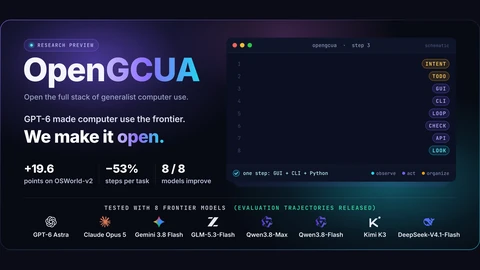
Scores from different companies are not directly comparable, because harnesses, prompts and retry rules differ. Meta, for example, reported 79.0 on DeepSWE 1.1 for its Muse Wonder Full model under its own setup. Computer-use results in particular move a lot with the agent wrapped around the model, as Alibaba showed when its OpenGCUA stack lifted eight models on OSWorld-v2.
| Benchmark | What it tests | M3.1 Flash |
|---|---|---|
| DeepSWE v1.1 | Long software engineering tasks | 73.7% |
| OSWorld V2 | Operating a computer across apps | 61.7 |
| Agents' Last Exam | Real professional work | 29.6 |
| BankerToolBench | Finance workflows and tool chains | 76.2 |
| CyberGym | Finding and validating vulnerabilities | 82% |
Half the list price of M3
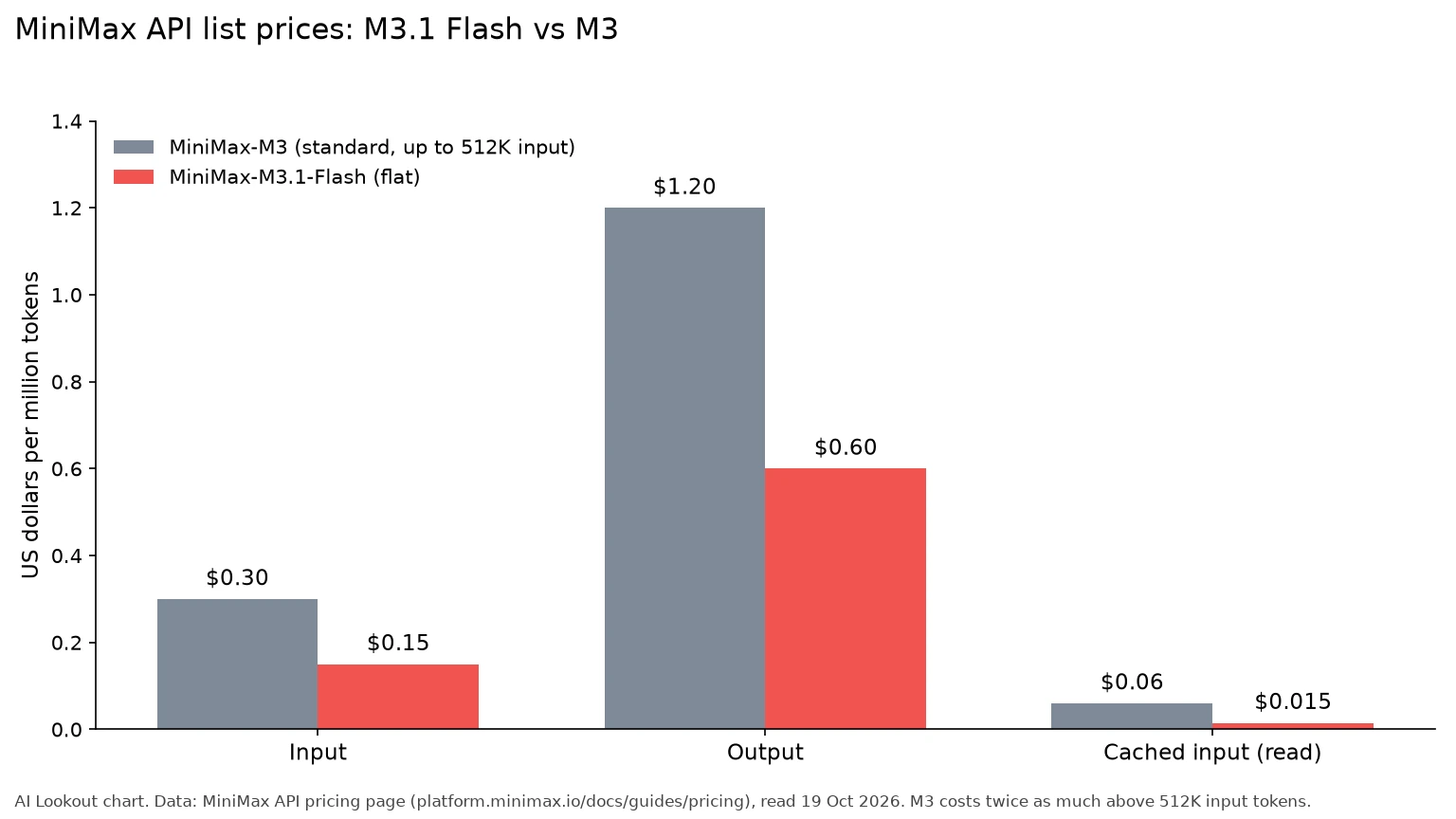
MiniMax's pricing page lists M3.1 Flash at $0.15 per million input tokens, $0.60 per million output tokens and $0.015 per million cached input tokens, with one flat rate whatever the prompt length. M3's standard rate is $0.30 for input and $1.20 for output up to 512,000 input tokens, and it doubles above that. So for long-context work, such as an agent carrying a large codebase in its prompt, Flash costs as little as a quarter of M3 per token, and cache reads cost a quarter of M3's at any length.
The 70 percent saving MiniMax advertises is a different measure: total cost for agentic tasks, which also depends on how many tokens the model spends thinking and how many steps it needs. MiniMax says it made the model sparser to speed it up, and reports output speeds above 200 tokens per second in everyday use, with a median of more than 170. Those are the company's numbers for its own servers; speeds through other hosts will differ.
How to use it
Developers call the model as MiniMax-M3.1-Flash. MiniMax recommends its Anthropic-compatible endpoint, which returns thinking as separate blocks, and also offers an OpenAI-compatible endpoint and the OpenAI Responses format. Thinking is always on. A field called effort, named output_config.effort or reasoning_effort depending on the format, accepts low, medium, high, xhigh or max. If it is left out the model defaults to max, the slowest and most token-hungry level, so teams that care about latency or cost should set it deliberately rather than try to switch thinking off, which the API rejects.
There are two ways to try it without paying per token. OpenRouter lists a free version and says it will stay free for 72 hours from launch. And Ronny He of MiniMax said on X that the model will be free for every MiniMax Code subscriber through 25 October, with no credits used. After those promotions, the normal API prices apply.
Open weights are promised, not published
Calling M3.1 Flash open-weight is, for now, a promise. MiniMax has not published a model card, a parameter count, an architecture description, a licence or a release date for the weights, and its launch post gives no technical report. Until the files and their licence appear, developers cannot run it on their own hardware, inspect it or fine-tune it, and the terms will matter as much as the files.
The timing puts M3.1 Flash in direct competition with DeepSeek, which two days earlier shipped V4.1-Flash-1017 with MIT-licensed weights and kept its prices unchanged. Cheap Chinese flash models already carry a large share of real traffic: Vercel's latest index found open-weight models handled 71.5 percent of its gateway's tokens in September while taking about 23 percent of spend.
Limits and open questions
Every benchmark figure in the launch post is MiniMax's own. Its comparison charts mix its own runs with public leaderboard data gathered weeks earlier, and they give little detail on settings beyond the harness and effort level. AI Lookout has not run the model. The Space Bunny traffic shows that developers liked a free, fast model, but free traffic says little about how it performs on paid, demanding workloads.
The cybersecurity claims deserve particular care. A model that is good at finding and validating vulnerabilities and analysing malware is useful to defenders and attackers alike, and MiniMax has not said what safeguards apply through its API or what will travel with the open weights once they are released. Data handling also matters for companies outside China: the free OpenRouter stealth period came with a no-training promise, but the terms of MiniMax's own API and apps are what apply now.
Why it matters
Flash models are where most agent traffic goes, because coding assistants and automation tools make thousands of calls. If M3.1 Flash really delivers near-frontier results on software and computer-use tasks at $0.15 and $0.60 per million tokens with a million-token context, it raises the pressure on every provider to cut prices on its small models. The things to watch are independent benchmark runs, the arrival and licence of the weights, the promised Pro model, and whether the stealth-launch route, in which developers pick a model before they know who made it, becomes a standard way to launch.
Common questions
What is MiniMax M3.1 Flash?
A MiniMax language model released on 19 October 2026 for agentic work, coding, computer use and cybersecurity tasks. It has a 1M-token context window, accepts text, images and video, and always reasons before answering, with an effort setting from low to max.
How much does MiniMax M3.1 Flash cost?
$0.15 per million input tokens, $0.60 per million output tokens and $0.015 per million cached input tokens on the MiniMax API. OpenRouter offers it free for 72 hours from launch, and MiniMax Code subscribers can use it free through 25 October.
Was Space Bunny MiniMax M3.1 Flash?
Yes. MiniMax confirmed that the anonymous Space Bunny model on OpenRouter was an earlier version of M3.1 Flash. OpenRouter says it processed 56.7 trillion tokens there before the stealth period ended on 5 October.
Sources & further reading
- MiniMax M3.1 Flash: Redefining Agent Performance and Cost ↗
- Text generation guide (MiniMax-M3.1-Flash model overview, effort, endpoints) ↗
- Pricing overview (LLM) ↗
- Model release notes (Oct. 19, 2026: MiniMax M3.1 Flash) ↗
- Posts on X about Space Bunny and M3.1 Flash (MiniMax, Ronny He, OpenRouter, MiniMax Agent) ↗
- OpenRouter models API entries for minimax-m3.1-flash:free and minimax-m3 ↗
How this story was made
Written by Kristian Kostov with AI assistance and checked against the linked sources. Company performance claims are attributed to the company. Analysis reflects AiLookout’s interpretation; we have not independently tested the products discussed. The cover places the companies’ own logos, taken from public-domain or openly licensed files credited in the caption, on a plain background. It is not a product photograph, a screenshot, or an endorsement.
Our editorial standards