Announced 15 Oct 2026 · Sources checked
What Tencent released
Tencent's Hunyuan team has open-sourced Hy-Memory-30B-A3B, a model built for one job inside AI agents: deciding what to write into long-term memory. The weights went up on Hugging Face on 15 October 2026 under an Apache 2.0 licence, which Tencent says carries no additional restrictions, alongside a technical report on arXiv dated the same day.
The release came with a wider update to Tencent's memory software. The Hy-Memory repository on GitHub, created on 15 October, holds Hy Memory 2.0, a Python SDK and memory engine published to PyPI as hy-memory, and MemHub, a local-first desktop and command-line app that pools memory from several AI tools.
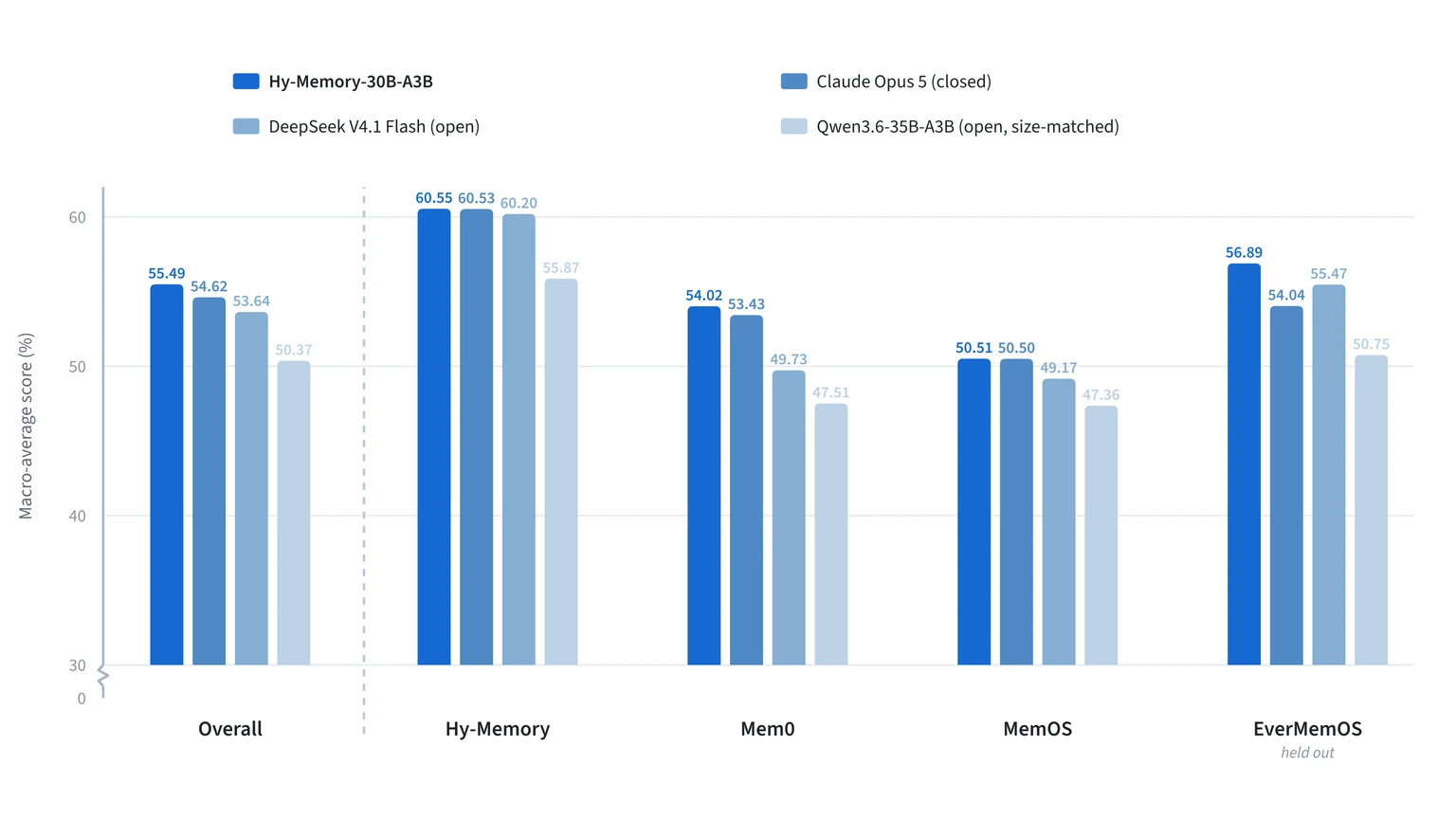
Tencent's headline claim is that the 30-billion-parameter model, with about three billion parameters active per token, matches or edges Claude Opus 5 as a memory writer across four memory frameworks, including one it was not trained on. Those are Tencent's own results, run on a fixed 20 per cent sample of each benchmark, and the margins over Opus 5 are very small in three of the four frameworks.
What a memory writer does
Agent memory systems usually have two halves. A read path retrieves stored facts when a new request arrives. A write path runs after a conversation or work session and decides what is worth keeping, how precisely to phrase it, and whether new information should update or replace what is already stored. AI Lookout's explainer on agent memory design covers why that second step matters so much.
Frameworks such as Mem0 and MemOS normally put a general-purpose large language model behind framework-specific prompts to do the writing. The report argues this raises serving cost, because the writer runs over and over, and that a writer tuned for one framework's protocol does not transfer to another. Hy-Memory-30B-A3B is meant to replace that general model directly inside Mem0, MemOS and Tencent's own Hy Memory, which covers chat, productivity work and coding.
Shared, persistent memory is becoming a product feature in its own right. Microsoft, for example, has just given Copilot Studio agents a shared team memory. Tencent's bet is that the writing step can be handled by a small open model rather than a frontier API.
How Hy-Memory-30B-A3B was trained
The model's configuration file describes a mixture-of-experts design with 48 layers, 128 experts of which eight are routed per token plus one shared expert, and a maximum position setting of 262,144 tokens. The training diagram shows the student starting from Tencent's Hy3-30B-A3B and being trained inside the same unmodified framework setups it later serves, so it learns from the memory banks it actually writes.
Training has two stages. In Memory On-Policy Distillation, a frozen Hy3 flagship model acts as teacher, giving dense feedback on memory states the student generated itself, so the model learns each framework's write protocol. In the second stage, Attributed Memory Reinforcement Learning, the report says the model is optimised for how well its stored memories later answer questions, using per-chunk probes, rewards attributed across chunks, controls against storing too much, and a chunk-level form of GRPO.
The diagram spells out the reward: a chunk score combines a process signal from probes and traps, twice an outcome signal, and a penalty for memory-bank growth. Several rollouts are compared chunk by chunk, and the final memory bank with the highest total score is carried forward as the starting point for the next window, which keeps long-horizon training close to how memory accumulates in use.
The benchmark results
Tencent evaluates by changing only the memory writer. The framework version, prompts, retrieval settings, answer model and judge are held fixed, and each writer builds its own memory bank from empty. Each framework score is the equal-weight average of six metrics: LoCoMo, LongMemEval, PersonaMem-v2, a travel task, a shopping task and Tencent's Code Memory Bench.
On that matrix Hy-Memory-30B-A3B averages 55.49, against 54.62 for Claude Opus 5, 53.64 for DeepSeek V4.1 Flash, 51.63 for Tencent's larger Hy3, 50.37 for Qwen3.6-35B-A3B and 47.66 for the Hy3-A3B base model. The gaps over Opus 5 are 0.59 points in Mem0, 0.02 in Hy Memory and 0.01 in MemOS. The clearest lead is in EverMemOS, the framework held out of training, where it scores 56.89 against 54.04 for Opus 5 and 55.47 for DeepSeek V4.1 Flash.
The detailed tables show a mixed picture underneath. Opus 5 beats Tencent's model on several individual metrics, for example LoCoMo in the Mem0 setup, 69.47 to 59.54, while Hy-Memory wins on LongMemEval and the travel task there. Shopping scores sit around 15 to 24 for every writer, which suggests that task remains hard regardless of model.
Hy Memory 2.0 and MemHub
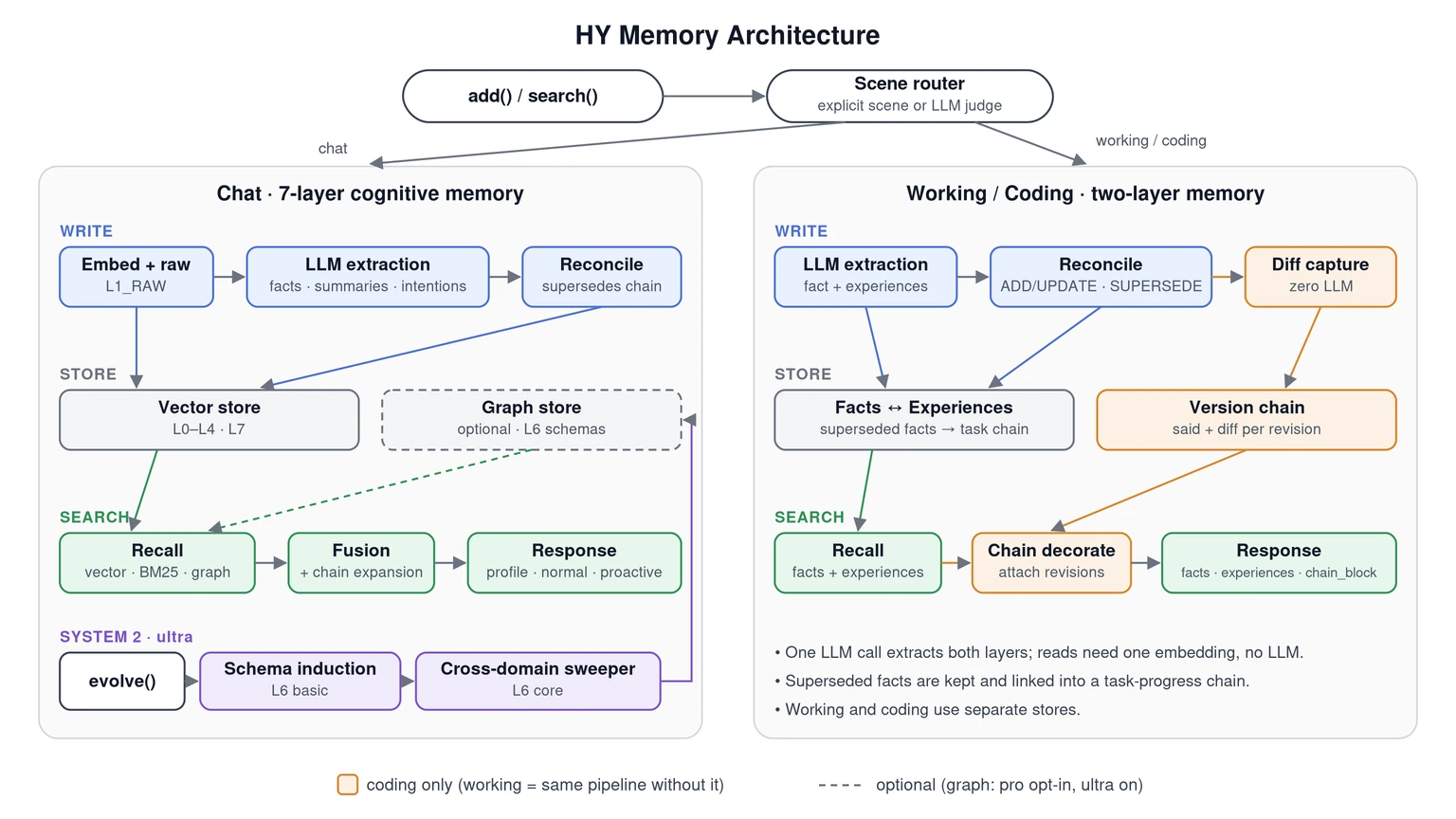
Hy Memory 2.0 is the framework around the model. Version 2.0.1 reached PyPI on 15 October and version 2.0.2 on 16 October. It routes each write into one of three scenes: chat, with a layered hierarchy running from raw conversation through atomic facts, summaries and schemas to time-limited intentions; working, which stores one fact per session plus reusable experiences; and coding, which adds a version chain storing the real diff of every code revision without an extra model call. Lite, pro and ultra modes trade cost for depth, and storage can use ChromaDB, Qdrant, FAISS, Kuzu or Neo4j.
The MemHub app builds on that SDK as a local-first tool that unifies conversation history and coding traces from AI tools the user authorises, such as Claude Code, Cursor, Codex, OpenCode and Qwen Code, into one store. Its README says version 1.0.2 targets a Linux runtime and a macOS app, that Windows is not supported, and that it does not capture the screen, accessibility tree, keyboard, clipboard or background audio. Data sits in a local folder by default, and the npm package is a roughly 384 KB bootstrap that downloads the full runtime only when the user runs an explicit install command.
Tencent has been releasing agent tooling as open source at a steady pace, including TeamAI, a Git harness for shared agent skills. Within a day of the model's release, community GGUF, MLX and ExLlama quantisations had also appeared on Hugging Face.
How to run it
The model card's quick start serves the weights with vLLM, tested with version 0.31.0, under the model name hy-memory, and calls it through an OpenAI-compatible API. Its example asks the model to extract explicit user facts and preferences, write each as a concise self-contained statement, avoid inventing information and return a JSON list, with a no-think reasoning setting and temperature zero.
The Hy Memory SDK needs only an OpenAI-compatible language model endpoint and an embedding endpoint, so developers can point it at the new model, a hosted API or another local model. The SDK also lets callers tag memories by source, such as cursor or codex, and filter searches by source, workspace and branch, which matters when several agents share one store.
For teams already using Mem0 or MemOS, the practical test is simple: swap the writer, keep everything else fixed, and compare answer quality and cost on their own data. Tencent publishes evaluation utilities in the repository, but no hosted API or price for the model.
Limits and open questions
Every number in the release is Tencent's. The main matrix uses fixed 20 per cent subsamples of each benchmark for computational efficiency, so the sub-point margins over Claude Opus 5 in three frameworks are within the range that a full run or a different sample could reverse. AI Lookout did not run the model, and no independent reproduction has been published yet.
The comparison also measures memory writing only. The report does not claim the model is a general assistant, and the answer model and judge were fixed, so results may shift with a different reader or grader. Tencent's Code Memory Bench is its own benchmark, submitted to ICLR 2027, which adds a home-field element to one of the six metrics.
Memory tools also raise privacy questions. A writer that decides what to keep about a user, and an app that pools history from several AI products, both need clear deletion and consent controls. MemHub's README describes separate permission boundaries and a guarded delete command, but those controls have not been independently reviewed. The things to watch are third-party reruns on full benchmarks, adoption inside Mem0 or MemOS, and whether MemHub reaches Windows.
Common questions
What is Hy-Memory-30B-A3B?
An open-weight model from Tencent Hunyuan that writes and updates long-term memory for AI agents inside frameworks such as Mem0, MemOS and Hy Memory. It has 30B parameters, about 3B active per token.
Is Hy-Memory-30B-A3B better than Claude Opus 5?
Only on Tencent's memory-writing tests, and narrowly: 55.49 versus 54.62 on average, with gaps under one point in three frameworks. It is not a general assistant, and no independent rerun exists yet.
Can I use it commercially?
Tencent licenses the weights under Apache 2.0 and says it imposes no additional restrictions. The Hy Memory SDK and MemHub are also Apache 2.0.
Sources & further reading
How this story was made
Written by Kristian Kostov with AI assistance and checked against the linked sources. Company performance claims are attributed to the company. Analysis reflects AiLookout’s interpretation; we have not independently tested the products discussed. The cover places the companies’ own logos, taken from public-domain or openly licensed files credited in the caption, on a plain background. It is not a product photograph, a screenshot, or an endorsement.
Our editorial standards