Announced 3 Nov 2026 · Sources checked
What xAI actually installed in Mississippi
Elon Musk's xAI is running eight converted jet-engine turbines at a site in Mississippi to help power Colossus 2, its data center complex near Memphis, Tennessee. TechCrunch reported the arrangement on 3 November, citing New York Times reporting based on state permits and satellite imagery. Tom's Hardware followed with the regulatory details the same day.
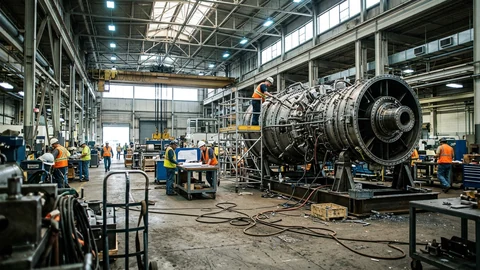
The units come from ProEnergy, a Missouri company that takes unused General Electric turbines normally bolted to Boeing airframes and rebuilds them as land-based generators. Tom's Hardware puts each unit at up to 50 megawatts, roughly enough electricity for 15,000 homes. Eight of them is a meaningful slice of a campus that Musk has said he wants to grow aggressively: in August he said xAI would increase data center capacity sevenfold before the end of 2027.
This is not a pilot project or a press release about a future ribbon cutting. It is metal on gravel, running now, because the alternative was waiting.
Why anyone would power a data center with an aircraft engine
The answer is a queue. Hooking 100 megawatts of new load to the grid in Northern Virginia takes about seven years, according to International Energy Agency figures cited by TechCrunch. Most new power capacity is not expected to arrive until 2031, a Mitsubishi Power executive told Bloomberg last week.
Converted turbines skip most of that. "It's all about getting power as fast as possible," Rystad Energy analyst Audun Martinsen told the New York Times, in a quote carried by TechCrunch. With jet-powered units, he said, operators "can have a data center running in 24 months."
That gap between 24 months and seven years is the entire business case. It is also why the delay is already costing people money: Microsoft pulled out as anchor customer for Nscale's data center in Loughton, England, after the local utility said it could not deliver enough power until the early to mid-2030s.
The White House has made the same bet from the other direction, encouraging data centers to generate their own electricity rather than wait in line. Once self-generation is blessed, the question stops being whether an operator should buy a turbine and becomes which turbine can be delivered first.
The Mississippi permit fight
Speed has a cost, and in this case it is measured in air quality permits. Tom's Hardware reports that the Mississippi permits allow a 25% higher limit for volatile organic compounds than the standard, and that the combination of those compounds with carbon monoxide has environmentalists calling jet-powered data centers a step backwards.
The Southern Environmental Law Center has already challenged Mississippi's decision to approve the turbines. According to the Tom's Hardware account of the New York Times reporting, the group argues xAI has not provided guarantees that the units meet emissions standards for specific pollutants including formaldehyde, and accuses the company of undercounting projected emissions relative to the data center's power sources.
That challenge did not arrive in a vacuum. The same organisation previously sued xAI over its use of gas generators without the required permits in an area with more than 100,000 inhabitants. This is a fight that has been running for months, and the jet engines are simply the newest exhibit.
For AI Lookout's earlier coverage of the pollution litigation around xAI's Memphis operations, see [the ruling allowing the NAACP lawsuit to proceed](/blog/judge-allows-naacp-lawsuit-over-xai-data-center-pollution-to-proceed/).
A conversion industry is forming around the shortage
xAI is the loudest example, not the only one. FTAI Aviation launched FTAI Power to convert retired CFM56 engines, the most widely used commercial aircraft engine family with more than 34,000 units delivered according to engine maker CFM Aeroengines, into roughly 25-megawatt natural gas turbines for AI and cloud loads. ConstructConnect reported in February that production was expected to begin in 2026, with FTAI claiming control of more than 1,000 CFM56 engines and factories capable of more than 100 units a year once ramped.
Crusoe, the Denver company building OpenAI's first Stargate campus in Abilene, Texas, ordered 13 ProEnergy converted units in April, according to TechCrunch. OpenAI itself used gas turbines at that site in 2025. In September, Crusoe walked away from a $1.25 billion deal to buy 29 natural gas turbines from Boom Supersonic, a startup that had begun selling a power-plant version of its supersonic jet engine; Crusoe said at the time it still planned to use turbines.
That last sequence is the clearest signal of how thin this market is. A billion-dollar order for turbines evaporated and the buyer still intends to buy turbines elsewhere. Supply, not demand, is the constraint, which is exactly the condition that makes scavenging engine boneyards economically rational.
The broader turbine squeeze sits alongside the financing questions already circling the sector, which AI Lookout covered in [the neocloud debt dispute between Huang and Musk](/blog/huang-and-musk-clash-over-ai-neocloud-debt-crisis-as-coreweave-bond-yields-hit-15-percent/).
The engineering trade-off nobody is advertising
A converted aircraft engine is a compromise dressed as a solution. TechCrunch spells it out: the units are less efficient and pollute more than turbines designed for conventional gas plants, and it takes more of them to produce the same amount of power.
Aeroderivative turbines are, by design, lightweight and quick to start, which is why they are attractive for bridging a gap. Stationary heavy-duty turbines trade that responsiveness for fuel efficiency and lower emissions per megawatt hour, and they take years to build and queue for. Operators are effectively choosing speed now and paying for it in fuel and in permitting fights later.
The numbers behind the demand are not subtle either. Tom's Hardware cites a July 2026 report projecting that data centers will consume 20% of all US power by 2035, an 83% increase over the same forecast made seven months earlier. As of April, half of data center buildouts had been cancelled or delayed, with power availability among the reasons.
Put those two facts together and the jet engine stops looking like an eccentric choice. If half your pipeline is stuck behind a grid interconnection study, a 50-megawatt generator that arrives on a flatbed in months is not a compromise, it is the only option that ships.
What to watch next
Three things decide whether this stays a stopgap or becomes infrastructure. First, the Mississippi challenge: if the Southern Environmental Law Center succeeds in forcing tighter limits or a fuller emissions accounting, the template for fast permits gets harder to copy in other states.
Second, emissions rules generally. Converted turbines win on speed but lose on air quality, and the politics of data centers have soured as power prices and water use have become local issues. A permitting regime that demands formaldehyde guarantees and accurate projected emissions makes every conversion project slower and more expensive.
Third, whether the conversion supply chain scales. FTAI's stated ambition of more than 100 units a year against a market where a single cancelled order was worth $1.25 billion tells you how far demand outstrips the ability to rebuild engines. If grid queues shorten, the economics invert overnight and these units become stranded assets. If they do not, expect more aircraft boneyards in Arizona and more permit fights in state capitals.
For now the scoreboard is simple: one hyperscaler has eight engines running, another has 13 on order, and the grid has not moved.
Common questions
How much power do xAI's converted jet engines produce?
Tom's Hardware reports each converted turbine is capable of producing up to 50 megawatts, which it says would normally be enough to keep around 15,000 homes running. xAI has eight of them installed at its Mississippi site.
Who converts the jet engines into generators?
ProEnergy, a Missouri-based company, repurposes unused General Electric turbines typically found on Boeing aircraft. Separately, FTAI Aviation is converting retired CFM56 engines into roughly 25-megawatt natural gas turbines through a platform called FTAI Power.
Why are environmental groups opposing the permits?
According to Tom's Hardware, the permits allow a 25% higher limit for volatile organic compounds, and the Southern Environmental Law Center argues xAI has not guaranteed the turbines meet emissions standards for pollutants including formaldehyde, while undercounting projected emissions.
Sources & further reading
How this story was made
Written by Kristian Kostov with AI assistance and checked against the linked sources. Company performance claims are attributed to the company. Analysis reflects AiLookout’s interpretation; we have not independently tested the products discussed. The cover is an AI-generated editorial illustration, not a photograph or evidence of an actual event.
Our editorial standards