Announced 22 Oct 2026 · Sources checked
The pivot
Boom Supersonic, the Colorado-based aerospace company developing the Overture supersonic airliner, announced on October 22 that it has completed and shipped the first turbine core of its Superpower 42-megawatt natural gas generator — designed specifically for AI data center power. The company is building the Superpower Superfactory near Centennial Airport, a $150 million manufacturing plant that will employ about 500 people.
CEO Blake Scholl described the pivot as a strategic diversification: the turbine technology shares core capabilities with the propulsion systems Boom was developing for its aircraft, and the timeline for data center power demand is more immediate than the supersonic airliner timeline, which has faced doubt from United Airlines over its 2029 delivery target. The company frames the energy business as a parallel revenue stream, not a replacement for the aircraft program.
The technology
Each Superpower turbine delivers 42 megawatts of electrical power. Boom plans to ramp from first deliveries in mid-2027 to annual production of 25 turbines by 2028 (about 1 GW) and 50 by 2029 (about 2 GW). For context, a medium-sized AI data center draws between 100 MW and 300 MW, so a single turbine is roughly a module that fits into a larger data center campus.
The turbine is natural-gas-fired, which means it supplies on-demand power that can fill gaps in renewable-heavy grids — a fast-growing requirement for data center operators that cannot afford intermittent downtime. Boom says the turbine is designed for low-emission operation and will compete with similar offerings from traditional power-equipment manufacturers.
Why it matters for AI
Boom's entry into the data center power market is a signal that the AI industry's energy demand is creating opportunities in unexpected places. A supersonic aircraft company should not be in the gas turbine business, but the capital markets for data center infrastructure are so hot that adjacent industrial capability is being diverted into the sector.
For AI operators, the trend is good news: more competition in the turbine and generator market means potentially shorter lead times and lower prices for data center power equipment. For the broader economy, it shows that AI infrastructure spending is reshaping industrial investment the way war mobilization once did — pulling in companies from unrelated sectors to build capacity.
Caveats
The turbine core has shipped for testing but has not been validated at full power on a data center grid. The 2027-2029 timeline is ambitious, and scaling from first-delivery to 50 turbines per year is a significant manufacturing ramp. Boom remains an aircraft company first, and any diversion of capital or engineering resources to the turbine business could affect the Overture timeline.
The timing also depends on the broader AI capex cycle: if the AI investment boom slows before 2028-2029, demand for additional power infrastructure may soften along with it.
The energy context
Boom enters the data center energy market at a moment when the biggest constraint on AI buildout is no longer GPU supply but power availability. Data center operators report connection queues at utilities running 3-5 years, and new power plants of any type take years to permit and build. Turbine-based solutions that can be sited near data centers and connected to existing gas infrastructure offer a faster path.
The 42MW per-unit size is significant: it is roughly the power demand of a large hyperscaler cluster building, and modular enough that a campus can add capacity in predictable increments. The natural-gas fuel is a tradeoff — cleaner than coal but not zero-carbon — but for operators who need power now rather than in 2030, the choice is often between gas turbines and waiting for grid upgrades.
Caveats and outlook
The turbine core has shipped but has not completed full validation testing at rated power. Boom's aircraft program remains its primary business, and any financial or engineering strain on the company could affect the turbine timeline. The $150 million factory is a credible investment, but scaling from a first build to 50 turbines per year is a manufacturing step that has tripped up larger companies. The company is targeting first customer deliveries for mid-2027, and the Colorado Air and Space Port test site will validate the turbine at full power. For now, the first core is a working prototype; the question is whether Boom can execute the manufacturing ramp as reliably as it executed the engineering.
For the AI industry, the larger signal is structural: data center power demand is so intense that adjacent manufacturing capacity is being redirected into the sector. This is a positive supply indicator — the market is finding ways to address the power constraint — but also a sign that the conventional utility construction timeline cannot keep up with AI-driven demand.
Common questions
What is the Superpower turbine?
A 42MW natural gas generator built by Boom Supersonic, designed for AI data center power.
When will deliveries start?
First customer deliveries targeted for mid-2027.
Is Boom abandoning aircraft?
No — the turbine business is a parallel diversification, not a replacement for the aircraft program.
Sources & further reading
How this story was made
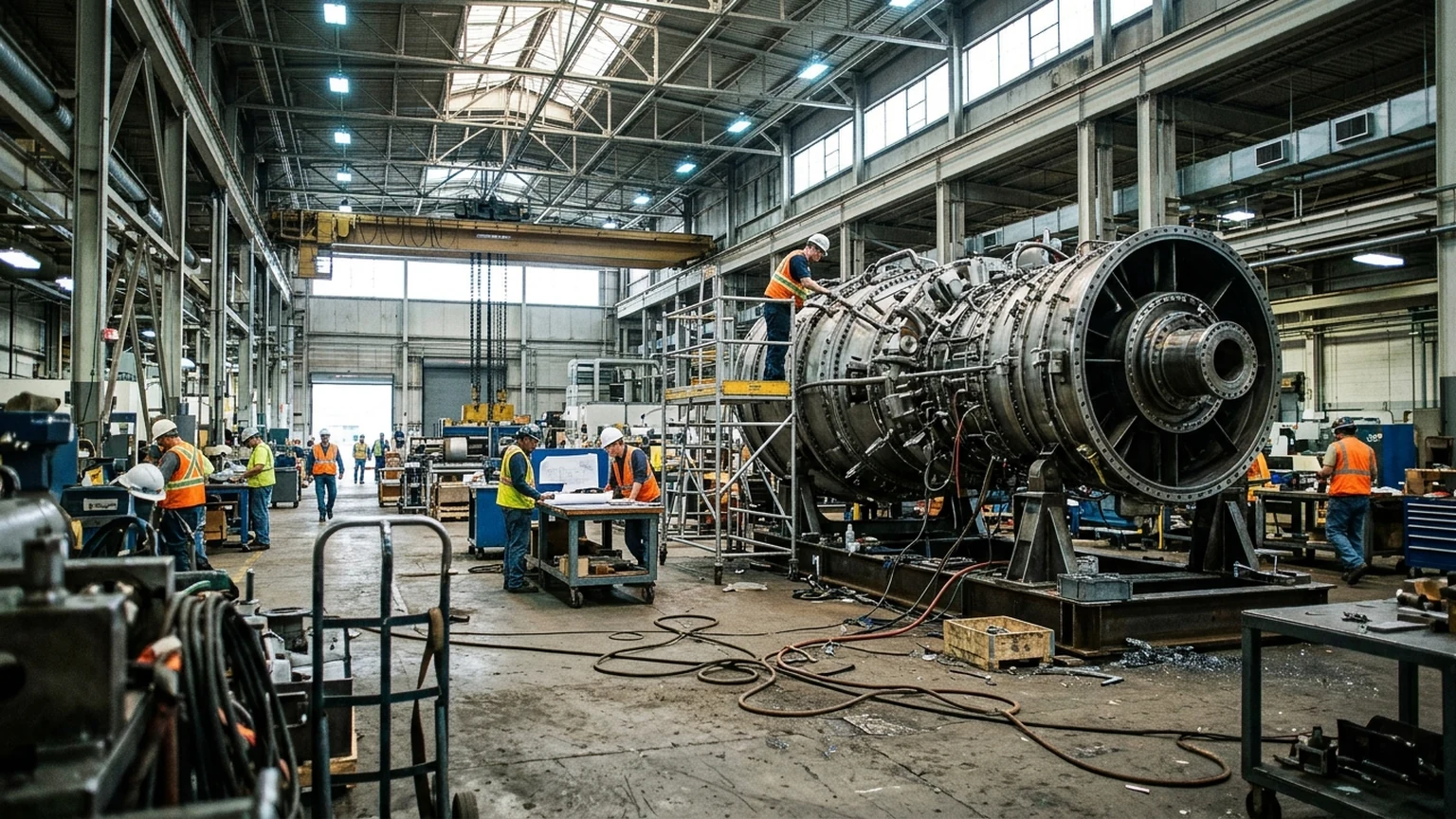
Written by Kristian Kostov with AI assistance and checked against the linked sources. Company performance claims are attributed to the company. Analysis reflects AiLookout’s interpretation; we have not independently tested the products discussed. The cover is an AI-generated editorial illustration, not a photograph or evidence of an actual event.
Our editorial standards