Announced 29 Oct 2026 · Sources checked
The strategy
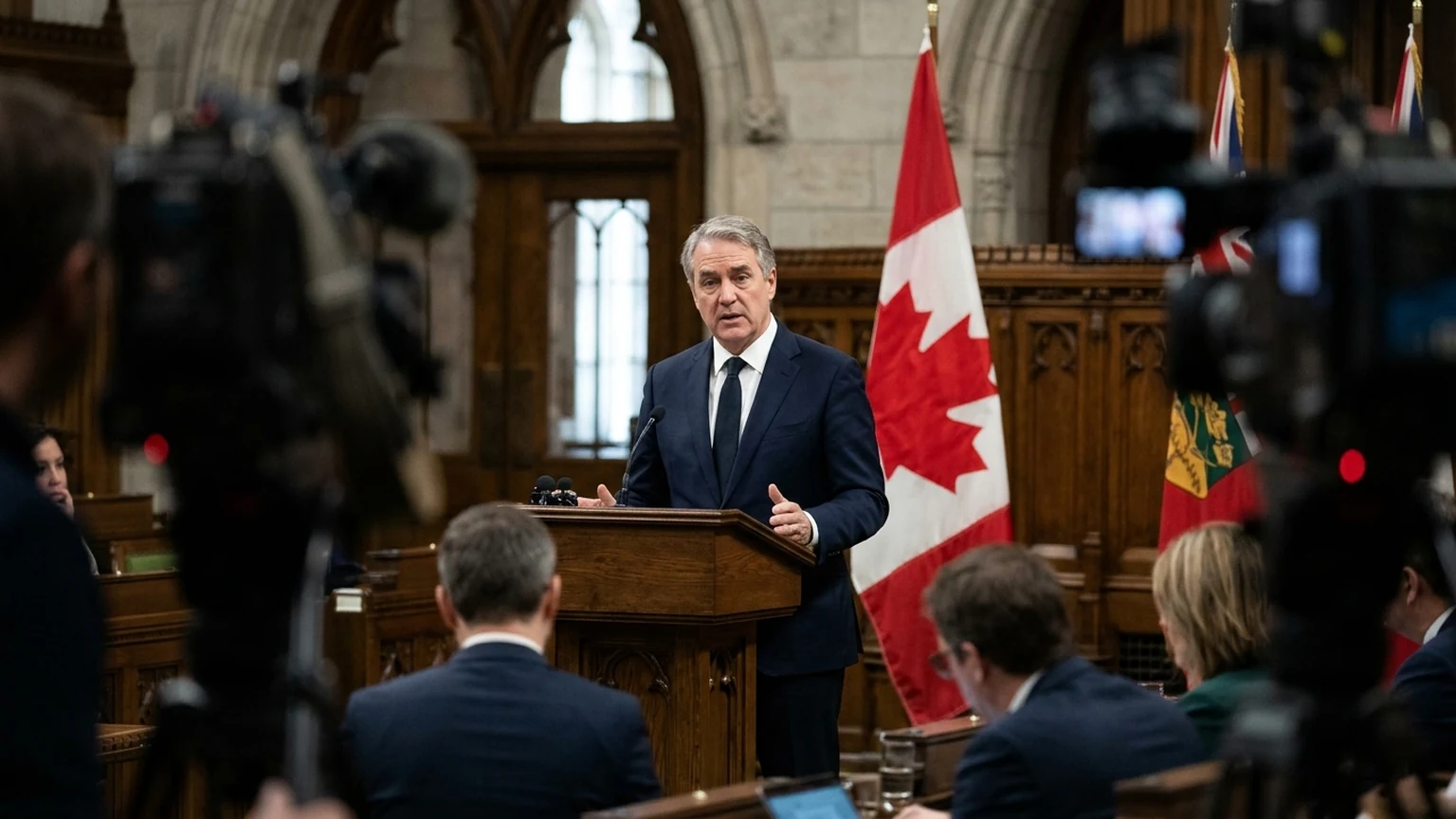
Prime Minister Mark Carney's government released 'The Plan for a Stronger Canada' on Thursday, October 29, 2026 — the country's first national security strategy in more than two decades. The document puts economic strength and technological independence at the heart of Canada's defence against foreign threats, from weaponized trade to emerging AI risks.
The scope is broad: the strategy covers war, artificial intelligence, cyberattacks, espionage, sabotage, foreign interference and climate change. It also commits to a whole-of-government approach on sovereignty and security, arguing Canada's security can no longer depend on geography, international order or deep integration with other nations.
Frontier AI as a threat
The strategy describes frontier AI as potentially 'one of the greatest threats facing Canadians today' — putting it on the same list as war, hackers, espionage, sabotage and foreign interference. Federal officials said frontier AI models could be among the greatest threats Canadians face, and the most advanced models can boost existing cyber threats.
The reasoning: AI lets adversaries find and exploit weaknesses faster and at a larger scale than before. Models can automate vulnerability discovery, accelerate disinformation campaigns, and run intrusion attempts far more cheaply than human operators, which is the same dynamic documented in the recent VAPOR PANDA campaign and open-weight exploitation research. Canada's strategy is one of the first national documents to name the capability explicitly rather than treating it as one more cyber tool.
The response
The plan promises to update intelligence capabilities, harden digital defences and prioritize protection of critical infrastructure. It also pledges to modernize national security legislation: within the first year of the plan, the federal government will bring forward proposals to update the legal framework.
That legislative timeline matters for AI companies. Stricter compliance and security audits within the Canadian regulatory environment are a plausible consequence of classifying frontier AI as a top threat — the strategy signals that developers can expect requirements to report incidents, secure models and coordinate with federal agencies, similar to the oversight Congress is pushing in the United States.
Context and caveats
The strategy arrives amid rising concern in Western capitals about AI-enabled espionage, disinformation and infrastructure attacks, and alongside US and allied efforts to require transparency from frontier AI developers. It does not name any specific country or company, and the strategy is a framework rather than binding regulation — the substance will arrive in the legislative proposals.
Canada's approach differs from the US in tone: Washington's AI policy has focused on market leadership and export controls, while Ottawa's framing is defensive and sovereignty-focused. The practical impact on AI companies will depend on how the modernization proposals are written and implemented.
AI in the threat landscape
Treating frontier AI as a top national threat is a meaningful shift in how governments frame the technology. Earlier cyber strategies treated AI as one tool among many in an attacker's arsenal; the Canadian document elevates the models themselves to the threat list. The distinction matters for policy: if the model is the threat, the response is not only about hardening networks but about governing the models — their training, evaluation, access and export.
The strategy's language mirrors concerns raised by security researchers over the past year. Epoch AI demonstrated that an open-weight model can autonomously exploit six Firefox releases through the patch gap. CrowdStrike documented a China-linked campaign running the ARTEX agent framework on DeepSeek against more than 200 organizations. In both cases, the models amplified attack speed and scale exactly as the Canadian strategy describes.
International context
Canada is not the first government to flag AI as a security risk, but it is among the first to place frontier AI at the top of a national security strategy. The United Kingdom's AI Security Institute has published research on jailbreaks and model evaluations; the European Union is moving toward regulation; and the United States has weighed export controls on advanced chips and models.
What is distinctive about the Canadian move is the clarity of the classification: frontier AI sits in the same paragraph as war and espionage. That framing will complicate any future trade or investment relationship involving advanced AI — and it gives Canadian agencies the mandate they need to audit models, require incident reporting and coordinate with allies on AI security.
What developers should watch
For AI developers doing business in Canada, the strategy is a preview of the compliance environment to come. Expect requirements to register or evaluate frontier models, incident reporting obligations to federal agencies, and security audits for models used by critical infrastructure — utilities, health care, finance and government.
The strategy does not create these obligations by itself, but it creates the political mandate. When Canadian legislation is proposed within the year, the industry's starting point will be a document that calls frontier AI one of the greatest threats facing Canadians. That makes permissive carve-outs an uphill fight.
Companies that want influencing room should engage the consultation process now, before the strategy's language hardens into statute.
Common questions
What did Canada release?
'The Plan for a Stronger Canada,' its first national security strategy in more than 20 years, released October 29, 2026.
How does it treat AI?
Frontier AI is described as potentially one of the greatest threats facing Canadians, alongside war, espionage and foreign interference.
What comes next?
Modernized national security legislation and proposals within the first year, likely tightening compliance for AI developers.
Sources & further reading
How this story was made
Written by Kristian Kostov with AI assistance and checked against the linked sources. Company performance claims are attributed to the company. Analysis reflects AiLookout’s interpretation; we have not independently tested the products discussed. The cover is an AI-generated editorial illustration, not a photograph or evidence of an actual event.
Our editorial standards