Announced 18 Oct 2026 · Sources checked
What Robin Kahlow built
A single developer has trained an agent that plays the full, real game of Warcraft III and beats the built-in computer opponent on its hardest setting about nine games in ten. In a post on his site Warlock.AI, developer Robin Kahlow says the agent went from losing to the easy AI to that result in three weeks, trained by self-play on one desktop. The code is public as warcraftsim under the MIT licence.
The post is dated October 2026 and carries an update from 18 October, and the training timeline it gives runs from 27 September to 17 October. The agent plays the classic ladder map Echo Isles under the game's own rules against the insane built-in AI, and in its best version won 89 percent of test games it never trained on. It is a hobby-scale echo of the 2019 projects in which DeepMind's AlphaStar and OpenAI Five mastered StarCraft II and Dota 2 with the game makers' help and data-centre compute.
Running a 2002 game as a training environment
Warcraft III, released in 2002, has no bot API, no headless mode and no faster-than-real-time option, and reimplementing its rules faithfully would be very hard. So Kahlow runs the real 32-bit Windows game under Wine on Linux, about 50 copies at once, and drives it from Python. A harness written in the game's own map-scripting language reports what the player can see every half second of game time and carries out the agent's orders. A small DLL inside the game process replaces the game's clocks with a virtual one, so the game runs as fast as the CPU allows and waits at each step for the agent.
Most of the speed came from removing waste rather than adding hardware: games skip drawing, five games share one map load, per-unit bookkeeping moved from script into C, and the network runs as CUDA graphs from a C++ loop. The desktop plays about 50 games at once, each about 15 times faster than real time, which Kahlow puts at roughly 730 hours of Warcraft III every hour. Games are deterministic, so any replay reproduces a game step for step.
The README names the hardware: one machine with a Ryzen 9 5950X and an RTX 3090 runs the learner, the inference loop and about 56 games, around 1,600 to 2,000 agent steps a second and about 3,000 games an hour. A second machine, a laptop under WSL2, plays the evaluation games, about 1,300 an hour, so the one-desktop claim covers training while testing runs alongside on a laptop.
A small network and a head start
The agent sees only what its player sees and, every half second, decides for every one of its units at once. An order head picks each unit's order, target heads pick the unit or map point it is aimed at, a memory carries state between steps, and a value head, used only in training, predicts how the game will end. The whole network has about 3.2 million weights, tiny by language-model standards, and one decision for 60 units with 120 in view takes about 13 milliseconds on four ordinary CPU cores.
Learning from scratch was hopeless, because an agent giving random orders almost never wins and so gets nothing to learn from. Kahlow recorded thousands of games of the built-in AI playing itself and first trained the agent to copy its orders, a technique called behavioral cloning. Self-play followed against a league of the agent, its past selves and the built-in AI, with a reward of plus one for a win and minus one for a loss plus small rewards for gaining material, and a KL term that pulls the agent back toward an earlier anchor so a noisy batch cannot undo what works.
Three weeks of curriculum
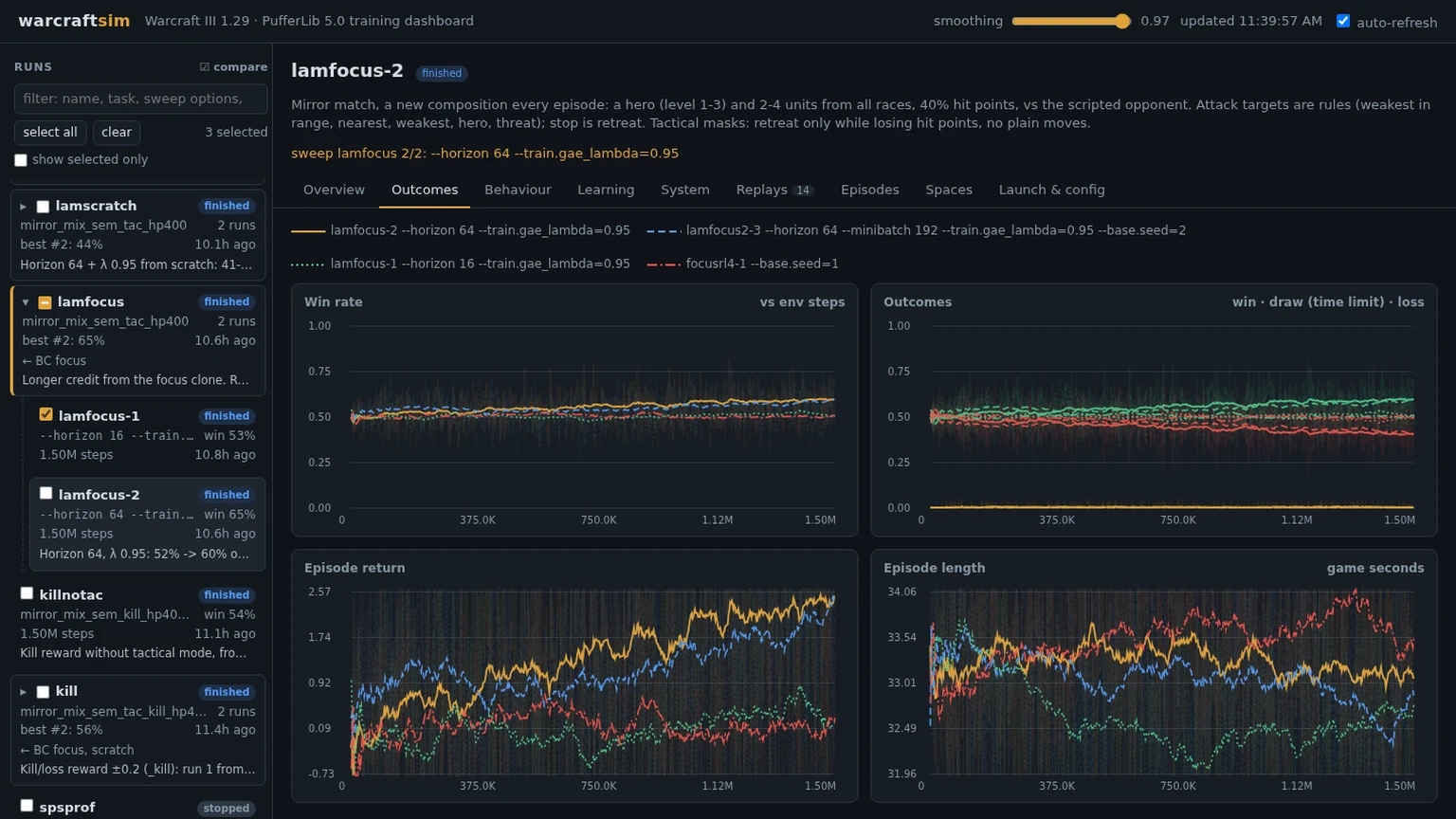
A full game can mean about 3,000 decisions per side before the single win-or-loss signal arrives, and even the cloned agent lost all 40 of its first test games on the real map. Training therefore followed a curriculum. It began with small fights, then whole two-minute games from 27 September on a small duel map with rules sped up seven times. To keep training games balanced, the built-in AI paid a tax on the gold and lumber it gathered, rising after each agent loss and falling after each win; it fell from about 75 percent to almost zero, and by 2 October the agent won 79 percent of untaxed test games.
From 2 to 14 October it played six-minute games against the insane AI and stalled at 1 win in 98 test games, because cloning never showed it situations the built-in AI avoids, such as an idle barracks with money to spend. Letting the built-in AI coach the agent inside its own games, on-policy distillation, lifted that to 13 wins in 50 within fifty minutes. Adopting AlphaStar's UPGO credit assignment gave the largest gain on that map, and coaching was dropped once the agent outplayed its coach. By 14 October it won 80 percent, and on 15 October it moved to Echo Isles.
The six changes that took it to 89 percent
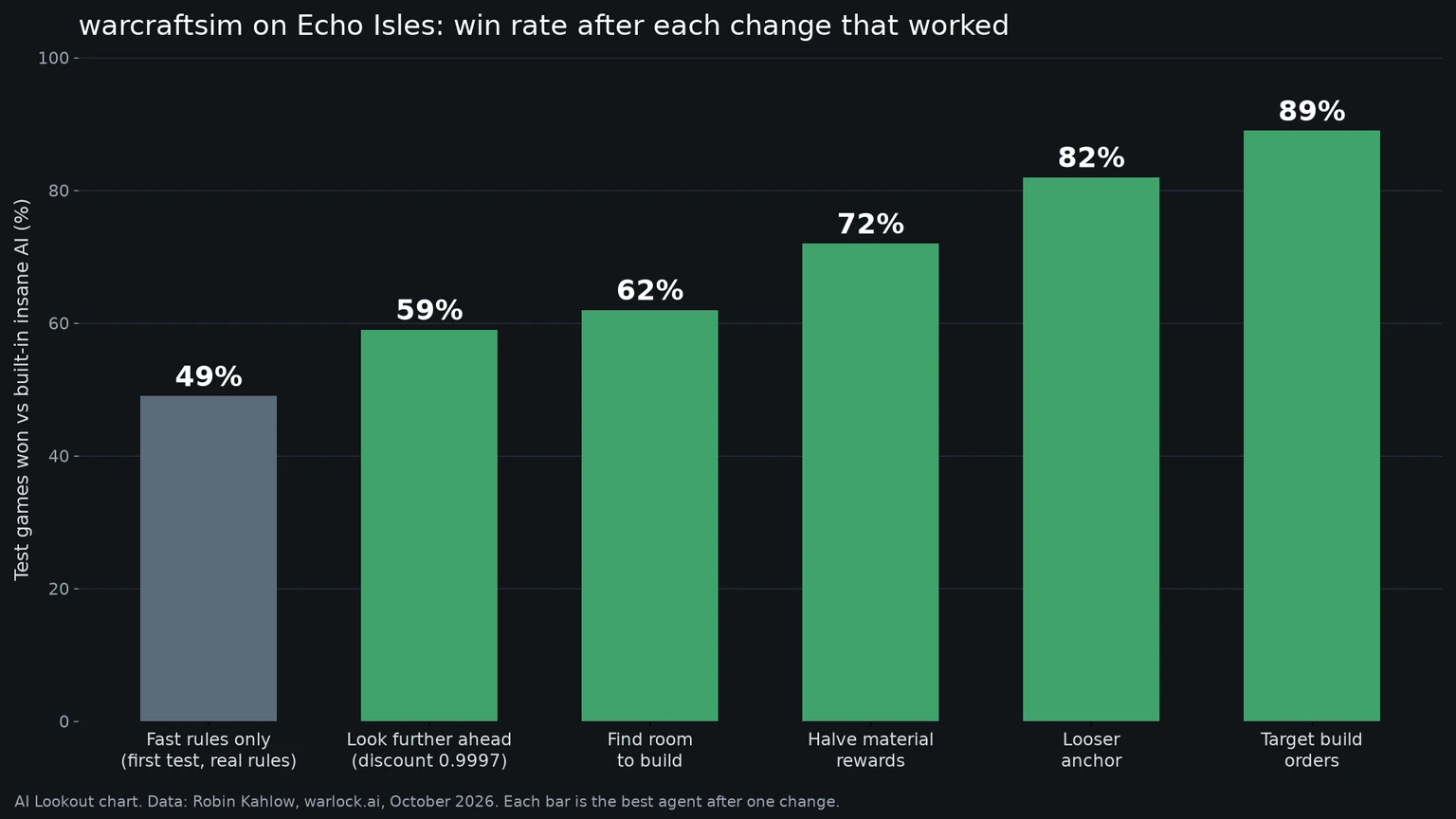
Trained on Echo Isles with fast rules only, the agent won 49 percent straight away when tested under the real rules it had never played. Raising its discount factor from 0.999 to 0.9997, so a win about 28 minutes away still counts, took it to 59 percent and made games shorter. A harness change that searches three times farther for a free building spot, after the game refused three in four undead buildings, added three points.
Halving the weight of the material rewards lifted it from 62 to 72 percent, mostly for the weakest races. Kahlow found that the reward signal per update was about 1 percent signal and 99 percent noise while the anchor's pull was clean, so cutting that pull to a quarter took it to 82 percent after about ninety minutes. Finally, borrowing another AlphaStar idea, half of training games came with a target build order drawn from 8,072 build orders in the built-in AI's games and human replays, and the win rate reached 89 percent. Many other experiments failed, and each is recorded in the project's experiment log.
What it cannot do yet
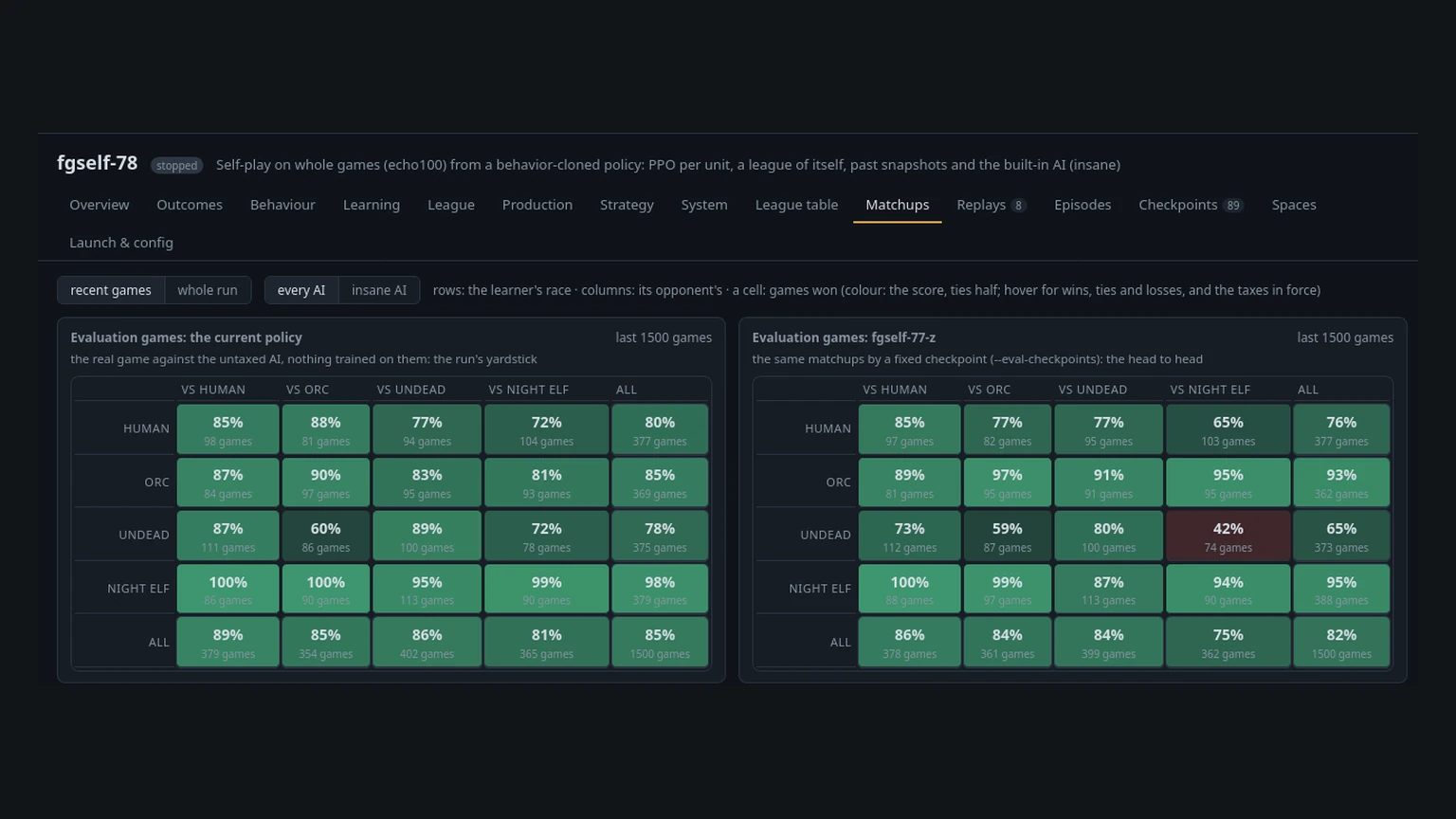
Kahlow is candid about the limits. The agent plays one strategy, an early rush of cheap units, and half of its wins come within ten minutes. Almost all of its losses are long games: across the best agent's 183 long losses, averaging 27 minutes, it built 35 workers against the AI's 16 but stuck to two or three kinds of cheap unit against the AI's nine and researched three upgrades against seventeen. It raises about one hero a game, hardly fights neutral camps, rarely expands and never uses the tavern or shops.
The opponent matters too. After readers on Reddit pointed it out, Kahlow added an 18 October update confirming that the insane AI gathers resources twice as fast as a normal player, and that every test game was against that boosted AI. On the other hand, good human players beat the insane AI reliably, and the agent has never faced a human. Kahlow expects a person would see the rush coming and push the game into the long phase where the agent is weakest.
How it compares with AlphaStar and OpenAI Five
The compute gap is the striking part. Kahlow's desktop played about 11 years of Warcraft III in total, two years a day. He notes that OpenAI Five played about 45,000 years of Dota 2 in ten months and that AlphaStar trained 12 agents for 44 days on 32 TPUs each, and both beat top human professionals, which this agent has not attempted. The comparison is about efficiency on a narrower goal, not equal skill. It fits a wider trend of reinforcement learning getting cheaper, from Modal's work on mixed-precision RL samplers to elastic training systems such as Alibaba's QwenGyre.
It is also a different route from the one large labs now take with games. Four Gemini 4 Argon agents beating Minecraft relied on a frontier language model reasoning through the game. Warcraftsim uses a 3.2-million-weight network trained for the game alone, with no language model in the loop, and shows how far careful engineering and classic RL methods can still go on one machine.
How to try it, and the caveats
Anyone curious can read the code and documentation, which include an optimisation log and the full experiment log. Running it requires a personal copy of Warcraft III: The Frozen Throne on the legacy 1.29 patch from 2018, because the repository ships no Blizzard game files and is not affiliated with or endorsed by Blizzard Entertainment. Newer versions, from Reforged in 2020 onward, run only through Battle.net, and Kahlow did not attempt them.
Next on his list are more varied strategies, an exploiter league to keep self-play from going in circles, more maps beyond Echo Isles, more compute, and eventually beating good human players. The results so far are his own measurements, one map, one opponent and a few hundred to 1,500 test games per comparison, and AI Lookout did not rerun them.
Common questions
What hardware did the Warcraft III agent train on?
According to the warcraftsim README, one machine with a Ryzen 9 5950X and an RTX 3090 runs the learner, inference and about 56 games at once, while a laptop under WSL2 plays the evaluation games.
Can the agent beat human Warcraft III players?
It has not been tested against humans. Its only opponents were itself, its past versions and the built-in AI, and its developer expects good players to counter its single early-rush strategy.
Can I run warcraftsim myself?
The code is on GitHub under the MIT licence, but you need your own copy of Warcraft III: The Frozen Throne on legacy patch 1.29, because the repository contains no Blizzard game files.
Sources & further reading
How this story was made
Written by Kristian Kostov with AI assistance and checked against the linked sources. Company performance claims are attributed to the company. Analysis reflects AiLookout’s interpretation; we have not independently tested the products discussed. The cover is a cropped example output published by the developer in its openly licensed repository, credited in the caption. It is not an AiLookout test or screenshot.
Our editorial standards