Announced 14 Oct 2026 · Sources checked
What was released
Researchers from Stanford University, Together AI and the University of Illinois Urbana-Champaign have released HybridAgent, an AI agent that does part of its thinking silently, inside the model's hidden states, and switches back to ordinary text when it needs to call a tool or answer. The paper, Hybrid Reasoning Agents, was posted to arXiv on 13 October 2026, and the team published the code on GitHub under the MIT license together with model weights and training data.
Project lead Jiaru Zou introduced the work in an X thread on 14 October with a simple pitch: “Your LLM agent has to think out loud, token by token, before it can search, run code, or act in the world.” The other authors are Yunzhe Qi, Sirui Chen, Federico Bianchi, Shang Zhu, Pan Lu, Jingrui He and James Zou. Qi lists affiliations with UIUC and Meta; Bianchi and Zhu are at Together AI, and James Zou is at both Stanford and Together AI.
The release includes two checkpoints on Hugging Face, HybridAgent-8B-Agentic and HybridAgent-14B-Agentic, built on Alibaba's Qwen3-8B-Base and Qwen3-14B-Base models, plus the supervised and reinforcement learning datasets used to train them, all gathered in a Hugging Face collection.
How HybridAgent switches between thinking and talking
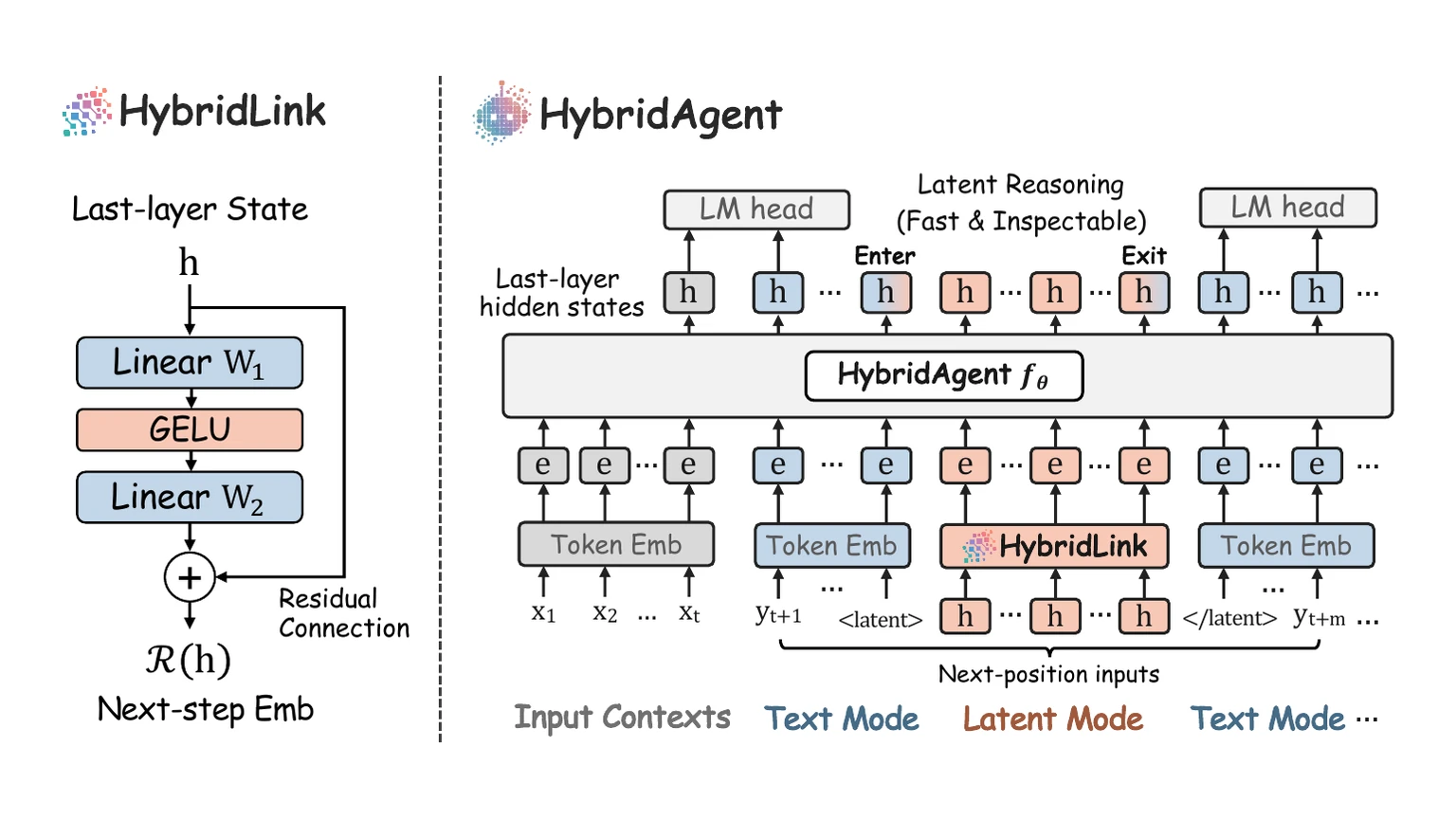
Today's agents reason in text. A model writes out its chain of thought token by token and only then issues a search query or runs code. A separate research line, latent reasoning, lets a model think in continuous vectors instead of words, which is faster because nothing has to be decoded, but those vectors cannot call tools and are hard for people to read. HybridAgent tries to combine the two in a single generation.
The key part is HybridLink, a small add-on made of two linear layers with a GELU activation and a residual connection. It takes the model's last-layer hidden state and maps it back into the space of input embeddings, so the model can feed its own thought straight back in as the next input without turning it into a word. A special <latent> token enters this silent mode and </latent> exits it. In training, each latent span ran for between 16 and 256 steps.
Outside latent mode the agent behaves like a normal tool-using model. It can call a Python interpreter in a sandbox and a live web search engine, and the paper caps tool use at ten calls per task. Text, latent thoughts and tool results all accumulate in the model's key-value cache, which the authors call its working memory, so nothing is lost or re-encoded between turns.
How it was trained
Training happens in two stages. HybridSFT, the supervised stage, uses 54,000 hybrid trajectories produced by an automatic annotation pipeline. Its trick is self-conditioning: a first pass produces latent inputs through HybridLink, and a second pass replaces the ground-truth embeddings with those predictions, so the backbone learns to reason over thoughts generated by its own link rather than idealised ones.
HybridRL, the reinforcement learning stage, then uses 12,000 deep reasoning examples and 1,000 agentic search examples, with rollout batches of 512 trajectories. It replays complete hybrid trajectories, latent parts included, when updating the policy, and teaches the model when to think silently and when to act through text. The authors report that as training went on, the agent moved more of its generation into latent mode while its reward and tool use both rose. Experiments ran on Nvidia H100 GPUs, and because existing frameworks such as vLLM do not support this kind of multi-turn hybrid generation, the team extended its own training and inference stack.
What the benchmarks show
The team trained HybridAgent at three sizes, 4B, 8B and 14B parameters, and tested it on 11 benchmarks: AIME 25, AIME 26 and MATH500 for maths; GPQA-Diamond, MedQA and MuSiQue for knowledge-heavy reasoning; and GAIA, Humanity's Last Exam, WebWalker, SealQA and DeepSearchQA for agentic tasks that need search and tools.
Baselines included text-based agent training methods such as GRPO and ARPO, latent reasoning methods such as Coconut, SoftThinking and SoftCoT, agent frameworks such as ReAct, Search-o1 and WebThinker, and frontier models including GPT-5.6-Luna, Kimi-K3, GLM-5.3-Flash and DeepSeek's V4.1-Flash. Across all of them, the authors report an average performance improvement of 10.4%, and say HybridAgent beat matched text and latent baselines by 18.5% at the supervised stage and 10.4% after reinforcement learning.
Some numbers from the paper's main agentic table show the size of the gap at 8B. On GAIA, HybridAgent averaged 43.7, against 38.8 for ARPO and 32.0 for GRPO trained on the same backbone. On WebWalker it averaged 42.5 against 32.0 for ARPO. Results are averaged over five runs, with an average standard deviation of 0.014 in accuracy. The paper also reports that HybridAgent kept improving as more samples were drawn at test time, and gained more from that extra compute than agents trained with text-only reinforcement learning.
Fewer tokens, faster answers, lower cost
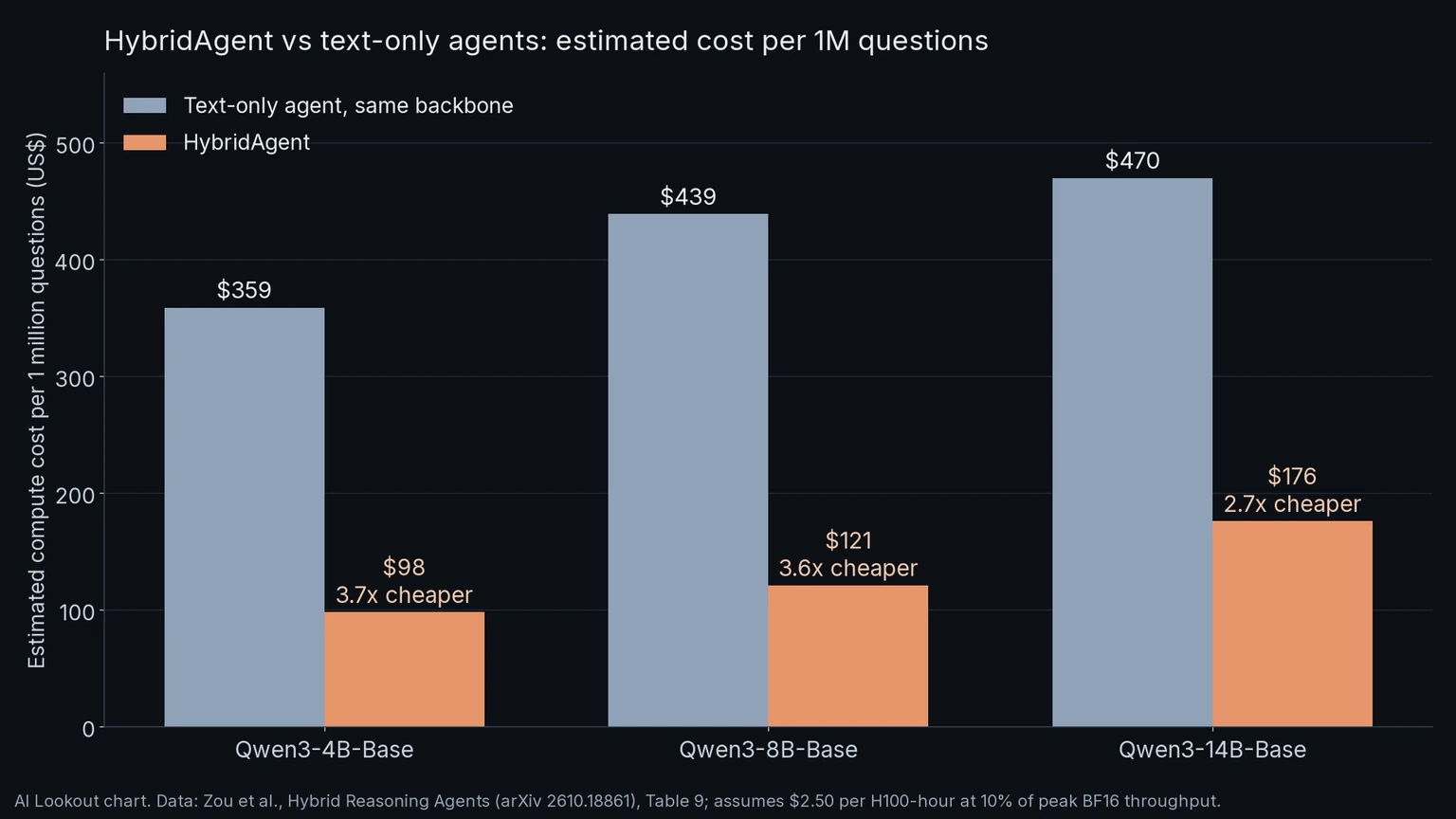
The efficiency claims are the most striking part. Because latent steps skip decoding words, the authors report that HybridAgent used 35.5% to 54.7% fewer tokens than matched text agents, ran 1.8 to 2.6 times faster, and cut estimated compute cost by 2.7 to 3.7 times.
The cost figures come from a FLOP count rather than a real invoice. Each text or latent step is charged as one full forward pass of the model, and the paper assumes $2.50 per H100-hour at 10% of peak throughput. On that basis, compute per question falls from 62.5 to 17.2 teraFLOPs at 8B, and the estimated cost of answering a million questions drops from $439 to $121. The chart below shows all three sizes.
Reading the silent thoughts
Thinking in vectors raises an obvious worry: if the model is not writing its reasoning down, how does anyone check it? The authors say that every latent step can be rendered as readable pseudo-text, and that their self-conditioned training makes those readouts clearer and more specific to the task. They measured readability and context-specificity on 200 questions across all the downstream tasks, and report that methods scoring low on faithfulness and specificity mostly produced unreadable artifacts, while the full HybridSFT gave clear, coherent readouts.
The paper's discussion goes further and pitches the design for commercial deployment. Labs that sell reasoning models through APIs often hide the chain of thought; the authors argue that latent thoughts “exist only as backbone hidden states” readable through the provider's own HybridLink, so “no text exists to leak,” while the provider can still monitor the full readout. That is a different bet from the one Google describes in its Gemini 4 Argon safety report, which leans on monitoring visible chains of thought, and it means users would see less of the reasoning, not more.
How to try it
Running HybridAgent needs the authors' code. The model cards note that loading the weights with the Transformers library alone gives a text-only model; latent mode and tools require the HybridAgent package, which provides batch inference, HybridSFT and HybridRL training scripts and an “Interpretable Latent Mode” viewer that turns latent thoughts into HTML reports. The search tool expects a Tavily API key. Developers who simply want open models inside existing coding agents have other routes, such as Together Link, but HybridAgent is a research system rather than a hosted product.
Limitations and open questions
All of the results are the authors' own and have not been independently reproduced. The frontier-model comparisons were run inside the authors' agent setup, with a cap on tool calls and GPT-5.6-Luna acting as both search-page summariser and judge, so they are not the same as each vendor's published scores. The released checkpoints only go up to 14B parameters on Qwen3 backbones, and it is not yet clear how the approach behaves on much larger models or whether mainstream serving engines will support it.
The readability of latent thoughts is also a claim to test. A pseudo-text readout is a translation of hidden states, and how faithfully it reflects what the model actually computed is exactly the kind of question outside interpretability researchers will want to probe now that the weights and code are public.
Common questions
What is latent reasoning in HybridAgent?
Instead of writing every reasoning step as text, the model feeds its own last-layer hidden state back in as the next input through a small HybridLink module. These silent steps sit between <latent> and </latent> tokens, and the model returns to text to call tools or answer.
Can I download HybridAgent?
Yes. The code is on GitHub under the MIT license, and HybridAgent-8B-Agentic and HybridAgent-14B-Agentic are on Hugging Face with their training datasets. Latent mode and tools need the authors' code, and the search tool needs a Tavily API key.
Are HybridAgent's latent thoughts hidden from users?
They are not written as text, but the authors say every latent step can be read out as pseudo-text through HybridLink. They suggest providers could monitor that readout while users see only tool calls, key decisions and answers.
Sources & further reading
How this story was made
Written by Kristian Kostov with AI assistance and checked against the linked sources. Company performance claims are attributed to the company. Analysis reflects AiLookout’s interpretation; we have not independently tested the products discussed. The cover is an original AiLookout conceptual diagram, not measured data or a product photograph.
Our editorial standards