Announced 12 Oct 2026 · Sources checked
What did the Qwen team announce?
The Qwen account announced QwenGyre on X on 12 October as “bringing elastic RL to extreme-long-horizon (XLong) agent training”, with two core designs: an elastic scheduler and a trajectory processor. The technical detail is in an arXiv paper by 12 authors from Alibaba Token Hub, the University of Science and Technology of China and Tsinghua University, first posted on 27 September 2026.
IT之家 (ITHome) reported the same day that Alibaba had “officially released” the framework. In this case “released” means the method and results are public; the paper links no QwenGyre code repository, and we found no open-source release.
The paper matters partly for what it reveals about Alibaba’s models. It describes RL training of “our flagship model, Qwen 3.8 2.4T”, a 2.4-trillion-parameter model, on tasks with about 700,000 tokens per rollout.
Why is RL on hours-long agent runs so wasteful?
Online RL for coding agents works by letting the model attempt many tasks, scoring the results and updating the weights. For short tasks such as fixing one bug, a rollout takes minutes. The QwenGyre paper is about tasks like building a whole repository from a natural-language specification, measured by NL2RepoBench, where a single attempt can run for hours. That is a much longer horizon than the bug-fixing tasks in SWE-bench.
Two problems follow, the authors say. First, run times vary enormously. In their Qwen 3.6 122B experiments, a rollout took 1.93 hours on average and 9.51% of queries took at least four hours. With the common “colocate” design, the whole GPU pool waits for the slowest runs before it can switch to training. With the “async” design, GPUs are split into fixed rollout and training pools, and training GPUs sit idle while they wait for a full batch.
Second, long agent runs do not produce one neat transcript. Harnesses compact histories when the context fills, delegate sub-tasks to sub-agents and retry failed paths, so one run becomes a tree of overlapping contexts. Our guide to context compaction explains why harnesses do this; for training, expanding every branch into its own sample repeats the same tokens many times.
How does the elastic scheduler work?
QwenGyre groups GPUs into “cells”, each large enough to hold the model for both inference and training. As rollouts finish, freed cells switch to training and join the current batch, while cells still serving live runs keep going. The live runs are not restarted: QwenGyre reroutes their requests and migrates their KV caches, the stored attention state, to the cells that remain in rollout.
Training uses centralised data parallelism, so new cells can join a batch already in progress, and a streaming mode starts training on completed groups before the full batch is ready. The authors report average switching times of 8.52 seconds from rollout to training and 3.46 seconds back, which they call negligible next to runs lasting hours.
In the smaller experiments, 32 nodes were split into eight four-node cells. For Qwen 3.8 2.4T, the setup used four cells of 48 nodes each, 192 nodes in total, with up to 384 concurrent inference requests.
How does QwenGyre turn branching runs into training data?
The trajectory processor sits in a proxy between the agent harness and the model. It records every model call at the token level, a technique the paper calls TITO (token-in, token-out), keeping the exact input and output token IDs and the probabilities the model assigned at the time. That means each output keeps its original context even if the harness later compacts it away.
Records from one run are arranged into a trajectory tree with shared prefixes. When a run times out but has done assessable work, “partial scoring” still assigns a reward instead of discarding it. At training time QwenGyre picks a bounded set of paths per run, by default at most five, counts shared tokens once and averages losses per run so a run with many branches does not count for more.
The harness itself is unmodified. All three workloads in the paper used Claude Code 2.1.220 to run shell commands and edit files in containers, and NL2RepoBench training was scored by a separate Qwen 3.7-Max evaluator against independently written tests.
What did Alibaba’s experiments show?
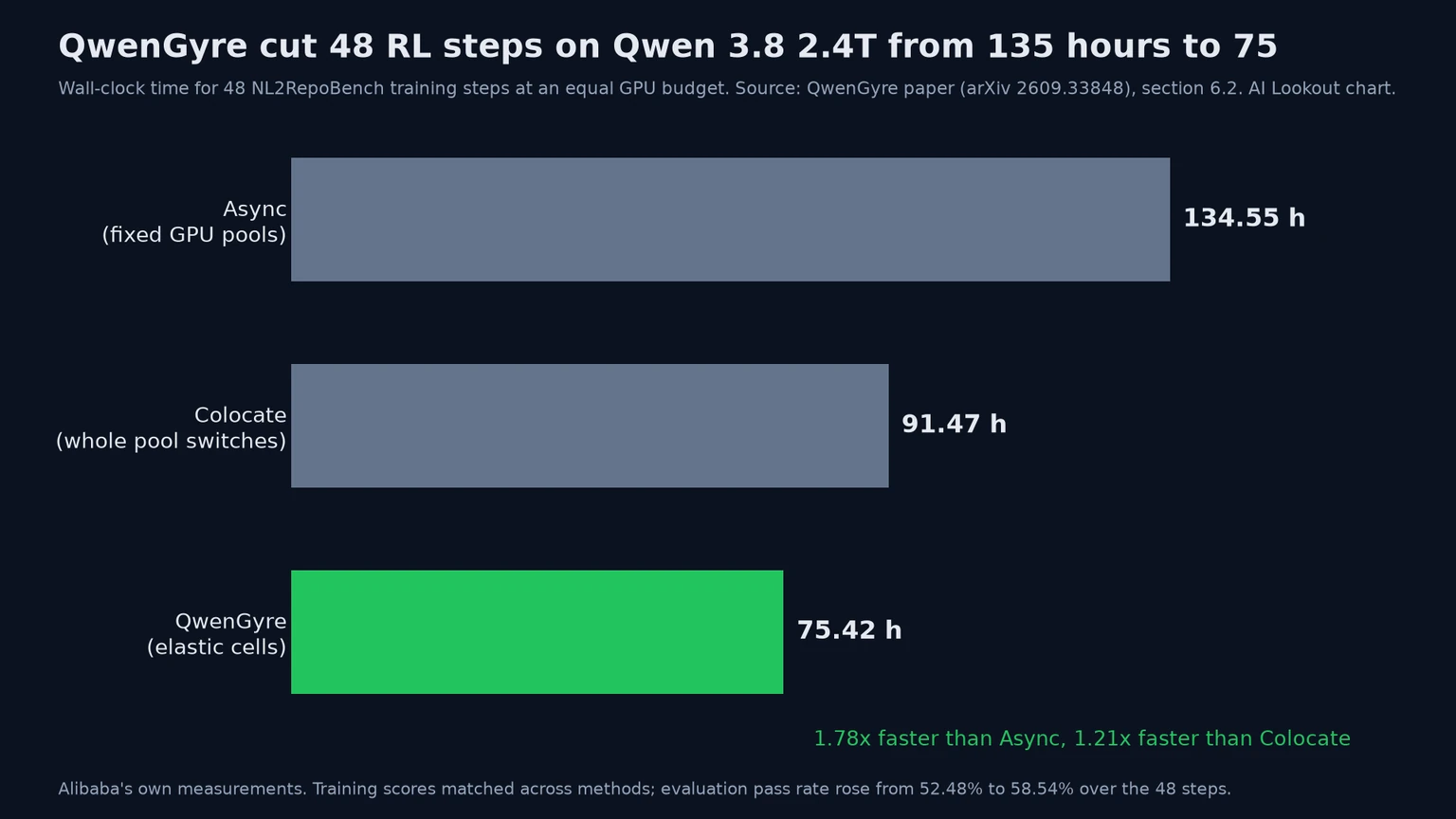
On Qwen 3.8 2.4T, 48 NL2RepoBench training steps took 75.42 hours with QwenGyre, against 134.55 hours for the async baseline and 91.47 hours for colocate, speedups of 1.78x and 1.21x. The training scores matched the baselines, and the evaluation pass rate rose from 52.48% to 58.54% over the 48 steps. The authors note that the big model timed out often: 61.1% of its queries took at least four hours.
On Qwen 3.6 122B, QwenGyre was 1.42x to 1.53x faster than async and 1.36x to 1.47x faster than colocate on NL2RepoBench after 48 steps. Over 24 steps on DeepSWE and TerminalBench, it was 1.38x to 1.57x faster than async and 1.61x to 1.85x faster than colocate. The 1.85x headline figure is the best of those configurations.
All comparisons use the same GPU budget and matched targets for staleness, how far the model generating rollouts lags behind the model being trained. The improvement is in wall-clock time; the paper does not claim better final scores than the baselines.
What does it mean for agent builders?
For labs training coding agents, the scheduling problem is real and expensive: a 192-node job that sits idle for days waiting on stragglers is wasted money. QwenGyre joins other recent work on harnessed agent RL, such as Microsoft’s Agent Lightning and Xiaomi’s MiMo-V2.6 report, in treating the harness as a black box and fixing the training system around it.
For teams that build on Qwen models, the paper is a signal of where Alibaba is putting its RL effort: multi-hour, repository-scale tasks rather than single fixes. Whether that shows up in public models depends on releases Alibaba has not announced.
The partial-scoring and per-run averaging ideas apply beyond Qwen. Anyone scoring long agent runs, even without training on them, faces the same question of how to credit work that timed out; our checklist for evaluating AI agents covers the evaluation side.
![Grouped bar chart of QwenGyre speedups on Qwen 3.6 122B over Async and Colocate: NL2RepoBench 1.42 to 1.53x and 1.36 to 1.47x; DeepSWE 1.57x and 1.61x at E[d]=1, 1.57x and 1.82x at E[d]=1.5; TerminalBench 1.38x and 1.81x at E[d]=1, 1.43x and 1.85x at E[d]=1.5.](/assets/articles/figures/oct12-1900-qwengyre-speedups-1536.webp)
What are the limits and open questions?
Every number here comes from Alibaba’s own runs on internal training data, and no outside group has reproduced them. Without code, they cannot be checked.
The authors list two limitations. Elastic scheduling needs several independently switchable cells, so a small GPU budget may not support it; they did not test efficiency at much smaller budgets. And streaming training cannot shuffle data globally across minibatches, which they say constrains some training procedures; the effect of sample ordering on learning quality was not isolated.
The Qwen 3.8 2.4T results also come with a caveat the authors state themselves: 61.1% of its queries ran at least four hours, and in 38.2% of them the longest run hit the overall time limit, leaving less room for the scheduler to reclaim GPUs early. The paper says nothing about whether, when or under what licence Qwen 3.8 2.4T might be released.
Common questions
Is QwenGyre open source?
Not as of 12 October 2026. Alibaba published a paper and an announcement thread; the paper links no QwenGyre code and we found no repository.
What is Qwen 3.8 2.4T?
The QwenGyre paper calls it Alibaba’s flagship model, with 2.4 trillion parameters. The paper uses it for RL experiments but gives no release details.
Does QwenGyre make agents smarter?
It makes training faster. Alibaba reports the same training scores as the baselines in less wall-clock time; the 52.5% to 58.5% NL2RepoBench gain is what 48 RL steps achieved, not an advantage over other schedulers.
What to remember
QwenGyre is a training-systems advance: it stops GPUs idling while hours-long agent runs finish and keeps branching transcripts from bloating training. Treat the speedups as Alibaba’s results until code or a replication appears.
Sources & further reading
How this story was made
Written by Kristian Kostov with AI assistance and checked against the linked sources. Company performance claims are attributed to the company. Analysis reflects AiLookout’s interpretation; we have not independently tested the products discussed. Cover photography is illustrative and does not depict the specific announcement or product.
Our editorial standards