Announced 19 Oct 2026 · Sources checked
What Skyfall announced
Skyfall AI has released a research preview of SKY-001, a model it calls the first world model for engineering. In a technical blog post dated 19 October 2026, the company says the model can take an image of an engineered product, work out its assemblies and parts, and plan the sketches and operations that would build each part in computer-aided design (CAD) software. It can also turn a building outline and a short brief into floor plans for building information modeling (BIM).
Skyfall's headline claim is efficiency. On its own CAD benchmark it says SKY-001 matches GPT-6 Astra's accuracy while running about 51 times faster and costing about 150 times less per case. On floor plans it claims a small accuracy lead over Astra at roughly 120 times the speed. Those are vendor-run results on benchmarks that have not been published for others to use.
The model is not generally available. Skyfall's press release describes an initial research preview, with full commercial deployment targeted for early 2027, and no API, pricing or model weights have been announced.
How SKY-001 builds a design
Skyfall's argument is that language is a poor medium for engineering. A design can read well in text and still be geometrically wrong, and a real product can have hundreds of parts that all have to fit. So instead of writing code or text, SKY-001 plans in images and 3D states, working the way engineers do: the overall design first, then its assemblies, then individual parts and how to build them.
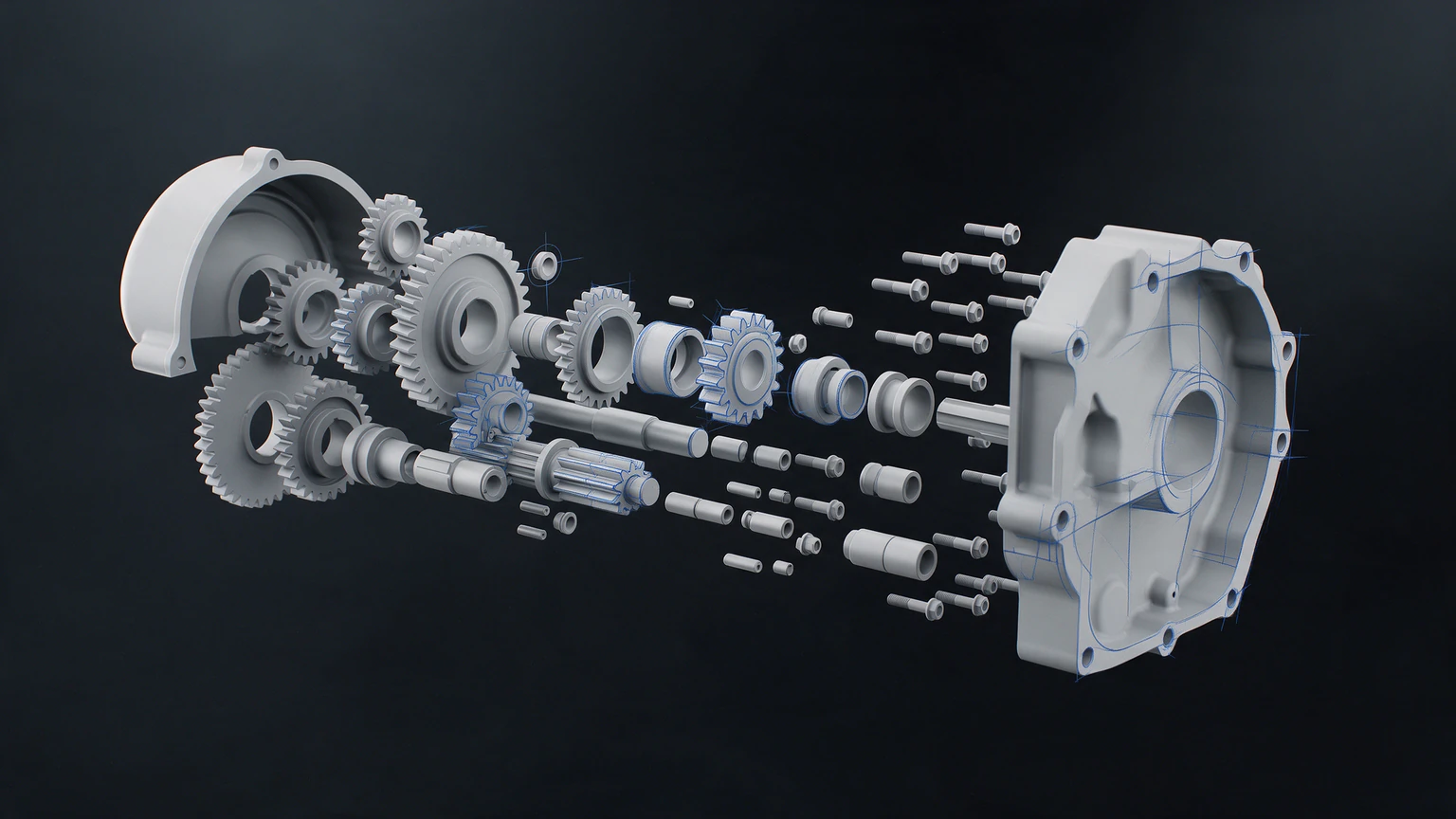
It does this in two stages. The first, which Skyfall calls the Hierarchical Composer, uses diffusion transformers to generate a rough 3D shape of the whole object from a single image, then splits it into main assemblies, splits those again, and keeps going until every piece is a single part. Because the rough shape has coarse surfaces and nothing hidden inside, a refiner then fills in missing geometry and fine detail for each part. In one example, a VMS-85 engine generated from a single photo was broken into a five-level tree of blocks, heads, intake, exhaust, timing drive, gears, shafts, hoses and sleeves.
The second stage, the Construction World Model, works out how each part is built. It plans the intermediate 3D states, such as a profile becoming an extrusion and then having holes cut into it, and between each pair of states it draws the 2D sketch that turns one into the next. The drawing happens in two passes: a rough rollout in a heavily compressed space, produced by a Matryoshka-style autoencoder whose first codes hold the overall layout, then a refiner that redraws every state at full resolution with sharp lines and exact corners.
Skyfall says the hierarchy is what makes this tractable. Once a parent is fixed, its children can be built in parallel, so the number of sequential steps grows with the depth of the design rather than its size, and each level passes the one below a concrete subgoal. Hierarchical planning is a recurring theme in world-model research, from AMI Labs' H-JEPA to Viggle's physics-native JST-2, though those generate scenes to look at or act in rather than build sequences.
Floor plans as well as parts
For buildings, the input is what an architect can write down: the outline of a storey with wall thicknesses and open edges, and a brief listing rooms, net area and rough positions. The model generates the whole plan down to doors, windows and fixtures, checks it against the brief, and splits large storeys into parts that are planned separately and joined back.
In Skyfall's example, a storey about 29 metres across was divided into three apartments around a shared corridor, stairs and lifts, and one 92 square metre unit was filled with seven rooms. The construction model then draws a floor the way an architect would, exterior walls first, then dividing walls and corridors, then each apartment room by room. Skyfall says a whole floor rolls out in about a second.
The training data
Skyfall says its CAD data comes from publicly available online datasets of real product assemblies, which it rebuilt into consistent engineering hierarchies because the raw files had overlapping faces, duplicated geometry and unnamed parts. Where a part's construction history was missing, engineering tools and LLM-based workflows reverse-engineered one and verified it. In total the composer learned from more than 200,000 parts and the construction model from over 600,000 construction examples.
The company compares this with PartVerse, a widely used part-decomposition dataset. By its count, PartVerse objects have a median of 6 parts and a 99th percentile of 33, while Skyfall's have a median of 288 and a 99th percentile of 4,180; a BMX bicycle in PartVerse has 8 parts against 988 for a fat bike in Skyfall's set. For BIM, the models learned from about 35,000 real and synthetic floor plans, some two million drawing states.
Skyfall's benchmark numbers
The CAD construction benchmark has 1,000 components sampled from objects including a Jaguar E-Type roadster, a FANUC ArcMate 100iB welding robot, a compact tractor, a Bell 222 helicopter and a jet engine. Each takes about 100 drawing steps, and the final shape is scored by intersection over union (IoU), the overlap with the reference shape.
Skyfall reports SKY-001 at 79.7 percent IoU, 3.9 seconds and US$0.005 per case. GPT-6 Astra scored 79.1 percent but took 199 seconds and US$0.75. Gemini 4 reached 76.9 percent, Qwen 3.8 Max 34.4 percent and Kimi K3 9.5 percent, while Grok 4.7 completed no cases. In other words, the accuracy claim is parity with Astra; the advantage is speed and cost.
On the composer, two language-model judges, GPT-6.1 Sol and Claude Opus 5.5, scored renders blind. SKY-001 beat Astra on all five criteria, for example 7.8 against 6.4 for part decomposition and 8.1 against 6.7 for matching the input image. Astra wrote Blender scripts for the whole assembly in one request and returned a model for 82 percent of assets.
The BIM benchmark has 1,000 floor plans, about 350 whole floors and 650 apartments, averaging around 70 drawing steps. SKY-001 scored 43.6 percent IoU in 1.22 seconds for US$0.0024 per case, against 40.6 percent, 144.6 seconds and US$0.446 for Astra. Gemini 3.8 Flash came close at 42.3 percent. Astra appears as the reference model in many recent comparisons, including AtelierBench's professional design tests.
Who Skyfall is and when it ships
According to its press release, Skyfall is a “neolab” building what it calls the autonomous enterprise, founded by the team behind Maluuba, the deep learning lab Microsoft acquired. It is led by Sam Pasupalak, Kaheer Suleman and Sumit Pasupalak, is headquartered in San Francisco with a research hub in Toronto, and lists Fidelity, Touring Capital, M13 and iNovia Capital as backers. Pasupalak argued in the release that replacing brute-force language-model calls with planning world models will make token costs “plummet.”
Next, Skyfall says it wants sketch rollouts to become executable CAD operations with an editable feature history, so a designer could ask to widen a bracket and have neighbouring parts update. Generated floor plans would become editable building models, and the approach could extend to circuit-board design. Output that lands in real CAD formats would matter; open geometry tools such as NVIDIA's open-sourced SMLib CAD kernel show how much of that pipeline is becoming shared infrastructure.
Caveats
Every number above is Skyfall's own, on benchmarks it built and has not released. The post does not explain how the general-purpose models were set up for the construction tasks, and in the composer comparison they had to write a Blender script for a whole assembly in one request, a format that favours a purpose-built model. The composer scores also come from language-model judges rather than engineers.
Absolute accuracy is also modest. An IoU of 79.7 percent means the shape is close, not exact, and 43.6 percent on floor plans leaves a lot of room. The blog itself notes that its animated transitions are illustrative and that the saved sketch and 3D geometry can disagree, which is the kind of gap that matters in manufacturing. The press release's “100x faster” claim also differs from the blog's 51 times for CAD.
Even so, a model that can propose a plausible part tree and build order in seconds could be useful long before it is exact, as a draft for engineers to correct. Physical-world automation from ICON's robotic construction to factory robots needs that kind of structured plan, and independent tests once SKY-001 opens up will show whether Skyfall's numbers hold.
Common questions
Can I use SKY-001 now?
No. Skyfall describes it as a research preview, with full commercial deployment targeted for early 2027. No API, pricing or weights have been announced.
Does SKY-001 output real CAD files?
Not yet in an editable form. It produces visual build plans of sketches and 3D states; Skyfall says turning them into executable CAD operations with a feature history is a next step.
Is SKY-001 more accurate than GPT-6 Astra?
Roughly equal on CAD in Skyfall's test, 79.7 against 79.1 percent IoU, and slightly ahead on floor plans, 43.6 against 40.6 percent. The large gaps are in speed and cost.
Sources & further reading
How this story was made
Written by Kristian Kostov with AI assistance and checked against the linked sources. Company performance claims are attributed to the company. Analysis reflects AiLookout’s interpretation; we have not independently tested the products discussed. The cover is an AI-generated editorial illustration, not a photograph or evidence of an actual event.
Our editorial standards