Announced 14 Oct 2026 · Sources checked
What did GitHub ship?
GitHub's changelog entry on 14 October 2026 does two things. It updates HydraFusion, the orchestration option that sits in Copilot's model picker, and it introduces HydraFusion Max, a variant 'tuned for frontier capability on more demanding tasks.' Both stay in research preview, and both now work across VS Code, the GitHub Copilot app and Copilot CLI.
HydraFusion is not a model. GitHub's documentation calls it 'an advanced runtime model orchestrator': for each prompt it picks an execution pattern, the models that run it and how hard each should think, then shows you one final response. The goal is to stop developers from hand-picking a model for every step of a task.
HydraFusion first appeared in Copilot CLI in early September, with a community announcement on 1 September and a blog post on 4 September laying out the design and benchmarks. A community FAQ placed it in a line of routing work: Auto model selection in January 2026, an intent-scored router called HyDRA in May, and HydraFusion's per-turn orchestration in August. Microsoft has also said HydraFusion is coming to Windows as an experimental preview later this month.
How HydraFusion decides who does what
HydraFusion currently chooses between three patterns. Single sends the task to one model. Cascade lets an efficient model draft a solution, then a judge inspects it and either accepts it or escalates to a stronger model. Critique has one model draft while several others critique it in parallel; their feedback is pooled and the original model revises once. The pattern is chosen per prompt, so one session can mix them.
GitHub frames the choice as an optimisation problem. HydraFusion scores each task on capability signals for reasoning, code generation, debugging and tool use, and picks the least complex pattern expected to meet its quality bar. The 4 September post says GitHub used beam search over candidate routing policies rather than hand-tuning thresholds.
The post also lists five operating rules: count cost across every leg, including retries and fallbacks; give each leg a timeout; run reviewers in isolated, tool-less contexts while the solver works in the real workspace; apply no patch if a workflow fails or is cancelled; and validate model bindings before a run starts. If you want the broader idea of routing work across models, our explainer on model routing workflows covers the trade-offs.
What changed in this update
The model pool is the headline change. GitHub says HydraFusion and Max now draw from a pool that includes Claude Opus 5.5, GPT-6 Astra, GPT-6.1 Sol and GPT-6 Luna, with the mix varying by workflow. GitHub does not publish a fixed roster and says the lineup will shift as new models arrive and its evaluations change.
Reasoning effort is now set per step. Before this update HydraFusion used each model's default effort. It now uses medium effort for drafts and high effort for review, and the docs say extra high reasoning is available with Max. GitHub says this keeps drafting efficient while saving deeper reasoning for checking the work. Pricing differs a lot between the pool's models; see our look at GPT-6.1 Sol's cost and capability for one example.
Both review patterns were reworked. Cascade can now add a judging step that inspects the first attempt and asks for a repair only when needed, instead of jumping straight to a stronger model. Critique, which previously relied heavily on text summaries, now uses tools to inspect the actual workspace and runs parallel critic models.
GitHub describes the two tiers in a table. HydraFusion is a 'balanced approach with moderate token savings' for agentic tasks that need a mix of speed, cost and performance. HydraFusion Max is for 'tasks requiring the deepest possible reasoning and most thorough analysis,' with token efficiency still considered through orchestration.
How it performed in GitHub's own tests
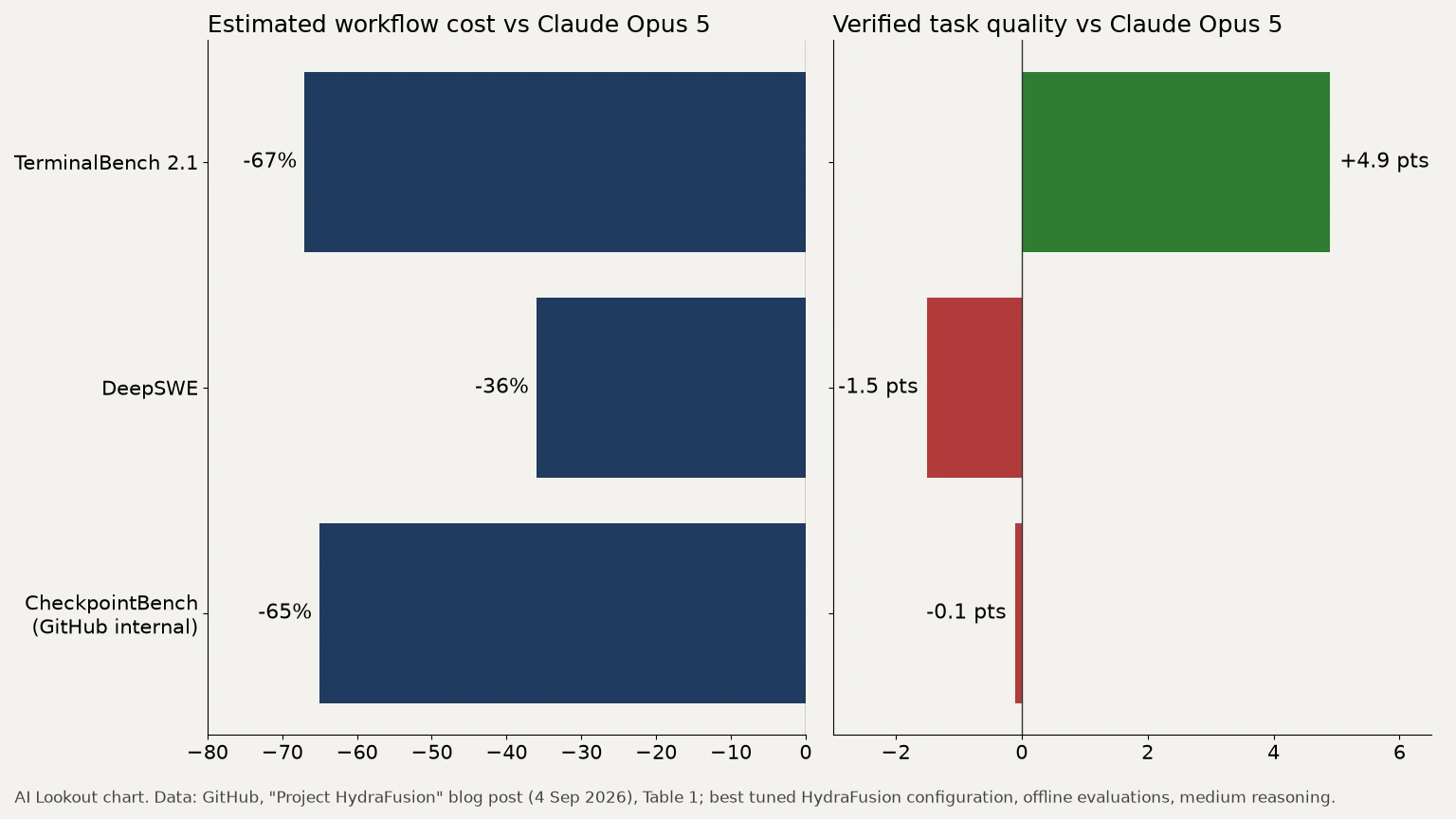
The only benchmark numbers GitHub has published are from September and predate this update. In offline tests on three agentic coding benchmarks, its best tuned HydraFusion setup was compared with Claude Opus 5, with all models at medium reasoning. On TerminalBench 2.1 it scored 4.9 points higher at 67% lower estimated cost. On DeepSWE it was 1.5 points lower at 36% lower cost. On CheckpointBench, GitHub's internal benchmark built from real Copilot sessions, it was 0.1 points lower at 65% lower cost.
Those are GitHub's own results on benchmark revisions, model pools and pricing assumptions it chose, and GitHub says so. TerminalBench is fairly saturated, which is why GitHub added DeepSWE's harder repository tasks. Independent leaderboards such as FrontierCode 1.1 test single models, not orchestrators, so there is no outside comparison yet. The changelog and docs we read include no new numbers for Max or for the Opus 5.5 and GPT-6 pool.
How to turn it on, and what it costs
In Copilot CLI, update with copilot update, start with copilot --experimental (or run /experimental on and restart), then pick HydraFusion (Research Preview) or HydraFusion Max (Research Preview) from /model. For scripts, the docs show copilot --experimental --model hydrafusion -p followed by your prompt. The CLI shows which pattern was chosen and the state of each pass, /usage shows credits per model, and /collect-debug-logs records the pattern and models for bug reports.
In VS Code you need version 1.140 or later, or Insiders, with the chat.copilot.hydraFusion.enabled setting turned on; then choose HydraFusion or HydraFusion Max in the chat model menu. In the Copilot app, turn on HydraFusion under Settings, Experimental. In both, hovering over a finished response shows which models ran.
The changelog lists Copilot Pro, Pro+, Business and Enterprise plans with experimental or preview features enabled, subject to organisation model policies. HydraFusion only uses models your plan and policies allow, and it disappears from the picker if none are available. There is no HydraFusion fee: each model is billed at its standard rate, and the Auto selection discount does not apply. GitHub says it keeps the main conversation on one model where possible so cached tokens still help, and reviewers get only the context they need.
What it means for developers and teams
For individual developers, the practical advice in the docs is simple: use Auto for everyday work and save HydraFusion for substantial, well-scoped tasks such as a complex bug or a change across several files, where extra passes may be worth the time and credits. Max is for the hardest of those. GitHub's September guidance said first-turn, single-prompt tasks run in autopilot mode suit it best, with multi-turn work still being improved.
For teams, HydraFusion changes how spend is predicted. A Critique run can call several frontier models for one answer, so admins should watch usage reports as Max rolls out. It also mixes vendors in one task, so model policies matter: if an organisation blocks a provider, HydraFusion works with what is left. Open-source routers such as vLLM Semantic Router mostly pick one model per request; HydraFusion can run several models on the same request.
Limits and open questions
GitHub is clear that this is a research preview with no SLA and is 'not intended for production workloads.' You cannot pick or exclude the models HydraFusion uses. It works separately from Copilot subagents and does not start them. Intermediate drafts are hidden, and if HydraFusion discards a draft, file edits that draft already made are not undone automatically, so review changes before committing.
The context window shown for HydraFusion is the smallest among its models, so long conversations may need compacting before you switch. Cascade and Critique are slower than a single model by design. The open question is whether Max's deeper reasoning beats simply choosing Claude Opus 5.5 or GPT-6 Astra directly, at a lower total cost. GitHub has not published that comparison, and we have not tested HydraFusion ourselves.
Common questions
Is HydraFusion a new model?
No. It is an orchestrator in Copilot's model picker that chooses an execution pattern and runs existing models such as Claude Opus 5.5 and GPT-6 Astra.
How is HydraFusion Max different?
It uses the same architecture and workflows but applies higher reasoning effort, including extra high reasoning, for the most demanding tasks.
Does HydraFusion cost extra?
There is no separate fee, but every model it calls is billed at its standard rate and the Auto discount does not apply, so a task can use more AI credits.
Sources & further reading
How this story was made
Written by Kristian Kostov with AI assistance and checked against the linked sources. Company performance claims are attributed to the company. Analysis reflects AiLookout’s interpretation; we have not independently tested the products discussed. The cover places the companies’ own logos, taken from public-domain or openly licensed files credited in the caption, on a plain background. It is not a product photograph, a screenshot, or an endorsement.
Our editorial standards