Announced 13 Oct 2026 · Sources checked
What did ICON announce?
ICON announced on 13 October 2026 that it had raised a $200 million Series D. The round was co-led by Baillie Gifford and funds managed by BlackRock, with participation from Capital Factory, CAZ Investments, Moderne Ventures, Moonshots Capital, Norwest, Overmatch, The Syndicate and Tiger Global, among others. The company did not disclose a valuation.
ICON describes itself as a construction-technology company that combines robotics, software, building materials and design. It is best known for printing the walls of houses from a cement-based material, layer by layer, with large robotic printers. The Series D is pitched as the moment that approach moves from projects to production: ICON says the money will start manufacturing its newest printer, Titan, at its Austin factory.
“Construction automation has crossed from potential into proven reality,” said Jason Ballard, ICON’s co-founder and chief executive. “This round puts that reality in builders’ hands: more Titan systems deployed across the country, deeper capability in housing, commercial, and defense, and continued work on the technology that will one day build humanity’s first structures beyond Earth.”
What is Titan, and how does ICON’s system work?
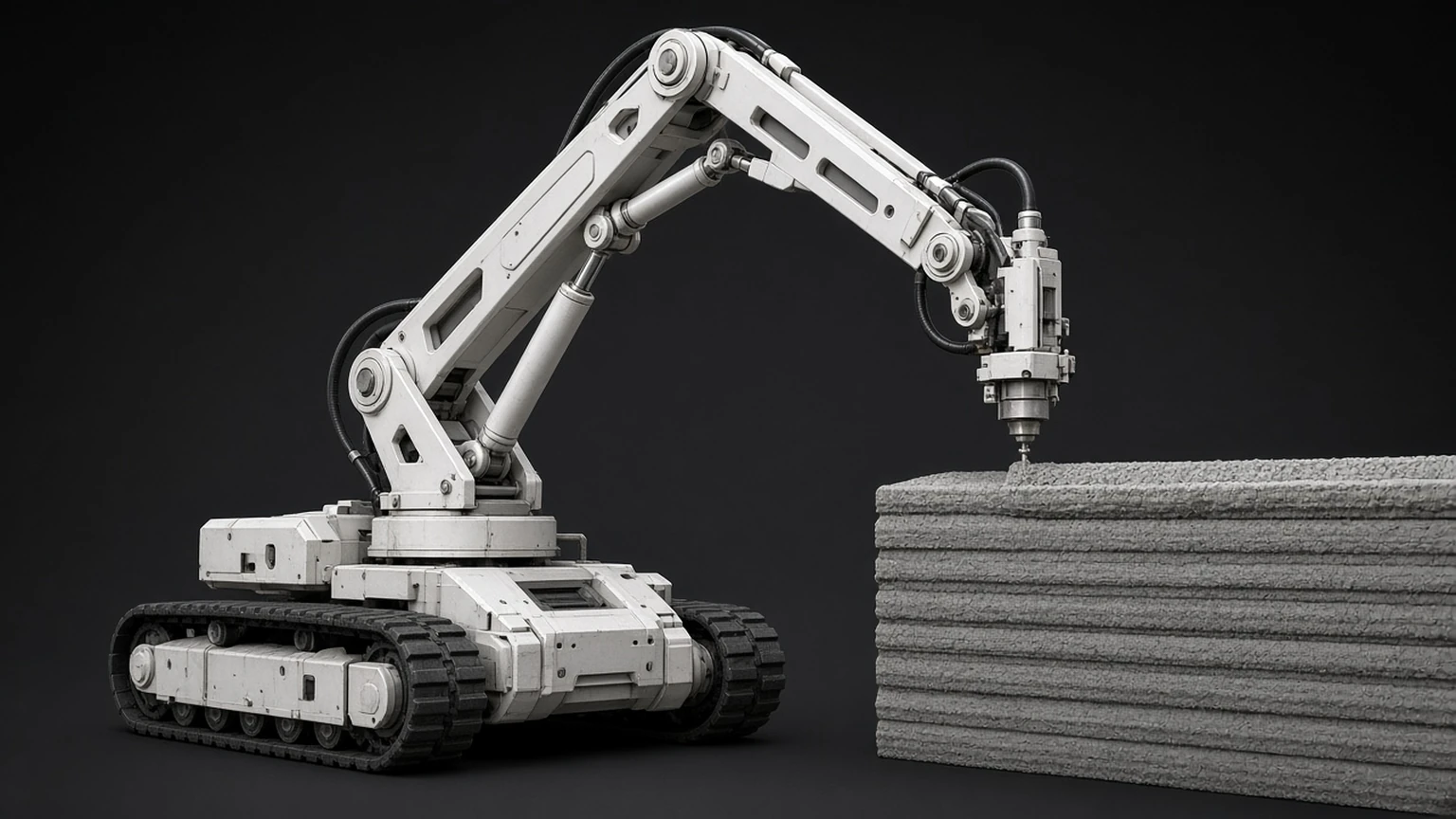
Titan is ICON’s multi-story robotic construction system, positioned for taller buildings than the single-storey homes most of its earlier projects produced. ICON’s release says the Series D marks the first commercial rollout of the system. Gallery images published with the announcement show it as a large white printer with a long articulated boom arm on a tracked base, rather than the fixed gantry frames ICON used before.
ICON makes two headline claims for Titan. It says the system is engineered to cut the construction time of an average home by six weeks, and to do it at 40% lower cost than the national average. A footnote in the release says the cost figure comes from ICON’s internal cost modelling compared against the National Association of Home Builders’ annual report, so it is a modelled estimate, not a measured result across finished projects.
The printer is only half of the system. ICON also sells FormCrete, its own printable building material, which it says produces walls rated for winds above 175 mph, against 40 mph for traditional stick-frame walls, and with a fire rating of more than two hours, against half an hour for conventional construction. ICON argues that controlling the robots, the software, the material and the building design together is what makes the approach efficient.
The company is organised into three units. Build delivers homes and commercial and hospitality buildings. Tech packages the printers, software and materials as a platform for other builders. Prime is a defence and space division, which builds for the military and develops off-world construction systems with NASA under Project Olympus.
Where ICON has built so far
ICON says it has built more than 270 homes and structures across five US states and two countries. The best-known project is Wolf Ranch in Georgetown, Texas, a neighbourhood of 3D-printed houses built with the homebuilder Lennar, which ICON calls the world’s first and largest community of its kind. It has also printed more than 100 homes for people experiencing homelessness at Community First! Village in Austin.
Military work is a growing part of the business. In January 2026 ICON broke ground on 10 barracks at Fort Bliss, which it describes as the largest deployment of robotic construction in US Department of War history and the first additively manufactured structures to meet the Pentagon’s Unified Facilities Criteria. ICON Prime says it has been awarded more than $370 million in government contracts.
The company has raised large rounds before. Its newsroom lists a $9 million seed, a $35 million Series A led by Moderne Ventures, and a Series B of more than $200 million led by Norwest Venture Partners. Trade outlet TCT Magazine reported the Series D details on 14 October in line with ICON’s release.
Why investors are betting on construction robots now
ICON’s pitch rests on two shortages. It cites estimates that the United States is about 4 million homes short of demand, and that the construction workforce is ageing: by its figures, only 10% of US construction workers are under 25 and 41% of the current workforce is expected to retire by 2031. Robots that print walls with a small crew are its answer to both.
Luke Ward of Baillie Gifford, which co-led the round, said ICON’s system is compelling because it “works with, rather than against, the business realities that shape a project’s success,” letting builders take on more work and owners get better value.
The round is part of a broader shift in robotics money toward machines with a specific job and a paying customer. Investors have spent the past year funding general-purpose humanoids and robot foundation models, from Physical Intelligence opening its Pi API for robot fine-tuning to NEURA Robotics’ Neuron AI model. Construction robots are a narrower bet: one task, a measurable output, and buyers such as homebuilders and the Army. Governments are also testing robots on real sites, as in South Korea’s humanoid sandbox for shipyards and factories.
What the money is for
ICON lists four uses for the money. It will start production of Titan at its Austin factory; open a large-scale research and development facility in Austin; keep developing next-generation systems including Titan and Olympus, the lunar construction programme; and expand its footprint across Texas, Florida, Washington DC and other US markets.
The company also says it is on pace for 4x revenue growth in 2026, without giving the underlying figures, and that it is hiring as it grows. The release does not say how many Titan units ICON plans to build, what they will cost buyers, or when units ordered by outside builders will ship.
What ICON’s numbers do and do not prove
The announcement is a company press release, and most of its numbers have not been independently checked:
- The 4x revenue growth, 270+ structures and $370 million in contracts are ICON’s own figures; ICON is private and does not publish financial statements.
- Titan’s six-week time saving and 40% cost reduction come from ICON’s internal cost modelling against an industry report, not from audited project results.
- FormCrete’s wind and fire ratings are ICON’s stated engineering figures; the release does not name the test standards or certifying bodies.
- Firsts and superlatives, such as the world’s largest 3D-printed community and the largest robotic construction deployment in Department of War history, are ICON’s descriptions.
- No valuation, Titan pricing or production volume was disclosed.
Common questions
Who led ICON’s Series D?
Baillie Gifford and funds managed by BlackRock co-led the $200 million round, with Capital Factory, CAZ Investments, Moderne Ventures, Moonshots Capital, Norwest, Overmatch, The Syndicate and Tiger Global among the participants.
What is ICON’s Titan?
Titan is ICON’s multi-story robotic construction system, which prints building walls from ICON’s FormCrete material. ICON says the Series D will start its manufacturing at the company’s Austin factory.
Are ICON’s cost and speed claims verified?
No. ICON says Titan can cut an average home’s build time by six weeks at 40% lower cost than the national average, but the release says this comes from internal cost modelling compared with an industry report.
Sources & further reading
How this story was made
Written by Kristian Kostov with AI assistance and checked against the linked sources. Company performance claims are attributed to the company. Analysis reflects AiLookout’s interpretation; we have not independently tested the products discussed. The cover is an AI-generated editorial illustration, not a photograph or evidence of an actual event.
Our editorial standards