Announced 15 Nov 2026 · Sources checked
The quiet departure
Outsiders had little reason to notice when Nvidia's longtime chief security officer and head of product security, David Reber, stepped down in August 2026. Reber spent four years as CSO and seven years at Nvidia overall.
He announced his departure on LinkedIn, disclosing that he had been diagnosed with young-onset Parkinson's more than two years earlier and needed to prioritize his health. "This wasn't a pivot I had planned.
But I know what needs to come first: family and health," he wrote.
Two and a half months later, the company's co-founder and CEO Jensen Huang resigned over growing questions about his extramarital relationships.
The cascade began with reports that Huang had an affair with Alice Huang, an executive at Megaspeed, a Singapore data center company, that US investigators suspect of funneling Nvidia chips to China.
The timing has drawn scrutiny from security specialists and former intelligence officers alike. Reber had been Nvidia's top security officer for four years after joining from a background in product security.
His LinkedIn post described the departure as necessary for his health, but he offered no timeline for a return.
The company declined to comment on whether his departure was in any way connected to the growing scrutiny of Huang's relationships and the Megaspeed investigation that would eventually force the CEO out.
Reuters later reported a second relationship, and The New York Times reported a third with an Nvidia vice president.
What the security team knew
Reber's replacement, Sasa Zdjelar, previously spent 17 years at ExxonMobil in Houston before one year at Salesforce and several years at the cybersecurity company ReversingLabs.
Zdjelar did not respond to questions about what the security team knew or whether any concerns were raised internally. Reber also did not respond.
The company itself has not answered questions about the timeline.
Relationships between a CEO and employees typically fall to human resources, legal and the board, not security.
But security specialists say any affair -- even one inside the office -- can give a foreign intelligence service leverage over an executive who wants it kept quiet.
Huang's relationship with an executive at Megaspeed, a company already under federal investigation, was not an office matter.
The intelligence playbook
Retired senior intelligence officer Nicholas Eftimiades, who has trained more than 1,000 corporate security professionals, told TechCrunch that spotting the clues is not easy.
Intelligence services collect much of their information through everyday conversation rather than hacking, making it especially difficult for security teams to identify risks. "Intel world tends to be like cancer," Eftimiades said.
"Once it gets into the body, it looks to spread and looks to reach out."
Technology can augment human intelligence operations. Eftimiades pointed to IMSI catchers -- devices that mimic a cell tower so nearby phones connect to them -- as one tool.
A basic version costs about $1,000 and fits in a suitcase, though government-grade models cost far more. There were cases involving Chinese espionage where these devices factored in last year.
It is not yet known whether such devices were used against Huang. Eftimiades, who wrote "Chinese Espionage Operations and Tactics" in 2020, said the playbook is not new, particularly for China.
Any executive dealing with the country will tell you they have been approached at some point. He described stories of US diplomats walking into a hotel room to find a woman on the bed.
What is newer compared with Soviet-era spying is that relationships now often last years rather than weeks, giving intelligence services deeper access to corporate decision-making.
Underfunded and overmatched
Corporate security teams are often underfunded because they do not drive revenue, Eftimiades said. It is "astonishingly common" for CEOs to answer a security team's warnings with "not a nickel more than compliance."
In an opinion piece in The Hill, Don Aviv, CEO of the corporate investigations firm Interfor International, and author Jeremy Hurewitz argued that too many companies still approach security primarily as a matter of protecting facilities, preventing cyberattacks and responding to physical threats.
Security teams need to pay greater attention to insider threats, including the cultivation of executives and employees by foreign intelligence services, suspicious business relationships and conflicts of interest.
Given Nvidia's scale and its relationships with defense and intelligence customers, it would be surprising if the company's security team did not have a more expansive remit than most. But even a well-resourced team faces limits.
An intelligence service that learns who is blocking a policy change simply shifts tactics. The gap between threat and response is especially wide in industries where export controls and government contracts create overlapping regulatory burdens.
Security teams in those environments spend heavily on compliance paperwork while the subtle intelligence threats get far less attention. "Who's the sticking point here?"
Eftimiades said, describing the question intelligence services ask, before looking for ways into that person's email and phone.
The wake-up call
Some people inside Nvidia clearly knew parts of the picture. The company's top lawyer was engaged with the government's Megaspeed inquiry more than a year ago, The New York Times reported.
Reports about Huang's relationships with employees suggest colleagues also knew of them, even if the behavior was not forbidden by Nvidia's code of conduct. What remains unclear is whether any of that reached the security team.
Huang has agreed to appear before Congress, according to BBC News. Shares in Nvidia plunged 14 percent after his resignation was announced before recovering to close more than 4 percent lower.
The company shed more than half a trillion in market value in a single day, according to The Guardian.
Eftimiades said he hopes the episode is "a wake-up call" for US industry, which he said is mostly "clueless" about China's tactics. "We have lost trillions in intellectual property," he said.
"Whatever we think we're doing isn't working."
The board's independent investigation and ongoing federal inquiries will determine what Nvidia's security team knew and whether it could have acted to prevent the crisis now unfolding in full.
Common questions
Who was Nvidia's chief security officer?
David Reber served as Nvidia's chief security officer and head of product security for four years. He left in August 2026, saying he had been diagnosed with young-onset Parkinson's.
Did Nvidia's security team know about Jensen Huang's relationships?
It remains unclear. Nvidia has not answered questions about what the security team knew.
Security experts say CEO-employee relationships typically fall to HR, legal and the board, not security.
Could Nvidia's security team have prevented the scandal?
Security specialists say corporate security teams are often underfunded and rarely equipped to detect intelligence operations targeting executives. Former intelligence officers say the playbook is well-known but widely ignored in US industry.
Sources & further reading
How this story was made
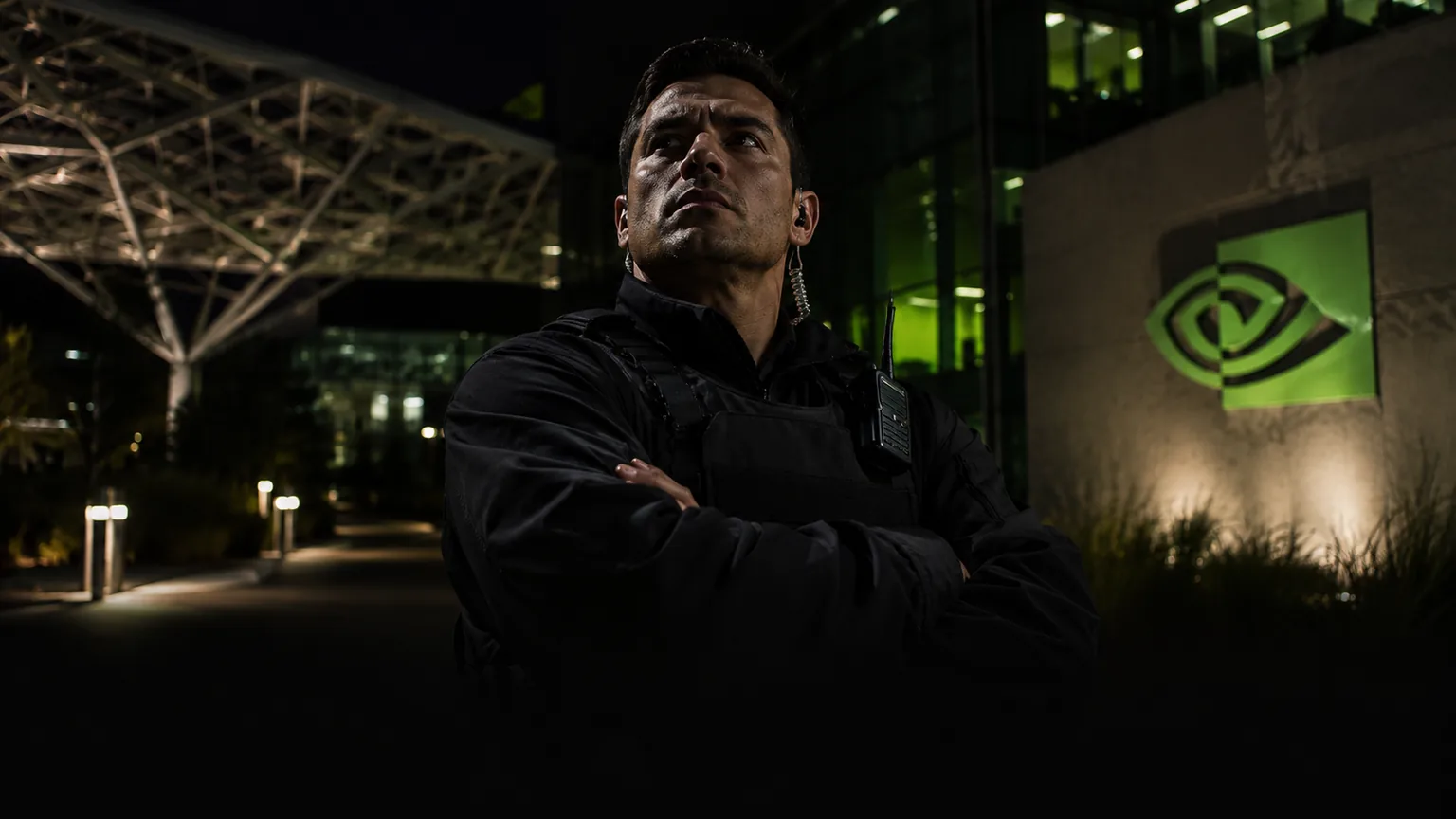
Written by Kristian Kostov with AI assistance and checked against the linked sources. Company performance claims are attributed to the company. Analysis reflects AiLookout’s interpretation; we have not independently tested the products discussed. The cover is an AI-generated editorial illustration, not a photograph or evidence of an actual event.
Our editorial standards