Announced 19 Oct 2026 · Sources checked
What Inception launched
On 19 October 2026, Inception published Diffusion at Scale: Introducing Mercury 3, calling it the most capable diffusion-based large language model released to date. The company says Mercury 3 beats OpenAI's GPT-6 Luna and Anthropic's Claude Haiku 5.5 across a range of benchmarks while running four to eight times faster, at more than 1,000 tokens per second.
The headline numbers in the post are specific. Inception lists an output speed of 1,068 tokens per second on NVIDIA GPUs, a context window of one million tokens (up from 260,000 for Mercury 2.5), and list prices of $0.20 per million input tokens and $0.70 per million output tokens. For launch, Mercury 3 is half price at $0.10 and $0.35, and cached input tokens are 90 percent off the input rate.
Inception also makes a scaling claim. It says Mercury 3 is more than 40 times larger in total parameters than Mercury 1, that its scores on standard benchmarks have roughly tripled since the first, smaller Mercury model, and that it is just as fast. The company does not publish the parameter count, the training data or the architecture details behind that comparison.
How a diffusion language model writes
Almost every chatbot model in wide use today is autoregressive: it writes one token, then uses that token to choose the next, and so on until the answer is finished. That makes output speed depend on how fast the hardware can run one step after another. Long answers, and agents that make many calls in a row, pile up those sequential steps.
Diffusion language models take the approach that image generators made familiar. They start from a rough or masked draft of the whole output and refine many tokens in parallel over a number of passes. OpenRouter's Mercury 3 model page describes it the same way: the model produces and refines tokens in parallel rather than one at a time, which is why it can grow much larger without slowing down.
The open question in the field has been whether this approach could keep up with autoregressive models on hard tasks as it scaled. Inception's post argues that it can, and that the scaling laws that drove progress in autoregressive models also hold for diffusion. That is a claim about Inception's own training runs. Outside researchers have not yet had a chance to test it on Mercury 3.
Inception's benchmark table
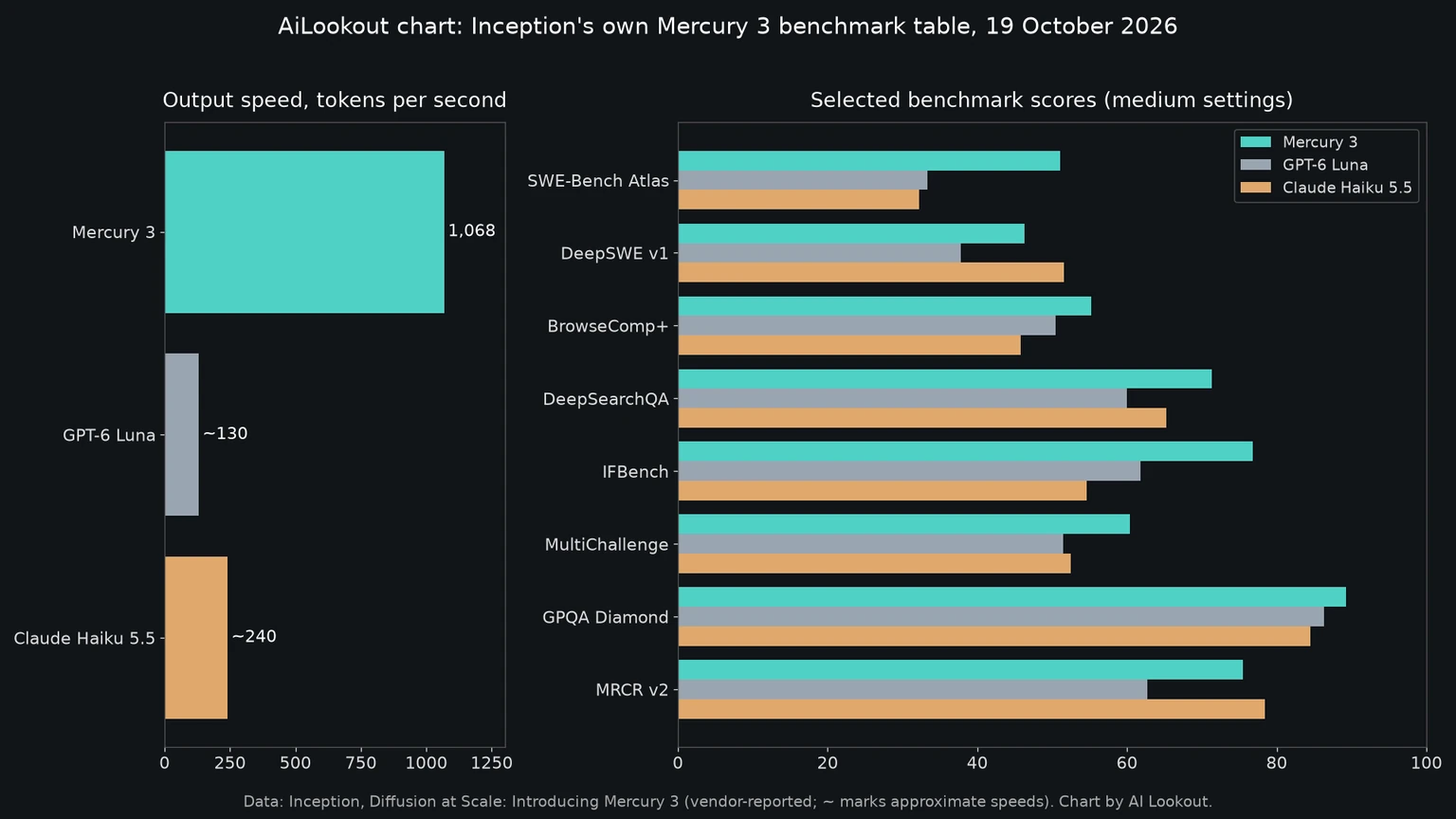
The launch post includes one comparison table, with all three models run at a medium reasoning setting. On Inception's numbers, Mercury 3 scores 51.08 on SWE-Bench Atlas against 33.33 for GPT-6 Luna and 32.26 for Claude Haiku 5.5. It scores 55.18 on BrowseComp+, 71.33 on DeepSearchQA, 76.84 on IFBench, 60.35 on MultiChallenge and 89.23 on GPQA Diamond, ahead of both rivals on each. Its GDPval-AA v2 Elo is 1,237.2, against 1,204.0 and 1,225.0.
The table is not a clean sweep. Claude Haiku 5.5 leads on DeepSWE v1 (51.62 against Mercury's 46.31) and on the MRCR v2 long-context test (78.40 against 75.50). GPT-6 Luna edges Mercury 3 on AA-LCR v1.1 (78.30 against 77.67) and on AA-Omniscience accuracy (46.94 against 46.44). On the tau-cubed Banking agent test, Mercury 3 posts 30.24, against 23.00 and 13.06.
The speed column is where the gap is widest. Inception puts GPT-6 Luna at about 130 tokens per second and Haiku 5.5 at about 240, against 1,068 for Mercury 3. Those rival figures are marked as approximate in the table, and the post does not say which provider endpoints or hardware were used to measure them.
Price, context and where to get it
Mercury 3 is available now through Inception's own API platform and through OpenRouter, Baseten and Vercel. The API is compatible with OpenAI's, so existing code can switch by changing the base URL and the model name. Inception's model documentation shows the model as mercury-3 with a reasoning_effort setting, and the company offers 100 million free tokens to try the API.
OpenRouter's listing adds some practical detail. It shows Mercury 3 with a one-million-token context window, a maximum of 131,072 output tokens, support for tool calling and JSON-schema structured outputs, and cache reads at $0.01 per million tokens. The listing is served by a single provider, Inception, and it is not currently available through OpenRouter's EU in-region routing. OpenRouter dates the model to 16 October 2026, three days before Inception's public announcement.
The price comparison needs care. At the launch discount, Mercury 3 matches the $0.10 input price that Anthropic charges for Claude Haiku 5.5 and undercuts its $0.50 output price. At Inception's stated list price of $0.20 and $0.70, Mercury 3 costs more per token than both Haiku 5.5 and GPT-6 Luna. The post does not say when the launch discount ends.
Who is already using it
Inception quotes four early-access customers, each describing a job where waiting on the model is the main cost. TinyFish AI co-founder Shuhao Zhang says Mercury 3 finished 50 percent of 50 live Mind2Web navigation tasks in its production web-agent harness, significantly more than GPT-6.1-Sol, with the same token volume and number of steps. The post does not give GPT-6.1-Sol's score.
RevisionDojo co-founder Michael Tong says hints, marked answers and definitions for students now come back in about a second. Octen AI founder Kuan Zou says that in tests for smart-glasses search, Mercury 3 had a median generation time of 0.9 seconds and a median end-to-end response of 2.2 seconds, with the search step itself taking about 80 milliseconds. Lorikeet, which builds customer-support agents for regulated businesses, says Mercury 3 beat other models on latency and scored higher on its evaluations.
These are customer testimonials published by the vendor. They describe real deployments, but none comes with a public test set, a method, or numbers for the models it was compared against.
Mercury Voice and Mercury Decide
Mercury 3 sits on top of a wider line-up. Inception says Mercury Voice is tuned for voice agents, aiming to cut the time to the first answer token rather than only total latency, and that it already powers agents at Audivi AI, Altur and OpenCall. Mercury Decide is a decision model for high-volume classification that Inception says outperforms Jev on JevBench and LegalBench.
OpenRouter describes Mercury Decide as a structured endpoint that returns a choice, a score or a yes or no answer with a calibrated probability, so output tokens are free, at up to 14 decisions per second. Earlier text models, Mercury 2.5 and Mercury 2, remain listed. Inception's docs also keep a Mercury Edit 2 model for code edits and fill-in-the-middle completions.
Limits and open questions
Every benchmark number in the launch is Inception's. The company has not published a model card, a technical report or the evaluation harness behind the table, and it has not said how large Mercury 3 is. The comparison is also narrow on purpose: it pits Mercury 3 against speed-tier models, not against flagship models such as GPT-6.1-Sol or Claude Opus, so it says little about the hardest tasks.
Speed claims depend on serving conditions. The 1,068 tokens per second figure is a measurement on NVIDIA GPUs that Inception does not specify, and real-world throughput through a router such as OpenRouter will include network and queueing time. Diffusion models can also behave differently from autoregressive models on streaming: they refine a block of text at once, so the time to the first visible word may not track the headline speed.
AI Lookout has not run Mercury 3. Mercury 3 is a hosted model with no downloadable weights, so outside testing will come through the API and independent leaderboards rather than local reproductions.
Why it matters
Since the first Mercury model, the question about diffusion language models has been whether they were a fast curiosity or a real alternative. Mercury 3 is Inception's strongest answer yet: a hosted model it says matches mainstream speed-tier models on quality while writing several times faster. It lands in a crowded low-cost tier that already includes MiniMax M3.1 Flash, launched the same day, and a stream of cheap open-weight models that Vercel says now carry most AI Gateway tokens.
If independent tests confirm the table, the practical gain is for agents and voice systems, where many short model calls stack up and every second shows. If they do not, the launch discount and the speed will still be worth a test for latency-bound work, but the quality claim will need more evidence than a single vendor chart.
Common questions
What is a diffusion language model?
A model that drafts a whole block of text and refines many tokens in parallel over several passes, instead of writing one token at a time. Inception's Mercury models are the best-known commercial examples, and the approach is what lets Mercury 3 claim more than 1,000 tokens per second.
How much does Mercury 3 cost?
Inception lists $0.20 per million input tokens and $0.70 per million output tokens. At launch it is 50 percent off, at $0.10 and $0.35, and cached input is 90 percent off. Inception has not said when the discount ends.
Can I download Mercury 3?
No. Mercury 3 is a hosted model available through Inception's API and through OpenRouter, Baseten and Vercel. Inception has not released weights or a model card.
Sources & further reading
How this story was made
Written by Kristian Kostov with AI assistance and checked against the linked sources. Company performance claims are attributed to the company. Analysis reflects AiLookout’s interpretation; we have not independently tested the products discussed. The cover is an AI-generated editorial illustration, not a photograph or evidence of an actual event.
Our editorial standards