Announced 14 Oct 2026 · Sources checked
What did OpenAI announce?
OpenAI added a new entry to its API deprecations page dated 14 October 2026, titled “GPT-4 series model deprecations”. It says the company has notified developers using certain GPT-4 series models that they will be removed from the API on 14 January 2027, three months later.
The page lists one recommended replacement for every model on the list: gpt-6-luna, which OpenAI describes as its most efficient model for focused, high-volume tasks. It also states that fine-tuned versions of these models follow the same shutdown schedule as their base models.
For many developers this is the end of a long-running default. GPT-4o and GPT-4.1, and their mini versions, have been common choices for chatbots, classification, extraction and other high-volume tasks. Any code that still calls them by name will start failing after the cut-off.
Which models and snapshots are affected?
The 14 October notice covers five model snapshots. All share the same shutdown date and replacement:
- GPT-4o: gpt-4o-2024-08-06 and gpt-4o-2024-11-20.
- GPT-4o mini: gpt-4o-mini-2024-07-18.
- GPT-4.1: gpt-4.1-2025-04-14.
- GPT-4.1 mini: gpt-4.1-mini-2025-04-14.
- Fine-tuned models built on any of the above.
Which GPT-4 models are already scheduled to go?
Some related models are already on an earlier schedule. An April 2026 notice on the same page lists gpt-4o-2024-05-13 and gpt-4.1-nano, along with older GPT-4 and GPT-4 Turbo models, for shutdown on 23 October 2026. Taken together, the two notices cover every snapshot listed on OpenAI’s GPT-4o, GPT-4o mini, GPT-4.1 and GPT-4.1 mini model pages, so by mid-January none of them will remain in the API.
Check aliases as well as dated snapshots. OpenAI’s GPT-4o model page lists gpt-4o-2024-08-06 as the default snapshot behind the plain gpt-4o name, so code that calls “gpt-4o” is affected even if it never names a date. GPT-4o’s audio, realtime and speech variants are covered by separate notices, listed below.
What happens to fine-tuned GPT-4o and GPT-4.1 models?
They go too. “Fine-tuned versions of these models follow the same shutdown schedule as their underlying base models,” the deprecations page says. A custom model trained on GPT-4o mini or GPT-4.1 mini to match a company’s tone, labels or output format will stop working on 14 January 2027.
The harder problem is what to replace them with. The GPT-6 Luna model page lists fine-tuning as “Not supported”. OpenAI is also winding down self-serve fine-tuning in general. A separate notice on the same page says new organisations lost access to fine-tuning in May 2026, and that from 6 January 2027 even active existing customers will no longer be able to create new fine-tuning jobs.
So teams with fine-tuned GPT-4 models cannot simply retrain the same way on the recommended successor. They will need to recreate the behaviour with prompts, examples, structured outputs and tools, or move that workload elsewhere. Our explainer on when fine-tuning is worth it covers the alternatives.
How does GPT-6 Luna compare on price and features?
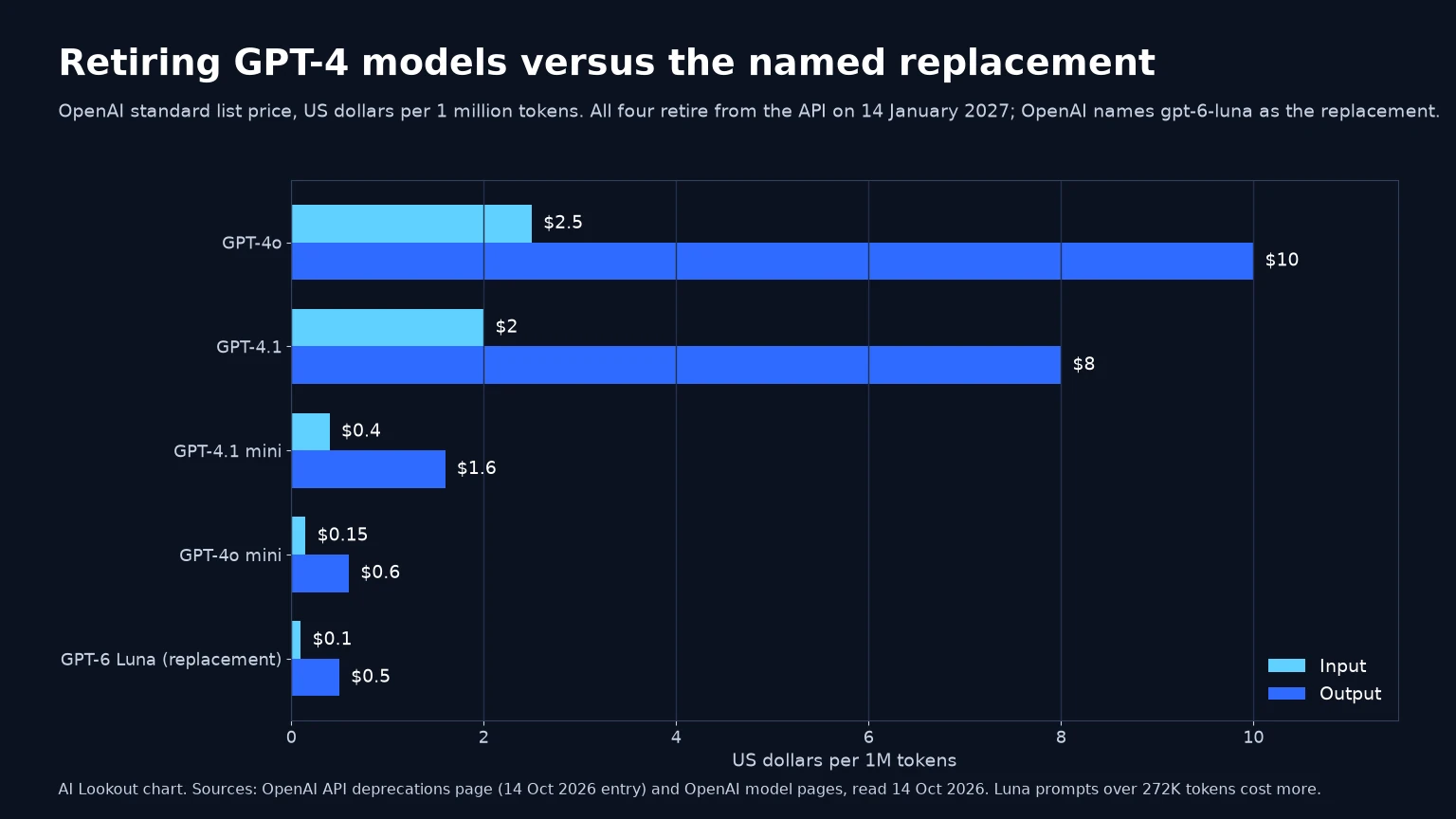
On list price, Luna is cheaper than every model it replaces. OpenAI’s model pages show GPT-4o at $2.50 per million input tokens and $10 per million output tokens, and GPT-4.1 at $2 and $8. GPT-4.1 mini is $0.40 and $1.60, and GPT-4o mini is $0.15 and $0.60. GPT-6 Luna is listed at $0.10 input and $0.50 output, with cached input at $0.01. Current rates for all major providers are on our API pricing page.
There are caveats. Luna prompts with more than 272,000 input tokens are billed at twice the input and cache rates and 1.5 times the output rate for the whole request. Luna is also a reasoning model, so it can spend output tokens thinking before it answers. A job that cost little on GPT-4o mini could cost more than expected if it runs at a high reasoning setting.
Luna has a 1,050,000-token context window, up to 128,000 output tokens and a knowledge cutoff of 18 May 2026, according to its model page. It accepts text and images and returns text. It supports Chat Completions, Responses and Batch, but not the legacy Assistants API, embeddings, or audio and image generation endpoints.
How should developers migrate?
Start with an inventory. Search code, configuration and prompt files for every model string on the list, including the plain gpt-4o alias. Our guide to planning for model deprecation covers how to keep that list current.
Then test before switching. Luna’s reasoning effort defaults to medium and can be set to none, low, high, xhigh or max. For drop-in replacements of fast, non-reasoning GPT-4o calls, start with low or none and compare quality, latency and cost on real traffic.
Watch one specific trap. Luna’s model page says Chat Completions supports function calling only when reasoning_effort is set to none. Apps that use tools through Chat Completions should either set that value or move to the Responses API, which OpenAI recommends for built-in tools and function calling.
Finally, budget for the change. Luna’s list prices are lower, but reasoning tokens, long prompts and retries can change the bill. If you need a refresher on what GPT-6 Luna is and where OpenAI uses it in ChatGPT, see our GPT-6 launch coverage.
What else is OpenAI retiring?
This notice is one of several. OpenAI’s deprecations page now lists a run of shutdowns over the next six months:
- 23 October 2026: gpt-3.5-turbo, gpt-4, gpt-4-turbo, gpt-4.1-nano, gpt-4o-2024-05-13, gpt-image-1, o1, o1-pro, o3-mini and o4-mini.
- 11 December 2026: the August 2025 GPT-5, GPT-5 mini and GPT-5 nano snapshots, GPT-5 pro, o3 and o3-pro.
- 6 January 2027: tts-1, tts-1-hd and the gpt-4o-mini-tts snapshots, replaced by gpt-realtime-2.1-mini.
- 14 January 2027: the GPT-4o, GPT-4o mini, GPT-4.1 and GPT-4.1 mini snapshots in this notice.
- 20 January 2027: legacy realtime and audio models, including gpt-4o-audio and gpt-4o-realtime.
- 26 February 2027: whisper-1 and the gpt-4o transcription models.
- 1 April 2027: gpt-5.1, gpt-5.3-codex and gpt-5.4-nano.
What is still unclear?
The notice covers OpenAI’s own API. It does not mention ChatGPT, and it does not say anything about the same models offered through other cloud providers, which publish their own retirement schedules. Developers using GPT-4o through a third party should check that provider’s terms rather than assume the same date.
OpenAI has not published a benchmark comparison showing how Luna performs on the tasks people used GPT-4o and GPT-4.1 for. “Recommended replacement” is OpenAI’s suggestion, not a guarantee of equal output. Some prompts tuned for GPT-4o’s style may behave differently on a reasoning model.
Three months is a short window for teams with many integrations or fine-tuned models, especially with the fine-tuning shutdown landing a week earlier. The practical advice is simple: treat 14 January 2027 as a hard deadline, and aim to finish testing well before the holidays.
Common questions
When will GPT-4o stop working in the OpenAI API?
On 14 January 2027, according to OpenAI’s deprecations page. That covers gpt-4o-2024-08-06 and gpt-4o-2024-11-20; the older gpt-4o-2024-05-13 snapshot is already scheduled to shut down on 23 October 2026.
What should I replace GPT-4o mini with?
OpenAI recommends gpt-6-luna. Its list price is $0.10 per million input tokens and $0.50 per million output tokens, but it is a reasoning model, so test quality, latency and cost at a low reasoning setting first.
Can I fine-tune GPT-6 Luna to replace my fine-tuned GPT-4o model?
No. Luna’s model page lists fine-tuning as not supported, and OpenAI says active customers can no longer create new fine-tuning jobs from 6 January 2027. Plan to rebuild that behaviour with prompts, examples and structured outputs.
Sources & further reading
How this story was made
Written by Kristian Kostov with AI assistance and checked against the linked sources. Company performance claims are attributed to the company. Analysis reflects AiLookout’s interpretation; we have not independently tested the products discussed. The cover places the companies’ own logos, taken from public-domain or openly licensed files credited in the caption, on a plain background. It is not a product photograph, a screenshot, or an endorsement.
Our editorial standards