Announced 16 Nov 2026 · Sources checked
What is the Apple Health AI Usage Study?
Apple launched the Apple Health AI Usage Study in the United States on Sunday, partnering with clinical AI platform OpenEvidence to build a dedicated research app.
The study is designed to understand how people interact with conversational AI tools for health information when the answers are grounded in peer-reviewed clinical data rather than general web training.
The company is recruiting up to 200,000 participants for the 12-month study. Eligible participants must be US residents aged 21 or older with an iPhone 15 Pro or later running iOS 26 with Apple Intelligence enabled.
The app is available for download starting today, and enrollment opens immediately.
The study marks a deliberate departure from how most AI companies approach health queries. OpenAI said users ask over 300 million health-related questions each week across its platforms.
Anthropic and other labs have also rolled out health-adjacent features. Apple's approach is to study first and productize later.
The study builds on Apple's existing research infrastructure. The company has run large-scale health studies since 2019, covering hearing, heart health, and women's health through the Apple Health Study platform and the ResearchKit framework.
What is new here is the focus on conversational AI rather than sensor-based health metrics.
The company is studying whether a dialogue interface backed by medical literature changes how people engage with their own health data, and whether it leads to better health decisions.
Apple said the study will produce peer-reviewed publications and data shared with the broader research community, not just internal product insights.
How the app works
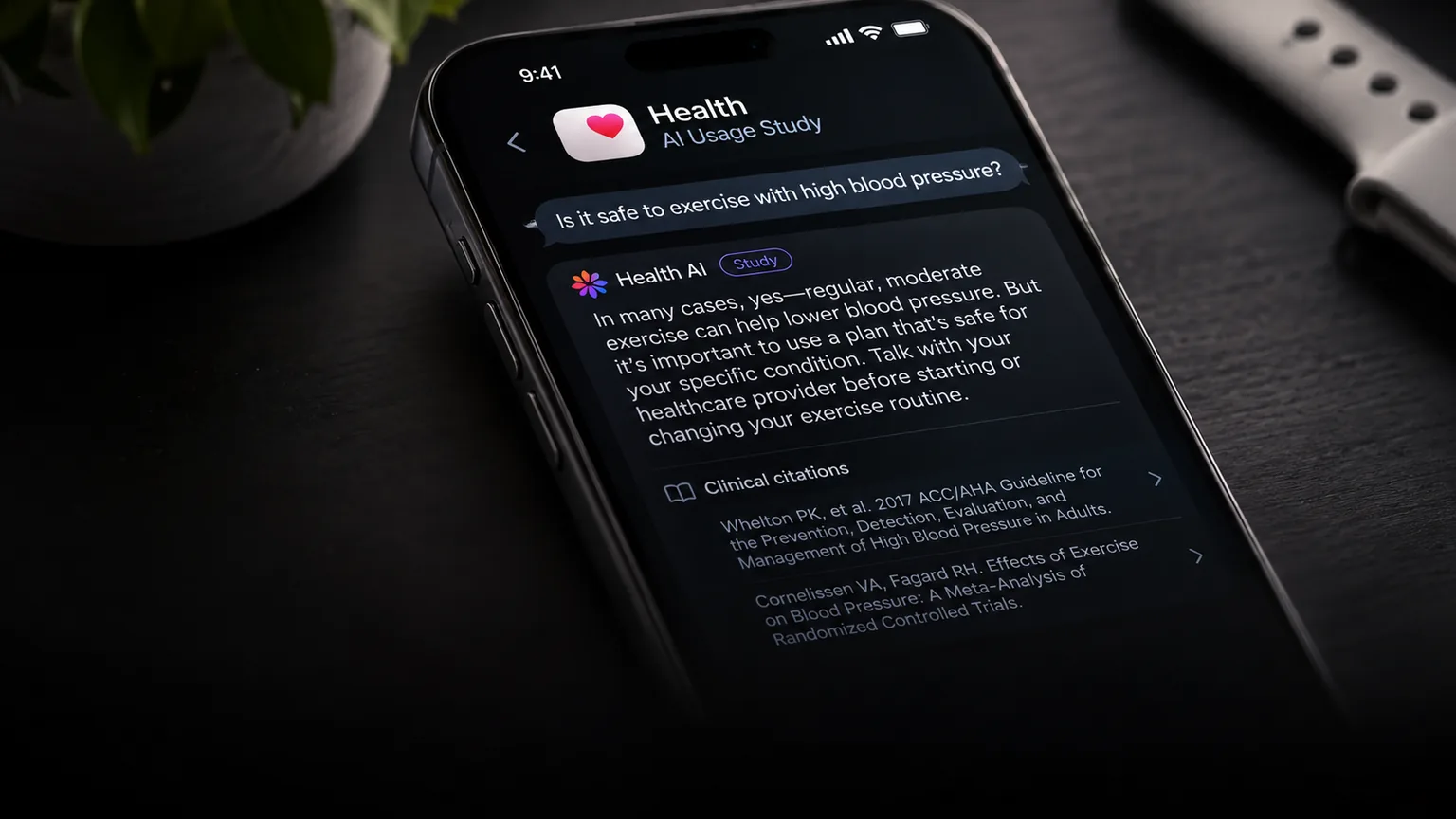
The study app lets participants ask health-related questions in plain text, similar to how they would use ChatGPT or Claude. The difference is in what generates the answer.
Responses come from clinical sources including The New England Journal of Medicine, the Journal of the American Medical Association, and Nature, with linked citations so users can verify each claim.
OpenEvidence is the clinical AI platform powering the backend. It is already used by healthcare professionals and trained on medical literature that is not available to general-purpose AI models.
Apple said it adapted OpenEvidence's outputs into simplified, easy-to-understand language appropriate for everyday users.
Participants can optionally share HealthKit data such as resting heart rate, activity levels, sleep patterns, or lab results to receive more personalized responses.
A user asking how to improve their resting heart rate, for example, could receive advice based on their actual health measurements rather than generic recommendations.
The company said the app can help users prepare better for doctor visits and will direct people to specific healthcare providers when answers involve concerning medical issues.
The app is text-based; dictation is available through the iOS keyboard, but the app is not integrated with Siri or Apple Intelligence.
Privacy and data handling
Apple emphasized privacy protections throughout the study design. Questions are processed through safeguards designed to remove identifying information before reaching OpenEvidence's infrastructure.
The company said the anonymized data is sent to a secure third-party cloud provider and will not be used to train any AI models.
OpenEvidence deletes all query and response data within 24 hours and does not use the exchanges to train its own models, according to Apple.
The app also includes safety features intended to recognize potentially dangerous situations and encourage users to seek professional medical assistance.
The company made clear that the study does not provide live medical monitoring and does not replace a healthcare professional. The app surfaces this disclaimer during use.
Apple's approach stands in contrast to general-purpose chatbots that may store user conversations for model training without explicit consent structures designed for health data.
The study is regulated under standard institutional review board protocols for human-subject research.
Participants complete an informed consent process before enrollment, and Apple said it will publish the study results regardless of outcome, a structure designed to avoid publication bias that can affect industry-funded research.
The AI health information gap
The study arrives at a moment when AI health chatbots are popular but their effectiveness remains poorly understood.
A February 2026 Oxford study published in Nature Medicine found that AI chatbots accurately identify medical conditions nearly 95% of the time when tested on clinical cases, yet everyday users reach the right answer less than 35% of the time when interpreting the same information.
According to the Pew Research Center, 35% of US adults, and roughly half of adults under 30, already use AI chatbots for some purpose.
The gap between model capability and user comprehension is one of the core questions the Apple study aims to explore.
"Millions of people are turning to AI for health advice, but accurate answers aren't always useful," said Dr. John Brownstein, professor of pediatrics and biomedical informatics at Harvard Medical School and an ABC News contributor.
"Confusing or incomplete information can create false reassurance or delay care."
What this means for Apple's health strategy
The study is the latest step in Apple's expanding health research program, which has previously covered hearing, heart health, movement, and women's health through the Apple Health Study platform.
What sets this effort apart is its focus on how people use and understand AI-generated health information, not just whether the technology works in a lab.
Sumbul Desai, Apple's vice president of Health and Fitness, said the company plans to make the research findings broadly available rather than keeping them internal.
"Insights from this study will help advance the broader scientific conversation and ensure that as technology evolves, we continue building trusted tools that genuinely support people wherever they are on their health journey," Desai said in a statement.
The study does not necessarily mean Apple is building a health chatbot for the Health app or Siri. The company said the goal is research, not product development.
But Apple has a long history of turning research-backed features into system-level tools, and the 200,000-person study gives the company one of the largest real-world datasets on how people interact with health AI.
Common questions
How is this different from asking ChatGPT or Claude about health?
The study app answers questions using peer-reviewed clinical sources like The New England Journal of Medicine and Nature rather than general web training data. Responses include linked citations so users can verify the source of each claim.
Does Apple use my health data to train AI models?
No. Apple said all data is anonymized before leaving the device, OpenEvidence deletes query data within 24 hours, and neither party uses the data to train AI models.
Who can join the study?
US residents aged 21 and older with an iPhone 15 Pro or later running iOS 26 with Apple Intelligence enabled can download the study app and enroll. Apple is recruiting up to 200,000 participants for the 12-month study.
Sources & further reading
How this story was made
Written by Kristian Kostov with AI assistance and checked against the linked sources. Company performance claims are attributed to the company. Analysis reflects AiLookout’s interpretation; we have not independently tested the products discussed. The cover is an AI-generated editorial illustration, not a photograph or evidence of an actual event.
Our editorial standards