Announced 2 Nov 2026 · Sources checked
What did Apple actually report?
Apple's fiscal 2026 fourth quarter, which ended September 26, produced revenue of $114.5 billion, up 12 percent from the $102.5 billion posted in the year-ago quarter, according to
the company's results announcement. Net income was $30.7 billion, or $2.10 per diluted share, against $27.5 billion and $1.85 a year earlier. Gross margin came in at 47.9 percent, and Apple attributed roughly one percentage point of that, plus five cents of EPS, to tariff refunds.
For the full fiscal year, revenue was $478.8 billion, up 15 percent, with net income of $132.2 billion. Apple called both figures records. The board declared a quarterly dividend of $0.27 per share payable November 16.
The product mix is the more interesting part for anyone tracking AI hardware. iPhone revenue rose 17 percent to $57.6 billion and Mac revenue rose 24 percent to $10.8 billion, while iPad fell 10 percent to $6.2 billion and wearables, home and accessories fell 8 percent to $8.3 billion. MacRumors logged the segment moves on its
live call recap at 23.7 percent for Mac, 17.5 percent for iPhone, 9.8 percent for services, a 7.9 percent decline for wearables and a 10.4 percent decline for iPad.
| Line item | Result |
|---|---|
| Total revenue | $114.5B, up 12% |
| iPhone revenue | $57.6B, up 17% |
| Mac revenue | $10.8B, up 24% |
| iPad revenue | $6.2B, down 10% |
| Wearables, home, accessories | $8.3B, down 8% |
| Services revenue | $31.6B, up about 10% |
| Diluted EPS | $2.10, up 14% |
| Gross margin | 47.9% |
Why was this call different?
It was John Ternus's first earnings call as chief executive. MacRumors notes that the handover from Tim Cook to Ternus took place on September 1, which means this quarter's record is being presented by a new boss with a product cycle already in flight. We covered the transition and Ternus's stated position on shipping AI in
our earlier report on his refusal to ship AI for its own sake.
Ternus used the release to talk product, not models. "We're closing the year with our most ambitious lineup yet," he said in the announcement, citing the iPhone Duo, the iPhone 18 Pro and Pro Max, new hardware for the home, Touch on Mac for the first time and "the all-new Siri AI." The framing matters: Apple is selling AI as a feature of hardware that people replace, not as a metered service.
The clearest evidence for that is the supply commentary. Ternus described the iPhone Duo as "the most transformational iPhone since the original" and said demand has exceeded available supply. Chief operating officer Sabih Khan said the Duo ramp is progressing well but that Apple could not predict when supply and demand would come into balance, according to the earnings-call summary published by
Yahoo Finance. A foldable iPhone that sells out is a better AI story for Apple than any assistant demo.
What did Apple say about AI money?
The line that travelled was from Parekh, asked how AI could contribute to revenue growth over time. "On the product side, you know, we feel AI offers a compelling reason for customers to upgrade and switch in order to get the latest capabilities, and we also feel there's opportunities across third-party apps and partnerships as well as first-party opportunities," he said, as quoted by
That is a deliberately vague sentence, and Parekh did not elaborate when pressed, per TechCrunch. TechCrunch also reported that Reuters had raised the question of whether Apple could profit by distributing third-party AI agents through the App Store and taking a share of the revenue they generate. Treat that as analyst speculation rather than an Apple plan: nobody on the call described a mechanism, a rate or a launch date.
Ternus separately pointed to iCloud+ and Apple Intelligence as areas with further opportunity, and Apple has been expanding iCloud+ bundles that include Apple TV and Apple Arcade. Subscriptions are the mechanism Apple already understands. Whether an AI agent distributed through the App Store becomes another subscription line, a commission line, or neither is the open question the quarter did not answer.
For context on how Apple has handled third-party AI so far, our report on
Apple picking Alibaba's Qwen for Apple Intelligence in China shows the company already treating model supply as a regional partnership problem rather than a single in-house stack.
Where is the App Store pressure coming from?
Services revenue reached an all-time high of $31.6 billion, up about 10 percent, with records in video, cloud services, payments and advertising and a September-quarter record in music. Apple said its installed base passed 2.5 billion active devices and paid subscriptions passed 1.5 billion.
The pressure sits inside that number. TechCrunch reported that third-party estimates in August suggested an 18 percent drop in US App Store commission revenue, with declines in Brazil and Japan after new regulations there. The Epic Games litigation forced Apple to allow apps to link out to external payment systems. Mobile gaming, historically a commission engine, has been weak.
Parekh acknowledged the shape of it. "We've also seen some factors that impacted the performance of the App Store, and during the September quarter, the performance on the App Store was similar to the prior year, and we had a record number of paid subscriptions with double-digit growth for third-party apps on the App Store," he said. He then guided December-quarter services growth to 8 to 9 percent, and said the outlook contemplates "sequential headwinds, primarily from third-party licensing."
Read those two statements together and the AI-opportunity comment starts to look defensive. Apple is not describing a new revenue stream so much as looking for one to replace commission income that regulators and courts are steadily eroding. Our coverage of
Apple's new App Store rules on AI apps and nonconsensual imagery is a reminder that Apple's leverage over AI apps is currently exercised through policy, not pricing.
What is the December quarter outlook?
Apple guided December-quarter revenue growth of 7 to 10 percent and gross margin of 45 to 46 percent, per the Yahoo Finance summary, which is a step down from the 47.9 percent just reported. Management flagged higher memory costs weighing on margins, iPhone Duo demand above supply, and continuing Mac and iPad constraints.
That memory-cost line is the AI-adjacent cost story nobody puts in the headline. Apple does not build training clusters at the scale of the hyperscalers, but it buys DRAM and NAND in enormous volume, and memory pricing has been pushed up by data center buildout across the industry. Apple's margin guide is where that shows up.
Geography was uneven. Greater China grew 21 percent, rest of Asia Pacific 15 percent, Europe 11.5 percent, the Americas 10.2 percent, and Japan fell 1.4 percent, according to the MacRumors recap. A 21 percent China quarter is a strong data point against the narrative that Apple is losing that market, though it comes against a weak comparison.
What should you watch next?
Three things. First, whether any concrete AI monetization mechanism appears in the December quarter or at the next developer event, because a sentence on an earnings call is not a product. Second, whether services growth lands inside the 8 to 9 percent guide, which would confirm the licensing headwind is real rather than a sandbag. Third, whether the iPhone Duo supply constraint clears, because the upgrade cycle Ternus is selling as the AI payoff depends on people actually receiving the hardware.
The
Siri AI language expansion we reported in October is the other piece. Apple's AI pitch only converts into upgrades where Siri AI is available and good, and language coverage has been rolling out market by market.
For now the honest summary is that Apple had a very good hardware quarter, guided services growth down, and left the AI revenue question open. Anyone telling you Apple has solved AI monetization is reading a sentence that does not say that.
Common questions
How much revenue did Apple report for the September quarter?
Apple reported $114.5 billion in revenue for its fiscal 2026 fourth quarter ended September 26, up 12 percent year over year, with net income of $30.7 billion and diluted earnings per share of $2.10.
Did Apple announce a way to make money from third-party AI apps?
No. CFO Kevan Parekh said on the earnings call that Apple sees opportunities across third-party apps and partnerships as well as first-party opportunities, but he did not describe any mechanism, rate or timing, and TechCrunch reported that Apple did not elaborate.
Who is Apple's chief executive now?
John Ternus. Apple's results announcement quotes him as Apple's CEO, and MacRumors notes the transition from Tim Cook to Ternus took place on September 1, 2026. This was his first earnings call as chief executive.
Sources & further reading
How this story was made
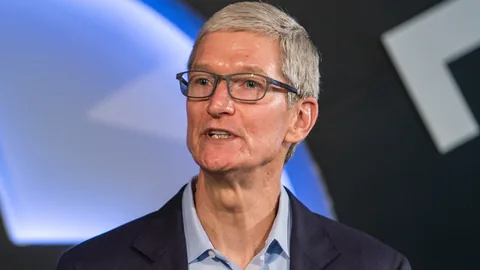
Written by Kristian Kostov with AI assistance and checked against the linked sources. Company performance claims are attributed to the company. Analysis reflects AiLookout’s interpretation; we have not independently tested the products discussed. The cover is an AI-generated editorial illustration, not a photograph or evidence of an actual event.
Our editorial standards