Announced 13 Nov 2026 · Sources checked
What did Claude find in Goedel's notebooks?
The discovery has drawn comparisons to the 2024 project that used Claude to analyze Garrett Lisi's unpublished unified field theory notes, but the Goedel project is far larger in scope and significance.
Goedel is widely considered the most important logician since Aristotle, and any new theorems from his hand carry substantial weight in the mathematical community.
Anthropic's Claude analyzed transcriptions of 1,009 pages from 16 notebooks that Kurt Goedel wrote in the early 1940s, shortly after he fled Vienna for Princeton.
Within days, the AI produced a 650-page analysis identifying 663 theorems and proof ideas that the legendary logician had never published.
According to The Guardian, the findings reveal that Goedel discovered significantly more mathematics than the world ever knew during his lifetime.
When the theorems were run through the Coq proof assistant — a system for formal mathematical verification — about 400 were verified exactly as stated, approximately 200 needed minor repairs to their framing or logic, and roughly 60 turned out to be incorrect.
Jan von Plato, the Finnish logician who has led the project since 2017, described the results as showing Goedel was ahead of his time.
The high verification rate is especially striking given that Goedel was working in private notebooks, not preparing formal publications with the usual editorial review.
How did researchers decode the notebooks?
Since 2017, von Plato has led a project at the University of Helsinki to understand the contents of 16 notebooks from the Goedel Nachlass — the literary remains held at Princeton's Institute for Advanced Study, where Goedel spent the last decades of his career after fleeing Vienna in 1940.
The notebooks contain densely written shorthand covering logic and mathematics from the early 1940s, a period when Goedel was also working on the continuum hypothesis and developing his close friendship with Albert Einstein.
Progress was painstakingly slow until the team turned to Claude.
The AI model, developed by Anthropic, ingested transcriptions of the handwritten material and produced a comprehensive digest of the entire corpus in a matter of days — a task that would have taken human researchers years of careful study.
The transcription process itself was a challenge. Goedel wrote in a personal shorthand that mixed German, English, and logical notation, making it difficult even for experts to parse consistently.
The research team had to first create machine-readable transcriptions of the handwritten pages before Claude could analyze them. Once the AI had the text, it could identify patterns, cross-reference known results, and flag statements that looked like theorem-proof structures.
Von Plato told NewsBytes that Claude surfaced 663 theorems and proof ideas from material that had resisted full analysis for decades despite dedicated effort from multiple researchers over nearly a decade.
What kind of mathematics did Goedel pursue in private?
The variety and depth of the material suggests Goedel was pursuing multiple research programs simultaneously, jumping between foundational questions and concrete combinatorial problems.The notebooks reveal Goedel working on combinatorial principles, set-theoretic arguments, and elements of what would later become computability theory — areas where he was decades ahead of the field.
These were not polished papers ready for publication but private explorations: ideas Goedel was developing alongside his formal work on the continuum hypothesis and his famous interactions with Einstein, who called him the greatest logician since Aristotle.
The fact that roughly 60 percent of the identified theorems were verified without correction in Coq suggests Goedel's private reasoning was remarkably rigorous even when he was not writing for an audience.
Even the 200 theorems that required repairs were, according to von Plato, close to correct — they needed adjustments to their framing or small gaps filled, rather than fundamental reworking of the core insight.
This suggests Goedel's informal proofs, jotted down for his own eyes only, were of unusually high quality compared to typical mathematical scratch work.
Why does this matter for AI and mathematics?
The project is a powerful demonstration of large language models as research tools rather than just content generators.
While much of the public conversation around AI focuses on code generation or chatbot conversations, this use case shows models acting as amplifiers for human scholarship — decoding, organizing, and extracting insights from material that is technically accessible but practically overwhelming for any individual researcher to process in a lifetime.
The ability to process 1,009 pages of dense mathematical notation in days rather than years has implications beyond historical scholarship.
If AI can extract novel theorems from archival material, it raises the question of how much other scientific knowledge is sitting in unread notebooks, unpublished manuscripts, and personal correspondence of great scientists.
The bottleneck is no longer the existence of the knowledge — it is our ability to read and synthesize it.
This is not the first time AI has contributed to mathematical discovery.
Microsoft researchers used AI agents to help prove the 31-year-old KLS conjecture, and Axiom used AI to formally verify the entire Stacks Project in Lean, a 10,000-page reference work in algebraic geometry.
What makes the Goedel project different is that the AI worked on historical material — unlocking discoveries that were literally sitting in archives at Princeton, waiting for the right tool to decode them decades after their author had passed away.
What comes next?
The project also demonstrates an emerging workflow for archival mathematics: transcribe historical manuscripts into machine-readable text, use an LLM to extract and organize mathematical statements, and then verify them with a formal proof assistant like Coq or Lean.
This pipeline could become standard practice for historical mathematics research, unlocking archives that have sat unread for decades.
The project also demonstrates an emerging workflow: transcribe historical manuscripts into machine-readable text, use an LLM to extract and organize mathematical statements, and then verify them with a formal proof assistant like Coq or Lean.
This pipeline could become standard practice for archival mathematics research.
The success of the Helsinki project opens the door to applying similar techniques to other historical scientific manuscripts.
Many of the greatest minds in mathematics, physics, and philosophy left behind notebooks in dense handwriting or personal shorthand that have resisted systematic analysis.
Large language models, trained on vast corpora of scientific text across multiple languages, are uniquely suited to this kind of pattern recognition and extraction work.
Common questions
How did researchers get access to Gödel's notebooks?
The notebooks are part of the Gödel Nachlass (literary remains) held at Princeton University's Institute for Advanced Study, where Gödel spent the last decades of his career.
Since 2017, Jan von Plato has led a project at the University of Helsinki to study and transcribe the 16 notebooks.
What kind of mathematics did Gödel work on in these notebooks?
The notebooks contain work on combinatorial principles, set-theoretic arguments, and elements of what would later become computability theory. They represent Gödel's private research during the early 1940s, much of which he never published.
Could this approach be used for other historical manuscripts?
Yes. The success of this project suggests that large language models could help decode and analyze other dense or shorthand historical manuscripts across mathematics, physics, and philosophy, potentially uncovering forgotten discoveries.
Sources & further reading
- The Guardian - Ahead of his time: AI helps unlock discoveries hidden in notebooks of man who transformed maths ↗
- NewsBytes - Helsinki team uses Claude to uncover previously unknown Godel theorems ↗
- Geo News - AI unlocks 80-year-old secrets of Einsteins friend uncovers hundreds of mathematical discoveries ↗
How this story was made
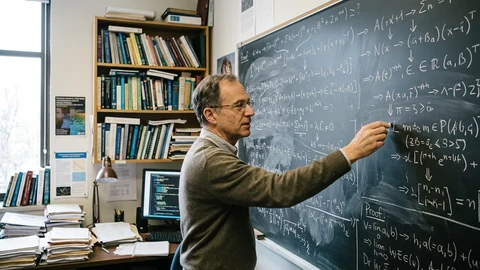
Written by Kristian Kostov with AI assistance and checked against the linked sources. Company performance claims are attributed to the company. Analysis reflects AiLookout’s interpretation; we have not independently tested the products discussed. The cover is an AI-generated editorial illustration, not a photograph or evidence of an actual event.
Our editorial standards