Announced 20 Oct 2026 · Sources checked
What Anthropic did
Anthropic says its Claude model designed small proteins that stick tightly to scorpion neurotoxins, a first step toward a possible scorpion antivenom. The company described the work in a research post published on 20 October 2026, alongside a 69-page technical report and a public data release of every design and its lab results.
The project built on an August 2026 study in which Claude designed protein minibinders from a single prompt. This time a group from the investment research firm Citrini Research asked whether AI drug discovery could let motivated non-experts tackle a real health problem. The team settled on scorpion antivenom, which Anthropic calls a neglected tropical disease.
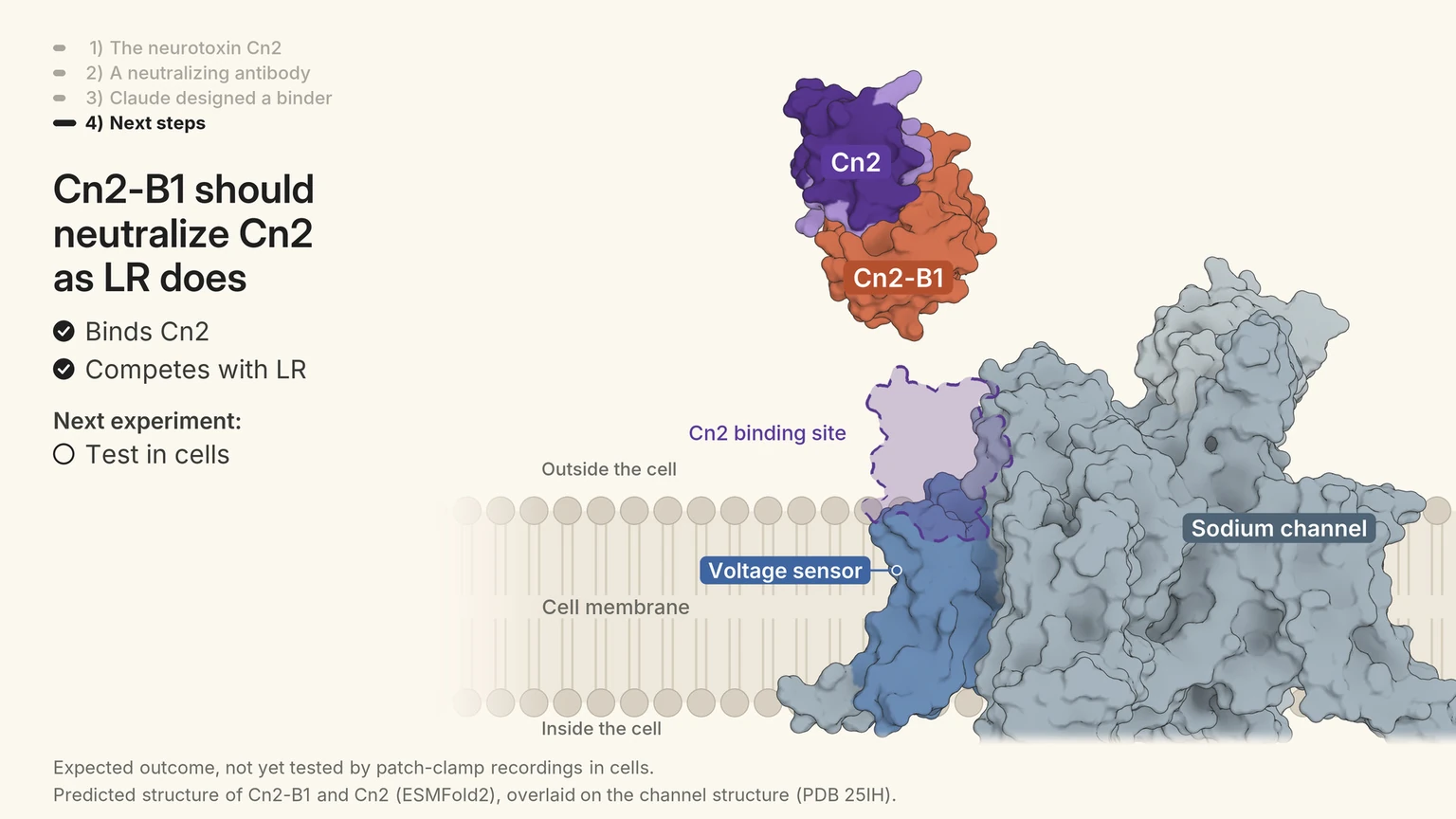
Of 211 designs that two outside labs tested, 17 met Anthropic's criteria for a binder. The strongest, named Cn2-B1, attached to a Mexican scorpion toxin with single-digit nanomolar strength, and a follow-up test suggested it grabs the same spot on the toxin as an antibody already known to protect mice. Anthropic is careful to say it has not made an antivenom, only binders.
Why scorpion toxins are a hard target
Scorpions sting more than 1.2 million people a year, Anthropic writes, and cause over 3,250 deaths, mostly among children with little access to care. The toxins that hurt people latch onto sodium channels, the proteins that let nerve cells fire. When a toxin jams a channel, nerves fire at the wrong time and flood the body with stress chemicals, which in bad cases can lead to heart failure or fluid in the lungs.
Existing antivenoms are made by milking venom from thousands of scorpions, injecting it into horses and purifying the animals' antibodies, a process that takes months. They tend to work against only a few toxins, are expensive and are often scarce where stings happen. A designed protein, built from scratch to block the part of a toxin that hits the channel, could in principle be cheaper to make and easier to supply.
Designing proteins against a target is the same kind of problem other AI groups are chasing. Last week Google Research agents ran wet-lab experiments and found nanomolar binders for a cancer target, and Anthropic has shown Claude taking on enzyme discovery as well. Anthropic's claim here is narrower and better documented than most: binders against five specific toxins, with the raw data attached.
How Claude ran the campaign
Anthropic chose five neurotoxins from four regions: Cn2 (Mexico), Ts1 (Brazil), AaH I and AaH II (North Africa) and LqhIII (the Middle East). It aimed the designs at each toxin's channel-binding site. The five share one overall fold but are only 26% to 62% identical in sequence, which made them a hard test, especially for designs meant to hit more than one toxin at once.
An internal research model working inside Claude Science ran the campaign with what Anthropic calls considerable autonomy. From one starting prompt and four follow-ups, it picked the toxin structures from public databases, chose the binding hotspots, set its own quality thresholds, decided how much to lean on each design tool, and drafted the final report and figures. It worked on its own for the first 24 hours; the whole run took 64 hours and about 10,000 GPU hours.
The report lists the 12 design tools Claude used, including RFdiffusion, RFdiffusion3, BoltzGen and FreeBindCraft, and three structure predictors it used to screen candidates. At Anthropic's request, Claude even emailed the chosen sequences to one of the labs, noting in the emails that they were written by Claude.
From 318,484 designs to 17 binders
Claude generated 318,484 designs and screened 553,052 design-toxin pairs, filtering out anything that looked like a known protein or a toxin. It then produced a final list of 180 designs; Anthropic's team added 31 more, for 211 in total. The set covered single-toxin binders, two groups aimed at families of toxins, and 91 aimed at all five at once.
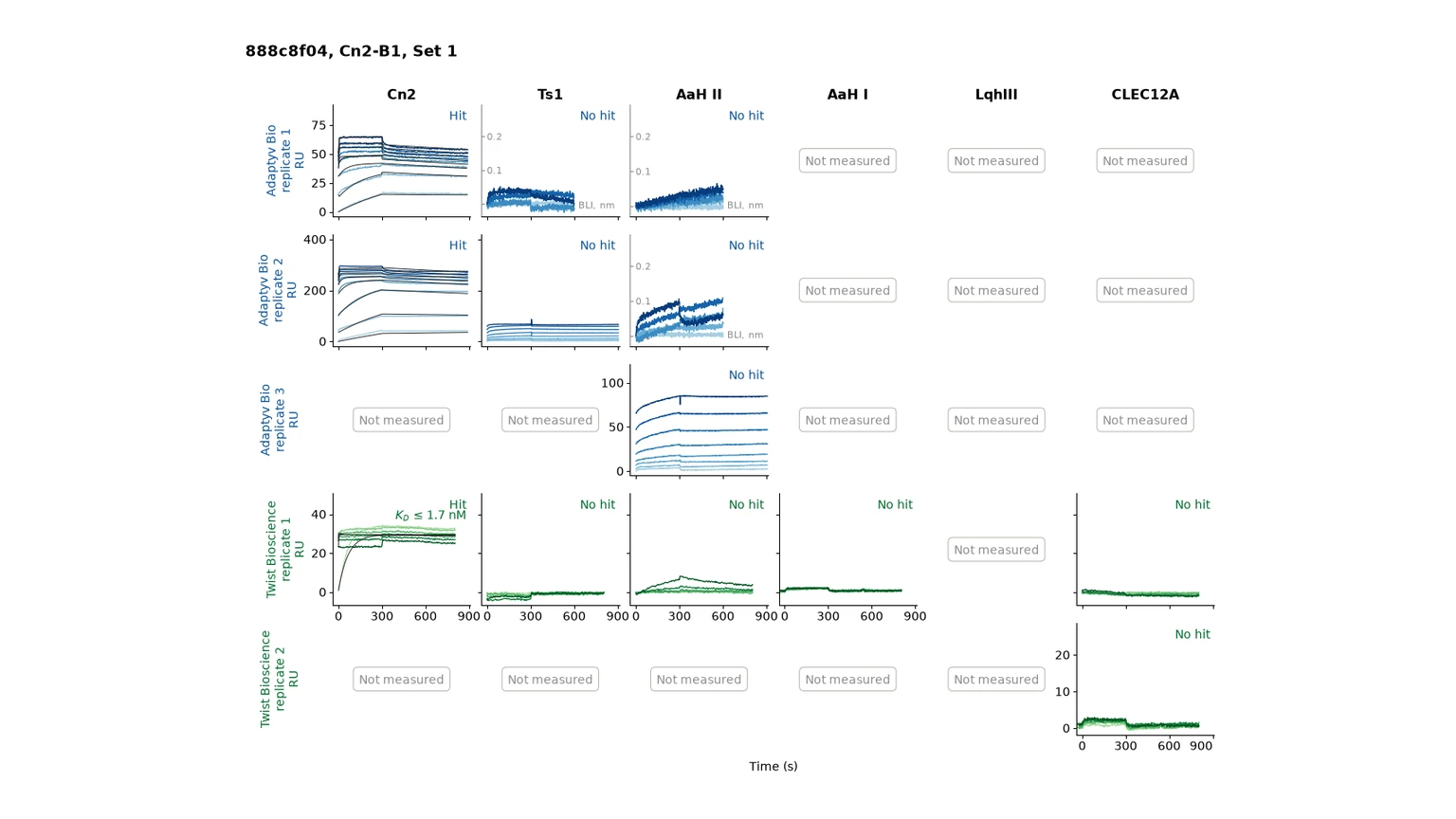
Two contract labs, Adaptyv Bio and Twist Bioscience, made and tested every design. Each measured binding with surface plasmon resonance, which watches in real time how fast a toxin attaches to and lets go of a design. Anthropic set a strict bar: a design counted as a binder only if it was a hit at both labs, in every replicate, with a dissociation constant of 1 micromolar or tighter, and showed no stickiness against an unrelated human protein used as a control.
Seventeen designs cleared that bar, each against a single toxin: seven against Cn2, four each against AaH II and AaH I, and two against LqhIII. None bound Ts1, and none of the multi-toxin designs worked against more than one toxin. Among the 60 single-toxin designs, 11 were binders, an 18% rate that Anthropic says is typical for protein-design campaigns, including its own earlier work.
The strongest binder, Cn2-B1
The standout is Cn2-B1, a 104-residue protein designed with RFdiffusion3 against Cn2, a toxin from the Mexican scorpion Centruroides noxius. It bound Cn2 tightly at both labs, with a dissociation constant around 3.1 nanomolar at one and 1.7 nanomolar at the other; the tighter the number, the stronger the grip.
Anthropic then ran a competition test to see where Cn2-B1 attaches. When an antibody called LR, which is known to neutralise Cn2 in mice, was already on the toxin, Cn2-B1's binding dropped, which suggests the two compete for the same site, the part of Cn2 that grabs the sodium channel. That is why Anthropic says Cn2-B1 should neutralise Cn2, while stressing it has not shown this.
The binding data behind that claim is what the sensorgram figure above shows: clear, repeated signal against Cn2 and nothing against the other toxins or the control.
What was released and under what licence
Anthropic released all 211 designs, their sequences, predicted structures, in-silico scores and the raw lab measurements as a data set on Hugging Face, under a Creative Commons Attribution 4.0 licence. The toxin chains in the structure files come from Protein Data Bank and AlphaFold entries, which keep their own terms. The full method is in the technical report.
That openness is the point the outside reviewers picked up. Anthropic sent the work to two protein experts, Susana Vázquez Torres and Timothy P. Jenkins, who called it a promising first step: if AI can design credible binders against hard toxins in days, and labs can confirm them in weeks, it could speed up work on envenomation and other neglected diseases.
Anthropic also notes it made the models about four times faster on average, and showed that a simpler setup using a single agent and a single GPU over 24 hours can reach comparable in-silico scores, a nod to researchers who do not have 10,000 GPU hours to spend.
The limits Anthropic is clear about
The caveats are large and Anthropic lists them plainly. The 17 binders were tested only against lab-made copies of the toxins, not venom. None has been tested for neutralisation in cells or in live animals. A binder that grabs a toxin is not yet a drug: it still has to stop the toxin from working, be safe and stable, and reach patients at a price they can afford.
The multi-toxin goal, which would matter most for a cheap universal antivenom, did not work at all. Anthropic offers several possible reasons, from its own prompting to the limits of today's design tools to the biological difficulty of hitting several different toxins with one protein.
There is also a practical asterisk on the control: in one lab's test against an unrelated protein, Cn2-B1 and one other design showed some off-target signal, which is the kind of detail the open data lets outside scientists check for themselves.
Why it matters for AI in science
The wider story is about how a general model is being used in science. Anthropic did not hand Claude a narrow tool and read off an answer; it gave the model a goal, a toolbox and a budget, and let it plan, run and write up a multi-day campaign, checked by humans at a few points. The lab work was still done by people and machines in real labs, and the judgment about what counts as a binder was Anthropic's.
For readers, the useful signal is the combination of a concrete result, named outside reviewers and a full public data set, rather than a benchmark score or a demo. It makes the claim easy to probe and hard to overstate. Anthropic's own framing is modest: this is a first step, and turning a binder into an affordable treatment is the hard part that lies ahead.
What to watch next is whether another group reproduces Cn2-B1's binding from the released data, whether Anthropic or a partner tests it in cells and mice, and whether the multi-toxin problem yields to better tools.
Common questions
Did Anthropic make a scorpion antivenom?
No. Claude designed proteins that bind scorpion toxins in the lab. Anthropic says none has been tested for neutralisation in cells or animals, so it is a first step, not a treatment.
How strong was the best binder?
Cn2-B1 bound the Mexican toxin Cn2 with a dissociation constant of roughly 1.7 to 3.1 nanomolar across two labs, and a competition test suggested it hits the same site as the protective antibody LR.
Is the data public?
Yes. Anthropic released all 211 designs, their predicted structures, scores and raw lab measurements on Hugging Face under a Creative Commons Attribution 4.0 licence, with a full technical report.
Sources & further reading
How this story was made
Written by Kristian Kostov with AI assistance and checked against the linked sources. Company performance claims are attributed to the company. Analysis reflects AiLookout’s interpretation; we have not independently tested the products discussed. The cover places the companies’ own logos, taken from public-domain or openly licensed files credited in the caption, on a plain background. It is not a product photograph, a screenshot, or an endorsement.
Our editorial standards