Announced 16 Oct 2026 · Sources checked
What Google Research announced
Google Research described on 16 October 2026 how it is putting AI agents in charge of parts of real wet-lab experiments. The blog post, by research scientists Pooja Rao and Annalisa Pawlosky and software engineer Petar Sirkovic, brings together three technical reports: a lab-automation layer called VERID, a closed-loop DNA aptamer campaign, and an agent-guided method for designing protein binders.
The headline result is that, in a few experimental runs, designs against fibroblast activation protein alpha (FAP), a large receptor overexpressed in solid tumours, produced binders with single-digit nanomolar affinity. Google says that level of tight binding is usually reached only after extensive rounds of lab optimisation.
The stated aim is agents that not only propose and analyse ideas but also run experiments, learn from the results and improve, while scientists keep directing the work. Google names two obstacles: frontier models still reason poorly about 3D geometry and physical state, and real lab readouts have become the bottleneck as computational design speeds up.
VERID: a digital twin that checks the robot's code
The first piece, the VERID report (VERified Infrastructure for Discovery Laboratories), is a live digital twin of a lab workcell. It tracks robot-arm geometry, the volume in every well, reagent identities and the remaining pipette tips. Its experiments ran on a Hamilton Microlab STAR liquid handler, and the software is built on the open-source PyLabRobot framework.
VERID offers four services: live state queries so an agent can check the deck before acting, simulated dry runs that take seconds, hardware safety checks that block invalid commands, and synchronised video and action logs for every run. Google's example of why this matters is code that is valid but physically impossible, such as lowering an 8-channel pipette into a trough that is too narrow, or aspirating from a well that is already empty.
The case studies used coloured dyes and water. When the simulator rejected an 8-channel aspiration that would not fit, the agent replanned and designed a factorial test that isolated a subtle bias from liquid carried on the tip walls. In a self-play challenge to work out blinded dye mixtures from overhead camera images, a multi-cycle agent that inherited earlier lessons cut its error more than fivefold. The report says these case studies ran on an internal preview checkpoint of Gemini 4 Argon.
Aptamers: three rounds of design, test and learn
The second report, Aptamers as a sandbox for lab-in-the-loop agentic molecular discovery, uses short DNA molecules that bind proteins as a fast test bed. A full design, test and analysis cycle takes 7 to 10 days, because DNA can be synthesised in pooled libraries and read out by sequencing, and the paper puts the cost at $1 to $3 per candidate. Agents built on Google's Gemini Pro and Flash models designed about 1,000 candidates per round, roughly 4,400 sequenced constructs in total, against two proteins: α-thrombin and myoglobin.
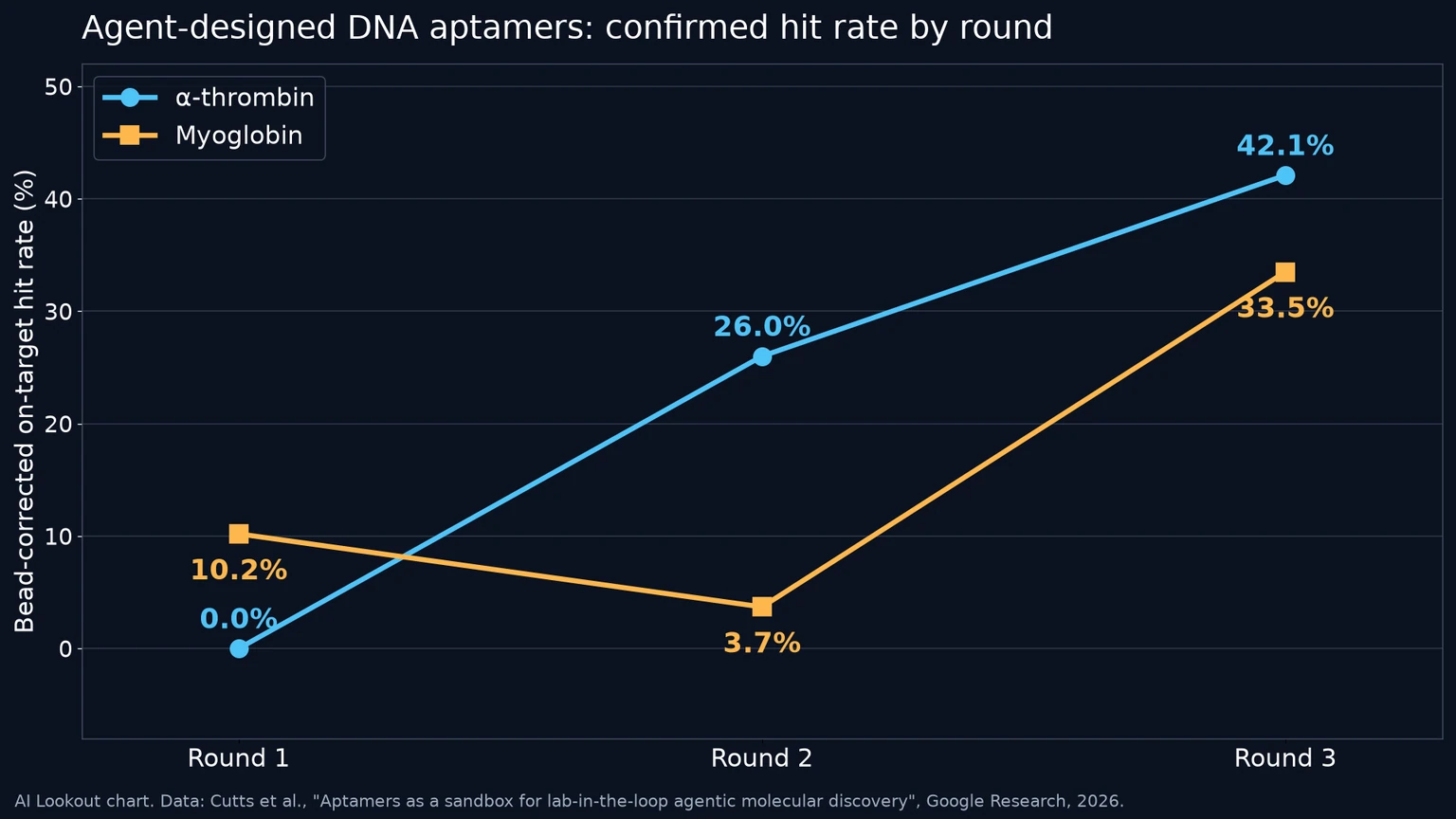
On α-thrombin, Round 1 produced no binders, because fixed primer overhangs disrupted folding in 48% of the sequences. The agents added clamped flanking stems in Round 2 and diversified in Round 3, and the bead-corrected on-target hit rate climbed to 26.0% and then 42.1%, at 98.5% specificity.
The paper is careful about affinity. In single-clone tests, literature-derived motifs that the agents re-engineered reached apparent dissociation constants of 24.6 to 133 nanomolar, while strictly new scaffolds bound only weakly, above 1 micromolar.
When the agents chased sticky binders
Myoglobin is the more instructive case. In Round 2 the agents prioritised raw binding, and 63% of their designs became G-quadruplexes, a folded DNA motif. Raw pull-down went up, but the lab data showed that most of these were sticky, binding off-target proteins and bare magnetic beads. Target specificity fell from 75.0% to 19.1% and the true hit rate from 10.2% to 3.7%.
Reading that result, the agents revised their own design rules for Round 3. They capped promiscuous motifs, subtracted bead binders and moved to non-G-quadruplex scaffolds. Specificity recovered to 72.4% and the on-target hit rate rose about ninefold, to 33.5%. Google's point is that the computational models alone would not have caught the problem; the wet-lab readout did.
FAP: nanomolar binders for a cancer-linked target
The third report, Agent-guided epitope excision enables economical de novo binder design, targets proteins, which are harder because each loop needs biological expression and folding. FAP's 719-residue extracellular domain makes full-structure design nearly intractable, since refolding each candidate with AlphaFold 3 is the main compute cost and scales with target length.
The fix is to fold each candidate against only a crop of the target around the intended binding site. Across 15 benchmark targets and 3,666 designs, the cropped windows closely reproduced full-target interfaces, with a median C-alpha deviation of 0.37 ångström. For FAP, a crop of 85 to 130 residues fits AlphaFold 3's smallest 256-token bucket, cutting each fold from 59.3 seconds to 6.9 seconds, about 88% less. The blog describes this as accelerating each cycle more than eightfold.
In the lab, the team built a 5,000-member yeast-display library, sorted it in three rounds at falling target concentrations and found 571 enriched sequences, 60 of them exact computational designs. Four representative leads bound FAP with apparent dissociation constants of 3.0 to 9.1 nanomolar.
Human plus agent beat either alone
The FAP campaign also compared levels of autonomy at a fixed GPU budget of 132.87 GPU-hours, with Gemini 3.1 Pro as the agent. A scientist working alone reached a 5.06% computational hit rate. A hybrid in which the scientist chose the catalytic-rim strategy and the agent tuned epitopes, crop sizes, sequence-design settings and compute allocation reached 9.33% using about 58% of the budget, or 23.2 hits per GPU-hour against 12.6.
A fully autonomous agent reached 6.18% and stopped itself at 124.43 GPU-hours. Left alone, it proposed blocking the mouth of FAP's catalytic channel, close to the human's own strategy, and spread its budget across 13 hit-producing surface patches, against 4 for the scientist and 7 for the hybrid. The authors conclude that a person setting strategy and an agent handling tactics worked better than either alone. They also note that a variant that changed two scoring settings appeared to reach 32.62%, a reminder of how sensitive raw hit rates are to how they are measured.
Safety controls and open problems
Google ties the work to its Frontier Safety Framework and approach to biological risk. It chose non-infectious biological systems with no gain-of-function risk, screens every designed sequence for biosecurity, dry-runs every protocol in VERID before it touches reagents, and has humans authorise sequences, verify protocols and supervise robot runs.
The post lists problems still open: making sure agents optimise for real target binding rather than experimental shortcuts, verifying multi-step lab protocols, and monitoring agents' reasoning and execution traces. The myoglobin episode is a small example of the first. The protein paper adds its own limits: one large enzyme target, one backbone class of three-helix bundles and one LLM controller, with soluble-protein binding characterisation and FAP inhibition assays still to come.
What it means for AI in the lab
Google has been moving toward agents that touch the bench. Last week DeepMind showed an Antigravity agent narrowing UniProt to an antimicrobial peptide candidate, though lab tests were still pending, and its SynthID Bio work tagged proteins in the lab. The new reports go further by closing the loop, with real readouts feeding the next round of designs.
The parallel with Claude Mythos 5's quantum-circuit search is clear: an agent improves fastest when a strict evaluator scores every attempt. In biology that evaluator is a physical experiment, slow and noisy, which is why VERID's logging and safety checks matter. Google says its next step is to combine VERID's automation with closed-loop protein discovery. The papers are Google's own and not yet peer-reviewed, and no code release is mentioned in the post.
Common questions
Did the AI agents physically run the experiments?
The agents planned and controlled protocols on a Hamilton Microlab STAR liquid handler through the VERID digital twin, which simulates and safety-checks each command. Humans authorise sequences, verify protocols and supervise the robot runs.
How strong are the FAP binders?
Four representative leads bound FAP with apparent dissociation constants of 3.0 to 9.1 nanomolar, measured by yeast-surface display. Google calls that drug-like affinity usually reached only after extensive optimisation.
Is this peer-reviewed or open source?
The three reports are Google Research papers released alongside the blog, not peer-reviewed publications, and the post does not announce a code release. VERID is built on the open-source PyLabRobot framework.
Sources & further reading
- Grounding AI agents in biological reality: Building blocks for autonomous wet labs ↗
- Semantic Representation for Agentic Self-Play in Automated Laboratories (VERID) ↗
- Aptamers as a sandbox for lab-in-the-loop agentic molecular discovery ↗
- Agent-guided epitope excision enables economical de novo binder design ↗
How this story was made
Written by Kristian Kostov with AI assistance and checked against the linked sources. Company performance claims are attributed to the company. Analysis reflects AiLookout’s interpretation; we have not independently tested the products discussed. Cover photography is illustrative and does not depict the specific announcement or product.
Our editorial standards